

Chronic and even acute supplies of fresh water in Israel and other parts of the Middle East has resulted in over-dependence on desalination. Even more ominous are predictions for the future of inadequate fresh water supplies following a NASA Image Technology survey of the accelerated disappearance of a large underground fresh water sea under Syria, Turkey, Iraq and Iran.
While Israel’s increasing reliance on obtaining adequate fresh water supplies through desalination is becoming obvious, its over use of its natural water resources, was exemplified in a recent news report that the country’s leading bottled water company, Mayanot Eden (Eden Springs) is being sold to an American investment company, Rhone Capital, for an amount of 70 Million Euros.
The news, as reported in Haaretz, is said to be causing a stir among local investors and environmentalists due to fear that the water used to make the company’s main product will now be controlled by entities outside of Israel. The Eden Springs bottling plant is located on the disputed Golan Heights; a region being claimed by both Israel and Syria (one of the countries under which the large but disappearing subterranean fresh water sea is located.
According to the Haaretz article, the CEO of the company’s subsidiary in the Netherlands, Raanan Zilbermsn, will continue running the company’s European operations which plans to market more mineral water to European markets, especially those in Eastern Europe. Mayanot Eden had accumulated large debts due to loses it accumulated against posted revenues (829,000-euro losses against revenues of 60.5 million euros in 2012).
The environmental issues regarding mineral water plants using “public water sources” to supply water for profit was explained by Abraham Diskin, head of the School for Interdisciplinary Studies in Administration, Government and Law at Sha’arei Mishpat College: Assets that were owned by the state and weren’t utilized efficiently were passed into private hands without protecting the public’s interest.”
In the case of water from the Salukia Spring on the Golan Heights, the primary water source for Mayanot Eden, it was based on the principle of “first come, first served.” Whoever found a spring was simply given a permit by the Israel Water Authority to pump water from it, at an exceptionally low price”. Mineral water companies pay the industrial rate of NIS 6 per cubic meter, much lower than the regular rate charged to households; and resell it to the public at a much higher price.
With Mayanot Eden being sold to new owners outside of Israel, more and more of this water will be exported to other countries; resulting in even less fresh water supplies available to local residents.
More on fresh water issues:
NASA Watches Underground Fresh Water Sea Vanish from the Middle East
Why It’s Hard to Celebrate World Water Day in the Middle East
Israel’s Mekorot Builds Global Connections Through Water
Israel Sends Wrong Message About Desalination
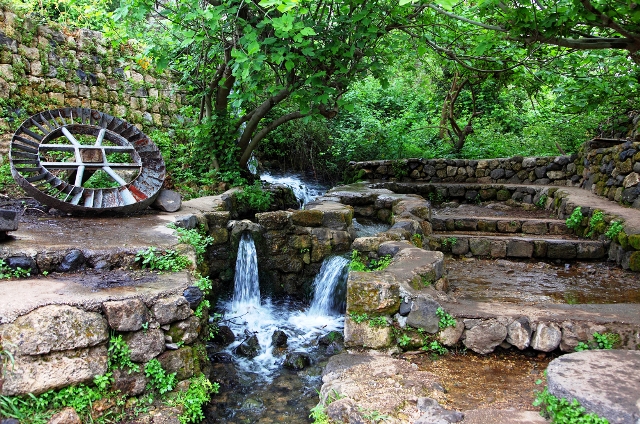
Photo: Banias in Spring by Shutterstock:




this is an outrage, the citizens of israel should take to the streets over this. unfortunately we are tired from protesting that tel aviv rent is too high
That is happening because certain religious fanatics, male supremacists and economic growth addicts all want to grow the human population to grow their wealth and power. Instead, the people should agree to peacefully reduce their population with family planning programs in which every woman is given the right to decide if and when to conceive and birth her children. Very few women want 5, 6, 7, 8, 9, 10 children. More want none at all. But the vast majority want no more than 1, 2 or 3. That way, the human population would return to a balance with the Earth’s supply of natural resources and there would be plenty for everyone.
JTR – I don’t think the religious part is needed here but the male stuff and economic growth are two factors I can agree with.