Turkey’s “Nature Law” Will Cause More Environmental Degradation, Activists Warn

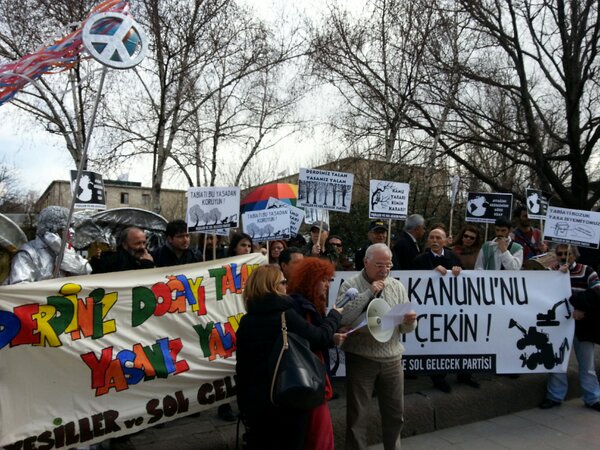
turkey environment protest against Nature law“Polluting nature is your problem, your law is a lie” and “Withdraw the Nature Law” read signs from protests last weekend in Ankara.

On Sunday, Turkey’s Green and Future Left parties organized small but loud protests in six cities around Turkey to oppose the country’s new Protection of Nature and Biological Diversity Law. The draft law, currently on the agenda of the Turkish Parliament, will allow formerly protected natural areas to be opened for construction, according to Turkish environmentalists, opposition politicians, and environmental engineers who have examined the bill.

The law allows formerly protected land to be developed when it serves the “great public welfare” of Turkey, according to a passage from the law quoted in Turkish paper Hürriyet Daily News: “If strategic areas seen important for great public welfare are inside the areas that should necessitate protection, then their management under certain conditions should be enabled.”

“Great public welfare” is too vague a term, according to Turkey’s Chamber of Environmental Engineers, and could allow protected habitats to be spoiled merely to boost tourism or industry.

In addition to the six rallies organized around the country on Sunday, the Turkish public have been making their voice heard online. More than 100 Turkish environmental groups have thrown their support behind the initiative to redraft the bill through a more transparent, participatory process, and a Change.org petition calling for the current bill to be withdrawn from parliament has so far received nearly 40,000 signatures

Opponents of the bill have raised other concerns, according to the HDN.

First, the bill will make Turkey’s ministries responsible for overseeing protected natural areas. The administration has a very checkered record on cases of clashing environmental and business interests, most recently demonstrated by the government’s backing of the Ilısu Dam project, on which construction has continued despite a January order from Turkey’s highest administrative court to halt until environment impact assessments have been conducted.

Second, locals will no longer have a part in helping maintain protected natural areas near their homes. Finally, the bill doesn’t include the term “national park”, suggesting that the entire concept might be expunged from Turkey’s law on the environment.

A deputy of Turkey’s largest opposition party, the Republican People’s Party (CHP), told the HDN that his party was willing to rewrite the law after consulting with environmental NGOs and academics.

The deputy, Mustafa Serdar Soydan, said the CHP would seek support from European Union groups if they cannot change the course of the bill in Turkish Parliament.

“Natural, protected areas form around 4 percent of [Turkish land] while this rate is 14 percent in the European Union. Instead of increasing this [rate], this draft law is leaving the protection job to the ministries, which will spoil these areas,” Soydan told the paper.

:: BianetHürriyet Daily News

Read more about conservation in Turkey:
Life Returns to Gulf – Once a Sewer on Turkey’s Aegean Coast
Istanbul’s Natural Oases: the Atatürk Arboretum and Belgrade Forest
Hydroelectric Dam Threatens “Ecological Massacre” in Turkey
Polluting Paradise Documentary Follows Turkish Village’s Battle Against Invading Garbage

Image via Yeşil Gazete

Julia Harte
Julia Hartehttp://www.greenprophet.com
Julia spent her childhood summers in a remote research station in the Rocky Mountains of Colorado, helping her father with a 25-year-old experiment in which he simulated global warming over a patch of alpine meadow. When not measuring plant species diversity or carbon flux in the soil, she could be found scampering around the forests and finding snowbanks to slide down. Now she is a freelance journalist living in Istanbul, where her passion for the environment intersects with her interest in Turkish politics and grassroots culture. She also writes about Turkish climate and energy policy for Solve Climate News.
2 COMMENTS

Comments are closed.

TRENDING

Costa Rica in Central America has blood on its wires

In Costa Rica, a country globally celebrated for its lush biodiversity and eco-tourism, a darker reality lurks in the canopy: the quiet, gruesome deaths of thousands of wild animals by electrocution. Sloths, howler monkeys, anteaters—icons of the rainforest and the tourism industry alike—are being burned alive on uninsulated power lines.

They Call Her Madam Torti. She Might Be the Only One Who Can Save Seychelles Turtles

Sea turtle expert Dr. Jeanne Mortimer warns that unchecked development on Assomption Island threatens Seychelles' most critical nesting beach. With over four decades of research, Mortimer advocates for science-based, turtle-friendly development to protect endangered species. Her quiet, persistent work underscores the urgent need for conservation-led planning in fragile island ecosystems.

Q&A: Dr. Nirmal Jivan Shah on Assomption Island, Qatar, and the State of Conservation in the Seychelles

As controversy brews over a Qatari-backed development on Seychelles’ remote Assomption Island, questions are being raised about environmental transparency, geopolitical influence, and the future of conservation. I reached out to Dr. Nirmal Jivan Shah, CEO of Nature Seychelles, for his unfiltered perspective.

Seychelles’ UNESCO island under threat from luxury development and Qatari-linked terror funds

The fate of Assomption Island may determine not just the survival of its biodiversity, but the integrity of Seychelles’ commitment to sustainable development in the face of land grabs and neo-colonialism by powerful foreign interests.

Pando aspen forest in Utah is one of world’s oldest beings

The Latin name Pando means "I spread," and the forest is one single living thing –– one one tree that has cloned itself tens of thousands of times. Pando consists of approximately 47,000 individual stems all connected by a single, vast root system.

Should You Invest in the Private Market?

startustartup Unlike public stock exchanges, which offer daily trading, strict...

How to build a 100-year-company

Kongō Gumi is a Japanese construction company, purportedly founded in 578 A.D., making it the world's oldest documented company. What can we learn about building sustainable businesses from them?

From Pilot Plant to Global Stage: How Aduro Clean Technologies’ 2026 Expansion Signals a Turning Point for Chemical Recycling Investors Like Yazan Al Homsi

The company's Next Generation Process (NGP) Pilot Plant in London, Ontario, has officially moved into initial operating campaigns, generating the kind of structured, repeatable data that separates laboratory promise from commercial viability.

How AI Helps SaaS Companies Reduce Repetitive Customer Support Work

SaaS products are designed for large numbers of users with different levels of experience, and also in renewable energy.

Pulling Water from the Air

Faced with water shortage in Amman, Laurie digs up...

Turning Your Energy Consultancy into an LLC: 4 Legal Steps for Founders in Texas

If you are starting a renewable energy business in Texas, learn how to start an LLC by the books.

Tracking the Impacts of a Hydroelectric Dam Along the Tigris River

For the next two months, I'll be taking a break from my usual Green Prophet posts to report on a transnational environmental issue: the Ilısu Dam currently under construction in Turkey, and the ways it will transform life along the Tigris River.

6 Payment Processors With the Fastest Onboarding for SMBs

Get your SMB up and running fast with these 6 payment processors. Compare the quickest onboarding options to start accepting customer payments without delay.

Related Articles

Popular Categories