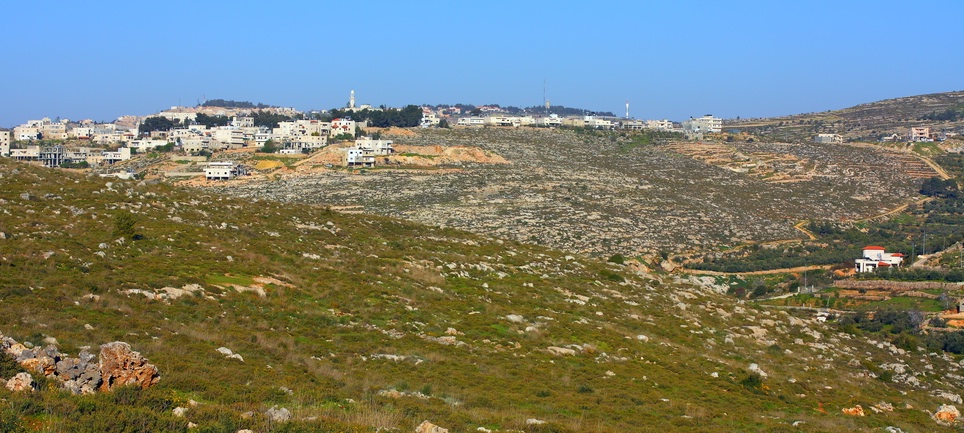

Water from natural springs burbles in the ancient Roman stone aqueduct as it carries water downward to this village’s ancient terraces. Palestinian families grow olives, cabbage and eggplant today the same way they did more than 2,000 years ago.
“Each family here gets water one day a week, but the week lasts eight days since there are eight families,” Kayan Manasra, the Palestinian Coordinator of Friends of the Earth Middle East (FOEME), a joint Israeli-Palestinian-Jordanian NGO, told The Media Line. “There are 13 springs and seven are still in use. We farm here the same way we are doing for thousands of years.”
Battir, with its 6,000 residents is in Area B of the West Bank, meaning that Palestinians provide municipal services such as garbage pickup but Israel is responsible for security.
Most crops are grown on terraces — small plots surrounded by stone walls on the slopes of the hill. Conservationists say the farming methods are the same as those used in ancient times. Residents here are hoping that the World Heritage Committee of the United Nations Educational, Scientific and Cultural Organization (UNESCO) will designate the village a World Heritage Site. Earlier this year, UNESCO gave Battir the Melina Mercouri International Prize for the Safeguarding and Management of Cultural Landscapes.
Battir also has a Jewish connection. Once a Jewish village, it was the site of the defeat of a Jewish revolt against the Romans led by Bar Kokhba in the Second Century. Archaeological artifacts show the site was inhabited since the Iron Age. Today, some 4,000 residents live mostly by farming.
Now, they fear that Israel is about to construct the barrier it is building in and around the West Bank right through the village lands, which some fear could end this way of farming.
“The barrier will disconnect part of the farming lands from their owners and disturb the landscape,” Gilat Bartana of FOEME, told The Media Line. “An appeal against the barrier was rejected so building could start anytime soon.”
Building the barrier has already begun in the neighboring village of Wallaje. The Israeli Supreme Court rejected several appeals and the planned route of the barrier will completely surround the village. Omar Hajableh, 47, told The Media Line that the barrier will run very close to his house on the outskirts of the village. He says he will not be able to reach his 450 olive trees.
“It will be a prison here,” he says angrily. “The Israelis want me to leave my land but I refuse to. They say it’s for security – what security do they need here?”
He said that in the past ten years there has been one terror attack in the area. Hajableh also said that Israeli officials told him would build a special agricultural gate in the barrier to enable him to reach his farmland. Hajableh says this is not a solution.
“They said I can cross in twice a year to farm my land,” he said. “I work alone. I can’t take care of even one tree, let alone 450. They are simply trying to find a way to take the land.”
Israeli officials defend the route of the separation barrier, which Israel calls a “security fence” and Palestinians an “apartheid wall.” In a statement, the Defense Ministry said the route of the barrier is based only on security considerations and Israel tries to minimize the damage to the Palestinians. They say the numbers speak for itself, that the construction of the barrier has made a major contribution to Israel’s security, and that Palestinian attackers have not been able to enter Israel since it was erected. The barrier costs an estimated $1.4 million dollars per mile to build. Some 90 percent of it is a fence with trenches on both sides, while ten percent, in heavily populated areas, is a 26-foot high concrete barricade.
Part of the barrier runs along the so-called “Green Line”, the demarcation line between Israel and the West Bank that was agreed to in the 1949 armistice agreements, but part also dips into the West Bank. The Israeli human rights group B’tselem says the barrier effectively annexes 8.5 percent of the West Bank to Israel, by keeping that land on the Israeli side of the barrier.
Back in Battir, the view from the top of the hill is breathtaking. A donkey ambles by, led by a famer on the way to his plot. Palestinians here say they fear that the Israeli bulldozers will come, and permanently change their way of life.
Image of Battir on a hill from Shutterstock