
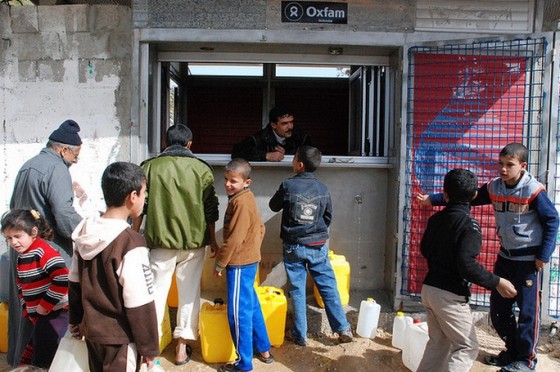


Gaza’s population is increasing, and the water supply is not keeping pace according to Oxfam, the British human rights organization. In a new report, the group asserts that Gazans are spending as much as one-third of their household income on drinking water, and are facing growing health risks.
“The infrastructure has been deteriorating rapidly because we are not able to repair and maintain it,” Karl Schembri, a spokesman for Oxfam in Gaza told The Media Line. Referring to action as far back as Operation Cast Lead at the end of 2008 and start of 2009, “Israeli military attacks have had a severe impact on the civilian infrastructure and particularly on the water network.”
Gaza’s main source of water for its dense population of 1.6 million people is the coastal aquifer. Ghada Snunu of EWASH, a non-governmental organization that deals with water quality, says that 95 percent of the water in the coastal aquifer has dangerous levels of nitrates and chloride, often ten times what the World Health Organization recommends.
“Drinking this water is causing diarrhea among children and ‘baby blue syndrome’ in which it is difficult to transfer blood into tissues, making the baby blue,” she told The Media Line. “Children in refugee camps have an increase in water-born diseases because of the poor quality of the water.”
Both Oxfam and EWASH blame the Israeli “blockade” of Gaza, which limits imports of some raw materials that could be used to make weapons, which was implemented in 2007 after the Islamist Hamas forcibly took over control Gaza from the Palestinian Authority.
Israeli government spokesman Mark Regev says Israel is doing everything possible to help Gazans drink clean water.
“Israel has been helping to improve the water infrastructure in Gaza and Israel was willing to double or even triple the amount of water going into Gaza,” Regev told The Media Line. “It is the same water that you and I drink, and the Gazans would pay less than what we pay but they weren’t willing to accept that solution.”
Palestinian water officials in Gaza say that Israel provides just 4 to 5 million cubic meters of water to Gaza per year, while Gaza uses 100 million cubic meters of water per year for drinking and an additional 80 million cubic meters of partially treated wastewater for agriculture.
Monther Shublaq, the director of Gaza’s Coastal Municipal Water Utilities (CMWU) told The Media Line that Israel has recently raised prices for the water it provides from 75 cents per cubic meter to $1.00 per cubic meter. And while Israel has offered more water, he says, it will not say when it will provide it.
“I don’t want it in the winter when I don’t really need it,” Shublaq said. “I want it all year.”
He said the majority of Gazans now rely on private water deliveries which are not regulated and are often contaminated.
Gaza is surrounded by the sea, and one solution is desalination. Oxfam and CMWU recently inaugurated a desalination plant and water distribution pipeline in the southern city of Rafah.
“Finally, for the first time in our life, we can drink water directly from our taps,” Abu Rami from Rafah told representatives from Oxfam. “It will take me a while to remember that I can drink tap water.”
But desalination is expensive. Shublaq says Palestinians hope to eventually desalinate100 million cubic meters per year to cover most of Gaza’s requirements. Updating the infrastructure would also help stop leakage.
Ghada Snunu of EWASH says Israel must allow water from the mountain aquifer, which runs under both Israel and the West Bank, to reach Gaza. Palestinians say the West Bank and Gaza, along with east Jerusalem, should be part of the Palestinian state.
But all of these solutions take time and are expensive. Meanwhile, many Gazans will continue to drink water that is expensive, polluted, or both.
This story is reprinted from The Mideast News Source, The Media Line.
Image of Gaza water line via Oxfam




Us Canadians should be ashamed, buying bottled water is so much a senseless waste.
The Hamas government is responsible for maintaining the infrastructure of Gaza yet the people continue to suffer while the politicians grow fatter. New luxury hotels continue to sprout up- with swimming pools and spas, and the ordinary people are neglected. Look at the photos of the new Al-mashtal Hotel- its a 5 star hotel. Look at their pool and facilities. Why is Hamas neglecting the very people who put it into power?
If the people living on the Gaza Strip would follow common sense instead of their tribal instincts, they could peacefully reduce their population with family planning education and live a peaceful and prosperous life within the ability of the land to support them.
If the people living on the Gazatrip would follow common sense instead of their tribal instincts, they could peacefully reduce their population with family planning education and live a peaceful and prosperous life within the ability of the land to support them.