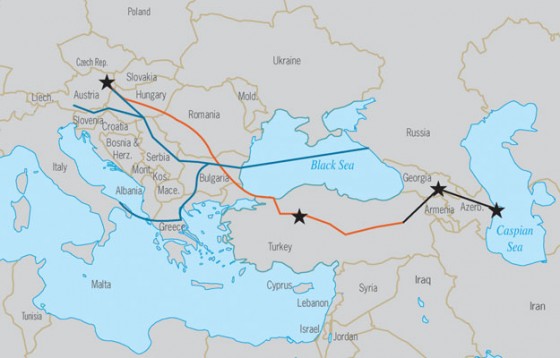
 The Nabucco natural gas pipeline (in orange) was designed to lessen eastern Europe’s dependence on Russia’s sometimes unreliable gas supply. But Russia’s South Stream pipeline project (in blue) now seems more likely to be built.
A 2,400-mile pipeline transporting 30 million cubic meters from central Asia to Austria each year. That was the plan when the European Union designed the Nabucco gas pipeline in 2009 as part of its Southern Gas Corridor initiative for enhanced energy security throughout Europe.
Turkey’s cooperation in the project was vital, given its central location between the gas-producing central-Asian ‘stans and the gas-hungry nations of eastern Europe. But now it appears that Turkey is favoring alternate routes instead, including a gas pipeline by Russia — the very nation whose gas supply Nabucco was designed to bypass.
A natural gas coup d’etat
In December 2011, Turkey gave Russia permission to run its South Stream pipeline from Russia through Turkey’s Black Sea waters and into Europe. The Russian pipeline would be able to transport more than twice as much natural gas as Nabucco, 63 million cubic meters.
More importantly, it would undercut the reason for Nabucco’s very existence.
Russia’s shaky relations with eastern Europe, especially Ukraine, have often resulted in gas supply cuts throughout Europe. So the European Union conceived of Nabucco specifically as a pipeline that would source gas from a different country, reducing Europe’s overall dependence on the Russian gas supply.
Turkey’s nod to Russia on the South Stream pipeline is viewed by most analysts as a way of keeping the regional power reins in Turkey’s hands. By cooperating with both Russia and Europe at this stage of the pipeline plans, Turkey ensures it will remain the central negotiator in all future dealings around a regional gas trading route.
This isn’t a new tactic; Turkey’s been using natural gas to cement its regional power for years now.
How dead is Nabucco, exactly?
Turkish officials won’t say outright that the Nabucco pipeline is dead. Turkish Energy Minister Taner Yıldız recently stated that Turkey’s efforts on the project would continue, and some analysts point out that the rival South Stream project that Turkey now appears to favor doesn’t directly conflict with Nabucco’s route.
A few alternate pipelines that follow Nabucco’s route through southeastern Europe have been proposed, including the Interconnector Turkey-Greece-Italy (ITGI) and the Trans-Adriatic Pipeline (TAP). Less ambitious in their territorial reach and cheaper, they might succeed where Nabucco seems to have failed.
Read more about energy politics in Turkey and its region:
A 2012 Energy Forecast For Turkey: Heading Down A Tried-And-False Path
Turkish Water Projects Stirring Resentment Around The Region
Natural Gas Creating New Axes Of Alliance Across Mediterranean
Image via Foreign Policy