Turkey Expected To Cancel Nuclear Plans After Massive Earthquake

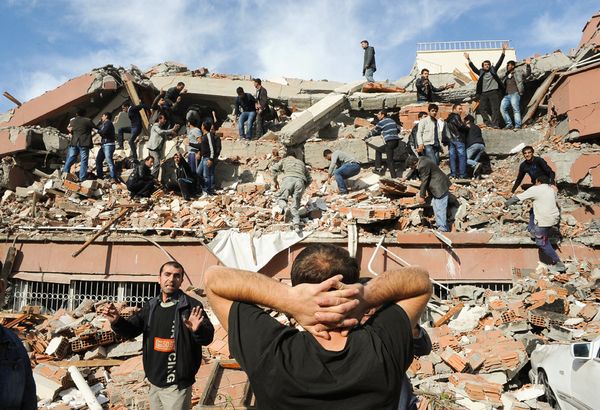
The earthquake struck approximately 20 kilometers north of the city of Van, pictured above. Turkey’s seismology institute estimated the final death toll would reach 1,000.

A 7.2-magnitude earthquake slammed Turkey‘s eastern province of Van on Sunday. Two days afterward, 366 deaths have been reported, 1,301 injured persons are being treated, and more than 2,000 buildings have collapsed.

Although the temblor didn’t shake the Black Sea region of Sinop, which was some 800 kilometers northwest of the epicenter, it may have stalled plans to build a nuclear power plant (NPP) there. The Korean nuclear industry now expects the Sinop NPP to be canceled, news agency dongA reports.

Nuclear ambitions

Turkey has already signed a deal with Russia to build a NPP at Akkuyu, a city off its southern Mediterranean coast. The Akkuyu plant would be the country’s first. But for the past year, Turkey has also been arranging to build a second NPP at Sinop, on the country’s northern coast at the Black Sea.

Although South Korea was the first country that Turkish officials considered when planning the Sinop NPP, the Turkish government switched its attention to Japanese nuclear companies last year, apparently attracted by their expertise about building NPPs in seismically active areas. After the Fukushima disaster earlier this year, however, Japan pulled out of all foreign nuclear projects, officially canceling its involvement in the Sinop NPP negotiations in July.

On an August visit to Seoul, Turkish Foreign Minister Zafer Çağlayan reaffirmed his government’s interest in hearing offers from South Korean nuclear firms for the Sinop project: “My ministry and the Turkish government are open to every proposal by South Korean companies over the issue of nuclear power plants.”

Cooling down

After the devastating earthquake that rocked Turkey’s southeast on Sunday, however, the Korean nuclear industry expects Turkey to drop the Sinop NPP. The Korea Electric Power Corporation and the country’s economy ministry will “change their strategy,” according to the report in dongA.

Sinop is on a small peninsula that juts into the Black Sea, and was one of the areas in Turkey most affected by the 1986 Chernobyl nuclear meltdown. The radiation that emanated from Chernobyl destroyed years of harvest for Turkish farmers along the Black Sea coast, and is believed to be responsible for unusually high cancer rates in the area today.

Although Sinop (unlike Akkuyu) doesn’t lie on an active fault, Sunday’s earthquake occurred 100 kilometers from the nearest major faultline, highlighting the unpredictability of seismic activity in this especially earthquake-prone country.

:: dongA

Read more about nuclear power in Turkey and the region:

Greenpeace Raises More Questions Over Jordan’s Nuclear Plans

Post-Chernobyl Agriculture In Turkey: A Sign Of What’s In Store For Japan?

Despite Japan, Turkey Goes Ahead With Nuclear Reactors

Image via ABDURRAHMAN ANTAKYALI/AFP/Getty Images

Julia Harte
Julia Hartehttp://www.greenprophet.com
Julia spent her childhood summers in a remote research station in the Rocky Mountains of Colorado, helping her father with a 25-year-old experiment in which he simulated global warming over a patch of alpine meadow. When not measuring plant species diversity or carbon flux in the soil, she could be found scampering around the forests and finding snowbanks to slide down. Now she is a freelance journalist living in Istanbul, where her passion for the environment intersects with her interest in Turkish politics and grassroots culture. She also writes about Turkish climate and energy policy for Solve Climate News.

Hot this week

The Christ’s thorn (sidr tree) is also a well-known folk medicine

Christ’s thorn jujube (Ziziphus spina-christi) also known as the sidr tree is a real, identifiable tree native to the Middle East, and it appears—directly or indirectly—in Islam, Judaism, and later Christian tradition. The connections between the three faiths are not theological agreements but overlapping uses, names, and symbolic associations rooted in the same landscape.

Farm To Table Israel Connects People To The Land

Farm To Table Israel is transforming the traditional dining experience into a hands-on journey.

The Lote Tree of the Utmost Boundary, explained

In Islamic tradition, there is a point where creation ends — a boundary that marks the limit of what any created being can reach. That boundary is called Sidrat al-Muntahā, often translated as “the Lote Tree of the Utmost Boundary.”

The Air Tea Kettle creates a new way to meet plants and herbalism

Air Tea is a new technology. Instead of drinking tea, you inhale herbal vapor through warm air extraction. There is no water and no combustion. The warm air releases essential oils that are often lost in hot water and digestion.

Why Health Systems Are Reaching a Turning Point

Health emerges from a continuous energy and material flow from water through food to human physiology. Technical energy systems support this cycle through water treatment, agriculture, and infrastructure.

Topics

The Christ’s thorn (sidr tree) is also a well-known folk medicine

Christ’s thorn jujube (Ziziphus spina-christi) also known as the sidr tree is a real, identifiable tree native to the Middle East, and it appears—directly or indirectly—in Islam, Judaism, and later Christian tradition. The connections between the three faiths are not theological agreements but overlapping uses, names, and symbolic associations rooted in the same landscape.

Farm To Table Israel Connects People To The Land

Farm To Table Israel is transforming the traditional dining experience into a hands-on journey.

The Lote Tree of the Utmost Boundary, explained

In Islamic tradition, there is a point where creation ends — a boundary that marks the limit of what any created being can reach. That boundary is called Sidrat al-Muntahā, often translated as “the Lote Tree of the Utmost Boundary.”

The Air Tea Kettle creates a new way to meet plants and herbalism

Air Tea is a new technology. Instead of drinking tea, you inhale herbal vapor through warm air extraction. There is no water and no combustion. The warm air releases essential oils that are often lost in hot water and digestion.

Why Health Systems Are Reaching a Turning Point

Health emerges from a continuous energy and material flow from water through food to human physiology. Technical energy systems support this cycle through water treatment, agriculture, and infrastructure.

Sustainability That Sells: How Profit and Purpose Come Together in the Hive

Whether you are a commercial grower, hobbyist beekeeper or retail equipment supplier, this system opens a new income stream with minimal environmental impact.

The Fitness App Revolution: Building the Future of Wellness Through Strategic Development

In an era where smartphones are ubiquitous and health consciousness is at an all-time high, the fitness industry has undergone a radical digital transformation. Fitness applications have moved far beyond simple pedometers, evolving into comprehensive wellness platforms that serve as personal trainers, nutritionists, and community hubs right in our pockets.

A Brief History of Basil From India to Italy

Beloved, fortunate, sweet, and royal; an herb with a long and storied history in Asia and across the world. Called by many names, basil has featured in previous Green Prophet articles, so enjoy another serving, a brief history of basil.

Related Articles

Popular Categories