

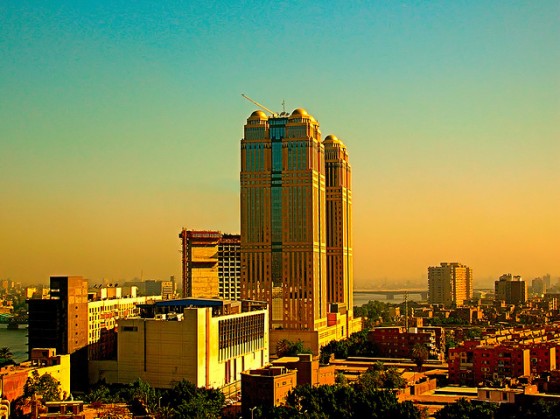
 Despite its numerous environmental challenges, Egypt can go green, according to Dominique Gauzin-Müller.
It’s hard not to compare Dubai and Cairo – two cities that occupy many of our worried green thoughts. Although different on so many levels, one thing stands out: despite being relatively young and stroppy, Dubai is definitely the cleaner city. Sure, there is litter along the beaches and in other more isolated areas, but when compared to Egypt, the Emirate comes out squeaky clean. Even so, French Architect Dominique Gauzin-Müller told Almasry Alyoum that she can envision a sustainable urban future for Egypt, particularly if the country embraces wisdom advocated by their very own father of sustainable architecture – Hassan Fathy.
Despite Cairo’s incredible challenges, including a burgeoning population, solid waste management issues, inadequate public transportation infrastructure, pollution, and poor drinking water, Dominique Gauzin-Müller has brought an exhibit to just this city with the belief that these negatives can be improved.
Called “Live ecological: what types of architecture for a sustainable city,” the exhibit is being shown at the Palace Amir Taz in Khalifa, Cairo. And it is supported by the French Institute and Paris-based Cité de L’architecture et du Patrimoine.
Since buildings consume the majority of our natural resources, the architect believes that it is especially important to ensure that they are built well and that they are built with a view toward cultural, ecological, economical, and social consciousness.
Gauzin-Müller sites Hassan Fathy’s architectural ethos as an appropriate model for Egypt to carry forward. Considered the inventor of ‘passive cooling,’ Fathy emulated indigenous building methods, such as courtyards and dense walls that absorb solar gain, in order to keep desert structures cool. Adobe, wallow, and blocks are among the materials the French architect proposes as ideal for Egypt, as long as no precious silt is used.
She also compares Cairo’s ‘informal’ areas to Europe’s Eco-Quartiers, according to the paper, and suggests that Egypt is in a good permission to learn from the mistakes in the west. Skyscrapers are not an intelligent use of scarce space since their foundations are necessarily large.
Al-Azhar parks receives high marks for its service to keep dust down, and Gauzin-Müller recommended that more green spaces should be considered. She especially advocates developing the Nile’s banks to create clean and green walking space for the city’s inhabitants.
Hassan Fathy’s legacy will never die.
More on Sustainable Architecture in the Middle East:
Hassan Fathy is the Middle East’s Father of Sustainable Architecture
Sustainable Architecture in Israel Blooms in a Strawbale House
Foster & Partners Finish Gorgeous Green Building in Morocco
image via Giampaolo Macorig

Thank you. That’s a really interesting perspective. In your view, is concrete more sustainable?
dear friends: unfortunately the architecture of tha great architect hassan fathy can be revived according to his traditional use of mud bricks! this because it is very hard today to get mud from the banks of river nile(actually,to my knowledge,it is forbidden!) because the assuan dam has elliminated the fertile mud that used to run along the river and being accumulated at its banks and at its “delta”.so, a new architecture has to be developed based on H.F.’s principles of climatic design(which i personally have successfully used in some of my buildings in israel) but with modern materials such as concrete blocks with external insulation.egypt is a great country(i have travelled along the nile river) but it grows very fast in population,about 1,000,000 a year,that is, it needs to build housing for at least 1,000,000 people every year to catch the rythm of growth!so,instead of investing the american aid in arms,it would be better to invest it in bio-climatic housing and infrastructure for the benefit of its people! anyway,israel it is not a threat to egypt and israelis would like to visit egypt as tourists( especially in sinai) not soldiers!