Hydropower Could Meet More Of Turkey’s Energy Demand — But At What Cost?

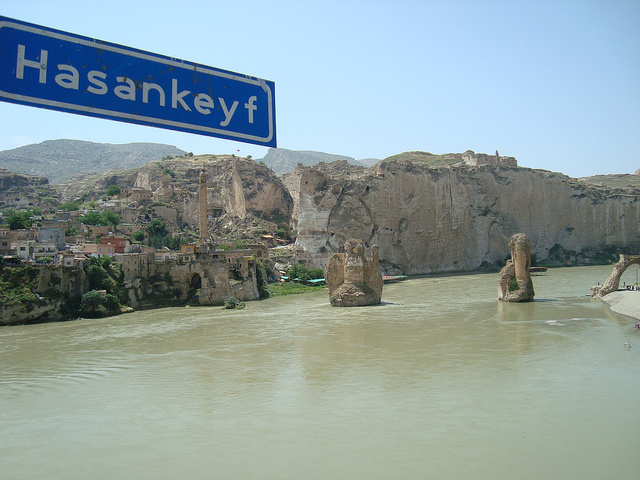
A planned dam in southeastern Turkey would submerge Hasankeyf’s 10,000-year-old cultural relics and displace 50,000 people from the region. How many kilowatt hours is that worth?

Electric energy demand in Turkey is projected to more than double over the next decade, to approximately 450 billlion kilowatt-hours. Traditional sources of power, such as coal- and natural gas-fired plants, pollute the local and global environment and have forced Turkey to rely on neighbors like Iran and Russia. A new report by a consortium of hydroelectric producers,  described in Turkey’s Today’s Zaman, points out that, so far, Turkey only uses one third of its potential hydropower. If fully utilized, it could supply more than 30 percent of the 450 billion kwH needed in 2020.

So why does hydropower still have a less than sterling reputation amongst environmentalists? For several good reasons, it turns out.

Although hydropower is renewable, and its generation does not directly release fossil fuels into the atmosphere, building a hydraulic dam involves tearing up land and clear-cutting forests all around the site. In Turkey, where some of humankind’s earliest settlements were built in the fertile land beside rivers, millennia of history can also end up submerged by rising water levels from a single hydro project. Interrupting a river’s flow with a dam adversely affects riparian ecosystems at the dam site as well as habitat hundreds of kilometers downstream from it.

In the past, for example, the Turkish government tried to build a dam in the country’s only biosphere zone, despite the fact that the project would have required uprooting 600 trees in a forest that is home to the only populationof a certain type of honeybee. That project was canceled because of intense opposition by local and country-wide environmental groups.

But other projects, such as a dam on the Euphrates that partially submerged the 2,000-year-old Roman trading town of Zeugma, have fundamentally altered habitats and caused the displacement of thousands of people.

Hasankeyf is the latest Turkish town to fight a hydroelectric project that would, quite literally, drown it. The Ilisu Dam would raise water levels in Hasnakeyf by 200 feet, forcing many of its residents to move and inundating a valley with a remarkably rich and ancient history. According to a Smithsonian profile of the town, it passed through the hands of Roman, Byzantine, Turkish, Arab, and Mongol dynasties, each of whom left some cultural or architectural marks on the area. Marco Polo may have passed through while the town was enjoying a commercial boom thanks to its position on the Silk Road.

But nowadays, rising energy demand and the allure of domestically produced electricity are high enough to endanger Hasankeyf and other sites like it. If the same institutional support could be marshaled for solar or wind, equal progress toward energy independence and cleaner power production could be made.

Judging by the feed-in tariffs the government announced for solar and wind at the end of last year, however, that move is a long way off yet. In the meantime, environmentalists, archeologists, and local residents of dam sites will continue to make noise about the dark side of hydropower in Turkey.

:: Today’s Zaman

Read more about hydropower and renewable energy in Turkey:

Turkey Plans To Dam Its Sole Biosphere

Turkey Joins 78 Others To Pass Feed-In Tariffs To Encourage Renewable Energy

“Dam” Victory For Turkey’s Environmentalists!

Image via mutsuzluksuzluk

Julia Harte
Julia Hartehttp://www.greenprophet.com
Julia spent her childhood summers in a remote research station in the Rocky Mountains of Colorado, helping her father with a 25-year-old experiment in which he simulated global warming over a patch of alpine meadow. When not measuring plant species diversity or carbon flux in the soil, she could be found scampering around the forests and finding snowbanks to slide down. Now she is a freelance journalist living in Istanbul, where her passion for the environment intersects with her interest in Turkish politics and grassroots culture. She also writes about Turkish climate and energy policy for Solve Climate News.

Read More

LEAVE A REPLY

Please enter your comment!
Please enter your name here

TRENDING

AI data centers are triggering panic, instead of cleantech opportunities

AI may unintentionally become the economic engine that finally modernizes America’s aging grid. California is experiencing a massive AI data center boom, ranking 3rd in the U.S. with 227 operating centers and 54 more in development as of April 2026, according to Stanford.

Korean researchers create battery from greenhouse gases

Professor Ji-Soo Jang, in collaboration with Professor Taekwang Yoon of Ajou University and Professor Hansel Kim of Chungbuk National University, has developed a novel energy device that generates electricity during the process of capturing greenhouse gases.

Should You Invest in the Private Market?

startustartup Unlike public stock exchanges, which offer daily trading, strict...

EU startup aiming to generate energy on moon villages

Stepping up to democratize the moon is an EU-funded company, Deep Space Energy, which has just raised more than $1 million USD as a seed fund to help it create energy generators on the moon.

Astro uses AI to help procure land for renewable energy

For oil-rich, environmentally vigilant Gulf states, Astro isn’t just another startup story. It is a blueprint for accelerating an energy transition that is now existential, not optional.

How to quiet noise from construction in your office

Streets need to be resurfaced in New York but the humming and grinding noise is unsettling. Noise is environmental pollution. 

EarthX and a blueprint for sustainable investing

Trammell S. Crow, a Dallas-based businessman and father of four, is focusing his efforts on impact investing, and media that focuses on saving the planet through EarthX.

Mining Afghanistan’s Mineral Discoveries Similar to Avatar

Now that American forces in Afghanistan are commemorating the longest period of any war that America has been involved in, including the 1965-73 Vietnam War, the recent discoveries of large and extremely valuable mineral and metal deposits may finally bring to light a reason to continue the presence of US fighting forces in this war torn and backward country.

From Pilot Plant to Global Stage: How Aduro Clean Technologies’ 2026 Expansion Signals a Turning Point for Chemical Recycling Investors Like Yazan Al Homsi

The company's Next Generation Process (NGP) Pilot Plant in London, Ontario, has officially moved into initial operating campaigns, generating the kind of structured, repeatable data that separates laboratory promise from commercial viability.

Nobul’s Regan McGee on Shareholder Value: “Complacency Is the Silent Killer” 

Why the governance framework designed to protect shareholders so...

Should You Invest in the Private Market?

startustartup Unlike public stock exchanges, which offer daily trading, strict...

How to build a 100-year-company

Kongō Gumi is a Japanese construction company, purportedly founded in 578 A.D., making it the world's oldest documented company. What can we learn about building sustainable businesses from them?

How AI Helps SaaS Companies Reduce Repetitive Customer Support Work

SaaS products are designed for large numbers of users with different levels of experience, and also in renewable energy.

Popular Categories