
Planned Flooding of Ancient Roman Spa in Turkey Shows Disregard for Archeological Sites

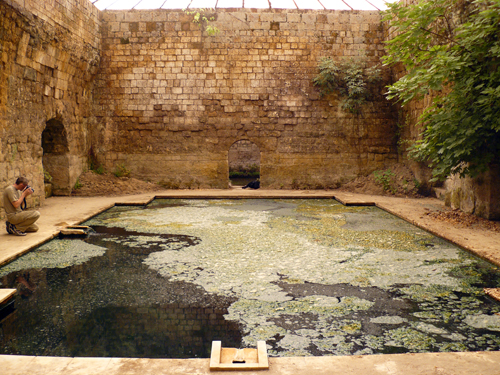
Allianoi Roman baths in better days. Is flooding this site for irrigation  a “massacre” or unavoidable water reservoir project?

In a planned act that seems to be no different than bulldozing ancient archeological sites in Libya the Turkish government is going through with work to flood the  ancient Roman hot springs spa of Allianoi. The site sits in a valley that will be flooded by a dam  that will create a reservoir with a capacity to irrigate 8,000 hectares of farmland. The project, reported in Lebanon’s Daily Star includes wall painting frescoes and columns as well as beautiful mosaic floors.  Even though efforts are being made to protect the site by covering it with a special coating and layers of sand (as Tafline reported), no effort was made on behalf of the Turkish authorities to let archeologists do a complete excavation of the site, which will soon be covered by at least 17 meters of water when the Yorganli Dam is completed.

Professor Ahmet Yaras, an archeologist who has been excavating the site for over 9 years, says that:

“Normally, cultural treasures need to be examined and registered before any action is taken on a site. Here, flooding the site before the excavation is complete is a ‘massacre’. There is no other ancient warm bath, health center in the world as well preserved as this.”

Prof. Yaras, adds that the site is still a long way from being fully excavated “with over 80% of it yet to see the sunlight.”. Even the hot springs that provided hot water for the thermal baths still issues hot water in parts of the site. The Turkish government’s seeming disregard for the heritage value of the site appears to reinforce earlier Green Prophet articles dealing with the country’s increasing water shortage problems.

Turkey used to have ample amounts of fresh water, and in the past has been a major water supplier to regional countries such as Lebanon, Iraq and Syria.

Professor Yaras adds that “it will be crazy to excavate the site” when it will eventually be covered by up to 15 meters of silt in 50 years time, as well as by the water from the dam. Area farmers are not as concerned, however, as they will benefit from the water. One farmer, Mehmet Aydin, thinks that the archeologists “are exaggerating” and that this site is “just another hot spring like many others in Turkey.”

Hot spring or not, a site that was probably one of the most popular in the Eastern Roman Empire, will be again lost to humanity by being covered up by a lake. As badly as Turkey needs this water resource, it seems that perhaps a less controversial site could have been found to create the lake. In a way, one could compare this to creating a lake at a Roman hot springs spa in Italy; or even in the City of Bath in the U.K., from which the city derives its name.

Turkish Culture Minister Ertugrul Gunay, appears to have dashed all hopes to save the site by saying that “the ruins of Allianoi were only discovered during drilling (for water) and remained in the ground for along time.” It looks like the site will now go back to the ground and will have to wait to be excavated again at a later date. The big question now is what condition the baths will be in when they are rediscovered sometime in the future.

Read more on Middle East archeological issues:

Libyan Archeological Sites Threatened by BP Offshore Energy Drilling

New Geo-Archeological Studies Reveal 2,500 years of Mediterranean Sea Level Fluctuations

Jordan Hopes for the Gulf and Levant’s First “Mixed” UNESCO Heritage Site

Image via Kulturhistorisk Museum, Oslo

Maurice Picow
Maurice Picowhttps://www.greenprophet.com/
Maurice Picow grew up in Oklahoma City, U.S.A., where he received a B.S. Degree in Business Administration. Following graduation, Maurice embarked on a career as a real estate broker before making the decision to move to Israel. After arriving in Israel, he came involved in the insurance agency business and later in the moving and international relocation fields. Maurice became interested in writing news and commentary articles in the late 1990’s, and now writes feature articles for the The Jerusalem Post as well as being a regular contributor to Green Prophet. He has also written a non-fiction study on Islam, a two volume adventure novel, and is completing a romance novel about a forbidden love affair. Writing topics of particular interest for Green Prophet are those dealing with global warming and climate change, as well as clean technology - particularly electric cars.
2 COMMENTS

Comments are closed.

TRENDING

Sink holes from over-watering farmers’ fields

Sinkholes are rapidly appearing in Turkey’s central Anatolian farming region, particularly around Konya and Karapınar. These giant gaping holes in the ground in areas of farmland, known locally as obruk, are not random geological events. They are linked to prolonged drought, climate-driven heat stress, and heavy groundwater extraction for agriculture in one of the country’s most important breadbaskets.

Arap Koftesi burgul balls in a garlicky yogurt sauce

This bit of Turkish home cuisine is called Arap Koftesi, and I discovered it in Özlem's Turkish Table. We can call them burgul balls.

Americans probe the alleged biblical ark on Mount Ararat in new study

The Durupınar formation's dimensions strikingly mirror the biblical description of Noah's Ark, as detailed in Genesis 6:15. Ground-penetrating radar (GPR) surveys have revealed internal features, including rectangular shapes and what appears to be a central chamber, located approximately 22 feet beneath the surface. These findings suggest the possibility of man-made structures within the formation.

Make Lahmacun, crispy Turkish flatbreads with meat

Lahmacun, or lahmajoun are fun to eat folded over and out of hand, as a snack or finger food. If you prefer to make bigger pastries, they also make a satisfying meal.

Earthquake data can predict war

Seismic meters used to detect upcoming earthquakes may be used in the Art of War

Should You Invest in the Private Market?

startustartup Unlike public stock exchanges, which offer daily trading, strict...

How to build a 100-year-company

Kongō Gumi is a Japanese construction company, purportedly founded in 578 A.D., making it the world's oldest documented company. What can we learn about building sustainable businesses from them?

From Pilot Plant to Global Stage: How Aduro Clean Technologies’ 2026 Expansion Signals a Turning Point for Chemical Recycling Investors Like Yazan Al Homsi

The company's Next Generation Process (NGP) Pilot Plant in London, Ontario, has officially moved into initial operating campaigns, generating the kind of structured, repeatable data that separates laboratory promise from commercial viability.

How AI Helps SaaS Companies Reduce Repetitive Customer Support Work

SaaS products are designed for large numbers of users with different levels of experience, and also in renewable energy.

Pulling Water from the Air

Faced with water shortage in Amman, Laurie digs up...

Turning Your Energy Consultancy into an LLC: 4 Legal Steps for Founders in Texas

If you are starting a renewable energy business in Texas, learn how to start an LLC by the books.

Tracking the Impacts of a Hydroelectric Dam Along the Tigris River

For the next two months, I'll be taking a break from my usual Green Prophet posts to report on a transnational environmental issue: the Ilısu Dam currently under construction in Turkey, and the ways it will transform life along the Tigris River.

6 Payment Processors With the Fastest Onboarding for SMBs

Get your SMB up and running fast with these 6 payment processors. Compare the quickest onboarding options to start accepting customer payments without delay.

Related Articles

Popular Categories