
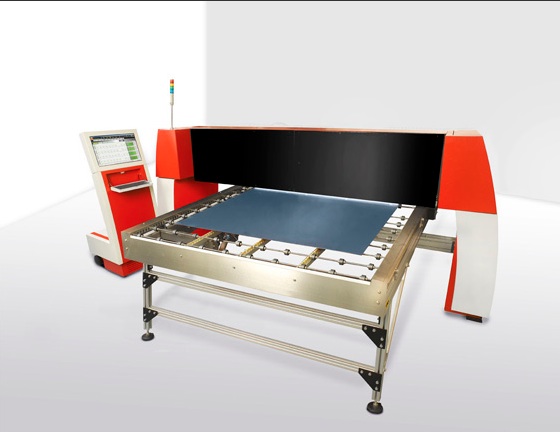

 It’s like an X-ray machine for solar panel quality control.
For hybrid cars, wind power, and solar energy technology, there’s more than just creative innovation involved in producing the batteries, generators and panels needed to drive the technologies forward. Reasonably-priced quality control processes are necessary so that the elements of new renewable energy technologies can be mass-produced according to the highest standards.
These same standards are required for the manufacture of photovoltaic (PV) thin film solar panels, BrightView System’s CEO Benny Shoham tells ISRAEL21c. Thin film is the specific area of PV production that is BrightView’s focus. Different from the standard PV wafers seen in most solar panels, thin film is not a bunch of wafers bundled together, but solar cells etched onto the panels. The aim is to eventually make this approach much cheaper than wafers, thanks to the abundance of glass.
Shoham and three partners founded BrightView in 2007 in the city of Petah Tikva in central Israel. Just as a production line in a car factory runs with state-of-the-art management software, robotics, and quality and production tests to ensure the line is working properly and cars are being produced with minimal defects, BrightView has developed a system for photo voltaic panels. Using optics and software, the system gives solar energy panel production factories the ability to analyze and understand what’s happening on the line.
With a $6 million investment from Israel Cleantech Ventures and Hasso Plattner Ventures, BrightView already has clients and major deals in the works with Fortune 500 companies eager to develop solar energy businesses.
Clients number Signet Solar, from the US, T-Solar, a large Spanish company and Sharp. “There are many deals I can’t reveal,” Shoham says, not long after returning from a tour organized by the California-Israel Chamber of Commerce to California, where BrightView execs are staking out new business opportunities in the emerging thin film market. The company is seeking a further $10 million investment.
BrightView has developed the first inline process control and optimization tool for thin-film photovoltaics manufacturers.
An X-ray machine for solar panels
 Likening the BrightView system to an X-ray machine used by doctors, Shoham (left) explains that it enables PV panel production facilities to see inside the panels, to check on quality and see how to optimize efficiency. Less than perfect panels can’t really be fixed, or recycled, he says, and “People need to wake up in the morning and have energy.”
With their system installed on production lines, BrightView’s WAM technology (for Wide Area Metrology), at a conservative estimate, can boost production rates by 10 percent, Shoham says. However, the problem in producing thin film solar panels is that they need to be absolutely reliable, with no flaws from the factory. The energy business relies on steady and constant power. Panels that don’t work well can’t be serviced easily, or fixed, and the company hopes that that’s what will make its solution, with a return on investment within about six months, an essential tool for any thin film factory.
“First we can help R&D teams develop the right processes and scale, to see if any fundamental problems will hit early on. Then when they start production and ramp up the line, we can help work out how to make the flow smooth and efficient,” Shoham relates. When installed on the line, WAM will provide high-resolution maps or schematics that show line managers how to optimize production in an efficient manner.
The technology, developed, run and managed by a staff of 25 people in Israel, was designed for one thin film solar system, but it can tackle all three major technologies in the field, according to Shoham.
The first system, called CdTe, is a crystalline compound formed from cadmium and tellurium. It is used as an infrared optical window and a solar cell material. Developed by the US NASDAQ traded company First Solar, it has proven success in the film arena. “It’s more profitable than anybody else in the business, and shows thin film will probably be the key player,” says Shoham, who doesn’t divulge any business relationship with the company.
The second system is based on the emerging technology called CIGS (a semiconductor material composed of copper, indium, gallium and selenium) that has been adopted by many companies such as Solyndra in the US, that recently hosted a visit from Obama; and the third is the widely-used, silicon-based solution.
BrightView’s ideal customers would be giants like LG, GE, DuPont, and Bosch – all of which are looking to adopt thin film PV technologies into their business arms. There has also been a big market shift to China and Japan, Shoham adds.
Steady and reliable power years into the future
The system based on PV panels is “simple, safe and it’s a unit that can work for 25, 30 and 50 years. It’s extremely reliable and basically, it’s as simple as that. The promise with solar energy is that you can generate energy when you need it,” Shoham continues.
Just as in the semiconductor business 30 years ago, today in the PV universe production numbers and price points have to be changed so that it can be a viable solution for homeowners, says Shoham, who has 20 years experience in the semiconductor business. For that to happen, clean energy rates need to be priced competitively compared to fossil fuels and coal.
“It took PCs 20 years to reach that point,” says Shoham. But unlike the CEOs of companies, the energy market today is pushed by countries and their presidents, by the likes of Obama, China, Israel and Germany. “Because this is how energy is being handled,” Shoham explains.
“These productions have to scale up, in sheer amounts of the number of factories that you’ll have to see to make PV panels. That’s where we fit in. We want to help make sure these products can work 20, 30 and 40 years down the road – to sustain winters with a foot of snow on the panels, which can boil in the summer, or work under low light conditions in cloudy European weather,” he says. And that’s where BrightView plans to make itself indispensible.
“Our story in essence is that we are at the beginning of a major industry build-up around solar PV which are cells, or panels, which look like the hot water collectors you see [on the roofs of buildings] in Israel. But instead of heating water, these panels capture light energy and transform it into energy.
“What you would see in this young industry over time is that one would have to cover a lot of space with panels, and there has been some controversy about the space needed. Today for humanity, if we could just cover all the roofs around the world, we’d probably have enough energy to run this world. A PV panel can do that,” Shoham concludes.
Read more on solar energy from Israel:
Aora Fires Up Solar Power Flower in the Desert
Taking Israel’s Lead, Egypt Solar Powers Water
Will Solar Panels Cover All of Israel’s Open Spaces?
(This story was first published on ISRAEL21c)




PLEASE SEND A QUOTE FOR X RAY MACHINE FOR SOLAR PANEL TESTING. ALSO DO YOU HAVE A REPRESENTATIVE IN BANGALORE
Need the quote for X ray testing machine for testing Solar Panels.
Regards
Deepak
Director Viff technology
Hello Pat,See what blurry vision does for you? I am so sorry for misken your guest blogger for you!Hope you are felling better!
It is very important that BrightView has developed the first inline process control and optimization tool for thin-film photovoltaics manufacturers.
Sri Jaiganesh has cultivated a healthy reputation for its high quality manufacture of Coil Winding, Relay panel, Marine panel, C&R Panels, assembly of chassis and cases for relays in India.
Ths x-ray machine is really important for the manufacturers.We called it EL test.