
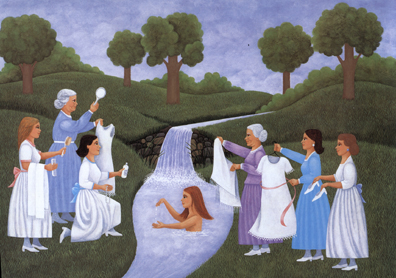

 The first time I entered into the mikveh, it felt as if my body was suspended in something extraordinary, primordial fluid, if you will. Every sense awoke. The water felt warm against my skin, like a comforting caress, and the gentle lapping sounds echoed against the walls and whooshed in my ears. Time became irrelevant when I held my breath, opened my eyes, and submitted to the experience.
It is with total reference when we say that Judaism’s ancient ritual – mikveh immersion – is both sacred and intimate, a rejuvenation of the heart, soul and body. But is it green?
What are mikvot used for? Most commonly, observant orthodox women go a specific number of days after the completion of menses. They’ve handled blood, and need to purify themselves in order to re-engage in sexual relations with their husbands.
It’s important to note that this cleansing is spiritual, not physical per se. The woman isn’t impure or dirty, although this information is often lost in translation. Perhaps this is one reason why submerging in these ritual baths became less desirable over the years for modern Jewish women.
Orthodox men have also traditionally gone before Shabbat or the High Holidays. The third most common reason is conversion: Mikvot are also used in the final stages of conversion to Judaism by most branches of Judaism (as in my case in 2007). Finally, it’s customary for Jewish brides and grooms to dip just before their marriage, regardless of how they adhere to Jewish teachings.
Nowadays, the list of reasons for submerging is taking on new twists as Jewish men and women from all walks of life and for many reasons are rediscovery the ancient ritual.
Rabbi Haviva Ner-David, the director of Sh’maya: A Spiritual, Educational and Religious Mikveh in the Galilee, has seen a growing interest from non-religious Jews in the symbolic experience: Bat mitzvoth, illness, divorce, bereavement, the birth of a baby, adoption, or even just curiosity – the list of reasons are as unique as the individuals seeking to experience it.
She now facilitates up to 200 emersions on a monthly basis for individuals, couples and groups at Sh’maya, the only pluralistic mikveh in Israel.
Every year, it is estimated that Jews visit the approximately 300 mikvot in Israel a total of 180,000 times. From a green love perspective, that’s a lot of eco-sensual ritualizing going on, using a resource we must steward with better care: water.
A certain amount of the water used to fill the mikveh must come from a natural, fresh source. Rainwater and the ocean will do. The rest can come from other sources, as long as the two flows intermingle. The dimensions, transport and immersion into the water are all determined based on ancient Jewish teachings.
Two green concerns present themselves at this point. What about the sanitation of the ritual purification baths? And what do we with all the gray water once it needs to be discarded?
The environmentally appropriate choice is recycling. Last year, greenprophet.com reported on the efforts of Shomera, an environmental organization in Jerusalem, to introduce these measures. As of this week, they haven’t responded to our requests to learn more about their initiatives, so we asked Rabbi Ner-David to comment on sanitation and recycling.
“That is a sticky point with me,” she confesses.
Most mikvot being used today don’t have grey water systems because at the time they were built, “most people (certainly the Israeli Rabbinate) did not think of this need.”
Nowadays, she says it is fair to assume that “mikvaot being built now that do incorporate a green approach.”
In the meantime, she’s working on obtaining grant funds to update Sh’maya in line with the principles of environmentalism.
As for sanitation, it turns out that ritual baths may purify the soul, but they often lack proper purification, although it is standard to have a water filter akin to what is used in swimming pools. “I change the water every month,” Rabbi Ner-David says, but “it is a huge waste of water.” Sh’maya recently got a donation to upgrade the filter system, “so hopefully soon we will be up to date ecologically.”
There is one line of thinking that a community is obligated to build a mikveh before a synagogue, so important is this ritual to ancient, and now a growing contingency, of modern Jews. Unfortunately, those ritual baths considered integral to our way of life are also draining a precious resource, and will continue to do so, until we turn those gray waters a proper shade of green.
More on green sexuality:
GM Foods Shrinking Sexual Health in a Womb Near You
When Females Rule Fornication, Mother Earth Delights
Are You An Eco-Sexual?
Shomera Aims to Save Mikveh Water




1. I think you meant “with total reverence”, otherwise your sentence doesn’t make sense.
2. Women do not go to the mikve because they’ve “handled blood”. The reason for going to the mikve is because the period represents the loss of potential life, a form of death, and immersion in the mikve spiritually cleanses from the contact with death.
3. Many men go to the mikve every day.
4. For more information on the meaning of the mikve see Rabbi Aryeh Kaplan’s “Waters of Eden”.
I think there are probably many different interpretations on the “why”, and that many sources should be consulted if someone is looking for this answer.