Israel Plans Wind-Powered Lighting for Coastal Highway, Takes Initial Step to Buttress Shoreline Cliffs

Israel's cabinet okays recommendations to combat cliff erosion

Israel’s cabinet has approved recommendations for preventing the further erosion of coastline cliffs.

The Israel National Roads Company  is preparing to publish tenders for the supply, installation and maintenance of wind turbines to generate electricity for highway lighting.

According to the Globes business daily, the CFO of Israel National Roads Co., Shay Yiftach, explained at a conference this week that small wind turbines could be installed on lighting poles on the coastal highway running along Israel’s Mediterranean coastline to exploit the sea winds.

The CEO of this government corporation, Alex Viznitzer, added: “We are initiating steps to integrate systems for producing renewable energy into the infrastructure of highways. Thousands of acres of available land at interchanges can be exploited for placing photovoltaic solar arrays. Many thousands of street lights can use wind turbines.”

The tenders are expected to be published after a survey is conducted to check the economic feasibility of potential sites, Globes reported.

Government seeks to shore up the shoreline

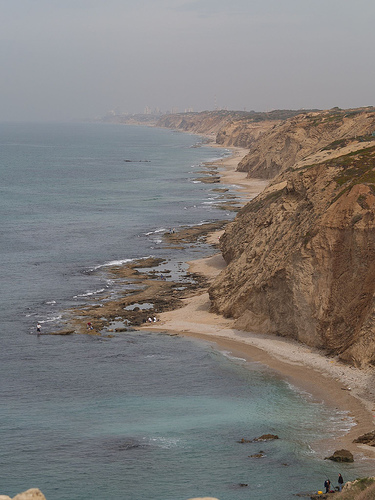
Meanwhile, the Israeli cabinet took initial action this week to prevent further erosion of shoreline cliffs along the Mediterranean, approving the principles of a policy paper prepared by the Environmental Policy Center at the Jerusalem Institute for Israel Studies and the Ministry of Environmental Protection.

The policy paper calls for an outlay of NIS 470 million to reinforce the cliffs over the next 20 years, the Haaretz daily reported. The cliffs have retreated a few dozen centimeters each year due to natural and human-induced erosion. The policy paper recommends physically reinforcing about 13 kilometers of the 45-kilometer stretch of cliffs, especially near Ashkelon and Herzliya.

Some of the alternatives for reinforcing the cliffs are already in place at the site of the Apollonia (Arsuf) Crusader fortress, about 15 kilometers north of Tel Aviv. However, environmentalists have complained that the work done at Apollonian ruined the beach at the foot of the cliffs.

The cabinet meeting this week included a discussion of the government’s responsibility for protecting endangered natural assets such as the shoreline cliffs. The attorney general argued that the state must take reasonable action to minimize such damage, but is not necessarily obliged to pay the costs.

Read more about wind power in Israel:

Can Israel’s Wind Power Sector Compete with Solar?

 Blower Fans in the Cow Shed Test Vertical Wind Turbines of Coriolis

:: Globes

:: Haaretz

Ira Moskowitz
Ira Moskowitzhttps://www.greenprophet.com/
When his kids were small, Ira would point to litter on the ground and tell them: “That makes me angry!” He still gets angry about pollution, waste and abusive treatment of our world, but is encouraged by the growing awareness of environmental issues and has been following the latest developments in cleantech with great interest. Ira grew up in the green hills of western Massachusetts and moved to Israel in the early 1980s after completing an MA in Middle Eastern Studies. He has worked as a software developer and journalist, and translates works of Hebrew fiction and non-fiction to English. Ira is trying to age gracefully, but refuses to surrender his youthful belief in the potential for change, including a collaborative future for the peoples of the Middle East. To contact Ira, email ira (at) greenprophet (dot) com.
1 COMMENT
  1. One of the most impressive things about Israel has always been the way that it has found creative solutions to difficult problems when it comes to agriculture, but it is really nice to see people turning their attention now to using technology to help improve and maintain Israel’s natural environment by finding new ways of reducing energy use and taking steps to help repair coastal erosion. I am a bit puzzled by the attorney general’s statement that the state is obliged to take action but not to fund the repairs to Israel’s coastline – perhaps there is room here for a partnership between the government and local businesses or non-profits. As for powering streetlights by using small wind turbines, I think this is a magnificent idea and if it proves to be a successful model other countries and the Middle East could adopt it as a way to help overall power consumption.

Comments are closed.

TRENDING

Should You Invest in the Private Market?

startustartup Unlike public stock exchanges, which offer daily trading, strict...

Eco organization offices destroyed by Iran missile

Tel Aviv's eco organization, the Heschel Center, was impacted by an Iranian missile.

What are AWG air-water generators, and why they aren’t a golden-bullet solution (yet)

Atmospheric water generators (AWGs) sound like magic: machines that can pull drinking water out of air. The idea is mentioned in the Bible, where the elders would pray for water collected as dew on plants and the catch on turning this into a machine is in the physics. To turn invisible vapor into liquid, you must remove heat, especially the latent heat of condensation.

Jordan’s $6 Billion Aqaba–Amman Desalination Project from the Red Sea Moves Forward

In 2025, the Jordanian government signed agreements with a consortium led by Meridiam and SUEZ, alongside VINCI Construction and Orascom Construction. Under a 30-year concession agreement, the consortium will design, build, finance, operate, and maintain the system before transferring it back to the Jordanian government. The total investment is estimated at approximately $6 billion USD.

The Saudi Startup Turning Desalination’s Toxic Waste Into Its Own Disinfectant

For millennia, the Middle East's water crisis seemed an immutable fact of geography — a region defined as much by what it lacked as by what lay beneath its sands. Today, a convergence of plummeting solar costs, advancing membrane technology, and hard-won engineering expertise is rewriting that story.

Should You Invest in the Private Market?

startustartup Unlike public stock exchanges, which offer daily trading, strict...

How to build a 100-year-company

Kongō Gumi is a Japanese construction company, purportedly founded in 578 A.D., making it the world's oldest documented company. What can we learn about building sustainable businesses from them?

From Pilot Plant to Global Stage: How Aduro Clean Technologies’ 2026 Expansion Signals a Turning Point for Chemical Recycling Investors Like Yazan Al Homsi

The company's Next Generation Process (NGP) Pilot Plant in London, Ontario, has officially moved into initial operating campaigns, generating the kind of structured, repeatable data that separates laboratory promise from commercial viability.

How AI Helps SaaS Companies Reduce Repetitive Customer Support Work

SaaS products are designed for large numbers of users with different levels of experience, and also in renewable energy.

Pulling Water from the Air

Faced with water shortage in Amman, Laurie digs up...

Turning Your Energy Consultancy into an LLC: 4 Legal Steps for Founders in Texas

If you are starting a renewable energy business in Texas, learn how to start an LLC by the books.

Tracking the Impacts of a Hydroelectric Dam Along the Tigris River

For the next two months, I'll be taking a break from my usual Green Prophet posts to report on a transnational environmental issue: the Ilısu Dam currently under construction in Turkey, and the ways it will transform life along the Tigris River.

6 Payment Processors With the Fastest Onboarding for SMBs

Get your SMB up and running fast with these 6 payment processors. Compare the quickest onboarding options to start accepting customer payments without delay.

Related Articles

Popular Categories