Want to speak “dolphin”?

Looks like Bill Murray and the crew from Steve Zissou: Denise Herzing and her team listening to dolphins

Is Anyone Listening? A Marine Biologist’s 40-Year Conversation with Dolphins

In 1985, marine biologist Denise Herzing set out on a six-week research trip to the Bahamas to study wild dolphins. Four decades later, she’s still there—immersed in what has become a lifelong effort to understand how dolphins communicate. Herzing’s new book, Is Anyone Listening? (University of Chicago Press, 2024), distills this remarkable journey and argues that it’s time we meet animals not just as research subjects, but as potential conversational partners.

Herzing’s work with Atlantic spotted dolphins (Stenella frontalis) through her nonprofit Wild Dolphin Project is among the longest continuous underwater studies of a single dolphin population in the world. She’s logged thousands of hours in the water and helped pioneer underwater keyboards and acoustic tools to investigate symbolic communication between humans and dolphins.
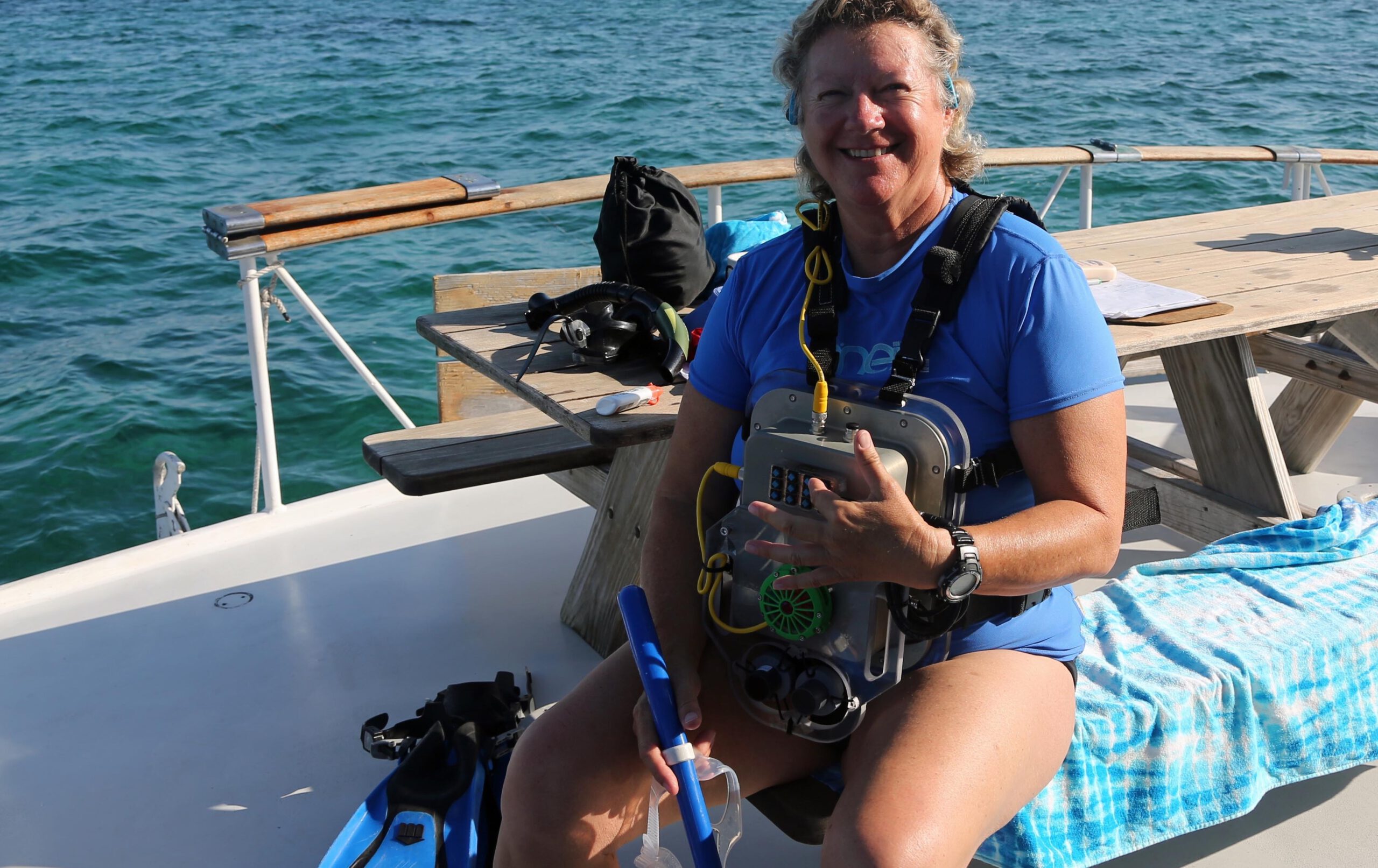
Life Aquatic
Life Aquatic with Denise

But not everyone is convinced the book qualifies as science. In a recent review for Nature, marine mammal expert Laela Sayigh praises Herzing’s “remarkable fieldwork” but warns that the book “lacks sufficient data and references,” leaving some claims unsubstantiated. “However, Herzing’s passion for nature and animals makes for a positive overarching message,” she writes.

Related: Saving Seychelles turtles – Jeanne Mortimer

Despite its speculative tone, the book opens important ethical questions: If animals are capable of language-like behavior, how should we interact with them?

Communication Underground, Underwater, and in the Canopy

Herzing’s work joins a growing body of research showing that non-human communication systems may be far more complex—and more meaningful—than once believed. At Green Prophet, we’ve followed this theme through the treetops, across deserts, and even underground.

Take frogs, for instance: scientists have shown that some species, like the red-eyed tree frog (Agalychnis callidryas), use seismic communication by shaking leaves beneath them to warn off predators or signal mates. These substrate-borne vibrations function like primitive Morse code, especially in low-visibility environments like rainforest understories.

And ants? Not to be outdone, recent soil science reveals how some tropical ant and termite species create micro-engineered soil structures, aiding water retention and plant growth. Their subterranean tunnel systems could inspire future architects and soil conservationists alike.

Even plants get in on the conversation. Some researchers suggest that root systems “communicate” chemically with fungi, triggering nutrient exchanges that resemble trading systems. Other researchers say they can pick up on the jabber. Whether we call it communication or co-evolution, it challenges long-held assumptions about intelligence.

While Is Anyone Listening? may not satisfy those looking for hard statistics, it’s a compelling read for anyone interested in the intersection of science, philosophy, and animal behavior. Herzing’s voice—at once personal, precise, and probing—asks us not just to decode dolphin sounds but to consider our role as co-inhabitants of a shared, noisy planet.

And with artificial intelligence now being deployed to analyze animal languages (see the CETI project on sperm whale communication), the field Herzing helped pioneer is more relevant than ever.

Read More

LEAVE A REPLY

Please enter your comment!
Please enter your name here

TRENDING

Econcrete makes built coastlines richer in marine life with new investment

    A decade ago, we met Shimrit Perkol-Finkel in a...

Fujitsu helps create a digital twin to save the sea

A new project in Spain shows how digital twins, which are virtual replicas of real environments, are becoming powerful tools for protecting ecosystems.

Mirai’s robots for the high seas can track polluters, pirates and saboteurs

Getting away with bad business at sea may soon be harder with Mirai Robotics on patrol.

Meet Andreas Weil, the founder of Israel’s EcoOcean, protecting the seas for all

A feature article interviewing Israel's leading marine conservationist, Andreas Weil. He founded EcoOcean and has enabled hundreds of thousands of people to learn about the ecological aspects of marine conservation. He also brought the concept of Blue Flag beaches to Israel.

They Call Her Madam Torti. She Might Be the Only One Who Can Save Seychelles Turtles

Sea turtle expert Dr. Jeanne Mortimer warns that unchecked development on Assomption Island threatens Seychelles' most critical nesting beach. With over four decades of research, Mortimer advocates for science-based, turtle-friendly development to protect endangered species. Her quiet, persistent work underscores the urgent need for conservation-led planning in fragile island ecosystems.

How to quiet noise from construction in your office

Streets need to be resurfaced in New York but the humming and grinding noise is unsettling. Noise is environmental pollution. 

EarthX and a blueprint for sustainable investing

Trammell S. Crow, a Dallas-based businessman and father of four, is focusing his efforts on impact investing, and media that focuses on saving the planet through EarthX.

Mining Afghanistan’s Mineral Discoveries Similar to Avatar

Now that American forces in Afghanistan are commemorating the longest period of any war that America has been involved in, including the 1965-73 Vietnam War, the recent discoveries of large and extremely valuable mineral and metal deposits may finally bring to light a reason to continue the presence of US fighting forces in this war torn and backward country.

From Pilot Plant to Global Stage: How Aduro Clean Technologies’ 2026 Expansion Signals a Turning Point for Chemical Recycling Investors Like Yazan Al Homsi

The company's Next Generation Process (NGP) Pilot Plant in London, Ontario, has officially moved into initial operating campaigns, generating the kind of structured, repeatable data that separates laboratory promise from commercial viability.

Nobul’s Regan McGee on Shareholder Value: “Complacency Is the Silent Killer” 

Why the governance framework designed to protect shareholders so...

Should You Invest in the Private Market?

startustartup Unlike public stock exchanges, which offer daily trading, strict...

How to build a 100-year-company

Kongō Gumi is a Japanese construction company, purportedly founded in 578 A.D., making it the world's oldest documented company. What can we learn about building sustainable businesses from them?

How AI Helps SaaS Companies Reduce Repetitive Customer Support Work

SaaS products are designed for large numbers of users with different levels of experience, and also in renewable energy.

Popular Categories