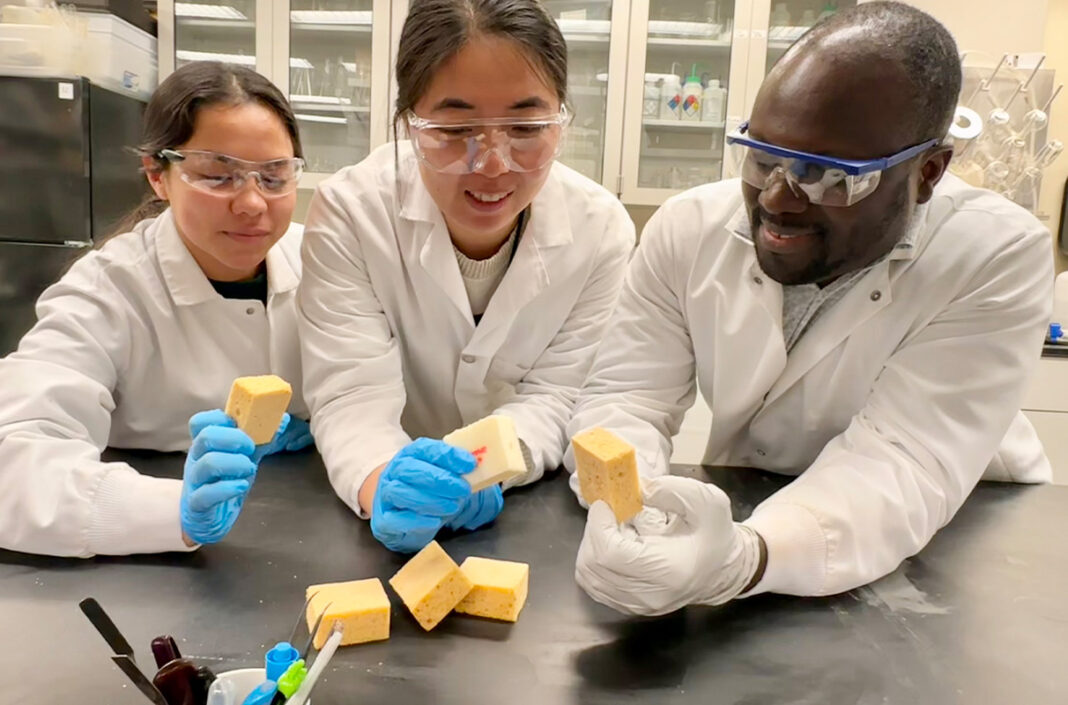


An environmentally-friendly preparation of plant material from pine could serve as a substitute for petroleum-based chemicals in polyurethane foams. The innovation could lead to more environmentally friendly versions of foams used ubiquitously in products such as kitchen sponges, foam cushions, coatings, adhesives, packaging and insulation.
The global market for polyurethane totaled more than $75 billion in 2022.
“It’s quite novel in terms of the material we generate and the process we have,” said Xiao Zhang from Washington State University. “Our extracted lignin offers a new class of renewable building blocks for the development of bio-based value-added products.”

Petroleum-based plastic materials are an increasing waste problem. They take centuries to break down, but they are expensive and difficult to recycle, most often producing an inferior second-generation product. Because it costs more to recycle than to generate new plastic, the plastics recycling rate has consistently stayed below 20%, said Zhang.
The research team used an environmentally-friendly preparation of lignin as a substitute for 20% of the fossil fuel-based chemicals in the foam. The bio-based foam was as strong and flexible as typical polyurethane foam. They report on their work in the journal, ACS Sustainable Chemistry and Engineering.
“It’s basically a no-win situation if you’re using petroleum-based plastics,” he said. “The ultimate solution is to replace them with naturally derived materials.”
Lignin is the second most abundant renewable carbon source, making up about 30% of the non-fossil fuel-based carbon on Earth, second to cellulose. It is the main component in wood. It is also notoriously difficult to extract from plants. The material is usually separated during papermaking and biorefining, but these processes often contaminate and significantly alter its chemical and physical properties, decreasing its value.
So most lignin is either burned to produce fuel and electricity or used in low-value products, such as for cement additives or as a binder in animal feed.

In their work, the researchers used a mild, environmentally friendly solvent to separate a high-quality lignin from pine. Compared to other lignin formulations, their formulation was homogenous with good thermal stability — similar to native lignin. The structural homogeneity is important in being able to produce high-value products.
When they tested their formulation, their product was stable and performed as well mechanically as the conventional foams.
“This work demonstrates that our prepared lignin formulation has a great potential for generating flexible, bio-based polyurethane foams,” said Zhang.