

The United Arab Emirates UAE-Caribbean Renewable Energy Fund (UAE-CREF) announced that the hurricane-resistant power project developed by Masdar for Antigua and Barbuda to withstand even the fiercest winds, is now operational.
In the wake of Hurricane Irma, which destroyed 95 percent of Barbuda on 6th September, 2017, and forced all 1,800 residents to be evacuated to Antigua, the climate-resistant plant is designed to survive 265 km-per-hour winds and provide a safe, reliable, and sustainable supply of electrical power for the island.
Some of Green Prophet’s family members were airlifted out of Dominica after a hurricane destroyed the island.
The hybrid solar, batteries, and back-up diesel project is already helping to support the twin-island nation’s objective of meeting 86 percent of its electricity sources from renewable energy by 2030. The Green Barbuda project was formally inaugurated at an event on the island of Barbuda by Gaston Browne, Prime Minister of Antigua and Barbuda, Hazza Ahmed Al Kaabi, UAE Ambassador to the Republic of Cuba, and Ambassador Brian Challenger from Ministry of Energy of Antigua and Barbuda, accompanied by a delegation from local and state entities.
Masdar developed and implemented the Green Barbuda project as part of its work under UAE-CREF, the largest renewable energy investment of its type in the region.

Fully financed by the Abu Dhabi Fund for Development (ADFD), the US$50 million UAE-CREF was launched at Abu Dhabi Sustainability Week 2017 as a partnership between the Ministry of Foreign Affairs (MoFA), ADFD and Masdar. New Zealand, Antigua and Barbuda and the CARICOM Development Fund (CDF) also provided funding for the project.
Mohamed Saif Al Suwaidi, Director-General of ADFD, said, “It is a landmark achievement for the UAE-CREF to have driven an energy transformation in Antigua and Barbuda at such a scale. The project took into consideration the country’s high dependence on fossil fuel imports for energy needs despite having the potential to exploit its solar, wind and geothermal power. This initiative highlights the extraordinary capability of clean energy to drive socioeconomic development. This is why ADFD is multiplying its effort to accelerate the energy transition in the developing world, as the UAE leads the way to a low-carbon and zero-emission future.”
Read Also: Masdar shows off smart city and smart irrigation
Renewable energy plays a key role in enhancing energy security within emerging markets, especially in small island countries that are vulnerable to the consequences of climate change.
The Prime Minister of Antigua and Barbuda, Gaston Browne, said, “The Government and people of Antigua and Barbuda are extremely appreciative of the assistance from the UAE in our efforts to achieve sustainable development. In that regard, the Green Barbuda electricity project has been a truly transformative one for Barbuda. It harnesses our indigenous renewable energy resources and has provided for the transfer of cutting-edge technologies as well as capacity building at the local level to manage the project.
The project supports Antigua and Barbuda’s efforts to reduce its dependence on costly and volatile imported petroleum fuels and to develop our own renewable energy resources. At the same time, it also enables us in both adapting to and mitigating the adverse impacts of climate change. We look forward to continuing to collaborate with the UAE and other partners in expanding this project as a showcase of sustainable energy in the Caribbean.”
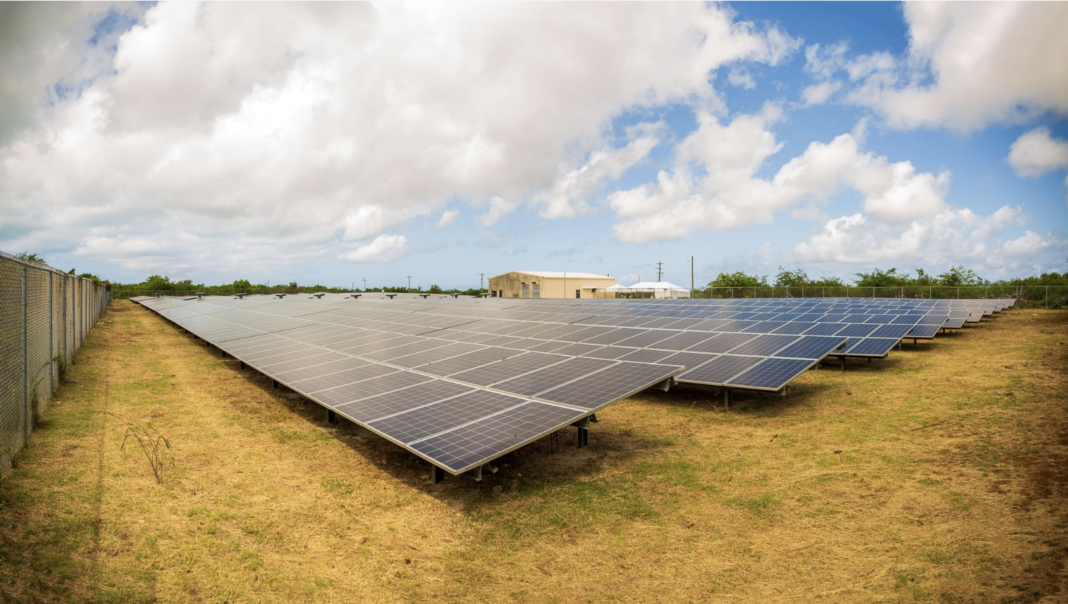
The project combines a hybrid solar photovoltaic (PV) plant, featuring 720 kilowatts-peak (kWp) of solar PV panels, connected to an 863 kilowatt-hour (kWh) battery, and capable of fully meeting the island’s current daytime energy demand. The plant will enable Barbuda to reduce annual diesel fuel consumption by 406,000 litres and cut carbon dioxide emissions by over 1 million kg.
The UAE-CREF initiative intends to deploy renewable energy projects in 16 Caribbean countries in three cycles to reduce energy costs, increase energy access, and enhance climate resilience.
Projects have already been successfully launched in the Bahamas, Barbados, and Saint Vincent and the Grenadines.
ADVERTISEMENT
Are you interested in sustainable investment and generational wealth? Green Prophet is working with 36North, an investment advisory in Canada on how to teach you how to build generational wealth. Email [email protected] for an introduction.