
Ancient Roman Facial Cream Found In London Excavation

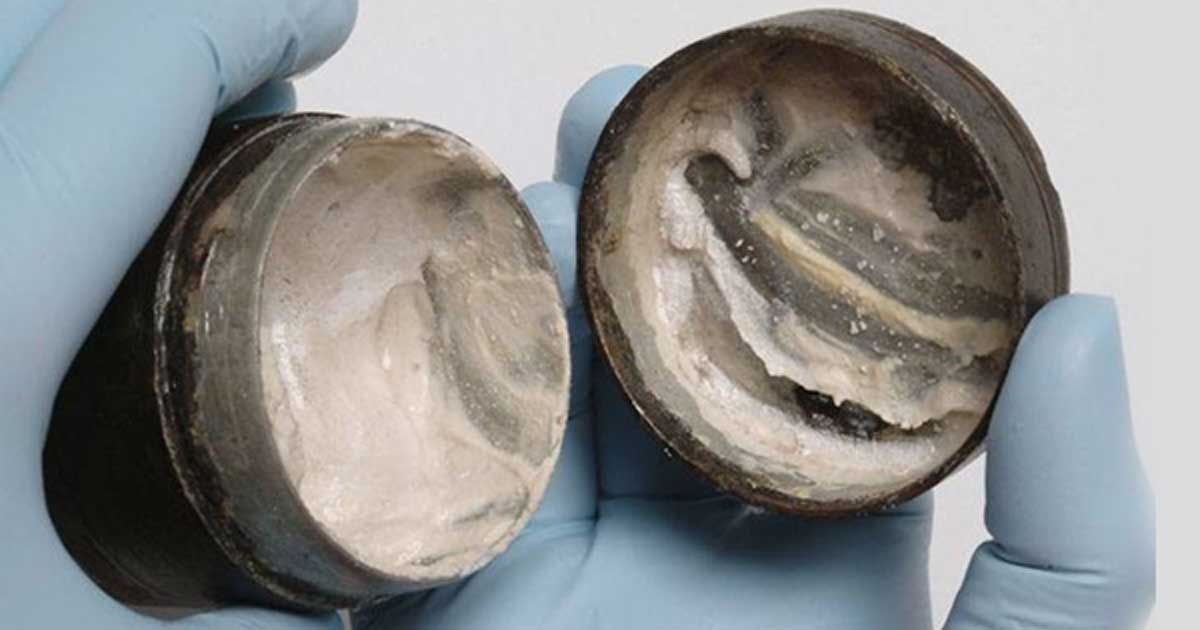
It was touching to see a picture of the finger imprints in the pot – fingers that scooped facial cream out of it 2000 years ago. You wonder, was the owner a wealthy woman with servants to dress her, and fix her hair? Maybe a high-class prostitute? Or just a woman of the middle classes who’d splurged on a fancy cream for once? 
ancient-roman-face-cream

The pot weathered two millennia with hardly any damage, an incredible find.  It was made of tin, considered a precious metal at the time. It was an expensive item, and the cream inside was likely the finest available. It must be said that when Liz Barham, curator at the Museum of London opened it, a powerful stench arose from the jar.

Hardly surprising. Cosmetic creams have always been formulated from fat, water, and something to blend the two. Today’s moisturizers are blended with fine vegetable oils, but in ancient Rome, it was animal fat, sometimes raw lanolin taken off sheep’s fleeces, and when they required something really fancy, gladiator’s sweat. Nothing likely to stay fragrant through the ages, although when fresh, it may have had rosewater added.

The tightly-sealed tin can was fished out of a ditch in Southwark, a busy London crossroads near the Thames. A Roman complex existed there that  housed two temples,  a hostel, an outdoor area that might have been used for mass worship, plinths for statues and a stone pillar. Given the religious character of the area, it’s easy to imagine  a scenario where a wealthy Roman and his wife or mistress went on pilgrimage, stayed at the guest house, and somehow mislaid the jar of cream. Maybe an envious servant stole it and stashed it in the ditch to come back for it later. The archaeologists who uncovered it say that it appears to have been deliberately hidden.

Federico Nappo, an expert on ancient Roman cosmetics of Pompeii, says, “It is likely that the cream contains animal fats. We know that the Romans used donkey’s milk as a treatment for the skin. However, it should not be very difficult to find out the cream’s composition.”

And indeed, the cream is undergoing scientific analysis today. We shouldn’t be startled if it was made of, among other things, oils of olive or almonds, honey, and perhaps fat taken from animals that had fought in the arena.

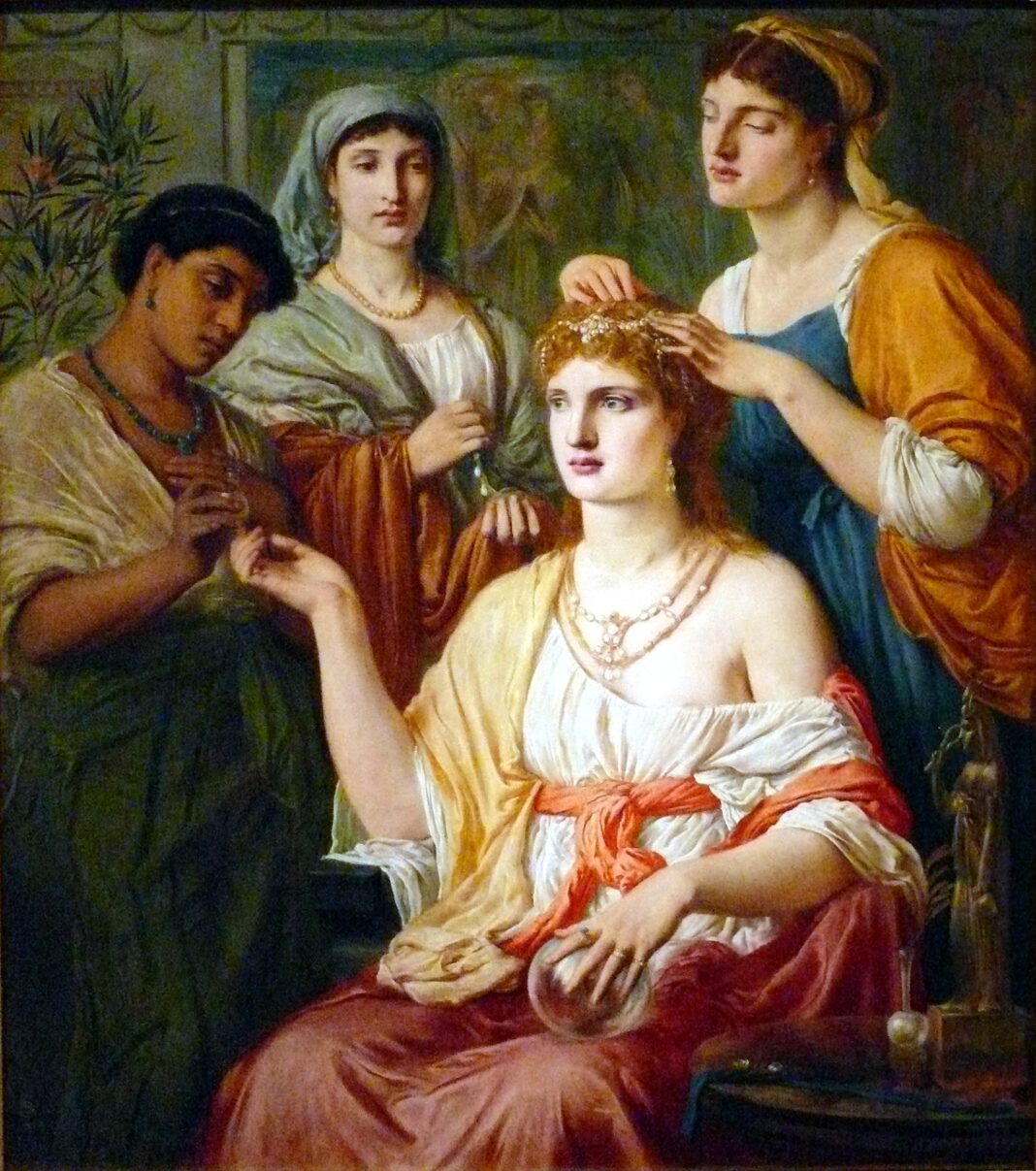
The well-brought-up Roman woman used kohl to outline her eyes, applied creams containing powdered lead to give their skin the treasured white hue, and rubbed perfume made from scented flowers macerated in oils. It was a delicate balance between looking good and looking too good to be respectable. Mummy portraits, pictures showing the deceased in life, show dramatically outlined eyes and brows, smooth skin free of freckles, and a demure expression.

ancient-roman-beauty

Philosophers of those times jeered at women who used cosmetics and perfumes, but the writer/poet Ovid wrote a long poem in favor of them, including five formulas for facial creams. Ovid’s moisturizers had innocuous ingredients such as barley, wild legumes, egg, powdered deer horn, spelt, and honey. “Any woman who uses this  on her face will shine smoother than her own mirror,” he wrote.

I’d be willing to try such a formula, if you can guarantee no animal fat, gladiator sweat, or another favorite ingredient – dung.

Miriam Kresh
Miriam Kreshhttps://www.greenprophet.com/
Miriam Kresh is an American ex-pat living in Israel. Her love of Middle Eastern food evolved from close friendships with enthusiastic Moroccan, Tunisian and Turkish home cooks. She owns too many cookbooks and is always planning the next meal. Miriam can be reached at miriam (at) greenprophet (dot) com.

Read More

LEAVE A REPLY

Please enter your comment!
Please enter your name here

TRENDING

The Textile Industry’s Dirty Secret: How Algaeing is Revolutionizing Sustainable Fashion

As consumers and brands alike search for sustainable alternatives, one company is leading the charge in transforming the dyeing industry—Algaeing. This innovative company harnesses the power of algae to create eco-friendly, biodegradable dyes, offering a groundbreaking solution to the toxic world of textile coloration.

12 Cosmetic Chemicals You Don’t Want to Touch

Beauty ads make a plethora of cosmetics virtually irresistible:...

Bedouin folk medicine by Miriam Aborkeek

I had the pleasure of meeting this enterprising Bedouin...

Bahrain’s Green Bar Offers Naturally Extravagant Fragrances

Green Bar makes local, natural beauty products in an...

Gamila’s Secret is its Druize Soapmaker and her Galilean Roots

Israeli Druize, Gamila Hiar, uses local herbs grown in...

How to quiet noise from construction in your office

Streets need to be resurfaced in New York but the humming and grinding noise is unsettling. Noise is environmental pollution. 

EarthX and a blueprint for sustainable investing

Trammell S. Crow, a Dallas-based businessman and father of four, is focusing his efforts on impact investing, and media that focuses on saving the planet through EarthX.

Mining Afghanistan’s Mineral Discoveries Similar to Avatar

Now that American forces in Afghanistan are commemorating the longest period of any war that America has been involved in, including the 1965-73 Vietnam War, the recent discoveries of large and extremely valuable mineral and metal deposits may finally bring to light a reason to continue the presence of US fighting forces in this war torn and backward country.

From Pilot Plant to Global Stage: How Aduro Clean Technologies’ 2026 Expansion Signals a Turning Point for Chemical Recycling Investors Like Yazan Al Homsi

The company's Next Generation Process (NGP) Pilot Plant in London, Ontario, has officially moved into initial operating campaigns, generating the kind of structured, repeatable data that separates laboratory promise from commercial viability.

Nobul’s Regan McGee on Shareholder Value: “Complacency Is the Silent Killer” 

Why the governance framework designed to protect shareholders so...

Should You Invest in the Private Market?

startustartup Unlike public stock exchanges, which offer daily trading, strict...

How to build a 100-year-company

Kongō Gumi is a Japanese construction company, purportedly founded in 578 A.D., making it the world's oldest documented company. What can we learn about building sustainable businesses from them?

How AI Helps SaaS Companies Reduce Repetitive Customer Support Work

SaaS products are designed for large numbers of users with different levels of experience, and also in renewable energy.

Popular Categories