Global warming and climate change weather patterns which may be causing monster hurricanes and typhoons are more than ever being brought to our attention as the dire results continue to wreck havoc the world over. This year’s COP24 Climate Change Conference ,being held in Katowice Poland, is bringing countries together again to try to find solutions to rising temperatures and severe weather patterns being caused by continuous dependence on fossil fuels and other human-caused factors.
One under-looked cause, now being considered as no less critical than fossil fuels, is beef and dairy cow farming; especially in affluent countries like Australia, the UK and the USA. Increasing fondness for beef in the USA, for example, is raising levels of Carbon Dioxide (CO2) and Hydrogen Peroxide (H2O2) in the atmosphere as high as the use of fossil fuels. This increase is being caused largely by a very important natural phenomena: cows fart.
The unique food digestion process of a cow’s 4 chambered ruminant stomach actually ferments the cellular plant material it eats creating methane and other gas, including nitrogen and carbon dioxide. These gases are released from both the animal’s mouth during digestion when it chews its”cud”; and afterwards expelled in even larger amounts from the large intestine and anus, causing the flatulence or farts. In a way, you might consider this process as similar to a biogas manufacturing process. So much of this natural biogas is created during the digestion process that scientists now say that the amount involved to create just 225 grams of beef releases as much biogas into the air as the exhaust from 55 cars! The released biogas is now considered to be a definite contributor to the “greenhouse effect” that causes global warming.
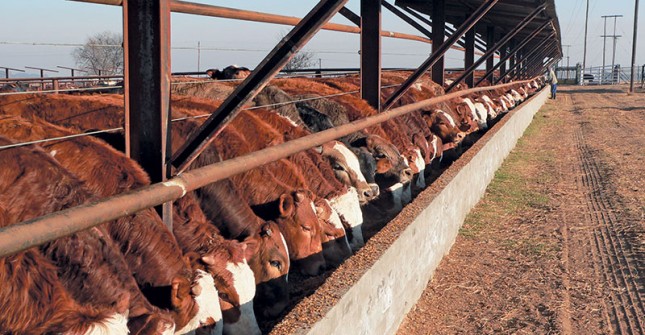
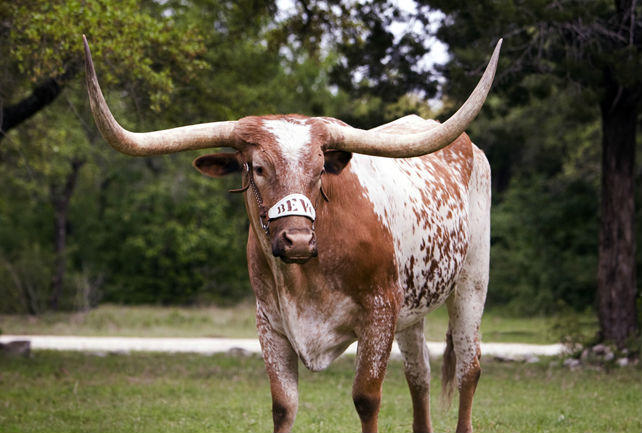
A recent program produced on CNN points this out more dramatically by illustrating the cattle farming industry in the American state of Texas, which has the distinction of being the USA’s top beef producing state. The program showed how cattle are raised there in giant feed lots and idolized by a college football team with its Big Bevo mascot: a giant longhorn steer. This particular species of cattle was once the State of Texas’ prime beef producing animal; and idolized as a colorful part of the Old West when massive herds of cattle were driven hundreds of miles overland to livestock markets in Kansas. There, they would then be shipped by rail to meat processing centers in Chicago and other locations.
According to the CNN featured program, cattle emit 10 times more greenhouse gases than other food mammals like pigs and chickens.
American fondness for beef remains high, however. Reducing the greenhouse gases emitted by cattle is now considered to be a primary objective to keeping the level of global warming within the 1.5 degrees C goal of the COP 24 conference. If the global temperature levels
exceed this threshold, catastrophic consequences to the earth’s environment will occur. Alternatives to naturally grown beef are currently being developed by scientists like Dr. Mark Post, one of the first innovators of laboratory produced “macro meat”. Dr. Post says that producing synthetic meat from stem cells may one day be commercially feasible and will be able to help satisfy people’s desire for beef, while dramatically reducing the amount of greenhouse gasses now being emitted by cattle.
It’s not just beef producing cattle that are causing the greenhouse gas problem, however. large dairy cattle herds also emit the same greenhouse gases as beef cattle. With this in mind, the only plausible solution will be less production of dairy products from cow’s milk, which will be much harder for most people to accept, myself included.
More articles on global warming and climate change:
Champagne production threatened in climate change
We need courage, not hope, to face climate change
Are monster hurricanes and typhoon fueled by global warming?
Photo of beef cattle feedlot by Farmers Weekly; Photo of Big Bevo longhorn University of Texas