Istanbul Considers 3rd Bridge Over Bosphorus

bosphorus-istanbul

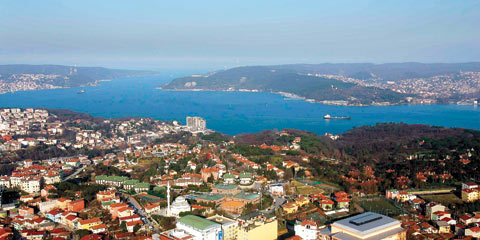
With one half in Asia and the other in Europe, the cultural hub of Turkey has long depended on two bridges to link the city over the Bosphorus Straits (above).  But a proposed third one has raised the ire of environmentalists who say it will damage the city’s forests and water resources, reports the English-language Turkish paper Today’s Zaman.

Supporters of the new bridge say it will make Turkey an important transportation corridor. They point to other highways that have crossed the three largest water reservoirs of Istanbul as evidence that mega infrastructure projects can be built safely. Cahit Turan, general director of public highways in Ankara, told Zaman:

“The important part of the project is preventing the construction on the direction of the third bridge. To discourage new buildings around the route, there will be a few necessary connection points from the main road to the city and these connections will not be throughout the forests but to already populated areas like Ümraniye and Beykoz.”

Turkey has made GP headlines recently for good and bad green news. On the one hand, the World Bank is funding an alternative energy scheme across the country, and farmers are cutting dangerous pesticides out of their crop schedule. On the other, Ankara just announced plans to dam a pristine biosphere for energy production.

Opponents to the third bridge don’t trust the government to prevent suburban villa neighborhoods from cropping up in the forests on the Asian side of Istanbul, which will be especially attractive once a bridge links them to the center of town. Ankara urban planner Tarık Şengül said there are other ways of improving Istanbul’s traffic, and that no scientists were consulted about the ecological footprint of the project. As he told Zaman:

“We’ve already seen the same story unfold for the first and second bridges. All of the areas around the routes of the bridges were opened to construction, which resulted in the destruction of forests along the Bosphorus.”

But the Environmental Ministry has said the bridge will not damage the forests.

Istanbul’s first two bridges were completed in 1973 and 1988.

:: (Photo from Zaman)

Daniella Cheslow
Daniella Cheslowhttp://www.greenprophet.com
Daniella Cheslow grew up in a car-dependent suburb in New Jersey, where she noticed strip malls and Wal-Marts slowly replacing farmland. Her introduction to nature came through hiking trips in Israel. As a counselor for a freshman backpacking program at Northwestern University, Daniella noticed that Americans outdoors seemed to need to arm themselves with performance clothing, specialized water bottles and sophisticated camping silverware. This made her think about how to interact with and enjoy nature simply. This year, Daniella is getting a Master’s in Geography from Ben Gurion University of the Negev. She also freelance writes, photographs and podcasts. In her free time, she takes day trips in the desert, drops off compost and cooks local foods like stuffed zucchini, kubbeh and majadara. Daniella gets her peak oil anxiety from James Howard Kunstler and her organic food dreams from Michael Pollan. Read more at her blog, TheTruthHerzl.com. Daniella can be reached at daniella (at) greenprophet (dot) com.

Read More

2 COMMENTS

LEAVE A REPLY

Please enter your comment!
Please enter your name here

TRENDING

Abortion Pills, Plan B and Mifepristone and what the new US mail ban means

Abortion pills, often confused with Plan B (the morning-after pill), and historically referred to as RU486 (mifepristone), are part of a broader category of reproductive health medications that women have been using for decades. But they are not the same thing.

Hormuz 2026 Conflict Poses an Energy and Food Security Dilemma in a Warming World

As tensions rise in one of the world’s most critical maritime chokepoints, the ripple effects go far beyond oil—touching food systems, climate pressures, and regional stability

Baby teeth read like tree rings paint a picture of toxins in early life

A new study from the Icahn School of Medicine at Mount Sinai in New York offers a striking insight into how the environments we are born into can quietly shape our brains years later. By analyzing naturally shed baby teeth, the ones tucked under pillows for the tooth fairy, researchers have reconstructed a detailed timeline of exposure to environmental metals during pregnancy and early infancy.

Poop in the East River shows the city’s rat problem and what people like to eat

New York ecology and health can be monitored by a jug of water a week.

Saving Gourmet Wild Plants For The Future

Think of truffles, a gourmet wild food. The European...

How to quiet noise from construction in your office

Streets need to be resurfaced in New York but the humming and grinding noise is unsettling. Noise is environmental pollution. 

EarthX and a blueprint for sustainable investing

Trammell S. Crow, a Dallas-based businessman and father of four, is focusing his efforts on impact investing, and media that focuses on saving the planet through EarthX.

Mining Afghanistan’s Mineral Discoveries Similar to Avatar

Now that American forces in Afghanistan are commemorating the longest period of any war that America has been involved in, including the 1965-73 Vietnam War, the recent discoveries of large and extremely valuable mineral and metal deposits may finally bring to light a reason to continue the presence of US fighting forces in this war torn and backward country.

From Pilot Plant to Global Stage: How Aduro Clean Technologies’ 2026 Expansion Signals a Turning Point for Chemical Recycling Investors Like Yazan Al Homsi

The company's Next Generation Process (NGP) Pilot Plant in London, Ontario, has officially moved into initial operating campaigns, generating the kind of structured, repeatable data that separates laboratory promise from commercial viability.

Nobul’s Regan McGee on Shareholder Value: “Complacency Is the Silent Killer” 

Why the governance framework designed to protect shareholders so...

Should You Invest in the Private Market?

startustartup Unlike public stock exchanges, which offer daily trading, strict...

How to build a 100-year-company

Kongō Gumi is a Japanese construction company, purportedly founded in 578 A.D., making it the world's oldest documented company. What can we learn about building sustainable businesses from them?

How AI Helps SaaS Companies Reduce Repetitive Customer Support Work

SaaS products are designed for large numbers of users with different levels of experience, and also in renewable energy.

Popular Categories