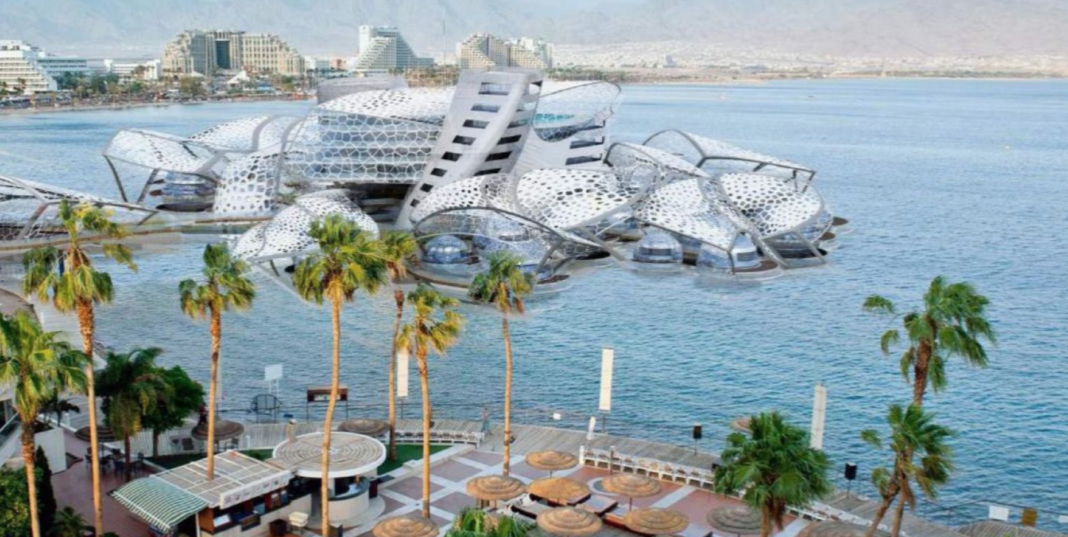

 Fifteen years ago the coral reef was still healthy in the Red Sea city of Eilat. I’d swim and snorkel there hand in hand with my love S. There were even wild dolphins swimming freely to their sanctuary around ships passing through the port city connecting Israel’s southernmost city to the Indian Ocean. But local news reports that the now maligned port area of Eilat – the coral reefs have crashed, the dolphins are fenced in for protection from the shipping industry and speedboats –– is expecting a new Disney-style hotel, an underwater hotel proposed by local developers from the Alon Group, and envisioned by Daniel Libeskind, the architect behind the 9/11 Memorial Museum and the Jewish Museum in Berlin.
Environmentalists fear the worst for the already devastated coral reef and marine life in the area of the Red Sea shore. Prof. Amatzia Genin, from the Interuniversity Institute for Marine Sciences in Eilat (I’ve had a great pleasure in visiting), told Haaretz: “It’s daylight robbery. It’s currently a beach that’s open to the public and they’ll turn it into a closed space. Ecologically speaking, it’s the destruction of the reef. Plain and simple.”
The city of Eilat has been known for accepting surreal tourism projects, and this is just the latest we hope will just die out as a dream. Think about the following: the Kings City biblical theme park is closed, an underwater restaurant was built and then sank, the IMAX cinema is now closed.

Really the only things worth doing in Eilat today are nature-related or anthropological: watch the worst of Israel conglomerate, eat and scream on the beach (yeah, I’ve been part of the milieu), around pools or on the boardwalk; or get out of the city for a nature tour on a Jeep or by foot. I’ve hiked into Eilat with my dog. It was way too hot and dry. I’ve tried to sleep on the beach. Too noisy from the trance parties. I’ve rented hotels and have attempted family holidays there. The only thing good about Eilat is that it’s on the way to Sinai. There is one beach, part of the nature preserve, close to the Sinai border, worth visiting.
The pink, mauve and purple mountains around the region are worth exploring and knowing. But you need a guide and a 4X4.

The city, founded in 1951, was once freshly populated by Israeli criminals given an option: move to Eilat or stay in jail. Today Eilat offers a getaway for budget-minded tourists and local Israelis. It’s hard for me to stay in Eilat without feeling depressed. The hotels along the strip are loud, dirty and rude, with no trace of professionalism; anything that could be good about it gets suffocated by the noisy people, never-ending breakfast and dinner buffets where every dish looks different but tastes the same; the endless stands of trinkets and stuff that you should never buy. Clearly I am not a fan of Eilat. The best the city could do is encourage hiking trails for early morning and late afternoon adventurers, and work harder to protect visitors from noise and people pollution. Of course it should not build an underwater hotel.
And to be positive, of course there were strong and important politically-minded motives for having a population of people down at the point of Israel where Jordan meets Saudi Arabia, meets Egypt. And of course if you add up all those reasons why Israel needs to protect itself from below, Eilat has all the reasons in the world as to why it should exist.
But to make it attractive, and forward-thinking and to feed its 80 percent of the economy that depends on tourism, Eilat needs a game plan, not a maniacal plan to ruin little of what’s left of its environmental treasures and public access to those treasures. I’d visit Eilat if it felt like Cannes. Even if it felt more cosmopolitan like Tel Aviv. Come on people of Israel. Come on Daniel Libeskind. You can do better.