


Aleph Farms creates non-GMO, slaughter-free steak by cultivating and replicating bovine cells in the lab. The company has started building its BioFarm and blueprints for a farm on Mars.
Aleph Farms, a company that really has nothing to do with farms, is heading towards selling thin steaks made in a lab. The company based in Israel has started to build facilities called the BioFarm to mass produce steak made from cow cells. The idea is to create meat that is exactly like cow flesh, without causing additional animal suffering. And greenhouse gases.
Taking a cue from my startup flux that launched a sneaky plan to grow cannabis in space (one of Aleph’s investors from Strauss was at my event a few years ago), Aleph also plans to create a meat lab for Mars. Cute renderings below.

(Sidenote: if you are interested in Mars contact my buddy Vera in California).
Not sure how vegans will react to this development of meat in the lab and on space when we have so much to deal with at home on Earth but one vegan dog- and chicken-sitter we had agreed to eat our chickens eggs because of how they were raised. Freely and in the sunshine. So there are exceptions and concessions to be made among vegans.
According to Aleph the steaks are grown from non-GMO cells of a living cow, and they taste, look and smell like meat. The company wants to create a terroir experience, eventually.
The prototype of its commercial product was shown in Singapore this weekend as part of a virtual cooking demonstration. The company “beefed-up” its proof-of-concept from 2018, increased the size of its slaughter-free product, and adapted it to fit controlled, automated machines to fit large scale production and economics.
“One of the big challenges of cultivated meat is the ability to produce large quantities efficiently at a cost that can compete with conventional meat industry pricing, without compromising on quality,” says Didier Toubia, Co-Founder and CEO of Aleph Farms.

How to do meat cultivation in the lab?
Aleph Farms mirrors the natural process of tissue regeneration processes that occur in the cow’s body, but outside of it and under controlled conditions. The process is designed to use a fraction of the resources required for raising an entire animal for meat, and without antibiotics.
To successfully grow whole pieces of meat, compared to minced meat, Aleph mimics the extra-cellular matrix found in animals with a plant-based matrix that enables the cells to grow and form structured tissues of meat.
These ‘cell-banks’ as they call them yield an unlimited source of pluripotent, non-GMO cow cells’ for growing large quantities of meat without the dependency on living animals.
Aleph Farms has designed comfy lab conditions to simulate the biological process occurring in vivo (in the body of a cow), providing the warmth and basic animal-free elements needed to build tissue in nature.

This includes water, proteins, carbohydrates, fats, vitamins, and minerals.
“It’s delicious and guilt-free, I can’t taste the difference,” declares Benjamin Netanyahu, Prime Minister of Israel at a recent tasting. “I have directed the State Secretary Tzahi Braverman to appoint a body to serve these
industries in order to connect and oversee all the stakeholders operating in this field. Israel will become a powerhouse for alternative meat and alternative protein.”
The next step seems to be recreating the terroir of single cows, and I think the Jewish grandmother I never had would say oy ve: “Meat can be cultivated from cells isolated from different animal breeds, have different cuts, and it elicits different emotions.
“We see Aleph Farms as crafters of experiences.” Toubia notes in a company press release.
But we need real animals
When it comes to lab-grown meat, plant-grown meat like Impossible Foods, or just any old lab meat (meat glue?) environmentalists will raise eyebrows. The general feeling is that if you want meat, eat organic, or responsibly, hunt your own meat if you live in Canada (and have tags to do so), and eat simply. Eat whole foods. The less a product is processed or manipulated it’s likely better off for you. And for the planet.
We got to a bad place fast because of fast food. Slow Food and fresh food can help us rewind. Growing meat in a lab is much like growing food using hydroponics (see Infarm). It’s a good solution for the interim (as we flail and people starve in some parts of the world) but where we need to go fast is to regenerative agriculture, biodynamic agriculture where all the parts feed into the whole. Mars is a nice story but I will stay on Earth, thank you.
Also adherents to regenerative agriculture like Woody Harrelson and Kiss the Ground are pretty certain about the importance of farm animals in the food chain for helping steward sensibly-sized farms into being sustainable and successful. Grazing animals fertilize the land faster and better than a plant-based compost. Because no one wants to use Miracle Gro, sourced from the chemical industry, on the garden unless they have no choice.
Have you thought about composting on Mars?
Tim Anderson, a technologist who may have spent some years “sleeping at MIT” and who may have been a founder at Z Corp believes that animals are an important part of our human story. And how we protect not only our own internal biome but the landscape and culture. He popped up on my Facebook feed as a possible friend. I liked the picture of a chicken on his head. I too have taken pictures of myself with chickens, although much more coercively.
I saw pictures of his farm and he didn’t look like a typical farmer, so I asked about any ideas he might have worth sharing about the process, the mission.
Consider the constant wildfires in California, he said.
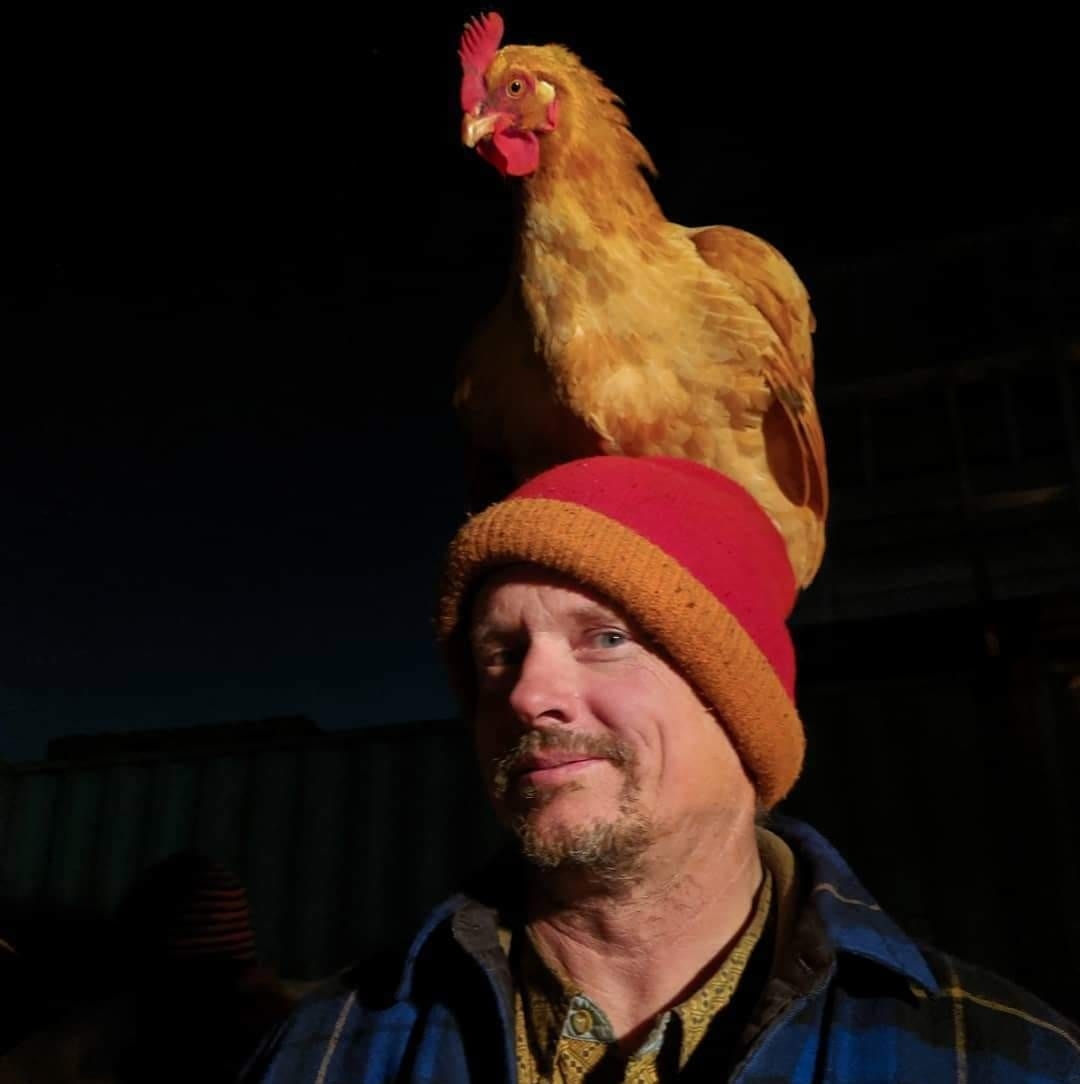
“Help California bring back the grazing animals. Those plants evolved to be eaten not just burned!” he wrote to me.
I’d heard that message before. That wildfires are more frequent and intense because land stewardship has changed radically in the last 100 years. Read this block of “why” information from University of California if it interests you.
Livestock grazing reduces fire fuels more effectively than most mechanical methods. Grassland not grazed creates high levels of fine fire fuels which can pose fire hazards. In addition, the invasion of ungrazed lands by shrubs also creates long-term fire fuel issues.
Increased shrub cover from removal of grazing has caused “a general increase in fire hazard within the open spaces of the San Francisco Bay Area” and in the context of the landscape matrix as a whole, this increased hazard indicates a greater possibility of fire being spread into adjacent forested areas and residential communities.
Using livestock to treat fuels has significant potential for managing combustible vegetation.
Anderson tells me to take a look at pictures of his pigs in California and how they live for more insight into my questions.

“Most of what humans do is ridiculous to everyone but them,” Anderson writes. “Tunnel vision makes many odd thoughts and behaviors possible. Presumably on Mars there would be nutrient cycling just like on Earth, but much more obvious.
“We Turn Sewage into Meat in a Lab” would be an exciting slogan for many people, but many more would find it disturbing. There would be a compost pile on Mars. Maybe with worms and bugs in it. Mice and rats would get there of course, maybe on the first ships. So the vegan factory would be full of mouse traps and a compost tumbler that kill mice and worms as part of making meat that doesn’t kill cows,” Anderson offers as strange, but 100% sensible food for thought.
Our great “elder” commenter, Pablo Solomon, environmental activist and artist always weighs in with a dose of much needed sensibility. From his ranch in Texas, Solomon writes:

“Okay, I admit I love beef. My mother’s side of the family have been ranchers for over 170 years here in Texas. I own a ranch now and once owned another. A well managed ranch is great for protein production, fibers for cloth, milk, cheeses, leathers and numerous other natural, sustainable products,” Solomon explains.
(We’ve been enjoying a weekly exchange where he picks a story from my newsletter and then provides some nuggets of wisdom on the story.)
He continues: “In my part of Texas, ranchers rotate cattle, sheep and goats in the pastures as each animal group tends to enjoy different plants. So we are keeping the pastures cleaner and less susceptible to wildfires. The animals naturally fertilize the soil. And the green plants absorb the CO2 released by the animals and use it in photosynthesis.
“The alleged dangers to the atmosphere from methane are so overblown as to be comical. In fact, were vegans and vegetarians so concerned about animal produced methane they would kill fluffy and fido and all other non productive feel good pets before killing off wonderfully productive livestock. And, the vegans eating so much vegetable matter to get enough nourishment creates relatively more human methane. Many ranch operators collect methane and use it to generate electricity. Many prominent vegans only use electricity.
“And of course, I have preached for decades about the “sin” of wasting our research minds and money on nerd toy crap like trips to Mars and driverless cars when immediate problems like providing clean water for humans and fresh water for agriculture remain unsolved.
“As far as “terrified” cows being killed, what a joke. Cows are killed so fast they literally do not know what hit them–yes hit them. Goats and sheep do die terrifying and painful deaths from being killed by coyotes, wolves and other predators which are often protected by insanely broad laws. We use sheep dogs and burros to protect the animals, but the coyotes can often elude them. ( A few years ago, before we could eliminate one particularly vicious pack of coyotes they killed over 50 young lambs in less than a week.)
“The terror these meat haters should care about is that of human parents watching their children die slow horrible deaths from diseases carried in dirty water and/or starving to death due to lack of water for agriculture.
“If you wish to avoid meat in your diet that is your choice. Do not try to forbid the rest of us from enjoying what we want to eat.( what is that mantra?–my body my choice ). I could give a list of things some of the most prominent anti meat people should give up in their lives before meat.”


