

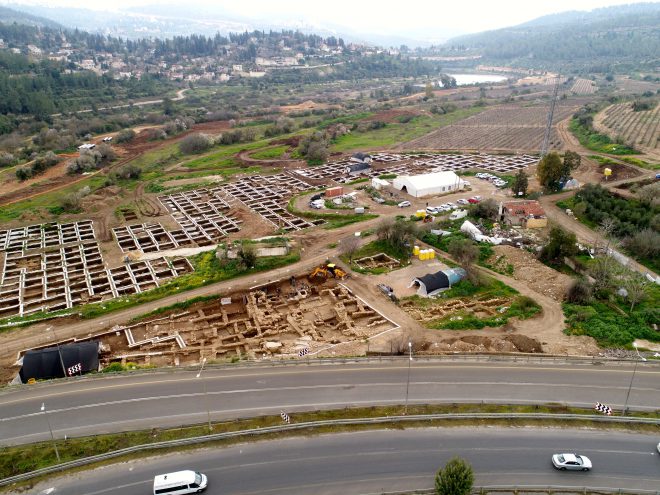
Enormous Neolithic Site Near Jerusalem Reveals 9000-Year-Old Secrets

neolithic site Jerusalem

Conventional thought among archaeologists was that Neolithic people didn’t settle in the area around the Judean Hills. Yet Motza, 5 kilometers west of Jerusalem, was always within easy distance of fresh water from the Sorek river, and near good agricultural ground. A trail coming from the southern foothills allowed access to traders and emigrants. All those were good reasons for past people to settle in the area.

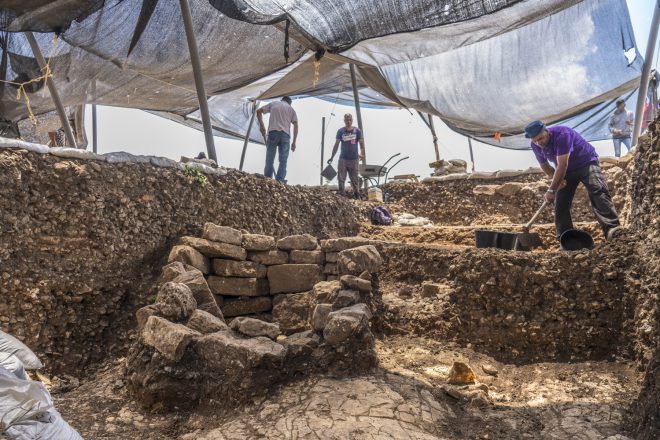
Recent excavations by the Israel Antiquities Authority at the Motza junction uncovered a huge settlement from the Neolithic Period (New Stone Age). It’s the largest known in Israel from that period, and one of the largest of its kind in the region. See also our post about the oldest-known bread, discovered in Jordan.

Dr. Hamoudi Khalaily and Dr. Jacob Vardi, Antiquities Authority excavation directors at Motza say,

“This is the first time that such a large-scale settlement from the Neolithic Period – 9,000 years ago – has been discovered in Israel. Until now, it was believed that the Judea area was empty, and that sites of that size existed only on the other bank of the Jordan river, or at the Northern Levant.”

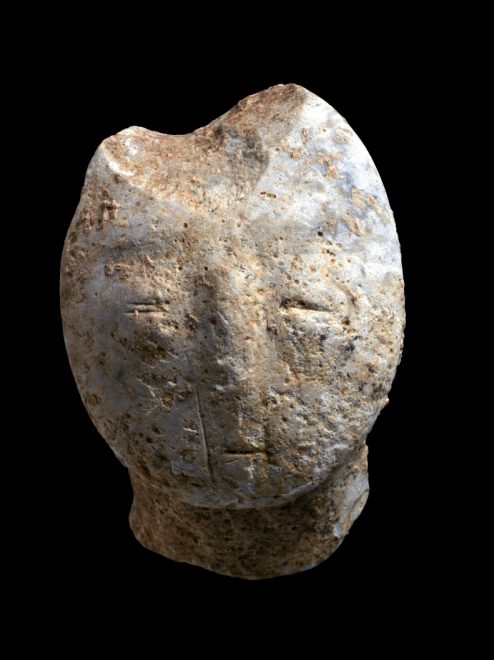
The researchers estimate that 2000-3000 people lived and worked in the area until now considered barren.  They excavated large buildings with alleys running between them, and found house spaces, storage sheds, public spaces, tombs,and places of worship. Uncovered burial offerings made of materials from Anatolian volcanic glass, and sea shells from the Red Sea and the Mediterranean Sea, show that the inhabitants traded with foreigners. Artistic figurines were found (presumably house idols).
Jewelry for everyday was also uncovered: bracelets and medallions made of alabaster beads and mother of pearl, and carefully crafted stone-bead bracelets for children to wear.
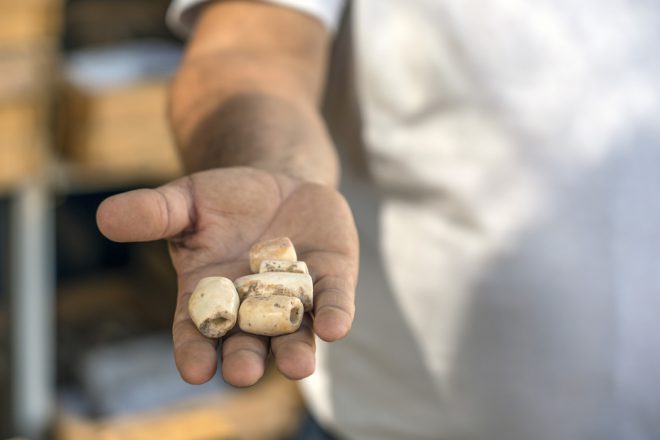
Neolithic jewelry

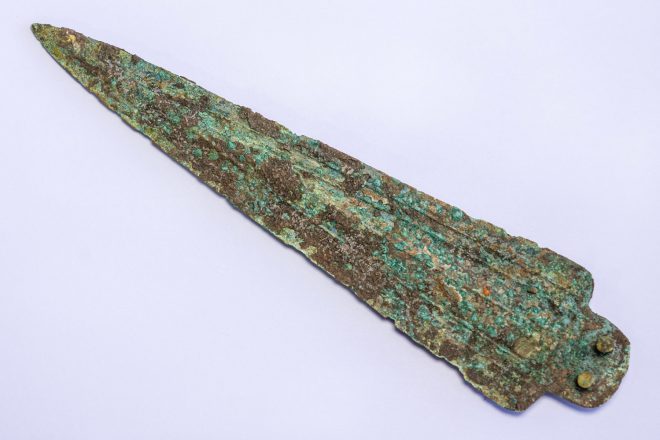
Judging from the thousands of flint arrowheads found, hunting was part of everyday subsistence, and warlike defense was well understood. The remains of axes, sickles and knives show that the inhabitants made and used tools for agriculture. Indeed, huge quantities of identifiable pulses, especially lentils, were found in the storage sheds. Yet it seems that the people of the settlement were turning away from hunting, as large quantities of sheep bones found indicate a preference for home-raised meat instead.
The excavations were initiated and financed by the Netivei Israel Company (the National Transport Infrastructure company), after the Highway 16 Project revealed archaeological remains. The project is constructing a new entrance road to Jerusalem from the west, connecting the National Highway 1 from the Motza area to the southern part of Jerusalem including two double tunnels. It is considered vital to access to Jerusalem.

Gilad Naor, Head of Projects Department at the Netivei Israel Company says, “It is a huge privilege for us, as the Israel National Transport Infrastructure Company, that tomorrow’s transportation infrastructure projects facilitate such special discoveries in the splendid history of our country.”

In preparation for the release of the excavated area, the entire site was documented using advanced 3D technology that will enable research of every detail digitally. A large part of the prehistoric site around the excavation will be preserved. In addition, there will be an exhibition showing the site’s history built by the Israel Antiquities Authority. At Tel Motza, adjacent to this excavation, archaeological remains are being preserved for the public. Conservation and accessibility works are underway in nearby Tel Bet Shemesh and Tel Yarmut.

Miriam Kresh
Miriam Kreshhttps://www.greenprophet.com/
Miriam Kresh is an American ex-pat living in Israel. Her love of Middle Eastern food evolved from close friendships with enthusiastic Moroccan, Tunisian and Turkish home cooks. She owns too many cookbooks and is always planning the next meal. Miriam can be reached at miriam (at) greenprophet (dot) com.

Read More

TRENDING

Iron age folks made tools from dead peoples’ bones

Scientists have uncovered evidence of an Iron Age funerary tradition involving the deliberate removal of human brains and the fashioning of long bones into sharp tools.

Ancient Clay Jug with Camel Art Unearthed in Israel’s Yatir Forest

The striking red-painted jug was found in a cave that had once been an underground olive press before being repurposed as a dwelling. Researchers believe the cave was in use during the Abbasid period (9th-10th centuries CE), when camels dominated trade routes, helping to move goods across vast distances.

Mysterious Minoan palace found on Greek island hilltop

Archaeologists have unearthed a unique and mysterious Minoan monument on a hilltop on the island of Crete and which is overlooking the newly planned airport, the Greek Culture Ministry announced recently. The new discovery in Crete may be legendary Minotaur labyrinth, from the time of King Minos.

Ancient mosque found in the Holy Land

A luxurious estate and a rare rural mosque – among the earliest known worldwide (over 1200 years old) - was recently discovered outside the Bedouin city of Rahat in the Negev Desert, Israel. 

Archeologists unearth ancient winery in Israel

Children and adults alike used to drink wine in the Holy Land and from this winery just unearthed in Yavne, that made at least half a million gallons of wine a year. 

Yerukim Forms a New Green Economy Where the Money is Really Green

The Yerukim members who pick up the recyclables get to keep the monetary reward, the public earns "green" bills that can be used in shops, and business owners get to be associated with environmentalism.

Choosing Riyadh over Dubai? What Investors Should Know

Saudi Arabia is deploying capital at unmatched scale to catalyze tourism and advanced industry while rewiring its power-and-water backbone. The investable frontier is widening—especially in renewables, grid storage, water efficiency/desal retrofits, and hospitality operating platforms. Prudent investors will insist on phased delivery, enforceable KPIs (energy, water, biodiversity), and RHQ/zone compliance—while pricing political-economy and reputational risks alongside growth upside.

Sell your cooking oil for biodiesel money

Want to make money on old french fry oil? Sell it.

Qatar Alternative Energy Summit Pairs Investors And Innovators

Alternative energy investors and innovators can meet n' greet in Doha, Qatar March 16 and 17.

Here’s How To Implement The Four Pillars Of Employee Engagement

If you throw a party for your work team and they are vegans, don't make it a barbecue. Know the sustainability values of your team to boost moral and retain good people.

Locals From Rishon Fight IKEA

Big Box stores are a pretty new concept in Israel, and thank God that not every Israeli city wants them in their backyard. A word from someone who has see the beautiful farmland around her hometown Newmarket, Ontario stripped and converted into vulgar strip malls of big box shops: they have no place in a healthy and sustainable town or city.

The Jewish National Fund Meets An Inconvenient Truth

According to the JNF, it has transformed thousands of acres of barren land into green forests in Israel. They state that each person emits about 23 tons of carbon per year, estimating that each tree planted can absorb one ton of carbon in its lifetime. That's a whole lot of trees you'd need to be planting. Could so many fit in Israel?

How to quiet noise from construction in your office

Streets need to be resurfaced in New York but the humming and grinding noise is unsettling. Noise is environmental pollution. 

Popular Categories