Renewable energy will triple in the Middle East, says Siemens

siemensA new report published by Siemens predicts that the share of renewables in the Middle East energy mix will triple over the next 17 years. That’s the good news.  The bad news is that natural gas will remain the dominant power source in the region.

Siemens, a German conglomerate and the largest industrial manufacturing company in Europe, predicts that by 2035, the Middle East power requirements will translate into 483 GW of power generation demand, an uptick of 277 GW from 2016 demand, and representative of an increase of more than triple from 5.6 percent (16.7 GW) in 2016 to 20.6 percent (100 GW) in 2035. (Siemens also operates a LEED Platinum headquarters in Masdar City.)

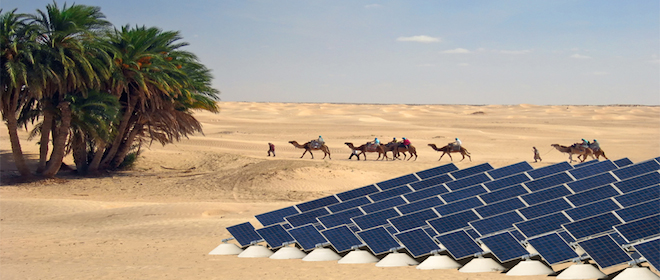
Solar power is forecast as accounting for approximately 61 GW of supply by 2035. The report highlights significant potential for wind power generation in Saudi Arabia and Egypt, but noted that this potential is not entirely reflected in the moderate capacity additions expected.

Mirroring the observations of industry experts, Siemens also noted that this means that reliable energy storage solutions and a stable and efficient grid is crucial. Dietmar Siersdorfer, Chief Executive Officer of Siemens Middle East and UAE told journalists at the Abu Dhabi Sustainability Week that the need to make grids smarter was “the most underestimated thing” in the global energy industry.

According to Siersdorfer, battery storage was sure to figure highly, and that hydrogen storage was a “holistic” solution. “You can build an eco-system for hydrogen”, he told Gulf Business, “This is because of its ability to act as a fuel for vehicles and also be utilized for other industries like petrochemicals.”

Although there will be a great rise of renewables in the Middle East, the report predicts that natural gas will still remain as the region’s primary power source, representing 60 percent of installed capacity through to 2035.

“A reliable, efficient, flexible and affordable power supply is the backbone of economic and social development in the Middle East,” said Siersdorfer. “While the energy mix will see significant diversification over the next 20 years, natural gas will remain the prime energy source for power generation in 2035.”

Baby steps towards a clean, green future.

Bhok Thompson
Bhok Thompsonhttp://www.greenprophet.com
Bhok Thompson is an “eco-tinkerer” who thrives at the intersection of sustainability, business, and cutting-edge technology. With a background in mechanical engineering and a deep fascination with renewable energy, Bhok has dedicated his career to developing innovative solutions that bridge environmental consciousness with profitability. A frequent contributor to Green Prophet, Bhok writes about futuristic green tech, urban sustainability, and the latest trends in eco-friendly startups. His passion for engineering meets his love for business as he mentors young entrepreneurs looking to create scalable, impact-driven companies. Beyond his work, Bhok is an avid collector of vintage mechanical watches, believing they represent an era of precision and craftsmanship that modern technology often overlooks. Reach out: [email protected]

Read More

TRENDING

Prologium files for IPO as solid-state battery race heats up beyond Tesla

The challenge has always been scaling production: Laboratory success does not automatically translate into mass manufacturing. Materials that perform well in testing often behave differently when produced in millions of cells. This has been one of the biggest obstacles facing the entire industry.

Alphabet buys Intersect Power for $4.5 Billion USD to sustainably power its AI infrastructure

That shift helps explain why Alphabet, Google’s parent company, has agreed to acquire American renewable energy company Intersect Power in a deal valued at roughly $4.75 billion. It’s a move that reflects a deeper change: technology companies are paying closer attention to the physical systems that support their growth. 

A Torus flywheel in the desert and a $200 Million Utah deal to reshape the grid

Utilities from New York to Ontario use flywheel farms to stabilize the grid when wind and solar fluctuate. In space, satellites use flywheel “reaction wheels” to orient themselves without fuel. Even race cars like Porsche hybrids have used flywheels for rapid energy recovery and boost. This is proven tech, now scaling to the grid.

Masdar City’s solar tree

Masdar City, an Abu Dhabi, UAE-based sustainability and innovation hub dedicated to making all cities a solution to climate change, has revealed a new installation called Solar Tree as its latest eco-friendly addition to its Eco Plaza.

Desalination investments from unlikely business partners

Just around the beginning of Covid something remarkable happened....

Yerukim Forms a New Green Economy Where the Money is Really Green

The Yerukim members who pick up the recyclables get to keep the monetary reward, the public earns "green" bills that can be used in shops, and business owners get to be associated with environmentalism.

Choosing Riyadh over Dubai? What Investors Should Know

Saudi Arabia is deploying capital at unmatched scale to catalyze tourism and advanced industry while rewiring its power-and-water backbone. The investable frontier is widening—especially in renewables, grid storage, water efficiency/desal retrofits, and hospitality operating platforms. Prudent investors will insist on phased delivery, enforceable KPIs (energy, water, biodiversity), and RHQ/zone compliance—while pricing political-economy and reputational risks alongside growth upside.

Sell your cooking oil for biodiesel money

Want to make money on old french fry oil? Sell it.

Qatar Alternative Energy Summit Pairs Investors And Innovators

Alternative energy investors and innovators can meet n' greet in Doha, Qatar March 16 and 17.

Here’s How To Implement The Four Pillars Of Employee Engagement

If you throw a party for your work team and they are vegans, don't make it a barbecue. Know the sustainability values of your team to boost moral and retain good people.

Locals From Rishon Fight IKEA

Big Box stores are a pretty new concept in Israel, and thank God that not every Israeli city wants them in their backyard. A word from someone who has see the beautiful farmland around her hometown Newmarket, Ontario stripped and converted into vulgar strip malls of big box shops: they have no place in a healthy and sustainable town or city.

The Jewish National Fund Meets An Inconvenient Truth

According to the JNF, it has transformed thousands of acres of barren land into green forests in Israel. They state that each person emits about 23 tons of carbon per year, estimating that each tree planted can absorb one ton of carbon in its lifetime. That's a whole lot of trees you'd need to be planting. Could so many fit in Israel?

How to quiet noise from construction in your office

Streets need to be resurfaced in New York but the humming and grinding noise is unsettling. Noise is environmental pollution. 

Popular Categories