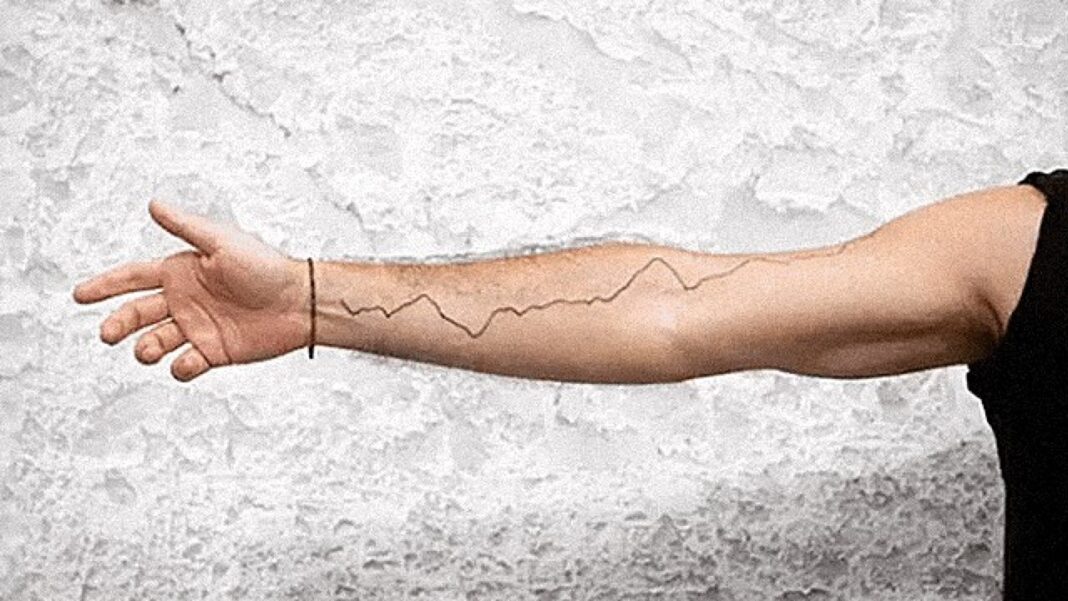

 Say hello to the “Anthropocene”, a new geological epoch brought about by humanity’s impact on planet Earth. A team of geologists say that ash from fossil fuels, plastic waste, rising seas (which are triggering a dramatic increase in upland erosion), and radioactive particles littered by nuclear bomb tests are all contributing to permanent changes in Earth’s rocks. Not necessarily something that warrants a party, people. But a New York City artist marked the event with a new tattoo.
Artist Justin Guariglia is obsessed with how people are changing the planet and his work explores contemporary debate about Earth’s future. His website states that his art bridges the gaps between “artistic production, technological imagination and the scientific reality under which we have lived since the 18th century”.
In a new partnership with the National Aeronautics and Space Administration (NASA), Guariglia works with NASA scientists to document the human on Earth’s land, water, air, and life systems. A recent expedition explored the melting glaciers of Greenland (below). Think that doesn’t affect us in the Middle East? Tuck into Green Prophet archives for a bit more on that.
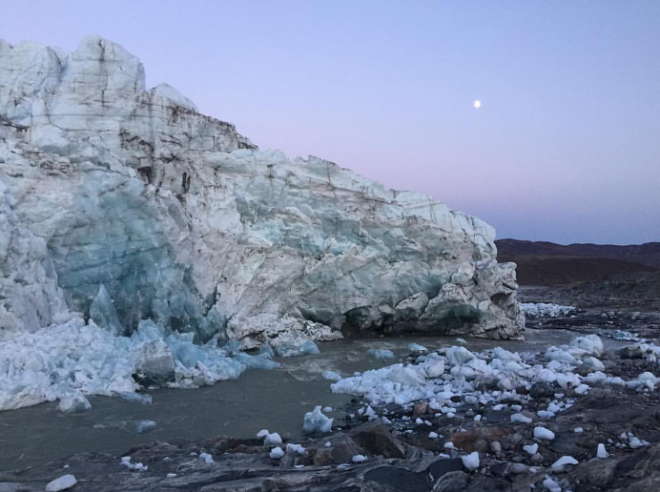
So the recent declaration by the International Geological Congress (IGC) that our planet has entered a new geological time scale was striking news to Guariglia.
A bit of backstory in in order. The IGC is an international working group that convenes every four years to assess big questions in geology, sponsored by the International Union of Geological Sciences, an non-governmental organization devoted to international cooperation in the field of geology.
This year’s congress concluded – by a vote of 34 to zero, with one abstention – that the Anthropocene is a geological reality, and it marks an end to the Holocene (Earth’s current epoch which began 12,000 years ago at the end of the last Ice Age). Scientists are now considering the exact demarcation point, likely to be pinned at the mid-20th century.
On the day the geologists made their announcement, Guariglia had the new tatt inked on his arm. The thin black line shows a running five year average of Earth’s surface temperature anomaly, from 1880 to 2016. Using NASA data, it illustrates how the planet’s deviates from historical averages, moving consistently upwards since 1970, the decade the artist was born. Climatologists have confirmed that last year was the hottest on record, and 2016 is already on track to be the hottest year ever on record, according to NASA officials.
Temperatures are rising at an accelerated scale today, with NASA data proving that every single month for the last 11 months has been “the warmest month ever” in the last 136 years.
“The tattoo was in commemoration of what the IGC had formalized,” he told Co.Exist. “It’s just another way I’m kind of reminding myself of this issue.” That day in August, as he was getting inked, Guariglia was disappointed that the public was not paying more attention to the International Geological Congress decision. It didn’t even make the New York Times, he says. “It should have been on the front page, the New York Times didn’t put it anywhere,” he says. “I was shocked.”
 The artist, who has collaborated with NASA since 2015, is preparing to embark on a new mission with the space agency. Named “Oceans Melting Greenland” (OMG for short), his goal is to bring public attention to the looming catastrophes caused by climate change. Follow his work via his website (link here).
Images from Justin Guariglia website