Garden of Eden’s Mesopotamian Marshlands in Iraq May Get An Eco Uplift

Mesopotamian Marshlands, UNESCO World Heritage Site, nature iraq, nature conservation in Ira, sustainable design, green designMiddle East architects Raya Ani and Zayad Motlib first told us about their plans for Mesopotamian Marshlands ecosystem and community earlier this year, and now they’re presenting their ideas to the first AIA Middle East conference in Dubai. 

Human settlement in the marshlands dates back to 5,000 years ago, with mostly Shia tribesmen and women but the Persian War destroyed the ecosystem.

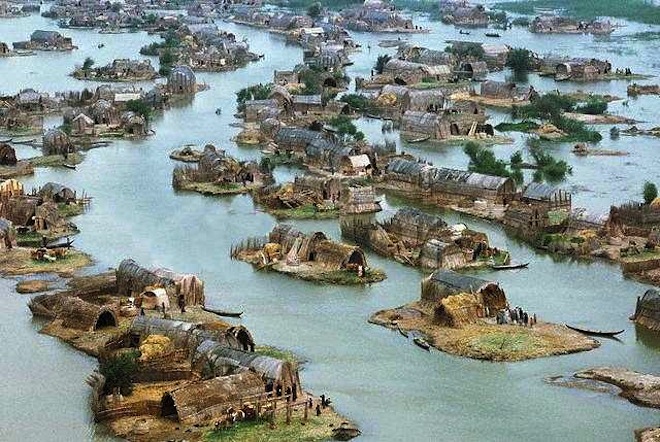
Recently named Iraq’s first national park, the Mesopotamian Marshlands in the south once comprised 8,800 square kilometers of permanent wetlands, and 20,000 square kilometers of marshlands when surrounding land became seasonally inundated.

As recently as 1991, up to 250,000 people lived in the marshlands, some of them in unique arched dwellings made of marsh reeds. Largely self-sufficient, the Ma’dan people mostly made their living on fishing and buffalo farming, and made crafts from cane – until the 1950s when Syria and Turkey started building dams.

But the biggest exodus took place following the Persian Gulf War. Saddam Hussein drained the marshlands and built giant canals, destroying the fragile ecosystem, and displacing hundreds of thousands of people.

The Mesopotamian Marshlands will never be what they used to be, but the husband and wife duo based in Dubai will explain to their peers at the AIA conference how they propose to help buttress efforts by local conservation groups such as Nature Iraq to revive what was once a thriving community.

Only they won’t rely on the same methods developed over hundreds of years to revive the marshlands; instead, Ani and Motlib will incorporate new strategies and technologies into their rehabilitation efforts.

“The vision is indicative of a shift from the traditional community structure to a sustainable, empowered community system,” the duo write in their AIA presentation brief.

Although they plan to maintain the region’s fishing and farming tradition, they also propose a system that not only produces wholesome organic food free of toxins and pesticides along with safe, potable water, but also generates renewable energy.

“It is conceived to inspire the indigenous people to be engaged in restoring their marsh environment while maintaining their traditions.”

While they are a bit shy to share specific details too soon and no renders have been made available yet, Ani and Motlib – both seasoned architects with international experience – will unveil their progressive design on November 20, 2013 at The Address Hotel in Dubai Mall from 2 pm to 3.

The Mesopotamian Marshlands is currently on UNESCO’s “tentative” world heritage site list, and the Middle East AIA chapter is the world’s second largest. So this is a big deal. Stop on by tomorrow for the full presentation if you are in Dubai and have the chance, and tell us about it if you do.

Raya Ani on Archinect, Zayad Motlib on Yatedo

Tafline Laylin
Tafline Laylinhttp://www.greenprophet.com
As a tour leader who led “eco-friendly” camping trips throughout North America, Tafline soon realized that she was instead leaving behind a trail of gas fumes, plastic bottles and Pringles. In fact, wherever she traveled – whether it was Viet Nam or South Africa or England – it became clear how inefficiently the mandate to re-think our consumer culture is reaching the general public. Born in Iran, raised in South Africa and the United States, she currently splits her time between Africa and the Middle East. Tafline can be reached at tafline (at) greenprophet (dot) com.

Read More

3 COMMENTS
  1. It looks like a Nirvana…and probably was until big government decided to ignore the environment and kowtow to big business.
    I would like to see the “progressive design” that was suggested at the conference. If they ended up with an safe environmental scheme, more power to them. We need people protecting people…..each other.
    Love Greenprophet site, it demolishes archetypes that we have created….thanks to bad press and government.

TRENDING

Self-repairing contact lenses and desalination membranes that fix themselves?

Could the humble contact lens become a sustainability breakthrough? Researchers in Korea have developed a self-healing hydrogel lens that repairs scratches with just one hour of UV light exposure. Beyond reducing waste from disposable contacts, the technology could one day help extend the life of solar panels, water filtration systems, and other plastic-based products.

Collecting kinetic energy from roads; REPS turns traffic into a power plant

REPS announced a $23.6M equity financing round to scale...

Baby teeth read like tree rings paint a picture of toxins in early life

A new study from the Icahn School of Medicine at Mount Sinai in New York offers a striking insight into how the environments we are born into can quietly shape our brains years later. By analyzing naturally shed baby teeth, the ones tucked under pillows for the tooth fairy, researchers have reconstructed a detailed timeline of exposure to environmental metals during pregnancy and early infancy.

Astro uses AI to help procure land for renewable energy

For oil-rich, environmentally vigilant Gulf states, Astro isn’t just another startup story. It is a blueprint for accelerating an energy transition that is now existential, not optional.

Make moss graffiti

Express your green views for all to see - right on the walls of your house, restaurant or office. Moss grafitti is the hottest trend in urban agriculture, after hydroponics and vertical farming.

Yerukim Forms a New Green Economy Where the Money is Really Green

The Yerukim members who pick up the recyclables get to keep the monetary reward, the public earns "green" bills that can be used in shops, and business owners get to be associated with environmentalism.

Choosing Riyadh over Dubai? What Investors Should Know

Saudi Arabia is deploying capital at unmatched scale to catalyze tourism and advanced industry while rewiring its power-and-water backbone. The investable frontier is widening—especially in renewables, grid storage, water efficiency/desal retrofits, and hospitality operating platforms. Prudent investors will insist on phased delivery, enforceable KPIs (energy, water, biodiversity), and RHQ/zone compliance—while pricing political-economy and reputational risks alongside growth upside.

Sell your cooking oil for biodiesel money

Want to make money on old french fry oil? Sell it.

Qatar Alternative Energy Summit Pairs Investors And Innovators

Alternative energy investors and innovators can meet n' greet in Doha, Qatar March 16 and 17.

Here’s How To Implement The Four Pillars Of Employee Engagement

If you throw a party for your work team and they are vegans, don't make it a barbecue. Know the sustainability values of your team to boost moral and retain good people.

Locals From Rishon Fight IKEA

Big Box stores are a pretty new concept in Israel, and thank God that not every Israeli city wants them in their backyard. A word from someone who has see the beautiful farmland around her hometown Newmarket, Ontario stripped and converted into vulgar strip malls of big box shops: they have no place in a healthy and sustainable town or city.

The Jewish National Fund Meets An Inconvenient Truth

According to the JNF, it has transformed thousands of acres of barren land into green forests in Israel. They state that each person emits about 23 tons of carbon per year, estimating that each tree planted can absorb one ton of carbon in its lifetime. That's a whole lot of trees you'd need to be planting. Could so many fit in Israel?

How to quiet noise from construction in your office

Streets need to be resurfaced in New York but the humming and grinding noise is unsettling. Noise is environmental pollution. 

Popular Categories