
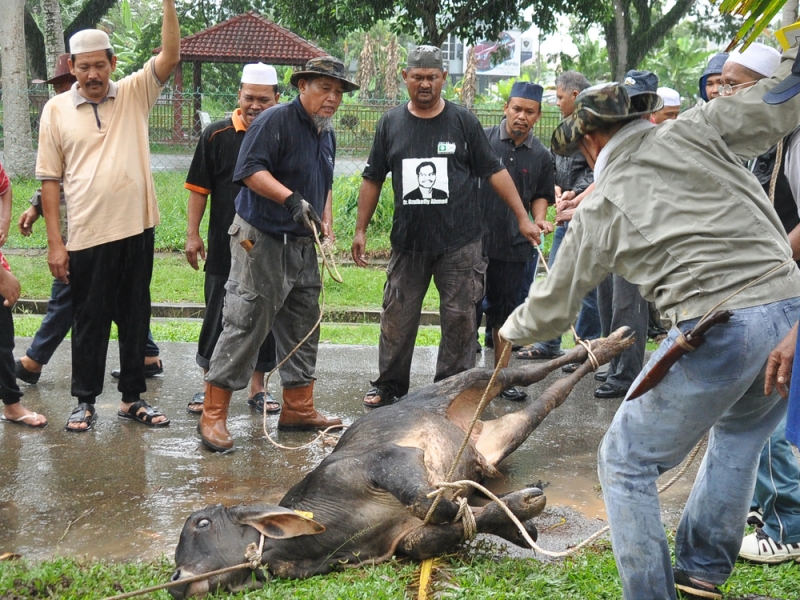


Amateur slaughterers are often injured on the job. Should slaughtering be left to the professionals?
The annual Hajj pilgrimage, on which we wrote about efforts to make it more green, has also become an event in which animals are being slaughtered inhumanely for the accompanying Ein al-Adha or the Muslim Feast of the Sacrifice holiday. This form of ritual slaughtering is also becoming an issue by animal rights activists. An attempt at slaughtering a cow went wrong this year as a Gazan animal took revenge by killing the man about to slaughter it.
What happened in Gaza may be happening in other parts of the Muslim world as well; and we welcome other stories of similar occurrences. Perhaps these examples could result in more humane treatment of animals being sent to be slaughtered for both festive and daily consumption.
The large numbers of animals that are slaughtered for the four-day Eid al Adha holiday feasting and the frenzy in which many of these animals are slaughtered resulted in a tragic incident in the Palestinian territory of Gaza in which a panicking cow killed a man who was trying to slaughter it on Saturday for the Eid al Sdha feast.
The article reported by AP went on to say that a Gaza health official, Asraf al-Kidra said that around 150 people had been wounded by either knife wounds or by the animals themselves during the slaughtering process. Al-Kidra added that the main reason this was happening was that people who had purchased live animals for the feast had attempted to slaughter the animals themselves instead of letting professional ritual slaughterers do the job for them.
Although countries like Holland are speaking out against ritual slaughtering of animals, according the Jewish Kashrut or Muslim Hallal methods of religious animal slaughter, if conducted properly this method of slaughtering animals for food is said to be humane if done by people who are trained properly.
In the Gaza case, much of the animal slaughter appears to have been done by ordinary people who try to slaughter the animals themselves. On a day to day basis, the process of slaughtering animals for food, even by so-called professional slaughterhouses, has often been criticized for mistreating and even abusing animals brought there to be “processed” into meat products.
The entire meat processing industry needs more inspection and control as meat is often contaminated by animal feces and meat contaminants.
Read more meat and man:
Eid al-Adha Across the Middle East: Celebration, War, Death, and Charity
Israel Meat Contaminated with Feces and pumped with Toxic Contaminants
Syria’s Cattle Caught in the Crossfire
Hollands Proposed Ban on Ritual Slaughter Affects Jews and Muslims
Image of Id al-Adha cow slaughter from Shutterstock


I was expecting to see the real cow which killed the Gazan slaughterer but the people in the picture are Malays. Cite the photo, man. that’s misleading.
Exactly. Those are not Palestinians. More like Asians.
what about the poor animal?? look at the fear in her eyes. god would not want us to kill our food this way.
To Maurice Picow, Karin Kloosterman, and readers:
“Human nature” is a meaningless phrase.
Human societies differ tremendously in what is considered natural, as well as moral, in time and in place.
What was “natural” thousands of years ago (an eye for an eye) is hardly acceptable in most human societies today, and what is “natural” in some parts of the world today (genital mutilation of girls, anyone?) is considered unnatural and immoral in others.
There is no such thing as biologically based human “nature.”
But if you hold that human nature is the reason humans kill and exploit animals then you must also hold that human nature can allow us to develop beyond such behavior and STOP killing and exploiting animals. As well as other humans: Speciesism is from the same page as racism and sexism.
It is farcical for the author of this (or any) article to include the words “slaughtering” and “[said to be] humane” in the same sentence. Please, do go visit those places you wrote about where “large animals like cattle are slaughtered.” If it is good enough for your teeth and your guts to ingest animals, it is good enough for your eyes and your brain to ingest the suffering you cause.
That the author, and the founder, of a so-called “green” newsletter claiming to be “a sustainable voice,” can support any kind of meat production, is ludicrous. There is nothing ethical or favorable to the environment in any meat or dairy industry, large or small, industrial or home-scale.
“[I]n their behaviour towards creatures, all men were Nazis. The smugness with which man could do with other species as he pleased exemplified the most extreme racist theories, the principle that might is right … for the animals, it is an eternal Treblinka.” (I.B. Singer)
“As long as there are slaughterhouses there will be battlefields.” (Leo Tolstoy)
As a point of information “an eye for an eye” was in its time incredibly forward thinking. It was never meant to be taken literally. The point was that in those far off days people would often take the law into their own hands, extracting their own form of revenge on the one they perceived had wronged them. The concept was to stop events spiralling out of control.
An eye for an eye meant that a punishment had to be proportionate – so if someone pushed you and you fell over it did not justify your kicking him or stabbing him,
It also meant that to mete out an appropriate and proportionate punishment you would first have to stop and consider what that might be. In other words there had to be a cooling off period. This was geared to encouraging people to seek neutral counsel. (Hence the beginning of independent judges, etc.)
The cow in this case wasn’t angry – it was utterly traumatized! I myself have not witnessed such animals being ritually slaughtered, except once at the shuk in Netanya and that was for chickens. Although I do eat meat, I wonder if I would continue to do so after visiting a place where large animals like cattle are slaughtered; whether ritually or “commercially” like in the USA.
“Amateur slaughterers are often injured on the job. Should slaughtering be left to the professionals?”
Wrong question.
Correct question:
“Why are animals still being slaughtered as captives by cowards with bloodthirsty tendencies?”
END THE WAR ON ANIMALS – THIS IS NOT ABOUT “RELIGION,” IT’S ABOUT COMMON SENSE!
Um… I think your comment isn’t that clear. Do you mean why are people still eating animals? Human nature, I guess.