Siemens Sells First 100 MW of Turbines to Morocco

The German renewable energy giant Siemens Energy has just secured its first wind turbine orders within Africa, with orders for two new wind farms going up in Morocco.

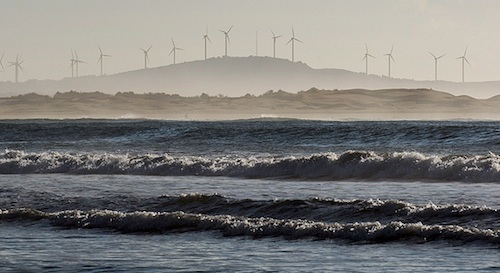
Siemens will supply turbines with a total capacity of 100 MW, 50 MW to the Haouma Wind Farm project in Northern Morocco, and 50 MW to Foum El Oued in Southern Morocco. Siemens has a 50 year history in Morocco, and supplied the electrical infrastructure for Morocco’s 60 MW-Essaouira wind farm (shown), so it would be natural for Morocco to turn to the engineering giant now that it is launching its renewable energy sector.

Plus – Siemens is one of the biggest backers of the Desertec Initiative – now beginning in Morocco.

Although 100 MW is a very small first order from an entire continent, Siemens is clearly banking on a future there. The company is announcing plans to establish a regional Wind Power Business Unit Middle East to focus on the MENA region as part of a new Wind Power Division.

The company says that Africa is an emerging wind market with Morocco currently being number two in installations.

Haouma will have 22 of Siemens’ very large 2.3 MW turbines, and Foum El Oued, which is in one of the windiest areas of Morocco in the municipality of Laâyoune, 9 kilometers south east of the port of Laâyoune in Southern Morocco, will also get 22 of the same capacity.

Siemens has signed a contract with Nareva Holding for the delivery of all 44 turbines, and the contract entails not just delivery but also installation and commissioning and a five-year service contract for each project, once they begin commercial operation in 2013.

Morocco is a very attractive investment region for renewables as its government is committed to very ambitious renewable energy development, with plans to get 26% of Morocco’s electricity from wind power by 2020.

These goals are among the highest in the world. Denmark, the world leader in wind, plans for 42% wind power by 2020, but it has been working up to this level for some decades.

China – the world leader in installed capacity plans to get 17% from wind. Recent world leader Germany plans for about 16%. A few US states are as ambitious. Iowa, with a similar electric demand as Morocco, now gets 20% of its electricity from wind.

More than merely ambitious, Morocco appears to be competently able to implement the plan, with the first of the projects already in place on time, and on target. The country began its first wind installations already, going from 54 MW in 2004, up to 286 MW by the end of 2010.

A healthy oil shock in 2008 steered the country in a new direction. By the end of 2009 a royal energy plan was issued calling for Morocco to end its dependence on oil (60%) and gas (6%). Laws were passed to enable foreign investment and financial support in the country.

“For decades, we searched for energy sources in Morocco,” says Dr. Driss Zejli at the Centre National pour la Recherche Scientifique et Technique. “We looked in the right places, but we were looking for the wrong things, namely oil and gas.”

“Morocco has two trump cards,” says Zejli. “First, we can store electricity in pump hydro units in the Atlas Mountains; one such facility is already up and running. Secondly, we have a high-voltage link with Algeria and power lines to Spain with a capacity of 1,400 MW. So one day we’ll be able to export electricity rather than purchasing it as we do now.”

Related stories:

Read More

1 COMMENT

TRENDING

Stardust’s solar geoengineered $10 billion plan to blot out the sun

Israeli-American startup Stardust Solutions has raised $75 million to develop technology that could cool the Earth by reflecting sunlight. Is solar geoengineering becoming a real industry? Or could it be a new threat?

Mongolia rangelands the center of climate change

Mongolia put the world’s overlooked rangelands on the climate agenda at UNCCD COP17, where governments and investors backed new financing for land restoration, drought resilience and pastoral communities.

Did China’s AI Boom Melt the Himalayas? Nepal’s Deadly Floods Raises Question About Data Centers and Climate

Nepal’s devastating floods reveal the growing risks of a warming Himalaya. As glaciers retreat and extreme events intensify, clean energy and climate action are increasingly urgent — and local organizations need support.

Jewish Climate Network founded so innovators don’t leave their identity at the door

Rather than retreating from climate change work, the Jewish Climate Trust organization has backed a new initiative designed to strengthen both climate action and Jewish community.

The Hidden Components Powering the Renewable Energy Revolution

A rooftop solar system looks simple: panels, an inverter, a battery and a few cables. But beneath that simplicity lies a bill of materials thousands of lines long, where tiny current sensors, magnetic cores, gate drivers, capacitors and connectors quietly determine efficiency, safety and lifespan. These overlooked components—not the solar panels themselves—are why today's residential solar systems are smaller, smarter and far more reliable than those of a decade ago.

Scientists make lead-free perovskite solar cells that can weather the elements

Scientists have developed a “raincoat” for lead-free tin perovskite solar cells, helping them withstand air, moisture and heat while maintaining high efficiency.

The Essential Guide To Sustainability in Project Management

Sustainability is an approach where businesses and individuals balance the environmental, social, and economic aspects of a project such that current and future stakeholders are not overburdened with the impacts of the project in future.

Yerukim Forms a New Green Economy Where the Money is Really Green

The Yerukim members who pick up the recyclables get to keep the monetary reward, the public earns "green" bills that can be used in shops, and business owners get to be associated with environmentalism.

Choosing Riyadh over Dubai? What Investors Should Know

Saudi Arabia is deploying capital at unmatched scale to catalyze tourism and advanced industry while rewiring its power-and-water backbone. The investable frontier is widening—especially in renewables, grid storage, water efficiency/desal retrofits, and hospitality operating platforms. Prudent investors will insist on phased delivery, enforceable KPIs (energy, water, biodiversity), and RHQ/zone compliance—while pricing political-economy and reputational risks alongside growth upside.

Sell your cooking oil for biodiesel money

Want to make money on old french fry oil? Sell it.

Qatar Alternative Energy Summit Pairs Investors And Innovators

Alternative energy investors and innovators can meet n' greet in Doha, Qatar March 16 and 17.

Here’s How To Implement The Four Pillars Of Employee Engagement

If you throw a party for your work team and they are vegans, don't make it a barbecue. Know the sustainability values of your team to boost moral and retain good people.

Locals From Rishon Fight IKEA

Big Box stores are a pretty new concept in Israel, and thank God that not every Israeli city wants them in their backyard. A word from someone who has see the beautiful farmland around her hometown Newmarket, Ontario stripped and converted into vulgar strip malls of big box shops: they have no place in a healthy and sustainable town or city.

Popular Categories