Limited Power Shackles Armenia to Precarious Nuclear Plant

In bucolic but earthquake-prone Armenia, people both fear and rely on a nuclear power plant that has operated for three decades with no primary containment structure.

In the 1970s, a series of first-generation nuclear reactors were built in the former Soviet Union, all lacking the infrastructure to contain major ruptures in the reactor’s primary circuit. Should a large rupture occur and the facility begin to overheat, the reactor would open to the outside air to cool down, exposing the surrounding environment to its contents and whatever accidents subsequently befell them.

One such nuclear power plant was built in present-day Armenia, in one of the most seismically active areas on the planet, a recent National Geographic article reports. Concerned citizens, scientists and international agencies have called on the Armenian government to shut down the plant, but there’s a snag: The plant supplies more than 40 percent of the power in a country that is exceptionally hard-pressed for energy.

The 31-year-old Metsamor power station is one of just five first-generation VVER 440 nuclear plants that lacks a primary containment structure. The rest are in Russia. The Armenian government has started planning to replace Metsamor’s 750 MW of capacity by 2016, but many are worried about what may happen in the intervening five years.

One-third of Armenia’s population live just 20 miles away, in the capital city of Yerevan. At a time when many countries in the Middle East are charging ahead with plans to develop nuclear power, including Armenia’s neighbor to the west, Turkey, Armenians dread becoming a tragic illustration of the dangers of nuclear technology.

At the same time, however, Armenians, are loath to turn off the plant until an equally large power generator has replaced it. Armenia was cut off by both of its nearest neighbors, Azerbaijan and Turkey, after the dissolution of the Soviet Union, so it relies on fuel imports from more distant countries, mainly Russia. After a 6.8-magnitude earthquake hit Armenia in 1988, the plant was shut down for six years even though it had escaped any damage. Ara Tadevosyan, director of a major Armenian news agency, recalled these years as a time of extreme deprivation in National Geographic:

“There were severe power shortages during the winter months. We had a situation where you had one hour of power a day, and sometimes no power at all for a week. You can imagine—it was as cold in the apartment as it was in the street.”

More than a thousand safety improvements have been made to the plant since it restarted in 1995, but that didn’t stop a United Nations envoy from calling the plant a “danger to the entire region” in 2004, or the United States from underwriting a study that similarly urged the country to replace it.

The European Union required Bulgaria and Slovakia to shut down VVER 440 units in those countries before they could join the EU. Since the EU hasn’t been able to convince Armenia to do the same, it has instead spent more than 59 million euros trying to improve the safety and sustainability of Armenia’s power supply.

Next year, Armenia plans to begin work on a new, $5 billion VVER 1000 nuclear reactor project: first steps toward its emancipation from the aging VVER 440. But that project won’t help relieve Armenia’s dependence on volatile, foreign sources of energy. As Green Prophet recently reported, a huge amount of oil is necessary to extract uranium, the fuel needed to run nuclear power plants.

For true peace of mind, Armenia should seek cleaner, more sustainable sources of energy within its own borders.

:: National Geographic

Read more about nuclear power in the Middle East:

Despite Japan, Turkey Goes Ahead With Nuclear Reactors

Time to Pause: Risks of Nuclear in the Volatile Middle East and North Africa Region

Nuclear Power Continues World Dependence on Middle East Oil

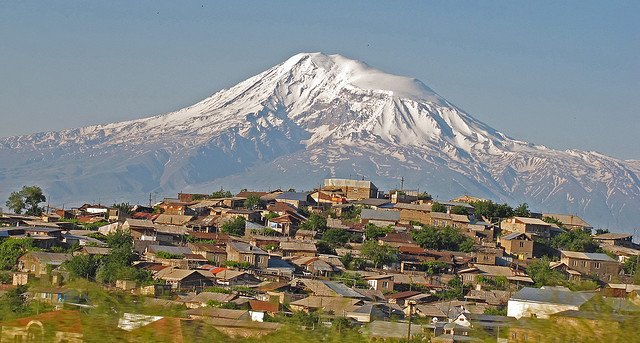
Image via Chuckdad

Julia Harte
Julia Hartehttp://www.greenprophet.com
Julia spent her childhood summers in a remote research station in the Rocky Mountains of Colorado, helping her father with a 25-year-old experiment in which he simulated global warming over a patch of alpine meadow. When not measuring plant species diversity or carbon flux in the soil, she could be found scampering around the forests and finding snowbanks to slide down. Now she is a freelance journalist living in Istanbul, where her passion for the environment intersects with her interest in Turkish politics and grassroots culture. She also writes about Turkish climate and energy policy for Solve Climate News.

Read More

TRENDING

Weston Higginbotham’s Funeral Set for June 17 as Family and Friends Honor Environmentalist

The family of environmentalist and eco-engineer in training, James "Weston" Higginbotham will gather with friends, classmates, and supporters on June 17 in Birmingham, Alabama, to celebrate the life of the Auburn University student whose death in a Kyoto forest in Japan touched people around the world.

Before Funeral, Auburn University Creates Environmental Scholarship in Memory of Weston Higginbotham

The James "Weston" Higginbotham Endowed Scholarship will support Auburn students pursuing ecological engineering, ensuring that the work Weston cared about so deeply continues long after his passing.

Weston Higginbotham’s Family Declines to Release Cause of Death in Kyoto Forest

The family of Weston Higginbotham,an Auburn University student whose disappearance and death in the mountains near Kyoto, Japan, drew international attention, has declined to publicly release the cause of his death.

Weston Higginbotham found dead in a Kyoto forest: is climate anxiety part of the story?

In some ways, Weston has become a symbol of a generation wrestling with environmental and technological anxiety. Friends and family described him as deeply concerned about environmental issues. Reports also noted that he questioned the growing role of artificial intelligence in daily life, even reportedly disagreeing with his mother about her use of AI.

Japan’s packaging turns black and white from Iran oil shortage

Japan is a country that builds 100-year companies; while...

Yerukim Forms a New Green Economy Where the Money is Really Green

The Yerukim members who pick up the recyclables get to keep the monetary reward, the public earns "green" bills that can be used in shops, and business owners get to be associated with environmentalism.

Choosing Riyadh over Dubai? What Investors Should Know

Saudi Arabia is deploying capital at unmatched scale to catalyze tourism and advanced industry while rewiring its power-and-water backbone. The investable frontier is widening—especially in renewables, grid storage, water efficiency/desal retrofits, and hospitality operating platforms. Prudent investors will insist on phased delivery, enforceable KPIs (energy, water, biodiversity), and RHQ/zone compliance—while pricing political-economy and reputational risks alongside growth upside.

Sell your cooking oil for biodiesel money

Want to make money on old french fry oil? Sell it.

Qatar Alternative Energy Summit Pairs Investors And Innovators

Alternative energy investors and innovators can meet n' greet in Doha, Qatar March 16 and 17.

Here’s How To Implement The Four Pillars Of Employee Engagement

If you throw a party for your work team and they are vegans, don't make it a barbecue. Know the sustainability values of your team to boost moral and retain good people.

Locals From Rishon Fight IKEA

Big Box stores are a pretty new concept in Israel, and thank God that not every Israeli city wants them in their backyard. A word from someone who has see the beautiful farmland around her hometown Newmarket, Ontario stripped and converted into vulgar strip malls of big box shops: they have no place in a healthy and sustainable town or city.

The Jewish National Fund Meets An Inconvenient Truth

According to the JNF, it has transformed thousands of acres of barren land into green forests in Israel. They state that each person emits about 23 tons of carbon per year, estimating that each tree planted can absorb one ton of carbon in its lifetime. That's a whole lot of trees you'd need to be planting. Could so many fit in Israel?

How to quiet noise from construction in your office

Streets need to be resurfaced in New York but the humming and grinding noise is unsettling. Noise is environmental pollution. 

Popular Categories