

 The 100-MW photovoltaic power station would be the first to harness Turkey’s remarkable solar resource.
Turkey has a lot of catching up to do when it comes to solar power. At more than 1 million terawatt-hours (twH) of solar radiation each year, it receives more sunlight than most countries in Europe — for comparison, Spain and California each receive about 800,000 twH annually. But solar power contributes a mere five megawatts to Turkey’s overall installed capacity of 46,500 MW. Without subsidies from the government for their power, solar companies have been discouraged from entering the sunny country, and the solar power market in Turkey, despite all its promise, has remained small and scattered.
A U.S.-Dutch company is planning to change all that.
GiraSolar is in talks with local Turkish energy companies to build a 100-MW photovoltaic power station in southern Turkey. According to GiraSolar executives, the project will require 2,000 square meters of land, and could be completed within two years — about half the time it takes to construct a nuclear power plant, which Turkey is currently preparing to do.
If the 100-MW solar plant is built, “this would make Turkey known as the solar source of the world,” GiraSolar CEO Wieland M. Koornstra told the Turkish Hurriyet Daily News & Economic Review.
It’s no surprise to regular Green Prophet readers that the Middle East has bountiful solar power potential. But it is surprising, given the dismal state of Turkish energy policy, to see a solar energy project this ambitious launching in Turkey. For decades, the country’s energy authority didn’t offer any financial incentive to solar producers to help them get started in the electricity market. And the Electricity Market Law makes it difficult for auto-producers — entities producing power primarily for their own use — to generate electricity at a large or medium scale.
In spite of that discouraging regulatory environment, some small solar companies have still managed to get off the ground in Turkey, usually with the aid of foreign lenders and equipment manufacturers. This grassroots solar industry comprises approximately fifty photovoltaics companies and several hundred thermal companies.
In December 2010, a long-awaited amendment to Turkey’s law on renewable energy passed, introducing a price guarantee of $0.133 per kilowatt-hour of solar energy. Though still far below the price incentives in countries like Germany or Spain, which offer solar producers feed-in tariffs of about $0.69 and $0.50 respectively, and have active solar power markets as a result, the new price guarantee in Turkey is a step in the right direction. And if it brings in more deals like the one GiraSolar has proposed, it will be have been worth the wait.
Read more about energy and climate policy in Turkey:
As Energy Demand Swells, Turkey Falls Dark For Earth Hour 2011
Despite Japan, Turkey Goes Ahead With Nuclear Reactors
Al Gore Talks Turkish Climate Policy
“Anatolia Won’t Be Blackened” Declare Turkish Anti-Fossil Fuel Groups
A Mosque in Turkey Goes Solar
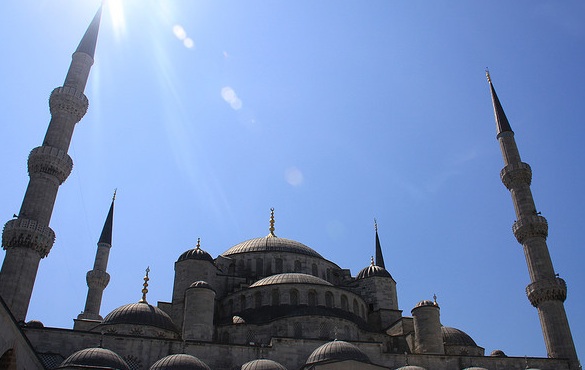
Image via jeremy vandel



Can you please explain me why the photo of a mosque is used in this article? Do you use a church when referring to UK, France or Belgium for example?
Suxch stereotypical and leading methods of propaganda should not be used at least on a website like this.
Good point, Delia. I’ve also noticed that Turkey mainly tends to be categorized as a European country when the news from here is good, but as part of the Middle East when the news is bad. There’s no single accurate way to geographically characterize the country, it seems. In this case, the European context was more relevant to the topic, because Europe has installed far more solar power capacity than the Middle East. But hopefully that’ll change soon!
Delia – here’s what the CIA Factbook says about Turkey’s geographical location:
“Southeastern Europe and Southwestern Asia (that portion of Turkey west of the Bosporus is geographically part of Europe), bordering the Black Sea, between Bulgaria and Georgia, and bordering the Aegean Sea and the Mediterranean Sea, between Greece and Syria.”
It’s interesting that when there are innovative developments in Turkey, then this sun-drenched country is described as being in Europe. Actually it is in the Levant or Middle East at the moment. Nonetheless, it is great to see that Turkey — along with Greece and Croatia — are finally looking to solar power as a real and significant alternative to conventional means of power generation.
There is a energy revolution going on! And solar power is going number one in the world.
Imagine that! 🙂