Creators who want to influence people for good should also think carefully about tone. Environmental storytelling does not need to lecture or shame audiences. It can invite curiosity instead.
The company's Next Generation Process (NGP) Pilot Plant in London, Ontario, has officially moved into initial operating campaigns, generating the kind of structured, repeatable data that separates laboratory promise from commercial viability.
In the modern nutrition universe, that level of commitment deserves an applause. But for those who don’t live in a Nordic fishing village, the nutrition company Zinzino has built its omega-3 research and formulations around these principles, combining biomarker testing, antioxidant protection and traceable sourcing across both sustainably harvested small-fish oils and a vegan marine-microalgae alternative.
Dubai Municipality has set up 12 AI-powered "Ehsan Stations" to safely and officially feed strays. The city also officially supports Trap-Neuter-Return (TNR) programs.
Creators who want to influence people for good should also think carefully about tone. Environmental storytelling does not need to lecture or shame audiences. It can invite curiosity instead.
The company's Next Generation Process (NGP) Pilot Plant in London, Ontario, has officially moved into initial operating campaigns, generating the kind of structured, repeatable data that separates laboratory promise from commercial viability.
In the modern nutrition universe, that level of commitment deserves an applause. But for those who don’t live in a Nordic fishing village, the nutrition company Zinzino has built its omega-3 research and formulations around these principles, combining biomarker testing, antioxidant protection and traceable sourcing across both sustainably harvested small-fish oils and a vegan marine-microalgae alternative.
Dubai Municipality has set up 12 AI-powered "Ehsan Stations" to safely and officially feed strays. The city also officially supports Trap-Neuter-Return (TNR) programs.
Creators who want to influence people for good should also think carefully about tone. Environmental storytelling does not need to lecture or shame audiences. It can invite curiosity instead.
The company's Next Generation Process (NGP) Pilot Plant in London, Ontario, has officially moved into initial operating campaigns, generating the kind of structured, repeatable data that separates laboratory promise from commercial viability.
In the modern nutrition universe, that level of commitment deserves an applause. But for those who don’t live in a Nordic fishing village, the nutrition company Zinzino has built its omega-3 research and formulations around these principles, combining biomarker testing, antioxidant protection and traceable sourcing across both sustainably harvested small-fish oils and a vegan marine-microalgae alternative.
Dubai Municipality has set up 12 AI-powered "Ehsan Stations" to safely and officially feed strays. The city also officially supports Trap-Neuter-Return (TNR) programs.
Creators who want to influence people for good should also think carefully about tone. Environmental storytelling does not need to lecture or shame audiences. It can invite curiosity instead.
The company's Next Generation Process (NGP) Pilot Plant in London, Ontario, has officially moved into initial operating campaigns, generating the kind of structured, repeatable data that separates laboratory promise from commercial viability.
In the modern nutrition universe, that level of commitment deserves an applause. But for those who don’t live in a Nordic fishing village, the nutrition company Zinzino has built its omega-3 research and formulations around these principles, combining biomarker testing, antioxidant protection and traceable sourcing across both sustainably harvested small-fish oils and a vegan marine-microalgae alternative.
Dubai Municipality has set up 12 AI-powered "Ehsan Stations" to safely and officially feed strays. The city also officially supports Trap-Neuter-Return (TNR) programs.
Creators who want to influence people for good should also think carefully about tone. Environmental storytelling does not need to lecture or shame audiences. It can invite curiosity instead.
The company's Next Generation Process (NGP) Pilot Plant in London, Ontario, has officially moved into initial operating campaigns, generating the kind of structured, repeatable data that separates laboratory promise from commercial viability.
In the modern nutrition universe, that level of commitment deserves an applause. But for those who don’t live in a Nordic fishing village, the nutrition company Zinzino has built its omega-3 research and formulations around these principles, combining biomarker testing, antioxidant protection and traceable sourcing across both sustainably harvested small-fish oils and a vegan marine-microalgae alternative.
Dubai Municipality has set up 12 AI-powered "Ehsan Stations" to safely and officially feed strays. The city also officially supports Trap-Neuter-Return (TNR) programs.
Creators who want to influence people for good should also think carefully about tone. Environmental storytelling does not need to lecture or shame audiences. It can invite curiosity instead.
The company's Next Generation Process (NGP) Pilot Plant in London, Ontario, has officially moved into initial operating campaigns, generating the kind of structured, repeatable data that separates laboratory promise from commercial viability.
In the modern nutrition universe, that level of commitment deserves an applause. But for those who don’t live in a Nordic fishing village, the nutrition company Zinzino has built its omega-3 research and formulations around these principles, combining biomarker testing, antioxidant protection and traceable sourcing across both sustainably harvested small-fish oils and a vegan marine-microalgae alternative.
Dubai Municipality has set up 12 AI-powered "Ehsan Stations" to safely and officially feed strays. The city also officially supports Trap-Neuter-Return (TNR) programs.
Creators who want to influence people for good should also think carefully about tone. Environmental storytelling does not need to lecture or shame audiences. It can invite curiosity instead.
The company's Next Generation Process (NGP) Pilot Plant in London, Ontario, has officially moved into initial operating campaigns, generating the kind of structured, repeatable data that separates laboratory promise from commercial viability.
In the modern nutrition universe, that level of commitment deserves an applause. But for those who don’t live in a Nordic fishing village, the nutrition company Zinzino has built its omega-3 research and formulations around these principles, combining biomarker testing, antioxidant protection and traceable sourcing across both sustainably harvested small-fish oils and a vegan marine-microalgae alternative.
Dubai Municipality has set up 12 AI-powered "Ehsan Stations" to safely and officially feed strays. The city also officially supports Trap-Neuter-Return (TNR) programs.
Creators who want to influence people for good should also think carefully about tone. Environmental storytelling does not need to lecture or shame audiences. It can invite curiosity instead.
The company's Next Generation Process (NGP) Pilot Plant in London, Ontario, has officially moved into initial operating campaigns, generating the kind of structured, repeatable data that separates laboratory promise from commercial viability.
In the modern nutrition universe, that level of commitment deserves an applause. But for those who don’t live in a Nordic fishing village, the nutrition company Zinzino has built its omega-3 research and formulations around these principles, combining biomarker testing, antioxidant protection and traceable sourcing across both sustainably harvested small-fish oils and a vegan marine-microalgae alternative.
Dubai Municipality has set up 12 AI-powered "Ehsan Stations" to safely and officially feed strays. The city also officially supports Trap-Neuter-Return (TNR) programs.
EcoVentures is a company – an emissions reduction specialist – which help companies in the Middle East take control of their carbon footprints.
According to a Gulf News story, the UAE companies aim to reduce their carbon footprint in their manufacturing operation and induce their employees to become more aware of the environment in which they live.
Eighty-two companies in the UAE were sent a 22 question survey dealing with what they can do to help reduce emissions caused by them.
Some companies preferred to remain anonymous, out of a fear of losing business from non-complying firms; and are instructing their employees to take measures such as conservation of the natural resources they are using to not only conserve them but protect the environment as well.
We couldn’t miss this one for the world: last night about 20 professional cyclists put the pedal to the metal and powered the Balkan Beat Box free concert at Rabin Square. Thousands of people (and dogs) of all ages took part in seeing the show.
The show to celebrate Earth Day couldn’t run on people power alone, so to keep the wattage flowing, the concert producers tapped into biodiesel made from used falafel oil.
Green Prophet and our entourage danced our way through the crowd, rushing to the center stage of the power production. The cyclists themselves.
See this amateur video of how pedal power of the Earth Day concert in Israel looks.
Israel celebrated the annual event a day after most others in the world, out of respect for Holocaust survivors who are memorialized the day before Earth Day. (It’s not considered respectful to party and celebrated as we mourn).
As we covered earlier in It’s The Water That Binds Us, in this video Alexandra Cousteau continues her mission Expedition: Blue Planet and interviews a local man from Jordan, Othman Mizra, whose father built a livelihood around a water oasis – Azraq – in Jordan. Now the water from the oasis is pumped to Amman instead and the Azraq oasis has run dry.
See the story of the tragedy in the above video.
According to Wikipedia, Azraq (Arabic: الأزرق) is a small town with a population of approximately 5,000 people (1990) in central-eastern Jordan, 100km east of Amman.
Azraq has long been an important settlement in a remote and now-arid desert area of Jordan. The strategic value of the town and its castle (Qasr Azraq where Lawrence of Arabia once stayed) is that it lies in the middle of the Azraq oasis, the only permanent source of fresh water in approximately 12,000 square kilometres of desert.
Alexandra Cousteau (who I spoke to while on her Expedition: Blue Planet in Israel) interviews an Arava Institute alum from the Palestinian Authority to get her take on how the security barrier affects water allocation in the West Bank. Cousteau manages to get a moderate and fair point of view from Muna Dujani, the young alum interviewed in Ramallah.
To read more about Cousteau’s amazing water education mission to Israel and the region, read It’s The Water That Binds Us.
To learn more about water allocations between Israel and the Palestinian Authority, read Green Prophet’s take on the latest World Bank report here.
Now she’s giving back. Alexandra Cousteau was recently in Israel where she was interviewing and filming for Expedition: Blue Planet. She’s working to raise awareness about protecting one of the the world’s most valuable resources, by talking with people, every day people, who are living with and seeing the changes in the allocation and quality of water around the world.
I spoke with Cousteau when she was in Israel, and here’s her story:
From the Ganges River, the spiritual heart of India, to the Mississippi River in America, legendary marine scientist and explorer Jacques Cousteau’s granddaughter is collecting stories about water. She’s not reporting on new technologies that promise to save the world, or on politics, or the regular environmental doom and gloom.
Thirty-two-year old Alexandra Cousteau, whose grandfather taught her to scuba dive at age seven — connecting her to water forever — seeks to re-connect all people throughout the world to water, our life support system.
At the end of last month, as part of her 100-day, five-continent journey ‘Expedition: Blue Planet’, she landed in Israel. “We started in India looking at water, faith and spirituality,” she says. In Israel, she and her crew are investigating how water scarcity “can lead to diplomacy and not necessarily conflict.”
Alexandra Cousteau at the Dead Sea in Israel
In Israel, she collected stories from housewives and farmers to spread to the global community through her blog and video news feeds. As part of her trip, she also met with Jordanians and Palestinians from the West Bank.
In total she interviewed about 10 different people from the region, “collecting archetypal stories that represent water stories facing the global community,” Cousteau, a dedicated environmentalist told Green Prophet. The stories and videos are now posted on her website.
Time to put water under the bridge
Water is the one thing that connects every individual on this planet of seven billion people, explains Cousteau, since the impacts of climate change will be felt most seriously on this essential natural resource. “Everyone will need to be involved in implementing solutions,” she says.
Filming on the road, and uploading videos and news feeds to her site, Cousteau expects the material will be visited by a wide audience, including journalists and young change makers.
Among the collection, are the stories of people — normal, every day people — that she met in Israel. As part of her trip, she visited and surveyed the Dead Sea, the Sea of Galilee, the Hula valley wetlands, and the Jordan River; in Jerusalem she met Israeli water officials and toured the Old City. Not far away in the Palestinian Authority’s West Bank, Cousteau met with officials there to discuss water allocations under the Oslo Accords.
Her visit in Israel and the region, adds to the hopeful things she’s seen in other parts of the planet, says Cousteau by telephone. “It’s been hopeful to talk with people from around the world about water issues. Water is life, and wherever I go, all of the people all say the same three words.
“Water is life,” she repeats. Whether it’s spiritual leader in Africa, housewives and farmers in Israel, Jordan and the Palestine Authority, Saudis, or activists in Turkey. All people say the same thing, “And that’s been amazing,” she says.
For Israel specifically, “water is a means for peace,” she says.
Israel, or other Middle Eastern countries, needn’t politicise the water issue, she believes. Water is a basic human right that everybody needs to survive: “We are not here to talk politics with people,” she explains.
Hosted by a green Israeli peace-making school
When asked about specific regional environmental concerns, Cousteau didn’t delve into specifics. These are issues that people know about anyway, like the problems with the shrinking Dead Sea, she says. Her mission rather, was as a story collector, to speak with average people in Israel about what water means to their lives. “We didn’t get too deep,” Cousteau says humbly.
In Israel, the Arava Institute, an environmental education group, helped Cousteau and her crew identify which people to interview. Finding the organization through a journalist friend of hers, the Arava Institute kept the team focused, she says.
After arriving from South Africa, she enters a fresh entry in her blog: “The reason we’re at Kibbutz Ketura is to visit the Arava Institute for Environmental Studies, a remarkable non-profit organization who makes its home here,” she writes.
Palestinians, Jordanians and Israelis Learn Together
“Arava brings Israelis, Palestinians, and Jordanians together with students from around the world to study environmental issues. However, their not-so-subtle agenda is not just a sustainable future for natural resources, but also cooperation between the peoples of this conflict-ridden region.
“As such, they compliment rigorous academic coursework with a special one-year mandatory class on peace and leadership skills, in which they confront issues such as religion, stereotypes, and the historical narratives of each group head-on. Their motto is: “Nature knows no borders.” We are curious to explore their model for how water scarcity can serve not as a necessary cause of conflict, but rather as a vehicle for peace,” she writes.
In awe over the dropping water levels in the Dead Sea, and the small size of the Sea of Galilee, Cousteau was impressed that neighbouring Jordan has a national water day. “All these things are contributing to creating wonderful stories,” she says. “There are lessons here that people should know about.”
The stories collected will be useful for “young people who want to work across political and cultural divides. It’s powerful stuff,” she adds.
While her legendary marine explorer grandfather started his career at the Red Sea, which is bordered by Israel, Egypt, Jordan, Saudi Arabia and other Middle Eastern and African countries, she has no specific recollection of him traveling to or having ties with Israel. “He was working in a different time,” it was about “exploration and discovery” and later in the end, she says, he started to get into marine conservation.
“This generation that I am part of has to move past awareness, and has to be proactive and be part of the solution,” urges Cousteau. “Now that we know [water’s] there, we have to protect it and prevent it from disappearing.”
Happy Earth Day! (Though technically yesterday, most of Israel is celebrating today.) Celebrations require desserts, we’re quite convinced, and since the citrus season is winding down we thought we’d talk about our absolute favourite thing to do with a lemon. Not lemonade (though we’re fans of that too) but lemon curd: smooth, custardy, tangy, riding that fine, perfect line between sweet and tart.
Lemon curd can get spread over scones, smoothed over a cookie crust for lemon bars, dolloped on pancakes, or licked straight off a spoon when you’re feeling especially indulgent. It tastes, quite simply, like concentrated sunshine.
(A blueprint for Park Holot, a sand dune park in the Israeli city of Holon)
Sustainable designers take note. Next week, April 30, a hip urban planning conference will be taking place at the Israeli Design Center in Holon, a suburb of Tel Aviv. Organizers of the conference say this conference will examine park planning and nature conservation in the urban arena. Designers, architects, landscape architects, conservationists, environmentalists and cultural experts from Israel and abroad will be attending.
2008 was a watershed year in human history; according to the 2008 UN report this was the first year in which most of the population of the planet, roughly 3.3 billion people, lived in cities.
It seems that we now stand at the precipice of an era in which a large percentage of humanity will no longer experience the wild natural landscape of old. A new reality is taking its place, a reality where urban Man (homo-Urbanus) knows only manmade landscape, one designed and maintained by human culture.
The basic working principle of modern-day ecology is based on the idea that human communities are unstable and constantly in flux. Different communities each take their own path and so human intervention in deciding this path does hold the possibility and the hope of determining our fate. This dynamic and unpredictable reality presents landscape and environmental architects with a complex and important challenge.
They must create a strong, indomitable spirit of living, breathing nature inside the ever-expanding and evolving urban space. In this way we may, perhaps, manage to moderate and restrain the human tendency towards “conquest” of the earth, the sense of ownership of it, and the damage to the environment and its delicate ecological structure.
In this design conference the key speakers are environmentalists, designers and landscape architects lecturing on various projects they have been involved in in Israel and around the world. They will review contemporary and future trends in this field of study.
Above is a chair and stool made from an Amcor 7 from the 1950s (the same model of fridge I owned for 7 years), modeled say the designers after Eero Aarnio’s Globe Chair from the 60s.
An upcycled table made from records
Looks like it would make my back a little stiff, and that it could topple over, but I would seriously consider buying the Moroccan-inspired recycled record table, like the one above.
As of 2021 when we updated this article, the Groovy website was no longer functioning.
Okay, so officially… Earth Hour was a few weeks ago and despite the fact that many other Middle Eastern cities participated, Israel was caught with its pants down. And yes, it’s probably true that instead of powering down, they were powering up to watch an important football match between Israel and Greece.
But it’s also true that Tel Aviv celebrated Earth Hour last year in a big way, with a large gathering in Rabin Square, by turning off all of the lights in City Hall and the Azrieli Towers, by soliciting the participating of Israeli President Shimon Peres, and by bringing a free bio-diesel and human cyclist powered concert to the masses.
Chances are, many Tel Avivians probably just showed up for the free concert. But if they were out in Rabin Square listening to the concert then that probably meant that their lights were off at home, right? Mission accomplished.
And so even though it’s a little belated, Tel Aviv will be celebrating Earth Hour again this year – this time on Earth Day eve (Thursday, April 23rd). The full day’s worth of festivities have already been described by Karin, but for those out there who may need something like a free evening concert to lure them out of their electrically lit apartments and away from their TVs and computers… keep reading.
The nighttime festivities will begin in Rabin Square at 6:30pm tomorrow with a countdown and many musical performances. The performers will include Asaf Avidan, Balkan Beat Box, and Shlomi Saranga and will be powered – of course – by biodiesel created from the excess oil of local falafel stands and human powered energy created live by cyclists near the stage. (Check out one of Balkan Beat Box’s live performances from 2007 in the video clip above.)
At 8:00pm, the lights will finally be turned off for a full hour. Even if you can’t make it to Rabin Square, feel free to turn (or dim) your lights in solidarity.
“The more we leave the non-human world behind, the less human we become: and the more fearful we become. It is not the thrilling fear of the kind I have experienced with horses, it is more a soul-deep, dislocated sense of anxiety. We lose our sense of trust in the wild world: we begin to forget that we need it. We impoverish ourselves and then we begin to consider it an enrichment.”
As part of our celebration here on Green Prophet of International Earth Day, I’m delighted to share with you a real treasure of a book I read recently.
Simon Barnes’s ‘How To Be Wild’ is a real delight to dip into, put down and keep returning to, as the author loves being out – out anywhere in true South African wildness, in East Anglian windswept fenland semi-wildness, or even looking at a tree or simply a solitary bird in the sky or swooping past his house, and Barnes’ passion is joyously written and infectious.
With most Earth Day events held in Israel tomorrow, on April 23, reports Haaretz, lights out will be the central event, where cities such as Tel Aviv and Jerusalem will turn their lights out from 8 to 9 pm in a bid to raise awareness about energy conservation.
Israel joins other cities around the world who will turn their lights off for the green cause. The United Nations has ruled that the event be marked worldwide.
Some of us are already using air conditioner water in our homes. Saving water may not be critical in Canada, but it is in the Middle East. Saving water to save money and energy is not only a personal financial consideration, but a global issue, as natural resources belong to all of us.
Some older washing machines, you might not know, have an option of using half the amount of water, saving near 10 gallons or 30 liters of water a load. As an added bonus, clothes come out cleaner.
How do clothes get cleaner when using less water? It turns out that filling the drum of the machine is unnecessary. As long as the clothes are wet, the agitation does the job, and better. Loose water only gets in the way, and also creates a need for more detergent.
What’s more energy efficient, top or front loader washing machine?
The current water crisis around the globe makes this a good time to revisit the long-time debate of American immigrants to the Middle East over whether a top-loading Maytag with the door on top is preferable to a European front-loader.
The top-loader works by filling its large drum with water, and a central agitator spins to clean the clothes. Standard front-loaders don’t need an agitator, so more clothes can fit into the smaller drum. The clothes agitate as the drum in a front-loading machine moves back and forth, capitalizing on gravity.
Seven years ago, my then 15-year-old Maytag gave out a few days before Rosh Hashanah (The Jewish New Year), and I bought an Electra for a price comparable to a new Maytag motor. I’ve had only minor repairs so far, but it’s largely a matter of chance. They are supposed to last about five years.
Are the advantages of top-loaders worth the excess water and energy use?
Below I list the main reasons to use a top-loading American machine, typically a Maytag.
Maytags last longer. That may be true, but they are much more expensive. Parts and repairs also cost more. Of course, your smaller European machine will end up in a landfill faster.
More clothes can fit into the top-loader. I did not notice a big difference, because the Maytag’s agitator is large and requires clothes to be stacked loosely. A huge amount can fit in a standard front loader, especially when using a regular cycle.
The Maytag cycle is faster. This is true, and the switch to a front-loader requires a readjustment. But with planning you don’t need to sit and wait for laundry to finish—you can do other things. And the front-loader squeezes out more water so clothes dry faster, whether on the line or in a dryer. The length of the cycle also depends on whether you heat the water (see next point).
Top-loading Maytags are connected to both hot and cold water faucets, allowing you to save money and energy on sunny days if you have a solar water heater. However, detergents today are designed to work well with cold water. Using cold water also shortens the cycle of the front-loader significantly, and extends the life of the machine. Front-loading machines attach to the cold water faucet and heat water according to the cycle chosen.
Top-loaders are easier on the back, but a front-loader can be placed on a pedestal.
There are several major disadvantages to the Maytag:
They don’t clean as well (but may put less stress on clothes for the same reason).
They are too large for many Middle Eastern apartments, and may require being taken apart to fit through doors. They also require two faucets, not standard in Israeli laundry areas.
They use twice as much water, more detergent, and more electricity (factoring out the heating of the water)
Repairs and parts are expensive.
Newer model front-loaders automatically adjust the water level, based on the amount of clothes.
Money and energy-saving laundry tips:
Don’t wash it it if it’s not dirty. Use smocks and aprons to protect clothes.
Always fill up the machine. Fill a front loader to the top, turning the drum to make more room. With a regular cycle (lower numbers) the machine can really be stuffed, as long as closing it doesn’t put stress on the door. Be gentle with the door as the hinges are a weak point, as are the knobs.
Have enough clothes. If you are always doing a load because you run out of socks, buy more socks (or work out a system to keep them organized). You should have enough clothes to have something to wear when you are washing, plus something extra in case of emergency.
Don’t have too many clothes. They tend to fall on the floor and require rewashing, and it’s harder to find what you need.
Give family members their own distinctive towels. They are more likely to reuse them.
When visiting friends offer to bring your own sheets, or a sleeping bag. Take the sheets you just took off the bed for changing.
“Grey water” from the bath can be reused for laundry. Keep a couple of buckets in the shower and pour the used water into the machine through the opening for detergent while the water is running. I’ve noticed that my machine adds water to the first cycle in intervals. I add water until the water stops running, and try to be around for the second addition of water as well.
Use a minimum of detergent. If your laundry smells like detergent after washing, you’re probably using too much. The extra soap also clogs up your machine.
Hang laundry to dry.
What tips can you share for more efficient laundering?
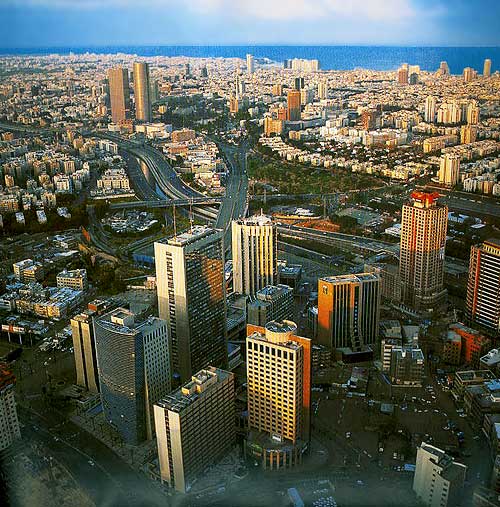
(View of parking lot below Azrielli Center in Tel Aviv)
They giveth and then taketh away: The recently Annual Report issued by the Bank of Israel, has devoted an entire chapter to the excessive use of leased company vehicles by employees, which are clogging up the country’s motorways and contributing greatly to the amounts of air pollution in and near major cities.
The report noted that even though amounts paid by employees for these vehicles increased considerably, following changes set in place by the Finance Ministry, the increased amounts have not caused any measurable reduction in the numbers of such cars on the road.
The report noted that 61% of the people using such cars drive them much more than those who drive their own cars (21%). The original idea was to enable company employees an easy way to get to and from work in situations in which public transport is not readily available; as well as allowing employees to work longer hours and not have to depend on bus or train schedules to get home after work.
While this appears to have been good logic, especially when employees of many high tech companies work as many as 12 to 14 hours a day; it was found that these employees use these cars for all types of private journeys, including weekend jaunts all over the country – at the employer’s expense.
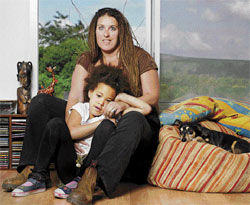
What’s a 37 year old single mom, who lives in a three room mobile home in Israel’s Galilee doing to support herself? Why she’s selling portable solar energy units to farmers, that’s what!
Shiri Broida, originally from Kibbutz Ein Harod Ihud, isn’t the normal example of an Israeli woman in her mid 30’s. Her lifestyle is simple, living with her 7 year old daughter Gal in a remote moshav (cooperative farming) village and smoking locally made Montana cigarettes: “no one bums any, ’cause they’re cheap.”
In addition to her solar energy enterprise, she also drives a Land Rover for an off-the-road tour company the takes people on 3 to 5 hour trekking trips in various rough terrain parts of Israel.
Shiri is no stranger to hard work, having left school at the age to 16 of work in the cotton and fish enterprises of her kibbutz, which included wading chest deep into fish ponds to net carp and other fresh water species being grown there.














 What’s a 37 year old single mom, who lives in a three room mobile home in Israel’s Galilee doing to support herself? Why she’s selling portable