Home Blog Page 712

World Bank Report Recommends New, Equal Water-Sharing Regime Between Israel and the Palestinian Authority

0

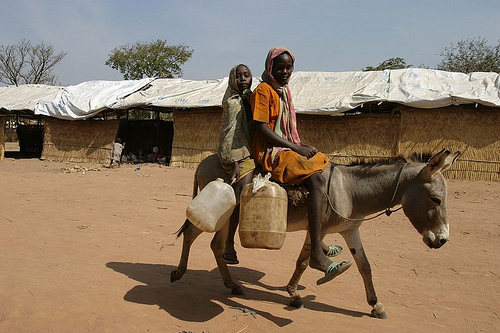
water bottles different sizes neutral colors photo

The World Bank published a report yesterday recommending an immediate change in the water regime between Israel and the Palestinian Authority.

Coming at a particularly sensitive time, considering the region’s ever-worsening water crisis, the report, entitled Assessment of Restrictions on Palestinian Water Sector Development, concluded that “the joint governance rules and water allocations established under the 1995 Oslo interim agreement, still in effect today, fall short of the needs of the Palestinian people.”

Due to the imbalance of power, capacity, and information between Israelis and Palestinians under the Joint Water Committee (JWC), the report notes, Palestinians have faced severe constraints on water resource development, use, and management.  These constraints have become even more serious since Israel began imposing movement and access restrictions in 2000, impairing Palestinian decision-making, access to water resources, infrastructure development, and utility operations.

Coral Reefs To Melt Away If CO2 Levels Double

5

melting-coral-reef photo

The earth is warming up. There is no doubt about that. And carbon dioxide levels are increasing too. New research from the Hebrew University in Jerusalem and the Carnegie Institution in the US suggests that if things get worse, coral reefs will start to dissolve. That’s millions of years of evolution that will simply melt away. Even if corals can “get sexy on the seafloor” due to effects of greenhouse gases, as we reported earlier, the rise in CO2 might happen too fast for them to cope.

Rising carbon dioxide in the atmosphere and the resulting effects on ocean water are making it increasingly difficult for coral reefs to grow, say scientists.

A study published in Geophysical Research Letters warns that if carbon dioxide reaches double pre-industrial levels, coral reefs can be expected to not just stop growing, but also to begin dissolving all over the world.

Etihad and Qatar Airways Cut Greenhouse Gas Emissions

Etihad business class

Etihad Airways from the United Arab Emirates has signed an agreement with Masdar (the same group developing the world’s first carbon neutral city), to reduce the carbon footprint of the airline. The company follows in the footsteps (or wings?) of two other Middle East airline projects we know about — one in Israel to green the country’s airport, and another more tangible project in Qatar. Today let’s focus on Qatar:

Qatar Airways, whose innovative advertisements are seen often on international news media programs such as CNN, is the first Middle East airlines to become involved in a plan that will enforce the reduction of greenhouse gas-causing carbon dioxide emissions by launching a carbon offsetting scheme for passengers.

The company just announced signing a “ground-breaking agreement with the International Air Transport Association (IATA) to spearhead the global carbon offset trading scheme designed to help fund global environmental projects,” reports the Peninsula.

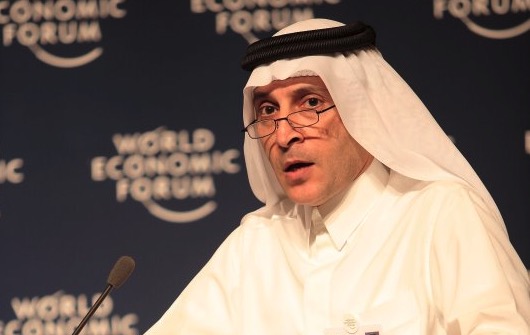
The plan, as announced by Sheikh Akbar Al Baker, the company’s CEO, calculates the carbon “footprint” for each flight, and then asks airline customers who purchase tickets online to contribute towards projects which will offset the carbon emissions caused by each flight.

The plan, endorsed in an agreement with the international air carrier organization IATA, will invest these contributions in community environmental protection projects such as alternative energy, reducing noise, recycling of waste products, and other environmentally friendly endeavours that will reduce the dangers of global warming. The airline will also invest in cleaner and more efficient aircraft to keep carbon emissions at a minimum.

Making the airline more environmentally friendly is part of Sheikh Baker’s Social Responsibility Plan for Qatar Airways which has created the “Five Pillar Corporate Social Responsibility Strategy” which deals with matters of change management, environment, integrated fuel management, communication, and sustainable development.

Sheik Akbar, world economic forum
Sheik Akbar Al Baker at the World Economic Forum in Davos

Al Baker believes that the airline must go beyond the current aviation industry standards for fuel and environmental management in order to assure a qualitative and competitive future for the company. His plan also entails ensuring a better future for the airline’s staff as well as for the world “neighborhood” in which they live:

“We have the responsibility to deal with the impact on global climate change, noise, local air quality, non-renewable resources and waste” he said.

Qatar Airways’ fleet aims to be one of the cleanest and most fuel efficient in the industry. By getting airline passengers involved in helping the environment, Al Baker feels that they will appreciate being a part of an overall effort to offset the problems of global warming and climate change.

“It goes without saying that our children’s future depends on the responsible actions of Qatar Airways, its peers, other industries, and you, the passenger,” he added.

More on green flying from the Middle East:
Join The Great Airways Debate Part I
The Great Airways Debate Part II
Will Tel Aviv Airport Be First Middle East Airport To Fly Green?

Doomsday 90s Film On Global Warming Becomes Stark Reality

6

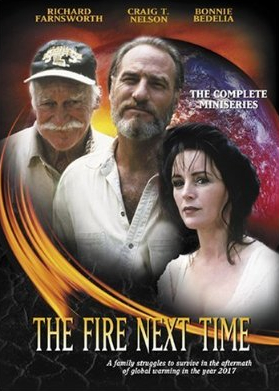
fire-next-time-posterWriting the Green Prophet story on ecomigration got me thinking about a cheesy made for TV movie The Fire Next Time made 15 years ago. (Plus Earth Day is coming up next week, giving us extra reasons to think about our blue planet.)

The movie gives a chilling preview of what the world might be like in the year 2017, as a result of the consequences of global warming and severe depletion of the earth’s ozone layer.

Directed by Tom McLoughlin, and starring Craig Nelson and Bonny Bedelia, the movie depicted an environmental nightmare in the United States, with much of the Continental 48 states in a disastrous situation due to severe drought, literally consumed by raging forest and brush fires, or plummeted constantly by hurricanes and similar severe storms.

The film’s main characters, a Louisiana family engaged in a dwindling shrimp fishing business, have both their livelihood and their home literally destroyed by a monster hurricane similar to Hurricane Katrina which hit the city of New Orleans and much of the U.S. Gulf Coast in August, 2005.

Global warming and the so-called “greenhouse effect” are definitely issues being dealt with in our present time, 13 years after the above movie was first shown. Events happening in countries all over the world, give testimony to the present state of the earth’s environmental problems that appear to be getting worse as time goes on. This is true in the Middle East as well.

Here in Israel, the country is literally “drying up” as a result of increasingly scarce rainfall, and country’s main fresh water source, the Sea of Galilee, is now at record lows, despite a late rainy season reprieve.

A Little glooq Stretches Your Green Reach and Advertising Dollars Via Email

6

glooq email campaign marketingEnvironmental activists and business people working on green technologies take note: a small application called glooq can be fitted into your email message to help generate eco awareness and sales. It takes a simple email message and turns it into a marketing campaign.

Think about how many more people know about your new wind turbine company or nature conservation project since you’ve built the website and added a link in your signature. Well glooq, in a simple way, takes all that you’ve built and helps you spread specific and meaningful messages to the people who are already reading your emails.

When challenged to generate donor dollars for a non-profit organization, two advertising execs based in Israel built glooq to take advantage of the power of employee emails (See one of the partners Elad Schneor pictured here).

Normally companies hate it when workers spend too much time communicating online. But glooq’s Schneor, originally from the UK, saw it as a way to enlist the organization’s 5,000 employees into marketing worker bees, without them having to do a thing. 

Are Muslim Women Ready For Bamboo Hijab and Chadors?

15

hijab women bamboo clothing eco muslim dress photoYou may not believe it, but the green stuff many people have growing as a decorative plant in their garden may become one of main fibers for manufacturing clothing, linens, curtains, and other fabrics that are presently being made from cotton (a very wasteful pant), and various synthetic fibers.

Presently a number of fashion designers and manufacturers are becoming interested in this plant –– bamboo –– that can grow in many types of climates and needs little or no attention. And some Muslim women’s clothing sites like ArtiZara already think bamboo-based head coverings are a good idea.

Green Prophet thinks it is an interesting plant for farmers in the region to cultivate since it can easily be grown in places like the Hula Valley in Israel, marshy areas of southern Iraq, along the Nile river in Egypt and Sudan, and other places as well.

All the positive environmental aspects of the plant itself will obviously be beneficial, and even clothing like the chador, khimar, jilbab or kameez garments Muslim women wear. See an example here from ArtiZara.

Naomi Tsur Is Sustaining Jerusalem From the Inside Out

1

naomi tsurNaomi Tsur

The city of Jerusalem is steeped in history, stretching back to before the Bible’s King David ruled the city. Today it is a major center for the three major monotheistic religions — Judaism, Islam and Christianity, who all hold Jerusalem near and dear.

But whether you are on a spiritual quest, pilgrimage, or have decided to make Jerusalem your home, there is no denying its importance from a historical, religious, cultural and political point of view. But the city needs a vision.

That vision, at least in the green sense, is now being inspired by Naomi Tsur, a new deputy mayor of Jerusalem, who heads planning, environment and preservation.

She has been working as an activist for 13 years spearheading campaigns to keep Jerusalem of Gold, green, and was recently elected to the new position in politics.

Jerusalem-Tel Aviv Train To Cut Through Heart of Precious Nature Reserve

train jerusalem environment photoIf all goes to plan, passengers will not get to see the beautiful Yitla Stream, or what is left of it, on the train from Jerusalem to Tel Aviv. As Green Prophet’s James has written, the scenery is pretty much the best reason to take the train.

Construction plans at present include a 144-metre bridge over the mini- canyon in the Jerusalem Hills known as the Yitla Stream. Local people and environmentalists want instead a tunnel link under the Stream in order to keep the habitat intact.

Israel Railways has been working on a new high-speed train link between Jerusalem and Tel Aviv via Ben Gurion Airport for the past six years. Some of the western part of the track close to Tel Aviv and the airport has been built, but the stretch through the Jerusalem Hills is still on paper.

The most controversial plan is that for a bridge to link tunnels at either end. The Nature and Parks Authority, along with the Society for the Protection of Nature have been leading opposition to the planned bridge.

“In the morning or in the afternoon, I come down here and then quickly climb that ascent there – and that’s my heart widening,” says Eyal Arad, resident of the nearby village Nataf over a late afternoon coffee on top of the gorge cliffs, metres away from where the bridge is supposed to be built.

Arad has been hiking here for the past seven years, out of 21 years of living in Nataf, and doing what he can to protect it.

Going On A Water Cequesta

0

cequesta logoIt’s a dirty job, but somebody has to do it: cleaning up wastewater from industrial and agricultural operations, that is.

A young Israeli company Cequesta is now open for business and has taken on the task of making America’s and the world’s waterways and businesses a whole lot cleaner. From cheese factories (yes even organic cheese factories!), to cowsheds, to automotive plants, to hotels, to private mansions, Cequesta is now forging ahead in a number of environmentally friendly directions by creating complete units that can, for example, recycle 70 percent of a building’s wastewater.

Architect Gil Peled Strives for a 'Carbon-Free House' in Stephen and Rebekah Hren's Book

351

Carbon emissions from the building environment are globally one of the major contributors to climate change. On average up to 50% of all carbon emissions are related to domestic use of energy – our household consumption.

How then will our personal conduct have any influence on the global climate?

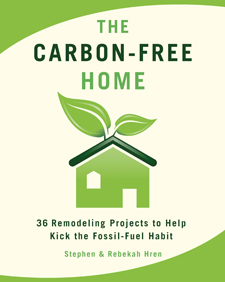
The answer to that is it all adds up. As is the case in the current global economic crisis, the “butterfly effect” also works on carbon emissions, hence accumulations of local reductions will have a positive global impact. So we are not alone in reducing our carbon-footprint as you will be able to read in this book: ‘The Carbon-Free Home’ by Stephen and Rebekah Hren.

The authors have gone through several phases in their attempt to live in a carbon-free home and have gained many valuable insights they share from their experience.

Many of the eleven chapters not only include the technical nitty gritty but also personal stories which make reading this book more enjoyable. Some insights are quite remarkable and the authors also bravely admit their mistakes. One was moving out of the city only to find that their daily commuting cancelled out any carbon reductions they may have made in their green country house. They realized that ultimately moving back to the city and retrofitting existing houses is the preferable solution.

What's Next for Israel's Green Movement – Meimad?

3

green-movement-meimad-logoOfer Kot, #10 on the Green Movement – Meimad’s list of candidates for Israel’s Knesset, spent election day in February handing out the movement’s fliers to people at voting stations – as they were on their way out.

When asked why he was giving election fliers to people who had already voted, he replied: “To get people ready for the next elections.”

The Green Movement – Meimad, a collection of people with an exceptionally strong record of environmental activity in Israeli society, did not make it into the Knesset this time – although they came close. However, according to Daniel Orenstein, a Post-Doctoral Fellow at the Technion’s Center for Urban and Regional Studies and the man behind the movement’s “Unofficial Blog”, the Green Movement – Meimad is just getting started, and is already planning its campaign for the next Knesset elections.

Fridge Voyeurism in Tel Aviv

5

fridge-voyeur-israel-photo

Are you an organic food addict? Or do you insist on eating food that grown locally, but pesticide-ridden, to spare food miles (or to serve an ideology?)

As food production is a major source of greenhouse gas pollution (Read: Global Warming), eating locally, and consuming less meat is one way we can do our part.

Following a worldwide trend, where people are opening up their fridge to show people what’s in their fridge (and on their palette) today I will expose myself and show you what’s in mine. It feels a bit like opening my underwear drawer to strangers, but here goes:

fridge-voyeur-tel-aviv-photo

CONTENTS (Door on right): Bio eggs, butter, organic strawberry jam, milk, mustard, sundried tomatoes, pomegranate concentrate, goat’s milk yogurt, V8, tehina, capers, guava juice, orange juice, batteries (not for eating!), coconut juice, goat’s yogurt, and the old Canadian maple syrup (thanks Mom!).

SOURCE: There are a number of imported items here like the V8 from North America and the juice from Egypt. The jam is from the United States. Phoeey on me, but it looked so good. And the pomegranate concentrate, I think is from Turkey, while syrup is from Canada. All the milk products are produced locally and bought at Eden Teva market or local non-organic shops. Milk costs about $1.50 a liter in Israel (non-organic), the organic yogurt about $3 a bottle.
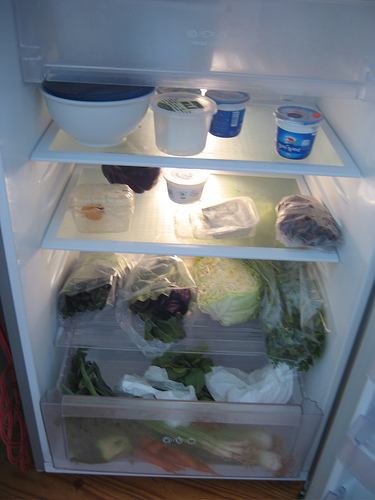
fridge-voyear-photo

CONTENTS: (from top to bottom, left to right) organic lentil sprouts, organic goat’s cheese, chessick fruit, soft regular white cheese 5%, organic red cabbage part of a weekly CSA veggie box delivery (choose from a list of CSAs here if you live in Israel); more cheese including a Rockfort goat’s cheese, Syrian dates, spicy lettuces, cabbage, parsley, green onions, carrots, leaks, tomatoes, radishes, cucumbers, and spinach.

SOURCE: Vegetables come from an organic farm, which delivers a box of whatever’s in season, once a week. Some of the cheese is from Eden Teva market, a health food store in Bnei Brak; some cheese is from Arab supermarket on the corner nearby my house.

Reducing food miles is important to me from an environmental perspective. I try to eat locally produced food, and things which are in season.
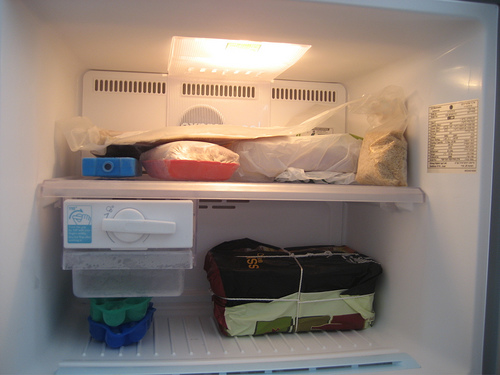
fridge-voyeur-israel

CONTENTS: It being Passover in Israel means that a lot of the bread products you might see here other times of the year have been cleaned out, eaten or burned, as per Jewish custom. Moving on, there is some sort of white fish, hamburger organic and regular, rice (stored in freezer to keep the bugs out), and a strange kind of sheep tail fat (bottom right) for making a Bukharian food known as Osh Pollo.

It is wrapped like that because someone (on their request) was supposed to “smuggle” it to the US where no such sheep tail fat can be found. It stays frozen in the meantime. (As a once a week meat-eater, Osh Pollo is very yummy and highly recommended.)

SOURCE: The frozen products come from Eden Teva Market, a health food store, a regular grocery store, and the sheep tail fat, a local market. Normally you won’t find so much meat in the freezer, as I tend to buy it when I want it. I have no idea how much meat costs per kilo, because I buy it so rarely. The organic hamburger, enough to feed 4, cost about $25 for the box, times 2 what you see above.

Want to know more about fridge voyeurism? Read this past Green Prophet post on a fridge in Jerusalem.

 

Turning A Cement Truck Into Giant Soil Cleaning Technique

4

lego-cement-mixer-photo

Byproducts from the electronics, fuel, chemical and defense industries can be far from benign. Toxic heavy metals like cadmium and lead can seep into our food chain and cause cancer. And if found in the soil, these dangerous materials can render parks off-limits and real estate worthless.

For environmental, health and financial reasons, new solutions are needed to help clean industrial chemicals from America’s soil.

Now, an innovative Tel Aviv University soil-cleaning technique, which turns a cement truck into a giant mixer, may change things for industry and environmental specialists. Prof. Amos Ullmann and Prof. Neima Brauner of TAU’s Faculty of Engineering and Prof. Eliora Ron of the Faculty of Life Sciences, in cooperation with Israeli researcher Dr. Zvi Ludmer, are working on a new cleaning agent that binds to and whisks dangerous materials away from the soil, leaving desirable minerals intact.

“My colleagues have developed a system that literally washes the soil,” says Dr. Michael Gozin of TAU’s School of Chemistry. Their top-secret formulation, now in the early stages of research and development, will make it possible for truckloads of contaminated earth to be cleaned in a cement mixer. The compound not only leaves life-sustaining nutrients in the soil, but it’s also biodegradable and environmentally safe

El Salvador Copies Israel's National Forestry Model To Combat Environmental Destruction

3

tree-planting-israel-woman-jnf-photo

There is only one nation in the world that has a net gain of trees over the past 100 years. While other countries, developing and developed, have been actively harvesting and lobbing trees down in the name of progress, Israel’s national organization the KKL-JNF (Keren Kayemeth LeIsrael – Jewish National Fund) has made it a national priority to plant trees in Israel, and to look after them.

Decades before tree planting became a hippy’s dream summer job in Canada, and a responsible thing to do for the environment, Israelis were already making it a national priority, calling on Jews from the Jewish Diaspora or people who wanted to support the Holy Land, to donate money to help plant trees.

That’s why today around the hills of Jerusalem, there are forests planted by nations from all around the world, such as the US, Canada and Mexico. Even America’s Kennedy Family visited Jerusalem and planted a living monument, trees in the name of past President John F. Kennedy, there. The Yad Kennedy monument, outside of Jerusalem, overlooks the very spot where the trees were planted, the John F. Kennedy Peace Forest.

Over the years, Israel’s KKL-JNF foresters have earned international acclaim for the work they do. They select drought hearty-species to cope with the arid land in Israel. And due to their expertise in forestry and fighting forest fires, Israel’s KKL-JNF has a number of cooperation projects with countries all over the world, including Australia and Spain.

Can't Take The Heat of Global Warming? Rafael Reuveny Says Ecomigration Drastic Measure to Survive Climate Change

3

eco migration africa photo

Why would a prominent Israeli-born professor at Indiana University decide to change his research emphasis from economics and political science to climate change and ecomigration? And to move from Israel to the United States?

Ecomigration is not an entirely crazy idea, and some western people have already started planning and moving to the most suitable locations for the best post-climate change scenario. 

Perhaps the answer to this professor’s career switch lies in what may be our eventual destiny on this planet, especially in light of global warming and climate changes.

“This is an absolutely rational way to do things,” said Reuveny, who moved from Israel to Indiana with an eye on environmental concerns. “When it comes to climate change, we tend to forget about it being better to be safe than sorry and say it is not going to be a problem,” he said in a recent Washington Post story.