Before promoting sustainability progress, companies must ensure their initiatives are genuine and measurable. Today’s audiences are increasingly skeptical of vague environmental claims, particularly as awareness of “greenwashing” has grown.
Sydney is best known for the Opera House and the Harbour Bridge. If you’re looking to enjoy dinner with views of these landmarks, here are some great options.
It's sea turtles which may in the end save islands in the Seychelles. They may also better help us understand climate change. Like rings on a tree, scientists have found a way to read sea turtle shells and how they are impacted by climate change tells a story.
For centuries, the Sámi shaman drum was one of the most powerful sacred objects in northern Europe, and one of the most feared by church and state. If ISIS looks bad to us today for its religious fundamentalism, Christians were just as fervent.
Before promoting sustainability progress, companies must ensure their initiatives are genuine and measurable. Today’s audiences are increasingly skeptical of vague environmental claims, particularly as awareness of “greenwashing” has grown.
Sydney is best known for the Opera House and the Harbour Bridge. If you’re looking to enjoy dinner with views of these landmarks, here are some great options.
It's sea turtles which may in the end save islands in the Seychelles. They may also better help us understand climate change. Like rings on a tree, scientists have found a way to read sea turtle shells and how they are impacted by climate change tells a story.
For centuries, the Sámi shaman drum was one of the most powerful sacred objects in northern Europe, and one of the most feared by church and state. If ISIS looks bad to us today for its religious fundamentalism, Christians were just as fervent.
Before promoting sustainability progress, companies must ensure their initiatives are genuine and measurable. Today’s audiences are increasingly skeptical of vague environmental claims, particularly as awareness of “greenwashing” has grown.
Sydney is best known for the Opera House and the Harbour Bridge. If you’re looking to enjoy dinner with views of these landmarks, here are some great options.
It's sea turtles which may in the end save islands in the Seychelles. They may also better help us understand climate change. Like rings on a tree, scientists have found a way to read sea turtle shells and how they are impacted by climate change tells a story.
For centuries, the Sámi shaman drum was one of the most powerful sacred objects in northern Europe, and one of the most feared by church and state. If ISIS looks bad to us today for its religious fundamentalism, Christians were just as fervent.
Before promoting sustainability progress, companies must ensure their initiatives are genuine and measurable. Today’s audiences are increasingly skeptical of vague environmental claims, particularly as awareness of “greenwashing” has grown.
Sydney is best known for the Opera House and the Harbour Bridge. If you’re looking to enjoy dinner with views of these landmarks, here are some great options.
It's sea turtles which may in the end save islands in the Seychelles. They may also better help us understand climate change. Like rings on a tree, scientists have found a way to read sea turtle shells and how they are impacted by climate change tells a story.
For centuries, the Sámi shaman drum was one of the most powerful sacred objects in northern Europe, and one of the most feared by church and state. If ISIS looks bad to us today for its religious fundamentalism, Christians were just as fervent.
Before promoting sustainability progress, companies must ensure their initiatives are genuine and measurable. Today’s audiences are increasingly skeptical of vague environmental claims, particularly as awareness of “greenwashing” has grown.
Sydney is best known for the Opera House and the Harbour Bridge. If you’re looking to enjoy dinner with views of these landmarks, here are some great options.
It's sea turtles which may in the end save islands in the Seychelles. They may also better help us understand climate change. Like rings on a tree, scientists have found a way to read sea turtle shells and how they are impacted by climate change tells a story.
For centuries, the Sámi shaman drum was one of the most powerful sacred objects in northern Europe, and one of the most feared by church and state. If ISIS looks bad to us today for its religious fundamentalism, Christians were just as fervent.
Before promoting sustainability progress, companies must ensure their initiatives are genuine and measurable. Today’s audiences are increasingly skeptical of vague environmental claims, particularly as awareness of “greenwashing” has grown.
Sydney is best known for the Opera House and the Harbour Bridge. If you’re looking to enjoy dinner with views of these landmarks, here are some great options.
It's sea turtles which may in the end save islands in the Seychelles. They may also better help us understand climate change. Like rings on a tree, scientists have found a way to read sea turtle shells and how they are impacted by climate change tells a story.
For centuries, the Sámi shaman drum was one of the most powerful sacred objects in northern Europe, and one of the most feared by church and state. If ISIS looks bad to us today for its religious fundamentalism, Christians were just as fervent.
Before promoting sustainability progress, companies must ensure their initiatives are genuine and measurable. Today’s audiences are increasingly skeptical of vague environmental claims, particularly as awareness of “greenwashing” has grown.
Sydney is best known for the Opera House and the Harbour Bridge. If you’re looking to enjoy dinner with views of these landmarks, here are some great options.
It's sea turtles which may in the end save islands in the Seychelles. They may also better help us understand climate change. Like rings on a tree, scientists have found a way to read sea turtle shells and how they are impacted by climate change tells a story.
For centuries, the Sámi shaman drum was one of the most powerful sacred objects in northern Europe, and one of the most feared by church and state. If ISIS looks bad to us today for its religious fundamentalism, Christians were just as fervent.
Before promoting sustainability progress, companies must ensure their initiatives are genuine and measurable. Today’s audiences are increasingly skeptical of vague environmental claims, particularly as awareness of “greenwashing” has grown.
Sydney is best known for the Opera House and the Harbour Bridge. If you’re looking to enjoy dinner with views of these landmarks, here are some great options.
It's sea turtles which may in the end save islands in the Seychelles. They may also better help us understand climate change. Like rings on a tree, scientists have found a way to read sea turtle shells and how they are impacted by climate change tells a story.
For centuries, the Sámi shaman drum was one of the most powerful sacred objects in northern Europe, and one of the most feared by church and state. If ISIS looks bad to us today for its religious fundamentalism, Christians were just as fervent.
In memory of the murdered Nigerian environmental activist who campaigned against Shell, we look at the importance of environmental action in the Middle East
On the 10th of November 1995, Ken Saro-Wiwa who had campaigned against the environmental devastation caused to the Niger Delta by oil companies such as Shell, was hanged by the Nigerian military government.
Israeli volunteers joined others worldwide on November 1st, in an international movement to “clean up” our environmental act.
The 11th annual International Cleanup Day activities in Israel, which took place on November 1st, were attended by 204 regional Israeli councils, 260,000 volunteers, environmental VIPs, and one solar powered taxi (driven by Swiss inventor Louis Palmer who is driving across the globe in his eco-friendly vehicle). The Cleanup Day was also observed by 40 million other people in 120 countries, who all set out to raise environmental awareness and, well, clean up.
KKL-JNF World Chairman Efi Stenzier, who attended the Cleanup Day ceremony in Ben Shemen Forest, said that “volunteers who participate in Cleanup Day are from all sectors and religions. Our message is clear and simple. If we are capable of cleaning up the forest, we can guarantee that the whole country will be cleaner. It depends on each and every one of us.”
[youtube]http://www.youtube.com/watch?v=_yXy4YGOyvU&feature=youtu.be[/youtube]If you thought that Emiratis lacked a sense of humor, you obviously haven’t seen this!
This isn’t necessarily green news, but it does have potential for sparking green activism projects: At the end of October 55 people posing as airport personnel and other normal citizens broke out in a well-rehearsed dance at the Dubai International Airport. It was a “flash mob” and it took months to organize. The film of the event has gone viral with thousands of hits within hours of being posted on YouTube.
Scott Marshall from Dubai-based Diverse Choreography was responsible for the high-energy routines that amassed hundreds of happy travelers. Real airport workers knew that the event was going to take place, so this isn’t a case of crazy westerners hijacking the Emirate airport. Instead, the mob dance was a marketing ploy sponsored by the airport to draw attention to the DXB Connect Debit Card.
This just goes to show that despite all the fun poked at rich sheikhs like Hamad, who carved his name into a beach so that it would be visible from space, and gold mercedes drivers, the Emiratis have a sense of adventure and humor. We hope that their willingness to hold a flash mob event, which definitely flouts convention, bodes well for future environmental policies as well!
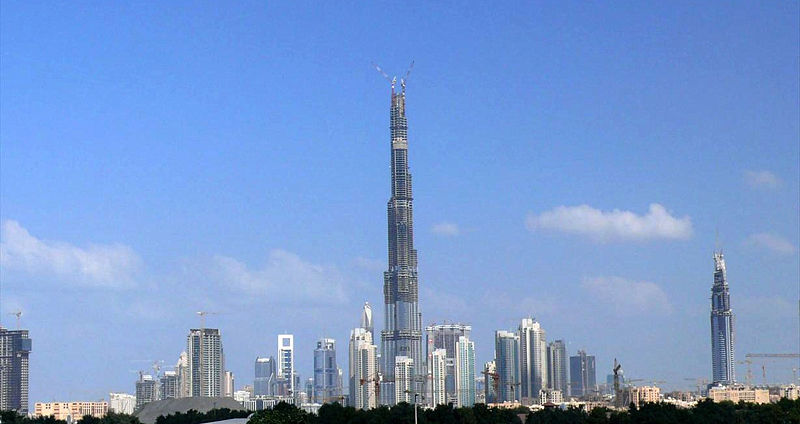
After having a hefty meal at the restaurant on the top of the World’s Tallest Building in Dubai… you excuse yourself from the table and head to the W.C…and without even thinking about it, you flush the toilet.
Where does the poop go?
We wish we could take credit for being the first to ask this question about Burj, in the United Arab Emirates. It’s the world’s tallest building but has no sewage system.
All due credit aside, did you ever wonder what happens when a toilet is flushed on the 100th floor of a high-rise? And where all that poop and pee lands up when it finally makes it back down to earth? If so, read on…
After having a hefty meal at the restaurant on the top of the World’s Tallest Building in Dubai, maybe you even secretly indulged in Hamour – one of the UAE’s most endangered fish species, you excuse yourself from the table and head to the toliet.
You do what everybody does and without even thinking about it, you flush the toilet.
Your number one and two then travels 160 floors at breakneck pace, past luxury apartments, gravity interrupted by a sophisticated system of bends in the pipes that slows it down. These pipes are soundproofed by the way, because nobody wants to listen to traveling excrement all day.
Anywhere else in the world, the waste would land in a septic system and then slowly make its way to the municipal wastewater treatment plant. In greener buildings, it might even go through a network of filters so that it can be re-used for landscaping or flushing more toilets.
But this is not what happens at the Burj Khalifa. The sewage system at the Burj is non-existent.
Some unfortunate soul – mostly likely several actually – collect the waste by truck. Gizmodo estimates that at full occupancy that could amount to a good 13 tonnes of human excrement every day, but the Burj isn’t operating at full occupancy, so let’s reduce that number. Let’s cut it down to 8 tonnes – a very conservative number. You have to admit, that’s still a lot of sh#t.
Ok, what then?
Well, since the Burj Khalifa was built in such haste that nobody thought about where the poop would go, those souls have to drive this high falutin’ waste to a wastewater treatment plant, where they often stand in line for up to 24 hours to deposit their pungent truckload.
[youtube]http://www.youtube.com/watch?v=ILlF34KJMJw[/youtube]Take a new tour through the Masdar Institute with this video.
Modeling traditional Arabic cities and using old innovation like windcatchers, Masdar has become an expensive showcase for sustainable living in the Middle East. The above video gives a tour of some of the renewable energy initiatives there, like heliostats, and its pod cars. I love the idea of incubating science fiction “green energy” ideas in the real world, but where are the people in this so-called sustainable community? Did the directors tell them to disappear when the cameraman arrived?
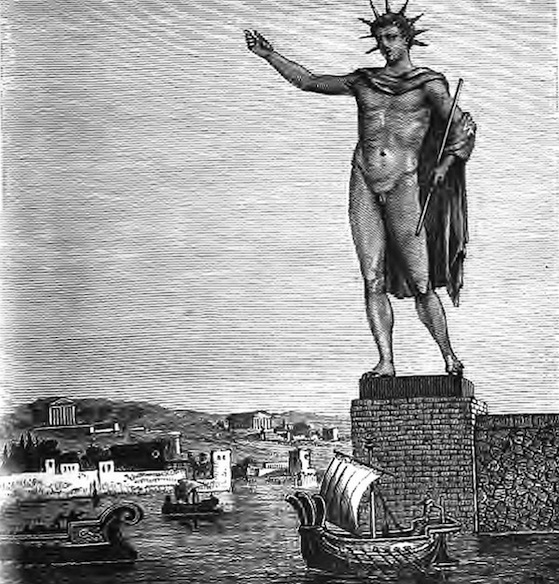
Helios, the sun god of ancient Greece could help Greece get out from under.
Here’s a surprise twist. The economic woes in Europe due to Greek debt may result in Greece supplying huge amounts of cheap solar power for Europe, by way of paying back its debts, but in the process creating rivalry with Desertec, the visionary plan to supply 15% of Europe’s energy from the deserts of the MENA region. Greece is in the process of arranging financing for a gigantic 10,000 megawatt $30 billion solar project that could be its ticket out of its financial woes.
The solar project, named Helios (the ancient Greek god of the sun) would just lay around and soak up gorgeous Greek sunshine and spit out free electrons for 25 years. The staggering amount of revenues generated would be used to pay down its debt.
Be prepared for some carbon monoxide withdrawal in Tripoli: Air pollution is Lebanon is getting bad. Local youths have appealed to the Environment Ministry to close the city to cars this coming Sunday. While it is documented that car-less cities and suburbs like Vauban in Germany may bring other problems for the elderly who need to lug around groceries, over all the sound of a car-less Middle East is music to my ears.
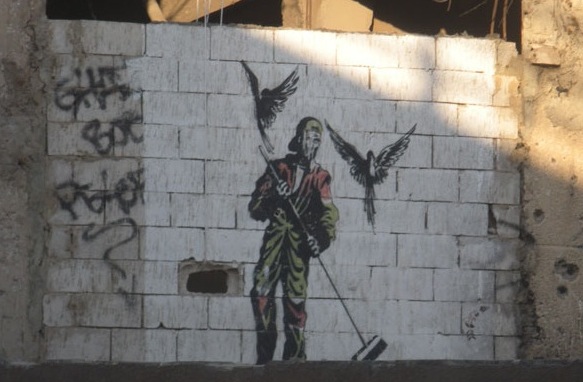
A do-gooder designer in Beirut launches poster campaign to give respect to street cleaners.
I aspire to see the day when we no longer need street cleaners. Citizens in the Middle East will have a moment of enlightenment and from that day forward stuff candy bar wrappers in their pocket, or place in appropriate waste disposal bins. Until that happens, we need to better appreciate our street cleaners – the Sukleen contracted street cleaners – argues an activist in Beirut, Lebanon.
Islam’s Zabiha method of slaughter came in the line of fire this year when Holland banned ritual slaughter. When one hears counter arguments from animal rights activists and even Muslims who live vegetarian lifestyles, the idea of killing another creature can seem unnecessary, cruel and inorganic, especially in a religious context. Yet, the Islamic faith recognises these concerns and answers them. Traditionally, Muslims carry out a meat Qurbaan (sacrifice) every year for the Eid-ul-Adha festival and slaughter animals for food using the zabiha method any other time.
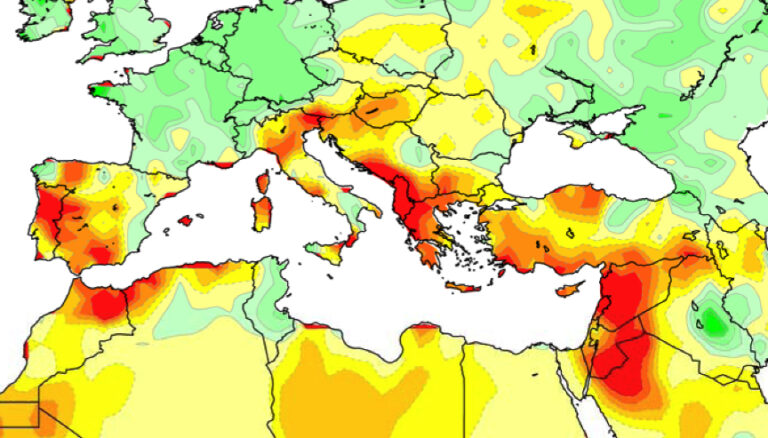
According to recent research, an increase in wintertime droughts in the Mediterranean is partly down to human-caused climate change
Over the last 20 years, 10 of the driest winters have taken place in the Mediterranean region that stretches from Gibraltar to the Middle East. As the region accumulates most of its precipitation during the wintertime, an increased dryness during this season is particularly worrying. According to scientist, this emerging trend may have a significant impact on water resources and food security in the future.
You may be eating a dead person’s hair in your commercially-baked bread. Watch out for L-cysteine if you’re queasy.
It’s name is inconspicuous enough, not something that would make the average consumer squirm as they read the ingredients label on a loaf of bread. The problem isn’t what L-cysteine does – it’s a non-essential amino acid used by many commercial bakers to condition the dough – but where it comes from: human hair. According to NaturalNews.com, much of it is from China, a country with a less than glowing track record for food contaminants.
A specialty of the Middle East, stuffed zukes are favorites with young and old.
In a Tel Aviv supermarket, I watched a mother soothing her tired, hungry little boy. “Just another few minutes, and then we’ll go to Grandmother’s house for lunch!” The little boy sniffled, looked up, and asked, “Are there going to be memoula’im (stuffed vegetables)?”
You can bet that Grandmother had an array of stuffed zucchini, eggplants, and maybe artichoke hearts for her family. Although you can sometimes pick up the vegetables all ready for stuffing in Arabic grocery stores, countless Middle Eastern cooks still pride themselves on their skill at hollowing them out. I myself bought a special peeler with a long, curved blade for this in Nazereth. The video below taught me how to use it. And if you have freekah around, you might enjoy using it instead of rice in this recipe. Treat it exactly the same as the rice.
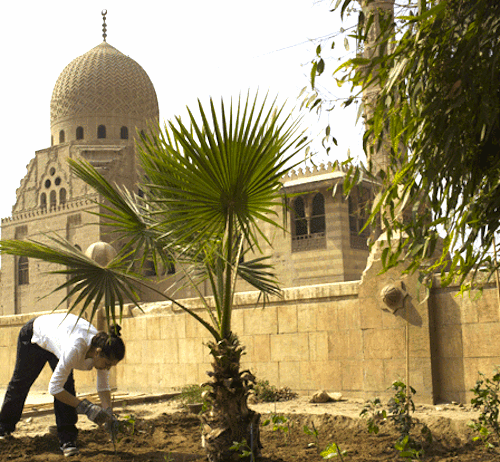
The City of the Dead in Cairo isn’t known for its fertile soil, but Liveinslums is working to change that with an awesome mini urban farming initiative.
Although everybody seems to understand that population growth is exploding, and that space – particularly in cities – comes at a premium, the extent of our vulnerability to soil erosion is less understood. Liveinslums addresses all of these problems with one inspiring program being developed in several countries around the world – including Egypt.
Cairo’s City of the Dead is both a cemetery and slum area in the country’s most densely populated city. And it’s not the most fertile part of town either. A Non-Governmental Organization (NGO), Liveinslums has worked with local architects and designers to help residents here grow microjardins – mini, soilless, and transportable subsistence gardens that also fertilize the sand.

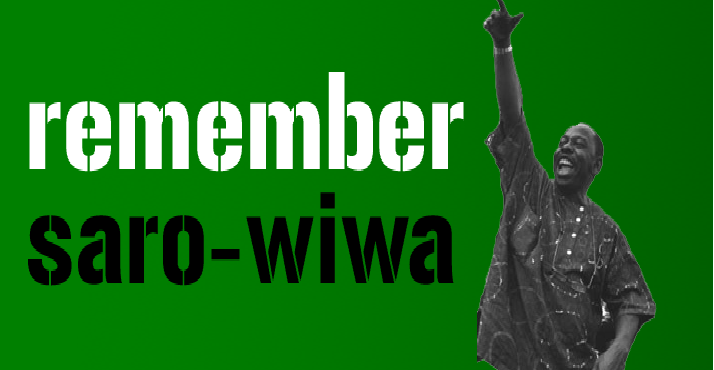
 In memory of the murdered Nigerian environmental activist who campaigned against Shell, we look at the importance of environmental action in the Middle East
 Bar’s out to save the Dead Sea -if the paparazzi will let her!