
I hate to buy new things and prefer vintage finds. But when it comes to a travel backpack, it’s wise to have something new and dependable. As an owner of the Cotopaxi Allpa 42L Travel Pack in light blue, priced at $250, I can confidently say it’s one of the best travel bags I’ve ever had. The design is both functional and stylish, with a suitcase-style opening that makes packing and organizing effortless. The internal compartments and mesh pockets keep everything in place, and I love the addition of a stretchable water bottle pocket and a luggage pass-through strap—it just makes traveling so much smoother.


One of the things I love most about this backpack is the color. The vibrant mix of blues and subtle color accents gives it a unique, personal feel—like it was made just for me. It’s not just another generic bag; it has character, and that makes me want to keep it for a long time. And that, in itself, is a form of sustainability—buying something you truly love and want to keep instead of replacing it frequently.
Related: how to pack your bags with the planet in mind
Beyond aesthetics, the sustainability aspect is a huge plus. Cotopaxi was founded by Davis Smith, an entrepreneur passionate about using business as a force for good. Inspired by his childhood in Latin America, where he saw both the beauty of nature and the struggles of poverty, he created Cotopaxi with a mission to give back. As a Certified B Corporation, Cotopaxi meets high social and environmental standards, ensuring that their products make a positive impact.
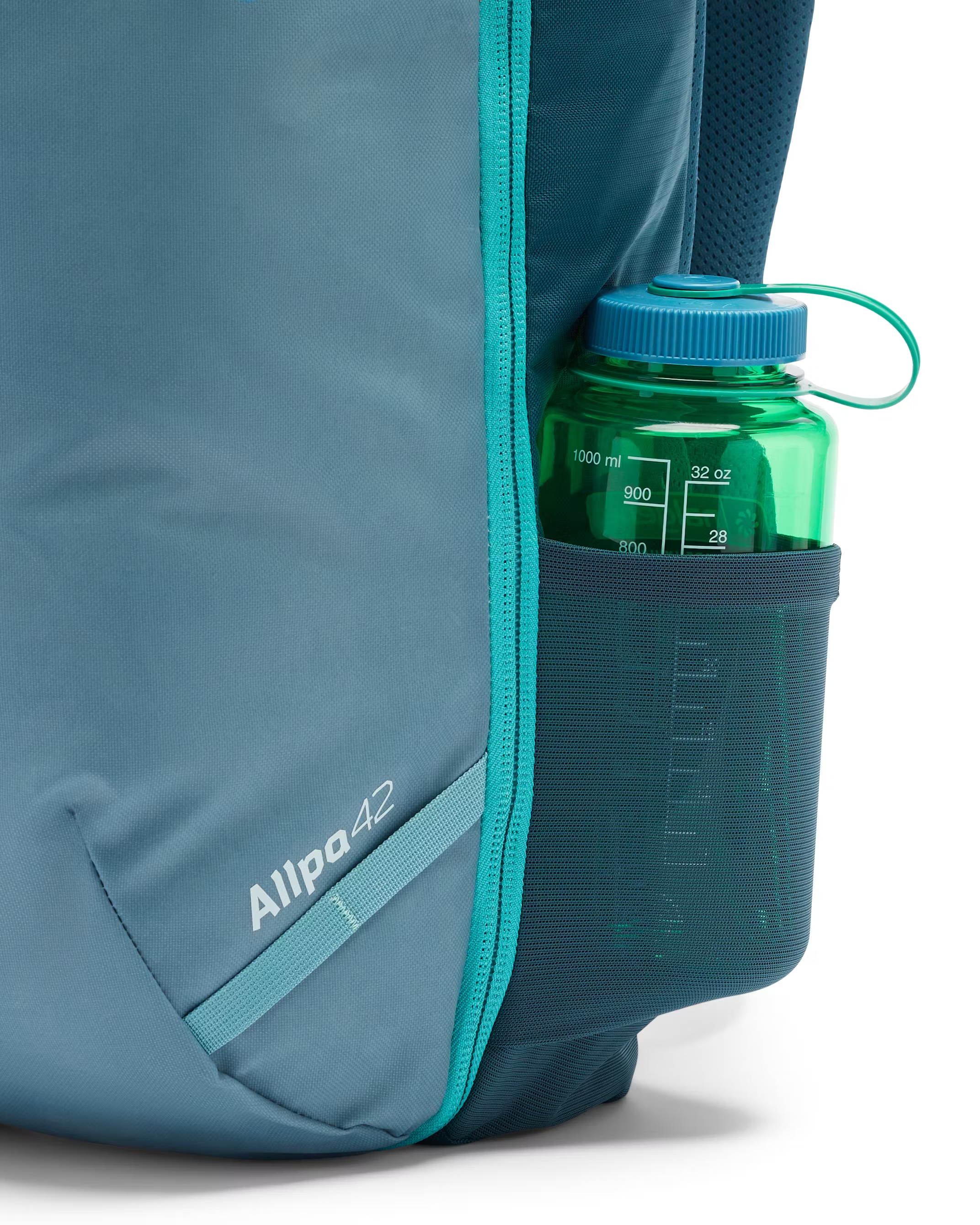
The Allpa 42L is made from 100% recycled polyester and repurposed nylon, reducing waste and keeping materials out of landfills. The company also focuses on fair labor practices by partnering with factories that ensure safe working conditions and fair wages for workers. Their Del Día collection uses leftover fabric from other companies’ production runs, preventing textile waste and creating one-of-a-kind designs. Cotopaxi also prioritizes carbon neutrality, offsetting emissions through environmental projects.
Related: wearable luggage ideas to beat Wizzair overcharges
Additionally, their Gear for Good initiative donates a portion of revenue to poverty alleviation, education, and environmental conservation efforts, particularly in underserved communities. Knowing that my purchase supports not just sustainability but also global humanitarian efforts makes me feel even better about this backpack.
Overall, the Cotopaxi Allpa 42L isn’t just a backpack—it’s a long-term travel companion. Between its durability, smart design, ethical production, and the personal connection I feel with its colors and craftsmanship, I know this is a bag I’ll cherish for years.
And because it’s made with sustainability in mind, I can travel knowing my purchase supports both the planet and the people who make these amazing bags.
:: Cotopaxi



![Academics from the University of Bath have issued a new resource on the potential for regenerative design to deliver net-positive benefits, as well as actionable principles for change. RENEW: a manifesto for regenerative design and engineering is a 35-page electronic guidebook developed by the university’s Centre for Regenerative Design & Engineering for a Net Positive World (known as RENEW). A top 10 ranked university in the U.K., the University of Bath has demonstrated international leadership in research dedicated to achieving climate resilience, decarbonization, and a healthy future for the planet. The RENEW center takes a cross-disciplinary approach to developing systems for the built environment that harmonize benefits to society with the natural world. RENEW combines expertise from more than 40 academics, researchers, and industry stakeholders in water and chemical engineering, materials and composites, and placemaking and architecture with social science, economic, governance, and ecological studies. Image courtesy of the University of Bath The University of Bath’s Centre for Regenerative Design & Engineering for a Net Positive World (RENEW) has released a guidebook focused on defining regenerative design and expanding awareness of its prospects. Left to right: Dr. Juliana Calabria-Holley, co-director; Prof. Sukumar Natarajan, director; and Dr. Emma Emanuelsson, co-director. The University of Bath’s Centre for Regenerative Design & Engineering for a Net Positive World (RENEW) has released a guidebook focused on defining regenerative design and expanding awareness of its prospects. Left to right: Dr. Juliana Calabria-Holley, co-director; Prof. Sukumar Natarajan, director; and Dr. Emma Emanuelsson, co-director. Regenerative > Sustainable? Technology, science, and education have long focused on improving the human experience—such as by extending life expectancy worldwide—and evolving the spaces where we live, work, and play, but have done so through “extractive, non-regenerative practices,” said RENEW members in the manifesto. Sustainability has been championed for four decades to manage and minimize damage to the Earth’s resources but has been slow to penetrate the industrialized world. The guidebook’s authors note that contemporary net-zero emissions efforts and global climate target policies do not prescribe a way forward for “human systems to contribute positively to natural systems.” In order to adequately mitigate the impacts of climate change, improve biodiversity, and rebalance social inequities, the RENEW manifesto authors indicate that society requires an evolution from resource exploitation to a framework that prioritizes restoration of the global ecosystem. Image courtesy of the University of Bath Cover image for RENEW: a manifesto for regenerative design and engineering “Regenerative design, as a philosophy and practice, aims not merely to limit the damage we cause to the environment but to restore natural systems.” In an announcement launching the RENEW guidebook, center director and professor Sukumar Natarajan said that the initiative is designed to provide guiding principles for engineering, architecture, and other disciplines that enable society to “create resilient, fair communities that can thrive in balance with nature, while improving standards of living.” Six Principles of Regenerative Design The RENEW manifesto lays out six guiding principles of regenerative design, then offers a framework for putting them into practice. The six principles include: Reflective governance—Establish continuously evolving metrics and monitoring practices to track progress and impact. Embrace interconnectivity—Recognize that the world is intricate and interdependent. Take a holistic view accounting for the dynamic relationships between ecosystems and communities. Work as nature—Work harmoniously with and as nature. Design systems that work as part of species and ecosystem patterns, processes, and cycles. Prioritize net positive—Prioritize regeneration, replenishment, and restoration, recovering and reusing waste to create net-positive solutions and an abundance of resources. The aim should be to repair, sustain, and enrich the planet, rather than deplete its precious resources. Cultivate resilience—Systems should be designed with a capacity to adapt, diversify, and self-renew even in the face of uncertainty, change, and disturbances. Transmit—Document, curate, and publicize to help proliferate best practice through active discourse on a global scale. The authors concluded that the guide is intended as a foundation for continuously evolving this multidisciplinary approach to solving building/engineering problems. Center co-director Emma Emanuelsson observed that “We want this manifesto to help create a less anxious future for today’s young people, and for humans and nature to prosper in equal measure. […It] may not show us the full journey, but it does have advice and a framework to allow us to get started.” For the full guidance, readers can download RENEW: a manifesto for regenerative design and engineering free of charge from the University of Bath’s website.](https://www.greenprophet.com/wp-content/uploads/regenertive-design-bath.avif)




 During the Spring Meeting in