Health insurance is a regulated financial product. Insurers operate under binding contracts, overseen by state insurance commissioners, that legally obligate them to pay claims meeting policy terms. Policyholders who believe a covered claim was wrongfully denied have legal recourse through state regulatory channels.
The New Zealand Merino Company, now rebranded as Zentera, has quietly removed the phrase “world’s leading ethical wool brand” from its website, a notable change that comes after a disturbing investigation by PETA Asia-Pacific into the company’s ZQ-certified wool supply chain, PETA reports to Green Prophet.
Somehow vegetables with short seasons excite the imagination and appetite more sharply than produce that’s available all year around. Good Middle Eastern cooks have many recipes for delicate fava beans, and this turmeric-fragrant soup is one.
Health insurance is a regulated financial product. Insurers operate under binding contracts, overseen by state insurance commissioners, that legally obligate them to pay claims meeting policy terms. Policyholders who believe a covered claim was wrongfully denied have legal recourse through state regulatory channels.
The New Zealand Merino Company, now rebranded as Zentera, has quietly removed the phrase “world’s leading ethical wool brand” from its website, a notable change that comes after a disturbing investigation by PETA Asia-Pacific into the company’s ZQ-certified wool supply chain, PETA reports to Green Prophet.
Somehow vegetables with short seasons excite the imagination and appetite more sharply than produce that’s available all year around. Good Middle Eastern cooks have many recipes for delicate fava beans, and this turmeric-fragrant soup is one.
Health insurance is a regulated financial product. Insurers operate under binding contracts, overseen by state insurance commissioners, that legally obligate them to pay claims meeting policy terms. Policyholders who believe a covered claim was wrongfully denied have legal recourse through state regulatory channels.
The New Zealand Merino Company, now rebranded as Zentera, has quietly removed the phrase “world’s leading ethical wool brand” from its website, a notable change that comes after a disturbing investigation by PETA Asia-Pacific into the company’s ZQ-certified wool supply chain, PETA reports to Green Prophet.
Somehow vegetables with short seasons excite the imagination and appetite more sharply than produce that’s available all year around. Good Middle Eastern cooks have many recipes for delicate fava beans, and this turmeric-fragrant soup is one.
Health insurance is a regulated financial product. Insurers operate under binding contracts, overseen by state insurance commissioners, that legally obligate them to pay claims meeting policy terms. Policyholders who believe a covered claim was wrongfully denied have legal recourse through state regulatory channels.
The New Zealand Merino Company, now rebranded as Zentera, has quietly removed the phrase “world’s leading ethical wool brand” from its website, a notable change that comes after a disturbing investigation by PETA Asia-Pacific into the company’s ZQ-certified wool supply chain, PETA reports to Green Prophet.
Somehow vegetables with short seasons excite the imagination and appetite more sharply than produce that’s available all year around. Good Middle Eastern cooks have many recipes for delicate fava beans, and this turmeric-fragrant soup is one.
Health insurance is a regulated financial product. Insurers operate under binding contracts, overseen by state insurance commissioners, that legally obligate them to pay claims meeting policy terms. Policyholders who believe a covered claim was wrongfully denied have legal recourse through state regulatory channels.
The New Zealand Merino Company, now rebranded as Zentera, has quietly removed the phrase “world’s leading ethical wool brand” from its website, a notable change that comes after a disturbing investigation by PETA Asia-Pacific into the company’s ZQ-certified wool supply chain, PETA reports to Green Prophet.
Somehow vegetables with short seasons excite the imagination and appetite more sharply than produce that’s available all year around. Good Middle Eastern cooks have many recipes for delicate fava beans, and this turmeric-fragrant soup is one.
Health insurance is a regulated financial product. Insurers operate under binding contracts, overseen by state insurance commissioners, that legally obligate them to pay claims meeting policy terms. Policyholders who believe a covered claim was wrongfully denied have legal recourse through state regulatory channels.
The New Zealand Merino Company, now rebranded as Zentera, has quietly removed the phrase “world’s leading ethical wool brand” from its website, a notable change that comes after a disturbing investigation by PETA Asia-Pacific into the company’s ZQ-certified wool supply chain, PETA reports to Green Prophet.
Somehow vegetables with short seasons excite the imagination and appetite more sharply than produce that’s available all year around. Good Middle Eastern cooks have many recipes for delicate fava beans, and this turmeric-fragrant soup is one.
Health insurance is a regulated financial product. Insurers operate under binding contracts, overseen by state insurance commissioners, that legally obligate them to pay claims meeting policy terms. Policyholders who believe a covered claim was wrongfully denied have legal recourse through state regulatory channels.
The New Zealand Merino Company, now rebranded as Zentera, has quietly removed the phrase “world’s leading ethical wool brand” from its website, a notable change that comes after a disturbing investigation by PETA Asia-Pacific into the company’s ZQ-certified wool supply chain, PETA reports to Green Prophet.
Somehow vegetables with short seasons excite the imagination and appetite more sharply than produce that’s available all year around. Good Middle Eastern cooks have many recipes for delicate fava beans, and this turmeric-fragrant soup is one.
Health insurance is a regulated financial product. Insurers operate under binding contracts, overseen by state insurance commissioners, that legally obligate them to pay claims meeting policy terms. Policyholders who believe a covered claim was wrongfully denied have legal recourse through state regulatory channels.
The New Zealand Merino Company, now rebranded as Zentera, has quietly removed the phrase “world’s leading ethical wool brand” from its website, a notable change that comes after a disturbing investigation by PETA Asia-Pacific into the company’s ZQ-certified wool supply chain, PETA reports to Green Prophet.
Somehow vegetables with short seasons excite the imagination and appetite more sharply than produce that’s available all year around. Good Middle Eastern cooks have many recipes for delicate fava beans, and this turmeric-fragrant soup is one.
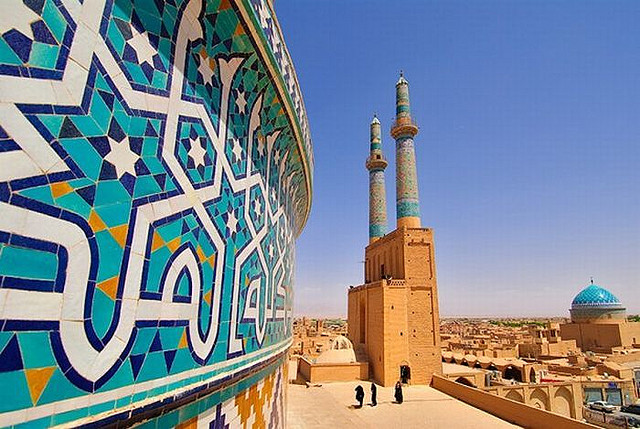
Sanctions have backed fossil-rich Iran into a corner, which could bode well for the country’s renewable sector.
The western-led sanctions against Iran have crippled the country’s ability to provide for its 74 million strong population, Reuters reports. Food prices have skyrocketed and many ships holding supplies are waiting for payment before allowing Iran to collect inventory. Meanwhile, sanctions have made conducting financial transactions virtually impossible. While the government’s failure to act could be disastrous for Iranian nationals, one potential upside is that the Energy Minister has recently admitted the importance of beefing up the country’s renewable energy sector.
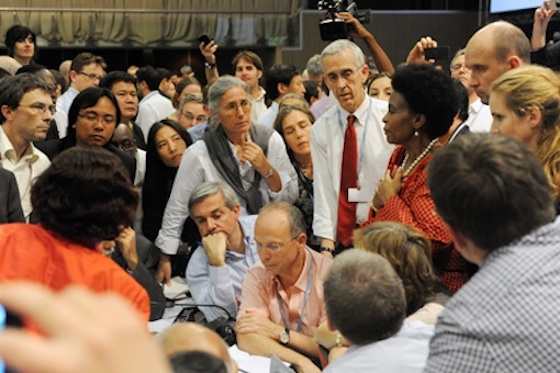
The funding for many of the great renewable energy projects within the Middle East and North Africa (MENA), and other developing regions, will continue to be directed via the World Bank, Reuters reports.
The funds support projects which cut climate-changing greenhouse gas emissions in developing nations under the EU’s cap & trade law, and is likely to be needed for the next five years while the UN designs the climate deal that will supercede it.
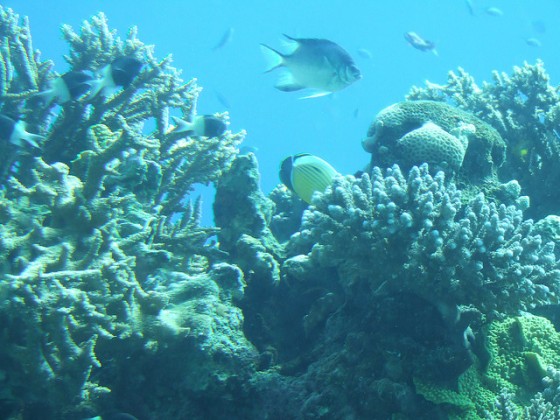
Eco-tourists may be able to get to see these underwater creatures in Eilat faster due to the construction of a railway line from Tel Aviv.
Eilat, located at the southern tip of Israel, draws both local and international tourists year-round due to its warm weather and marine biodiversity. Though not equipped with an international airport, it does receive domestic flights since the only alternatives are to drive yourself (which takes about six hours from Tel Aviv) or take a public bus (which takes even longer).
The Israeli Cabinet is hoping to improve public transportation to this popular destination and approved the construction of a new railway line from Tel Aviv to Eilat this week. The train would shorten the travel time to a speedy two hours.
Are Islamic banks anti-war? Islamic banks discourage investment in the arms and military industry as well as speculation and taking excessive risks
A couple of weeks ago, I was asked by a fantastic organisation to look into Islamic banking and how ethical it really is. Whilst I learnt that most Islamic banks may not have the best environmental record, I did discover that they do have some distinct ethical selling points. One of which is their reluctance to invest in the arms industry as well as an aversion to speculation and excessive risks which can destabilize the market. At a time when no-one trusts their bank, Islamic banking doesn’t look like such a bad alternative to the conventional profit-driven financial system.
Pay no attention to the fact that hundreds of partially unoccupied towers already line the Gulf shoreline: JW Marriott is building the world’s newest tallest hotel in Dubai.
72 Stories tall, the Rose Reyhaan Rotana on Sheikh Zayed Road currently holds the record as the world’s tallest hotel, but it is soon to be surpassed.
When the twin 1,165 feet JW Marriott Marquis Dubai hotel towers are complete, they will have ten additional floors each and 1,608 rooms between them.
An excellent time to get away from the cold weather, Thailand can easily become the Cancun or Ibiza for the Middle East. This week I’ve landed at the Japanese-influenced resort called Akyra. And while it is not a certified eco-hotel, which I am going to seek out and review later, there are a few elements of the resort that are in line with some of the values we might be looking for when looking to tread lighter on the planet. Of course sleeping on a beach bungalow without air-con is the best option for eco-travel in Thailand and something I do in Sinai. But not for me at this point in my life with a baby who’s now walking. I am looking for simplicity, quiet aesthetics and the kind of quality that will stand the test of time.
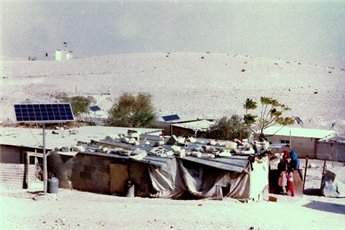
Palestinians living in Masafer Yatta who do not have access to the electrical grid have been developing home grown renewable energy plants.
Palestinians living in the Masafer Yatta village have been secretly pursuing wind and solar energy projects in order to mitigate a serious shortfall of energy in the village.
But the 150,000 residents that live in Area C, which has been under Israeli control since 1993, live in constant fear that Israeli authorities will demolish their projects. Why? Because Israelis are opposed to any new infrastructure projects that are built outside of construction and planning laws.
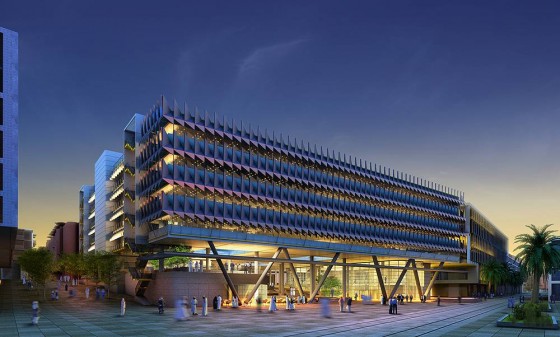
The MIPIM Architectural Review Future Projects Award in the office category acknowledges the resource-efficient construction’s contribution to Masdar’s overall goal to become a leading center of all things renewable and sustainable, and the designers will receive their prize at the MIPIM international real estate even in Cannes, France, on March 7.
Tu B’shvat, also known as the “Jewish New Year for trees”, marks the time that determines a tree’s age. It also commemorates the beginning of spring, and trees are often planted in celebration.
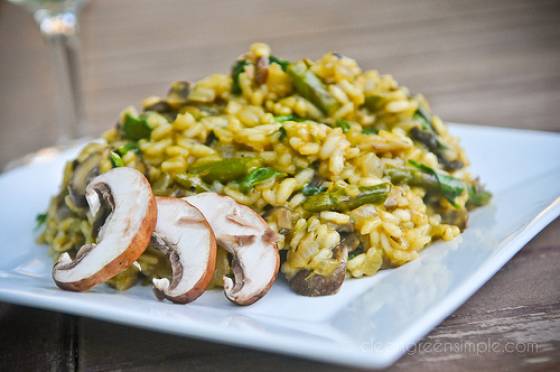
This creamy vegan rice dish, dotted with little chunks of aromatic asparagus, satisfies the taste for something substantial and savory.
Asparagus has been in the markets for some time in the Middle East. It’s worth buying it for this low-fat, creamy risotto. And don’t forget another great vegan recipe – Chickpea and Artichoke Salad. Two great dishes for a vegan buffet.
The winter months in the Middle East are the perfect time to travel to Thailand, especially with this year’s cold snap. Warm tropical temperatures hovering around 30, paired with a pineapple strip and a beach anywhere south of Bangkok can cure anyone’s winter blues.
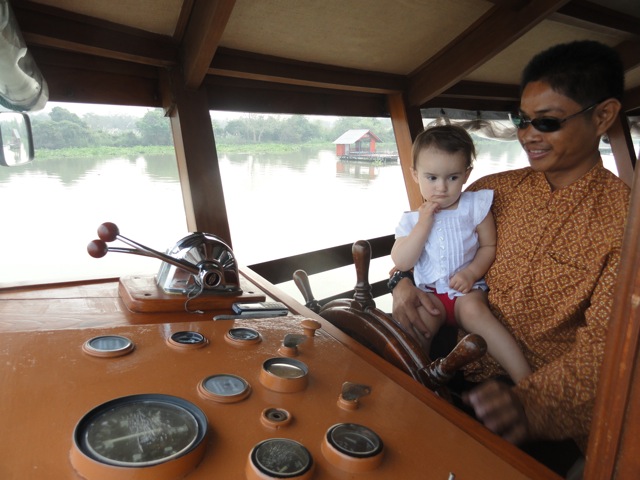
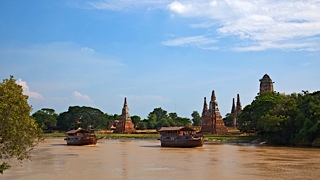
While Bangkok is fast, furious and very polluted, like the slow food movement, instead of lingering in Bangkok we decided to take a slow boat up the Chao Phraya River to the Ayutthaya province to see ancient ruins and the spirit of ancient Siam. And on this slow boat, The Mekhala Cruise (with an overnight luxury cabin) you can learn about good environmental stewardship by being among Thai people, and people of the river.
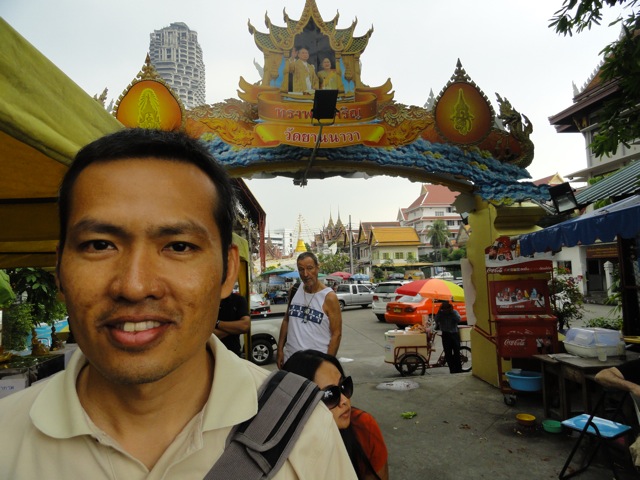
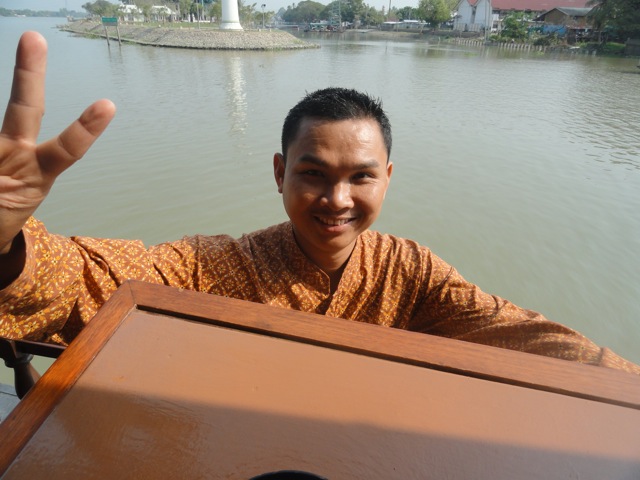
We boarded the boat at 1 PM and met with Teerapole (pictured just below) who we’d been coordinating with via email. We met at a well-traveled temple and on a small pier where the fish are protected from fishing.
He tells Green Prophet: “I think the river culture in Thailand is becoming something of the past. Not many tourists have an opportunity to see a simple way of lives of Thais since boat travel is less popular than other means of transportation. It’s also amazing to know how local people have learned to live with nature for centuries.”
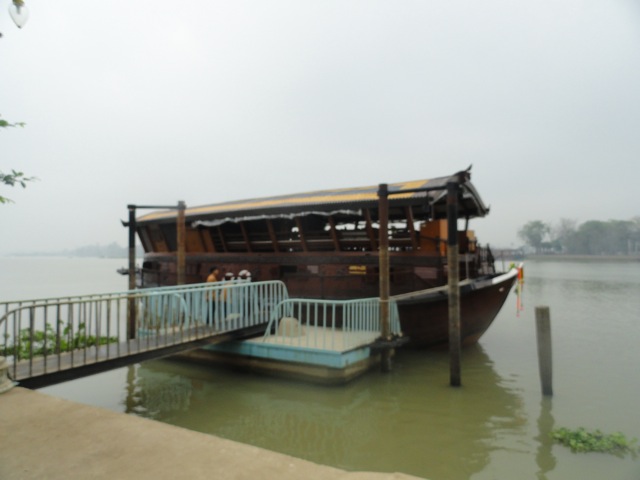
Over on the boat the group was small, about 15 of us, and we had ample space and privacy on the renovated rice barge, which is 92 years old. A covered deck protected us from the sun, and the occasional hot rain. Around 1:30 PM we pulled off the pier and headed up river, passing endless barges trucking goods like freight trains or Mac trucks to and from Bangkok.
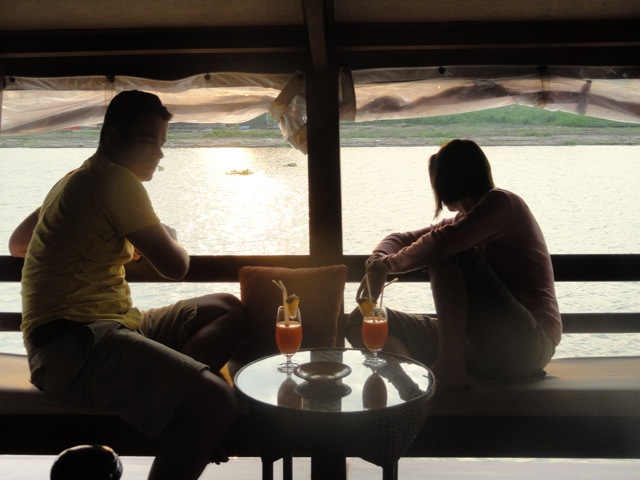
Don’t expect the excitement of the turquoise water you’ll find down in the south on this river trip. This is a well-traveled river, giving credence to Bangkok being the Venice of the East. The journey which will bring us finally at the banks of the King’s Summer Palace (the one from the movie The King and I) gave us ample time to think and imagine a different way of life so connected to the water, and so far from the thirsty Middle East from which we arrived.
Thai people do not lack water but they are still challenged with protecting what they have. Long over are the days when Thailand didn’t have to worry about water conservation. Water must be drank from bottles not as a luxury but a health precaution. The rivers around Bangkok are polluted and the country has no clear plan of action in sight. And winding our way down the river up to Ayutthaya we saw people toss kitchen waste into the water, and using it as a washtub for clothes or bathing. No doubt it is a toilet too.
Factories that line river, including the Singha Beer factory are contributors to industrial pollution in the river as well. There are over 30,000 industrial facilities that line the river, and many of these are in clear view as we chug along.
The drive to Ayutthaya from where we were in Bangkok takes about an hour and a half by car. The Mekhala Cruise about five hours at night, and a couple more in the morning. We enjoy the slowness of going up river.
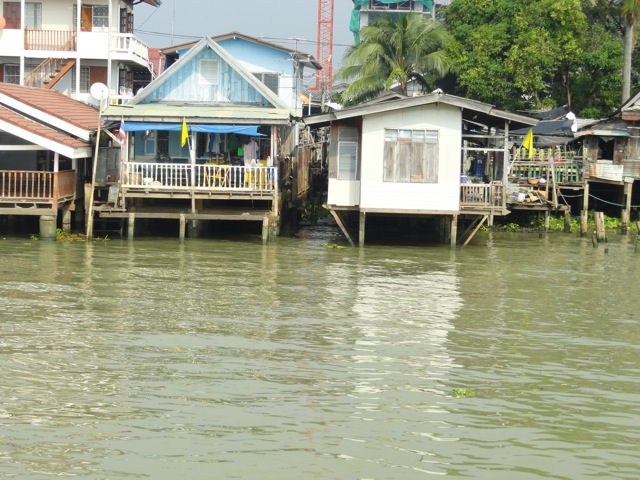
Along the way we couldn’t help but notice the sandbags, the general disorder and the waterline marked by paint or sand shadows, showing where the floodwaters had risen only three months ago. Even ancient river people attuned to the currents are not immune to the chaos of climate change.
But river people live simply, many of them parking their boats under their homes.
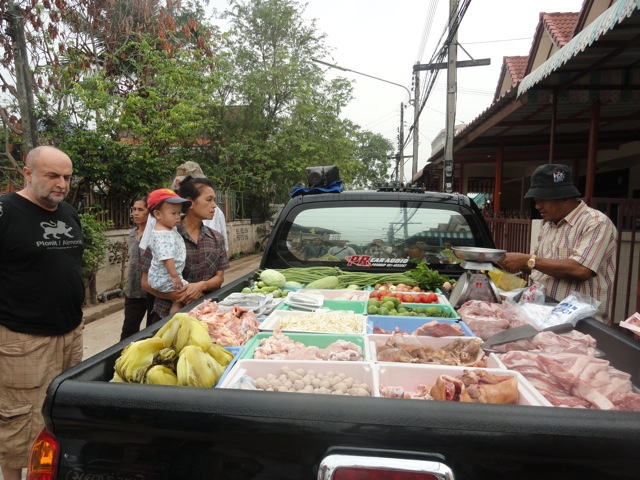
After a half day on board we get off to visit a fresh food market. Being a little late for the day, the pickings were slim. We returned home to find a wonderful candlelit dinner waiting for us. The food was the best so far that we’ve had in Thailand and the staff of four were very careful to make sure they prepared food to suit our dietary habits. I was eating lacto-ovo vegetarian and they got it without any explanation.
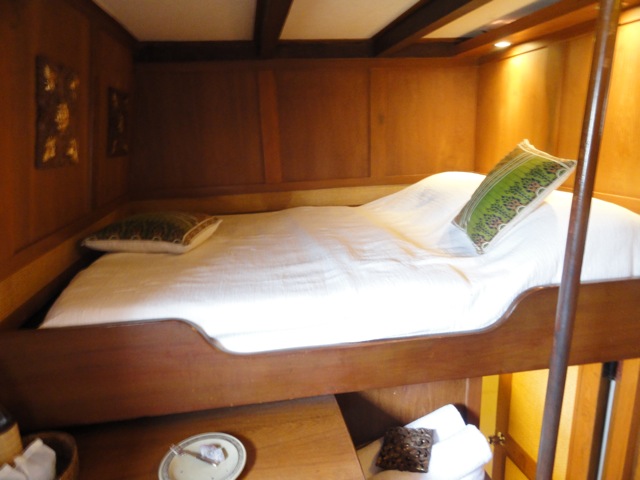
As for facilities you couldn’t be happier: The gorgeously renovated boat and cabins were spotless and well equipped with private toilets and showers.
After docking for the night, the next day early in the morning the boat started on its journey without us knowing it. Then we docked for a nice treat: we stopped at a Mon village (see the local food truck below), an ecological village that clearly was affected by the flood. Red flood lines were painted on all the electricity poles throughout the village. See how they shop for fresh food below.
Back on the boat we ate breakfast and continued along our way to the King’s Palace.
Run by the company Asian Oasis, the same outfit that runs a couple of eco-lodges in northern Thailand, the Mekhala Cruise was an overnight cruise that starts in Bangkok and ends in the old capital of Siam. The company says they can schedule trips according to your needs and interests and the company which also runs an eco-lodge in the north of Thailand (one of the very few ecologically responsible lodgings we found in Thailand) is knowledgeable and mindful of ecological practices and the importance of cultural preservation.
As revelers race towards the islands looking for parties and sunshine, an honest retreat is the Mekhala’s slow boat cruise bringing you closer to the every day people that inhabit the suburbs of Bangkok. The drop off destination is a perfect launch pad for another day of must-see tourism sites: the King’s Palace, and all the 4,000 year old ruins in the Ayutthaya region. These are the ruins that will give you a bit of scope and scale of the Thai culture.
In the spirit of protecting and celebrating the river culture of the Bangkok area, we learned from our own intuition and the staff on board how important the rivers are for the way of life in Thailand. I give this boat cruise a big thumbs up as a gentle way to ease into Bangkok and the time of your life in Thailand.
To extend the river trip take a long tail boat another hour up the river from the King’s Palace pier for 200 baht. It will bring you smack dab in the middle of all the ruins, with the help of a motorbike taxi.
Middle Easterners come to know Thailand through its migrant workers and domestic help. You might not notice this when they are foreigners, but Thai people have an extraordinary grace, charm and sense of humor that you can really only experience in person, in their own country.
What are Thai people best known for I asked Teerapole when we were docked in Bangkok. What can they give the ecological movement? Tolerance, he told me. Thai people are open-minded and are easy to embrace change. I told him that the Thai people also have a lot to teach the world. Their family values, communal eating habits, their simple way of life should be embraced by all of us.
For more lessons on Thailand’s ecological communities see the Asian Oasis eco-lodge in Northern Thailand. The company is probably the only one in Thailand I’ve seen so far that embraces ecological issues, not using these issues to sell tours or hotel rooms.
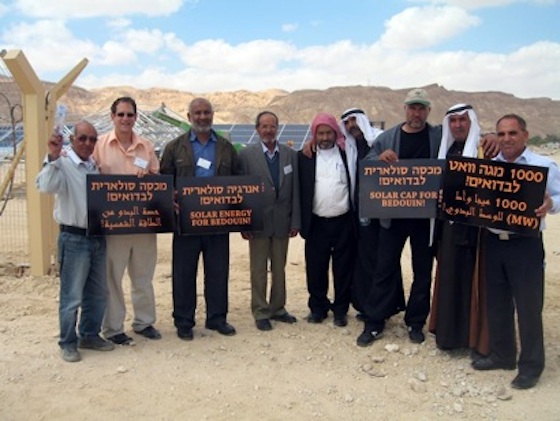
Arava Power Company pioneers first ever solar contract for Israel’s Bedouin minority
The first-ever license for a solar project has been awarded this week to Israel’s bedouin community by Israel’s Public Utility Authority. Yosef Abramowitz of Arava Power Company promoted and led the solar project, to make a solar energy dream come true for Bedouin living in the Israel’s Negev desert.
The Obama Administration is supplying 80 percent of the $30 million of financing it will take to build the small photovoltaic solar farm, using the little-known Overseas Private Investment Corporation of the US government: OPIC.
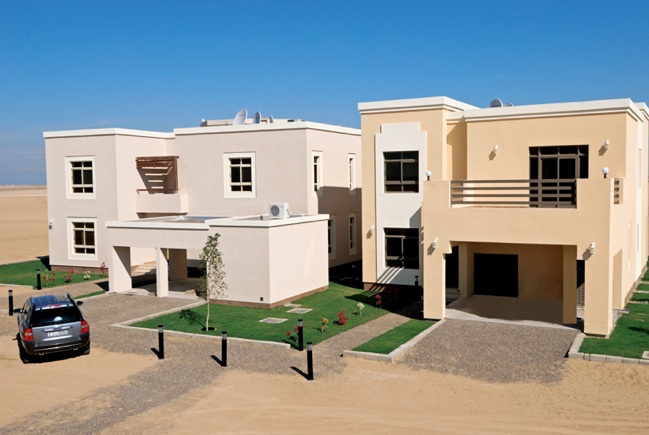
Going green doesn’t come naturally to wealthy villa owners in the Gulf.
An online real estate company listed a seven bedroom villa in Dubai’s neighboring Emirate Abu Dhabi for $95,300 a year, which amounts to nearly $8,000 a month. Anyone who can afford to spend that much money on rent probably has little incentive to turn off the lights in order to conserve energy or shorten their showers, which may explain why the Abu Dhabi Urban Planning Council sometimes has to meet with villa owners six times before they grasp the minimum requirements of the country’s mandatory Estidama green building code.
Omar Samra is an adventurer whose incredible pursuitshighlight the importance of environmental awareness.
When Omar Samra isn’t running one of the few genuinely eco-friendly and socially responsible tourism outfits in Egypt called Wild Guanabana, he climbs mountains. Big ones. He was the first Egyptian to summit Mt. Everest in 2007 and by the end of 2012, if he secures the necessary sponsorships, he will also be the first from his country to reach the top of the world’s seven highest peaks – including the formidable Mt. McKinley in Alaska. If you’re aren’t already impressed by the man who graduated from the London School of Business but eschewed a life of high finance life for something more soulful, maybe this will help: all of Samra’s journeys are carbon neutral.
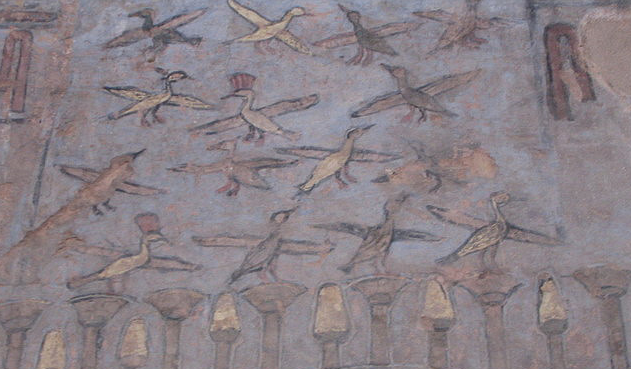
H5N1 has infected 159 and killed 55 people in Egypt since 2006.
A nationwide campaign to stop the spread of H5N1 avian influenza in Egypt is to be launched by the government in a few weeks, say officials, but details are still sketchy. The new plan, which will involve coordination between the Health Ministry, the Agriculture Ministry and poultry producers, requires close monitoring and various bio-safety measures.

 Sanctions have backed fossil-rich Iran into a corner, which could bode well for the country’s renewable sector.