Home Blog Page 410

Could Phones Revolutionize Palestinian Agriculture?

6

Palestine, West Bank, Gaza, Mobile Phone, Technology, Food Prices, Agriculture, Education
World food prices soared over 6 percent in July according to the United Nations’ Food and Agriculture Organization. Prices are continuing to rise, and food security is already a constant threat in the West Bank and Gaza.

The Applied Research Institute in Jerusalem estimates that over half the households in Gaza are food insecure, and almost 80 percent of households in Gaza are reliant on relief support. The institute estimates there are up to 550,176 food insecure persons in the West Bank, 22 percent of the population, and 829,954 in the Gaza Strip, around 52 percent. In the West Bank, those living along the border and separation barrier experience higher levels of food insecurity. These dire circumstances need innovative, domestic solutions.

Agriculture and Water Connect Israel to Africa

0

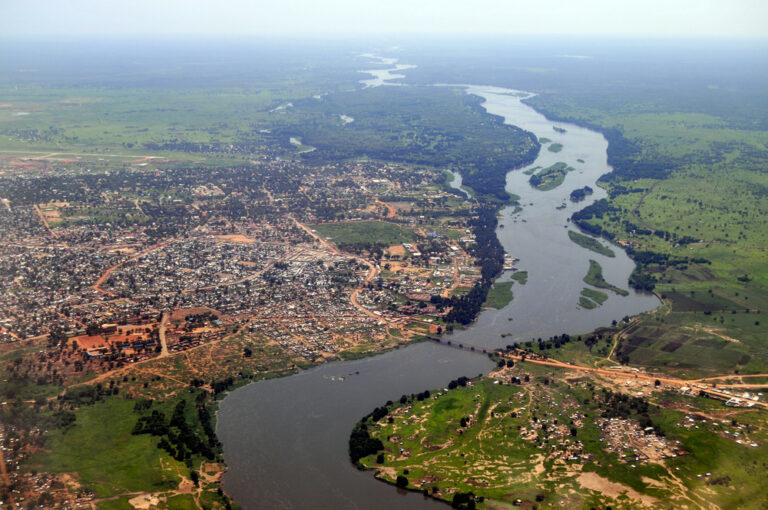
Nile, Egypt, Israel, River, Water, Agriculture, Sudan, Ethiopia, Uganda, Africa, RelationsIsrael’s Deputy Foreign Minister, Danny Ayalon, landed on Monday in Addis Ababa, Ethiopia. He continued on to Uganda and Kenya, where he will inaugurate two Israeli-cooperation projects in agriculture and health. According to Gil Haskel, Israel’s ambassador to Uganda, the Jewish state is interested in strengthening agricultural cooperation and collaboration with Uganda.

Agriculture and water are becoming the foundation for a new era of Israeli relations with African states.

Iran’s Earth Buildings are the Leading Cause of Quake Casualties

0

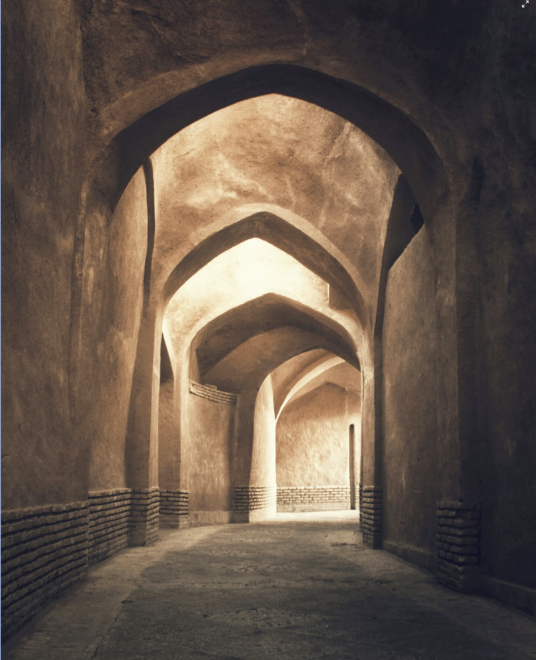
earthquakes, earth building, Iran, architecture, AFPWe’ve long extolled the virtues of earth building, but it turns out that Iran’s simple clay and mud brick buildings are a leading cause of casualties during strong earthquakes.

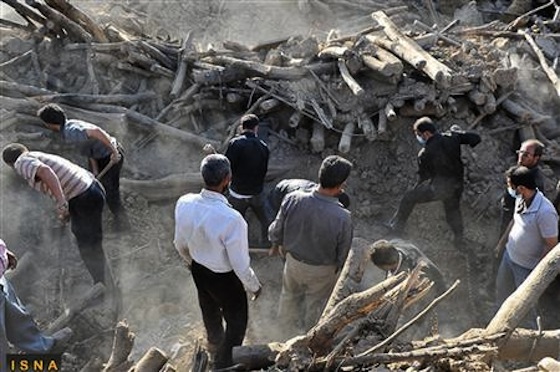
Over the weekend, two earthquakes measuring 6.3 and 6.4 on the richter scale hit the country’s east Azerbaijan province, killing at least 360 people and displacing and injuring thousands more.

Most of these casualties occurred because poorly-constructed buildings made with cheap materials collapsed, according to Kaveh Samiei, principal architect at AAG and a lecturer at Semnan University, crushing their inhabitants.

Leading causes of earthquake casualties

The Iranian authorities have been criticized for their emergency response to the earthquakes over the weekend after search and rescue efforts were called off within less than 24 hours.

But the Foundation of Housing, a branch of the Roads and Urbanism ministry should also be held to account as the development of rural areas falls under their jurisdiction.

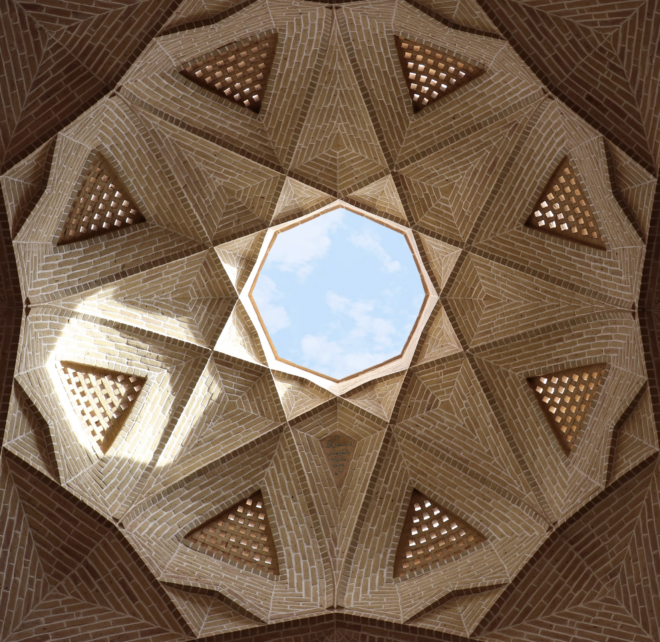
Yakhchal (Meybod), Yazd, Iran

The University of Tulane in the United States sites three main causes of high casualties in areas that are prone to earthquakes: a) population density, b) construction standards, and c) emergency preparedness.

Given that Iran is one of the most seismically-active areas in the world and that 126,000 people have been killed in earthquakes since 1900, the government should map fault lines and establish building codes accordingly.

“We can’t prevent earthquakes from happening,” Samiei told Green Prophet in an email interview, “but at least we can prevent the deaths of hundreds of people that are caused by collapsed buildings.”

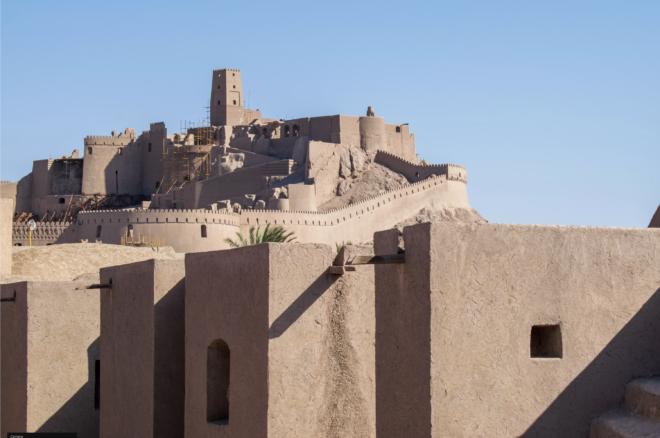
Crushed by the earth in Bam, Iran

Bam Citadel, Iran

“If we can build safe and resistant structures, then we will decrease the rate of deaths and injuries,” he added.

Samiei explained that most rural Iranians live in buildings that have bulky walls and wooden ceilings that crush residents when large earthquakes strike.

“In the recent earthquake, almost all of the buildings that were damaged were constructed in this way. And exactly the same thing happened in Bam.”

Samiei is referring to the 2003 Bam earthquake in southeastern Iran that killed 150,000 people.

“The experience of some countries like Japan shows that it is possible to construct safer buildings,” the architect continued. He said that the use of “lightweight” construction materials in Japan is a strategic approach that could be implemented in Iran, though he emphasized that technology should be supplemented with appropriate safety education and disaster preparedness.

Earthquake preparedness in earth buildings

The worst earthquake in recorded human history killed 830,000 people in 1556, according to Tulane researchers. Most of the casualties were living in wind-deposited silt and clay caves in Shaaxi, China.

Earth construction may be great for staying cool in hot climates and reducing waste of natural resources, but this kind of construction must be coupled with sophisticated engineering to ensure safety – especially along fault lines.

“In some parts of Iran it will be necessary to deconstruct nearly 100% of the existing buildings and plan a new village,” Samiei warns.

“This will take a lot of time to complete.”

Lightbulb Flips On Over Emirati Planners

0

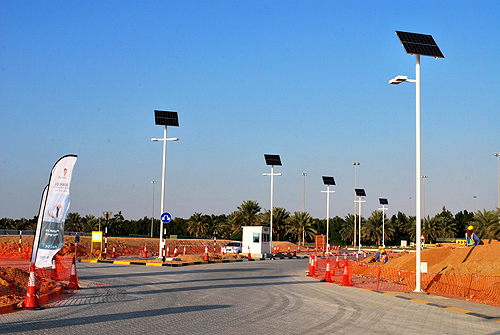
solar LED lights abu dhabi
Sustainable public lighting is mandated in Abu Dhabi City.

Over 6,000 units of sustainable public lighting have been installed across Abu Dhabi’s capital, as part of three separate projects carried out over the past year, according to a statement released to Gulf News by the Municipality of Abu Dhabi City . The light fixtures conform to sustainability standards specified in Abu Dhabi emirate’s Sustainable Public Lighting Strategy.  That program was decreed by the Department of Municipal Affairs, which oversees the municipality, along with Al Ain Municipality and the Western Region Municipality.

Emirati Royalty Threaten 48,000 Maasai in Lucrative Hunting Deal

8

maasai women africaA new campaign attempts to stop a hunting deal in Tanzania forcing 48,000 members of Africa’s Maasai tribe off their land so Middle Eastern royalty can hunt lions and leopards in the Serengeti

The Middle East’s love affair with wild animals has hit the headlines again. No, there haven’t been sightings of cheetahs on the streets of Dubai or dead wolves and owls on parade, rather Middle Eastern royals are being accused of aiding a massive sell-off of the Serengeti. And in a new twist to the land-grab meme, this land sell-off is not to secure access to precious food supplies but, rather, to indulge in the hunting whims of the Middle East’s elite.

The campaigning group Avaaz has launched a online petition to ask Tanzania’s President Kikwete to reject the hunting corporation’s big deal and stop the sell-off of the Serengeti.

“The last time this same corporation pushed the Maasai off their land to make way for rich hunters, people were beaten by the police, their homes were burnt to a cinder and their livestock died of starvation” explains Avaaz via email to Green Prophet.

“But when a press controversy followed, Tanzanian President Kikwete reversed course and returned the Maasai to their land. This time, there hasn’t been a big press controversy yet, but we can change that and force Kikwete to stop the deal if we join our voices now.”

Oxfam, an international charity, also reported on the eviction which took place in July 2009 in Tanzania leaving nearly 2,000 people homeless. They aded that “two of the most infamous land conflicts are with Emirates hunting company Ortello Business Corporation and American-owned Thomson Safaris Ltd.”

As of August 13, more than 400,000 people had signed the petition in just 24 hours and Avaaz reported that President Kikwete’s inner circle was starting to react: “ a few hours ago, the President’s close confidante, Mr. January Makamba MP, tweeted saying he would send our voices to the President himself. Keep up the pressure by signing now and forwarding to others.”

The Maasai are semi-nomadic herders who have lived in Tanzania and Kenya for centuries, playing a critical role in preserving the delicate ecosystem and wildlife of the Serengeti. As such, a deal to evict the Maasai to make way for rich foreign hunters is as bad for wildlife as it is for the communities it would destroy.

For more on wild animals in the Middle East see:

Dubai Porsche Driver Walks Pet Cheetah on a Leash

Africa’s Most Dangerous Animal to Greet Eid Visitors at Gulf Zoo

Gulf Country completely Bans Ownership of Wild Animals


Are Saudi’s Female Olympians Sea Remnants, Harlots or Heros?

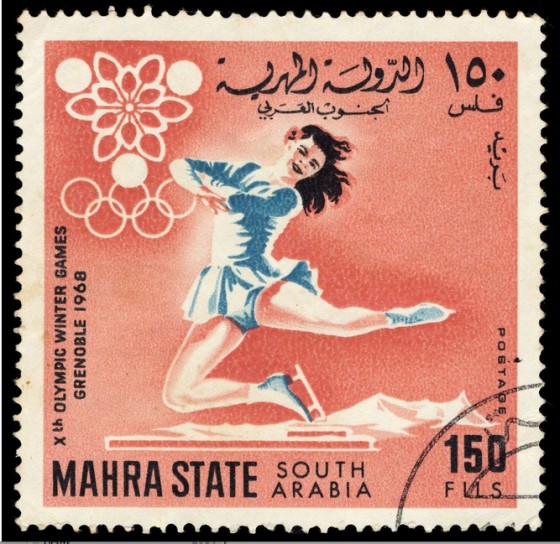
arab saudi arabia stamp 1968 olympics woman skatingOlympians Wojdan Shaherkani and Sarah Attar landed world records before the Games even began. But online they battle a new war where social media is calling them the “Prostitutes of the Olympics”

You know the story: two teens arrived in London as the first women athletes to ever represent the Kingdom of Saudi Arabia (KSA), where conservative clerics forbid women’s participation in sports. KSA wasn’t alone in coming late to the party: Brunei and Qatar also sent female athletes for the first time this year. But the post-Olympiad tongue-lashing these women are now suffering sets Saudi culture apart once again.

Saudi delayed until mid-July the announcement that their Olympic team would include women, a decision following months of negotiations between their government and the International Olympic Committee (IOC). Without women in their ranks, the KSA Olympic team would’ve likely been disqualified.

Saudi women lack the framework to develop into world-class athletes: they’re forbidden from entering all-male national trials, making it impossible for them to qualify for international competitions. So these competitors never actually qualified for their events, but, instead, were given special invitations by the IOC.

Their performances were unimpressive. Shaherkani was defeated in her first judo match after only 82 seconds and Attar finished last in her 800-meter dash. The results were not surprising; but how brave for these underpups to compete. What was surprising were horrendous comments uploaded on social media.

Mutant Fukushima Butterflies Should Discourage Middle East Nuclear

0

mutant butterfly, Fukushima, nuclear power, Middle East, earthquakesResearchers who collected and studied 100 pale grass blue butterflies from the Fukushima prefecture following last year’s nuclear meltdown have discovered serious mutations resulting from exposure to radiation. The butterflies, which were collected two months after the March, 2011 earthquake and tsunami caused the worst nuclear disaster since Chernobyl, had abnormalities in their legs, antennae and abdomens, as well as dents in their eyes. Some of them had broken or wrinkled wings and changes in wing size and markings.

Hit the jump to learn more about the study published in Scientific Reports if you need more convincing that nuclear power in earthquake-prone areas of the Middle East are an especially bad idea.

World Fitness: How Do You Weigh In?

11

world fitness calculator, slim woman, fat woman
A team of British researchers devised a calculator that weighs you against the world.

Did Olympic fever catch you?  Itching to get sporty and lean?  Before jumping into a new exercise routine, of course respect that classic disclaimer: first consult your doctor, who will check your weight and height and calculate your body mass.

Green Prophet’s brought you gizmos to calculate your carbon footprint, apps to save the planet, and techno-toys to play with global flooding.  Now, researchers at the London School of Hygiene and Tropical Medicine  have created a calculator to show how you score in the global games of girth.

Iran Criticized For Response to Earthquake which Killed 306

1

iran-earthquake-criticismA shortage of tents and an overseas trip taken by Ahmadinejad has sparked criticism of the Iranian government’s response following the devastating earthquake which hit the country

On Saturday afternoon, two earthquakes with magnitudes of 6.4 and 6.3 hit the East Azerbaijan province of Iran. Entire villages were flattened instantly, 360 people were killed and thousands were injured and displaced in the surrounding towns. Less than 24 hours later, officials announced that search and rescue operations had finished and all survivors had been freed from the rubble.

However, those who know the area well insist that it would have been impossible to finish the rescue mission so soon. Locals explain that some villages are unreachable by car and so it would have taken time to get to there and assist those trapped. This, as well as the shortage of tents for the displaced, has sparked criticisms of the Iranian government’s response to the crisis.

Africa’s Most Dangerous Animal to Greet Eid Vistors at Gulf Zoo

2

africa's most dangerous animal, hippo, al ain, zoo, gulf, Eid

Africa’s most dangerous animal will make its debut in time for the upcoming Eid holiday at the Al Ain zoo in the United Arab Emirates. The hippopotamus (Hippopotamus amphibius) is a massive herbivore that roams swamps and shallow waters throughout sub-saharan Africa.

My stepmother kissed Jessica the Hippo on her rubbery snout last year in South Africa, but get between a normal mother and her calf, and you may as well say your prayers.

Loveat Jaffa: a 20th Century Orange-Packing Plant Turned Rustic Cafe

1

green design, recycled materials, industrial design, Jaffa, Israel, renovation, Loveat, Ronen Levin, Eran ChehanowitzThe most creative design solutions are often spurred by the tightest restrictions and this is definitely true of the new loveat branch in Jaffa, Israel. Commissioned to transform a 20th century orange-packing plant just south of Tel Aviv into a hip new coffee shop, Ronen Levin and Eran Chehanowitz faced several challenges.

Not only were they prohibited from making any adjustments to walls and facades given the building’s historical nature, but glass louvers on three sides made establishing non-public areas an issue. Hit the jump to find out how the design team surmounted these obstacles to produce a fresh, industrial-chic space that both locals and visitors will enjoy.

Islam 101: Eid for Beginners

3

eid, ramadan, islam, muslim, class, questions, studying

Learn the ropes of how to live in a Muslim country. Laurie goes over the 101 of Eid, Ramadan and some Muslim holiday rituals that might baffle the average westerner.

Eid in the summer in the Middle East, when most ex-pats’ minds turn to quick trips-to-get-out-of-this-dry-heat. This year, my second in Jordan, I go native and learn more about the home team’s culture.

We landed in Jordan last July: school was out and I was unemployed. The husband (already here a year) dropped the kid and me at a pool center called The Orthodox Club.  “Orthodox”, to a New Yorker on hiatus from organized religion, conjures up black-suited Jews with impressive hats and beards, a wife in a wig and a herd of tiny kids any Irish Catholic would be proud of. But in Jordan, Orthodox means something different.

I languish in a Woody Allen moment, imagining  a whole club of swimming Hasidim, ‘til I realize that “orthodox” in the Middle East here means Christians, eastern sect Christians, who can eat and drink and co-mingle in cringingly teeny Speedos all through the heat wave of an Ammanian summer (which in 2011, included Ramadan).

So begins my life as a cable TV special: sort of The Sopranos go to Amman.

A year on, I have a job, and co-workers and new friends, who – in fair exchange for imported bags of Reese’s peanut butter cups – have jumped in as my cultural counselors.  Sure, there are Muslims all over Manhattan, and a few count me as their BFF, but religious practice is more muted and diluted amongst that city’s panoply of cultures.  Islamic traditions are not clearly visible to the untrained eye.

Much easier to learn the ropes when living in a Muslim country, one quite tolerant of quizzical foreigners.

Ramadan is a time of prayer, fasting, and charity for a billion plus Muslims.

Islam uses a lunar calendar, with each month starting with the sighting of the new moon: Ramadan is the ninth month of the Islamic year. Elsewhere the solar calendar is used, with months 11 days longer than their lunar cousins. This discrepancy is why the Islamic holy days move forward, occurring later each year.

Muslims believe that the first verses of the Qur’an were revealed to the Prophet Mohammad by Allah through the angel Jibril (Gabriel) beginning 610 AD.  The Qur’an can be considered as a book of guidance, and is composed of ayah, or verses, that form 114 suras, or chapters.

At many mosques during Ramadan, about one thirtieth of the Qur’an is recited each night in prayers known as tarawih.  By the close of the holy month the complete scripture will have been recited. I’m giving the tome a re-read this month too; using an English translation which the young man at the book store assured me,”isn’t nearly the same as the original”.

Muslims fast, a practice called sawm, throughout the month of Ramadan.

Nothing is eaten or drunk (or smoked, praise to Allah on that, I say) between dawn and sunset.  Able-bodied Muslims take part in sawm from about age twelve; illness or pregnancy or travel can exempt the faithful from fasting, although most will undertake the action later that same year.

During the holy month, most Middle Eastern restaurants close during daylight hours. The days begin with suhoor, a meal eaten before the sun rises. After the sunset, a meal known as iftar breaks the fast. Iftar usually begins with dates, simple soups and sweet drinks.

Then the real party starts. I tag daytime inertia not so much on fasting as on late night socializing with loved ones. Can there be a better reason to be shattered the next day?

Fasting is an opportunity to practice self-control. It cleanses both body and mind. It serves as a reminder of the suffering of the poor. As a child in a Catholic home, before Vatican II played with the rules, we did our fair share of fasting before taking Holy Communion.

For me, that was a matter of enduring hours without M&Ms. In summertime Ramadan, it can mean over 12 hours of no food, no drinks, no water.

My new friends tell me that increased solidarity with the wider community during this challenging month is the most gratifying take-away. There is a power to community. I fasted a few days alongside office friends. We eyeballed non-fasters slurping cold water like puppies; the connection I feel with those abstaining is real.

Ramadan ends with the festival of Eid al-Fitr.

Often abbreviated to “Eid”, and literally the “Festival of Breaking the Fast,” Eid al-Fitr is one of the most important Islamic celebrations. The three-day holiday marks the end of Ramadan. Everyone dolls up, homes are dressed with lights and decorations, kids get treats, and visits to friends and family go on steroids.  The holiday is also called “Little Eid”.

Charity and good deeds (always important in Islam) take on special significance at the end of Ramadan, with people sharing their blessings by feeding the poor and making contributions to mosques.

Eid al-Adha marks the end of the Hajj

About a month onwards, Eid al-Adha marks the completion of the hajj (pilgrimage) rites at Mecca, which is observed by Muslims throughout the world to commemorate the faith of Ibrahim (Abraham). The holiday begins the day after pilgrims on Hajj descend from Mount Arafat.

This one’s known as “Big Eid”: a holy day seeped in rich tradition and context, although for foreigners it’s just another good excuse to take a trip.  I’ll be back with a better account of Big Eid once I score some more peanut butter cups.

Isn’t world travel wonderful?

Image of Muslim classroom from Shutterstock

Teaching Old Planes New Energy Efficiency Landing Tricks

planes planding energy efficiency

A simple change in operations gives aviation an environmental win-win-win.

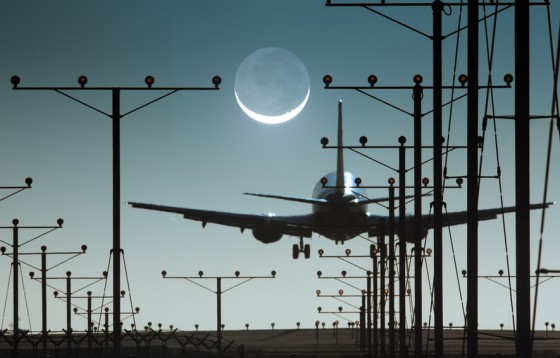
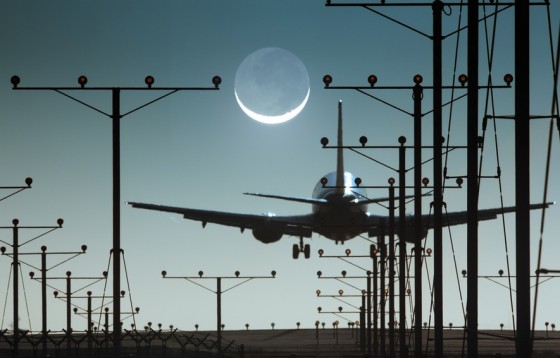
Continuous Descent Arrival (CDA) is an aircraft operating technique in which arriving planes descend in a relatively straight line to the runway. In conventional descent, an aircraft drops in a stair-step manner, requesting control tower permission to descend to each new lower altitude, with portions of level flight in-between altitude changes.

CDA skips the stairs and takes the slide, aiming to avoid level flight to the extent permitted by safe operating procedures.  The aircraft operates with minimal thrust, which significantly reduces power demand.  In Europe, the procedure is called Continuous Descent Operation (CDO) and in the US it’s named Optimized Profile Descent (OPD).

By allowing arriving aircraft to maintain their high cruising altitude for longer periods before starting a continuous descent to the runway, CDAs nearly absolves the three environmental sins of aviation: fuel burn, emissions and noise. Keeping aircraft as high as possible for as long as possible is a very effective method of reducing noise impact on the ground.

Protei Designs Sailing Robots to Clean the Sea

3

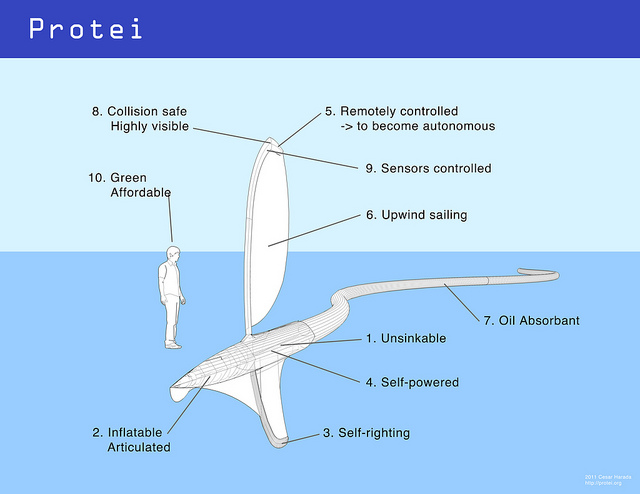
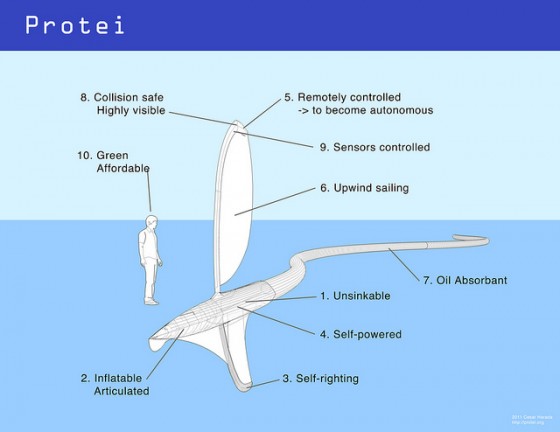
protei sailing robotIt is estimated that BP’s Deepwater Horizon disaster spilled 205 million gallons of oil into the Gulf of Mexico.  Local fishermen and other cleanup workers suffered from the toxic oil and carcinogenic dispersants, but at best only 3% of this oil was ever recovered.  The absorbent booms were never designed for open water.  When Cesar Harada heard about this disaster, he quit his dream job at MIT and moved to New Orleans to find a better way to clean up these spills.  His inspiration combined ancient sailing technology with modern materials and robotics.  He used crowd-funded kickstarter loan to hire some engineers and founded Protei.org.  Harada released the designs under an OpenSource Hardware (OSHW) license so that others can learn, refine and share solutions.

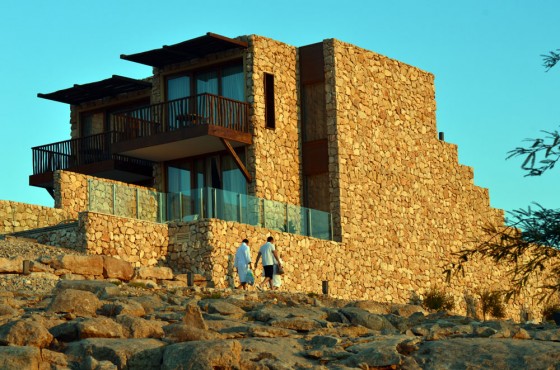
Isrotel Beresheet is a 5 Star Stone-Clad Hotel Overlooking Ramon Crater

0

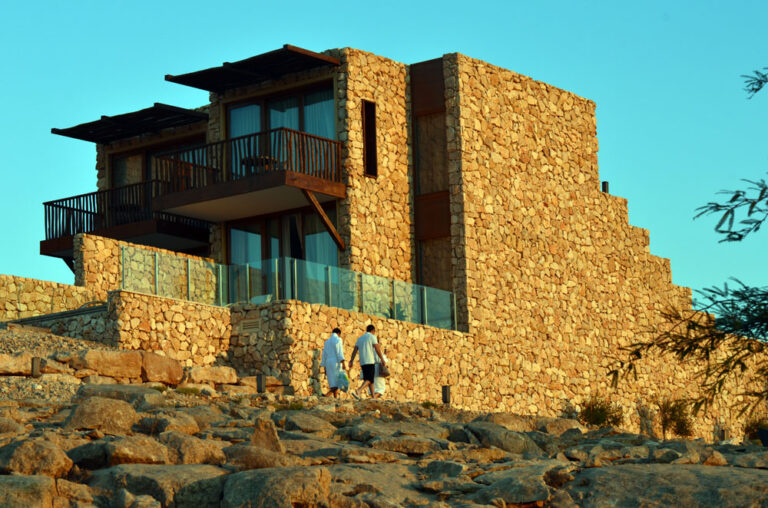
natural materials, 5 star hotel, Ramon crater, Negev desert, Isrotel, natural stoneI’d love to tell you more about the architects responsible for the 5 star Isrotel overlooking Ramon crater, but it’s impossible to get them to return calls and there’s no information online. As for the communications person, either she wasn’t given the skinny on the design or her English is as good as my Hebrew (which is virtually nonexistent.)

Nonetheless, the place is so beautiful that I had to show off my photographs. Located in the Negev desert and a comfortable distance from Israel’s busiest cities, the hotel offers eight different kinds of rooms and a range of beautification options that cost as much as renting a houseboat in Cairo – for a month.