The CFTC, FINRA, and NASAA have jointly warned retirees about precious metals fraud targeting retirement accounts. This checklist provides a structured framework for evaluating any company before transferring savings — and illustrates what credible providers look like across 7 measurable criteria.
A vast and largely untapped lithium reserve may be hiding beneath one of North America’s oldest landscapes, the Appalachian Mountains, offering a surprising twist in the global race for clean energy materials. According to new findings from the U.S. Geological Survey (USGS), as much as 2.5 million tons of lithium could be buried across the region, stretching from the Carolinas up through New England.
Energy equities are responding unevenly to the evolving landscape. Companies with direct exposure to UAE production growth and infrastructure are benefiting from increased activity expectations, while global oil majors face a more mixed outlook.
All air conditioners release water. That's Physics. Cities like Los Angeles pour billions of water down the drain every year. And while home owners who are savvy to water reuse are finding ways to use AC water in the garden (here are 5 ways to use air con water at home), or in art studios (it's basically free distilled water), cities could save water in meaningful ways by using creative ideas. These are solutions you can send to urban planners and those running smart city accelerator programs. Pick one of them and you might win the grant!
As tensions rise in one of the world’s most critical maritime chokepoints, the ripple effects go far beyond oil—touching food systems, climate pressures, and regional stability
The CFTC, FINRA, and NASAA have jointly warned retirees about precious metals fraud targeting retirement accounts. This checklist provides a structured framework for evaluating any company before transferring savings — and illustrates what credible providers look like across 7 measurable criteria.
A vast and largely untapped lithium reserve may be hiding beneath one of North America’s oldest landscapes, the Appalachian Mountains, offering a surprising twist in the global race for clean energy materials. According to new findings from the U.S. Geological Survey (USGS), as much as 2.5 million tons of lithium could be buried across the region, stretching from the Carolinas up through New England.
Energy equities are responding unevenly to the evolving landscape. Companies with direct exposure to UAE production growth and infrastructure are benefiting from increased activity expectations, while global oil majors face a more mixed outlook.
All air conditioners release water. That's Physics. Cities like Los Angeles pour billions of water down the drain every year. And while home owners who are savvy to water reuse are finding ways to use AC water in the garden (here are 5 ways to use air con water at home), or in art studios (it's basically free distilled water), cities could save water in meaningful ways by using creative ideas. These are solutions you can send to urban planners and those running smart city accelerator programs. Pick one of them and you might win the grant!
As tensions rise in one of the world’s most critical maritime chokepoints, the ripple effects go far beyond oil—touching food systems, climate pressures, and regional stability
The CFTC, FINRA, and NASAA have jointly warned retirees about precious metals fraud targeting retirement accounts. This checklist provides a structured framework for evaluating any company before transferring savings — and illustrates what credible providers look like across 7 measurable criteria.
A vast and largely untapped lithium reserve may be hiding beneath one of North America’s oldest landscapes, the Appalachian Mountains, offering a surprising twist in the global race for clean energy materials. According to new findings from the U.S. Geological Survey (USGS), as much as 2.5 million tons of lithium could be buried across the region, stretching from the Carolinas up through New England.
Energy equities are responding unevenly to the evolving landscape. Companies with direct exposure to UAE production growth and infrastructure are benefiting from increased activity expectations, while global oil majors face a more mixed outlook.
All air conditioners release water. That's Physics. Cities like Los Angeles pour billions of water down the drain every year. And while home owners who are savvy to water reuse are finding ways to use AC water in the garden (here are 5 ways to use air con water at home), or in art studios (it's basically free distilled water), cities could save water in meaningful ways by using creative ideas. These are solutions you can send to urban planners and those running smart city accelerator programs. Pick one of them and you might win the grant!
As tensions rise in one of the world’s most critical maritime chokepoints, the ripple effects go far beyond oil—touching food systems, climate pressures, and regional stability
The CFTC, FINRA, and NASAA have jointly warned retirees about precious metals fraud targeting retirement accounts. This checklist provides a structured framework for evaluating any company before transferring savings — and illustrates what credible providers look like across 7 measurable criteria.
A vast and largely untapped lithium reserve may be hiding beneath one of North America’s oldest landscapes, the Appalachian Mountains, offering a surprising twist in the global race for clean energy materials. According to new findings from the U.S. Geological Survey (USGS), as much as 2.5 million tons of lithium could be buried across the region, stretching from the Carolinas up through New England.
Energy equities are responding unevenly to the evolving landscape. Companies with direct exposure to UAE production growth and infrastructure are benefiting from increased activity expectations, while global oil majors face a more mixed outlook.
All air conditioners release water. That's Physics. Cities like Los Angeles pour billions of water down the drain every year. And while home owners who are savvy to water reuse are finding ways to use AC water in the garden (here are 5 ways to use air con water at home), or in art studios (it's basically free distilled water), cities could save water in meaningful ways by using creative ideas. These are solutions you can send to urban planners and those running smart city accelerator programs. Pick one of them and you might win the grant!
As tensions rise in one of the world’s most critical maritime chokepoints, the ripple effects go far beyond oil—touching food systems, climate pressures, and regional stability
The CFTC, FINRA, and NASAA have jointly warned retirees about precious metals fraud targeting retirement accounts. This checklist provides a structured framework for evaluating any company before transferring savings — and illustrates what credible providers look like across 7 measurable criteria.
A vast and largely untapped lithium reserve may be hiding beneath one of North America’s oldest landscapes, the Appalachian Mountains, offering a surprising twist in the global race for clean energy materials. According to new findings from the U.S. Geological Survey (USGS), as much as 2.5 million tons of lithium could be buried across the region, stretching from the Carolinas up through New England.
Energy equities are responding unevenly to the evolving landscape. Companies with direct exposure to UAE production growth and infrastructure are benefiting from increased activity expectations, while global oil majors face a more mixed outlook.
All air conditioners release water. That's Physics. Cities like Los Angeles pour billions of water down the drain every year. And while home owners who are savvy to water reuse are finding ways to use AC water in the garden (here are 5 ways to use air con water at home), or in art studios (it's basically free distilled water), cities could save water in meaningful ways by using creative ideas. These are solutions you can send to urban planners and those running smart city accelerator programs. Pick one of them and you might win the grant!
As tensions rise in one of the world’s most critical maritime chokepoints, the ripple effects go far beyond oil—touching food systems, climate pressures, and regional stability
The CFTC, FINRA, and NASAA have jointly warned retirees about precious metals fraud targeting retirement accounts. This checklist provides a structured framework for evaluating any company before transferring savings — and illustrates what credible providers look like across 7 measurable criteria.
A vast and largely untapped lithium reserve may be hiding beneath one of North America’s oldest landscapes, the Appalachian Mountains, offering a surprising twist in the global race for clean energy materials. According to new findings from the U.S. Geological Survey (USGS), as much as 2.5 million tons of lithium could be buried across the region, stretching from the Carolinas up through New England.
Energy equities are responding unevenly to the evolving landscape. Companies with direct exposure to UAE production growth and infrastructure are benefiting from increased activity expectations, while global oil majors face a more mixed outlook.
All air conditioners release water. That's Physics. Cities like Los Angeles pour billions of water down the drain every year. And while home owners who are savvy to water reuse are finding ways to use AC water in the garden (here are 5 ways to use air con water at home), or in art studios (it's basically free distilled water), cities could save water in meaningful ways by using creative ideas. These are solutions you can send to urban planners and those running smart city accelerator programs. Pick one of them and you might win the grant!
As tensions rise in one of the world’s most critical maritime chokepoints, the ripple effects go far beyond oil—touching food systems, climate pressures, and regional stability
The CFTC, FINRA, and NASAA have jointly warned retirees about precious metals fraud targeting retirement accounts. This checklist provides a structured framework for evaluating any company before transferring savings — and illustrates what credible providers look like across 7 measurable criteria.
A vast and largely untapped lithium reserve may be hiding beneath one of North America’s oldest landscapes, the Appalachian Mountains, offering a surprising twist in the global race for clean energy materials. According to new findings from the U.S. Geological Survey (USGS), as much as 2.5 million tons of lithium could be buried across the region, stretching from the Carolinas up through New England.
Energy equities are responding unevenly to the evolving landscape. Companies with direct exposure to UAE production growth and infrastructure are benefiting from increased activity expectations, while global oil majors face a more mixed outlook.
All air conditioners release water. That's Physics. Cities like Los Angeles pour billions of water down the drain every year. And while home owners who are savvy to water reuse are finding ways to use AC water in the garden (here are 5 ways to use air con water at home), or in art studios (it's basically free distilled water), cities could save water in meaningful ways by using creative ideas. These are solutions you can send to urban planners and those running smart city accelerator programs. Pick one of them and you might win the grant!
As tensions rise in one of the world’s most critical maritime chokepoints, the ripple effects go far beyond oil—touching food systems, climate pressures, and regional stability
The CFTC, FINRA, and NASAA have jointly warned retirees about precious metals fraud targeting retirement accounts. This checklist provides a structured framework for evaluating any company before transferring savings — and illustrates what credible providers look like across 7 measurable criteria.
A vast and largely untapped lithium reserve may be hiding beneath one of North America’s oldest landscapes, the Appalachian Mountains, offering a surprising twist in the global race for clean energy materials. According to new findings from the U.S. Geological Survey (USGS), as much as 2.5 million tons of lithium could be buried across the region, stretching from the Carolinas up through New England.
Energy equities are responding unevenly to the evolving landscape. Companies with direct exposure to UAE production growth and infrastructure are benefiting from increased activity expectations, while global oil majors face a more mixed outlook.
All air conditioners release water. That's Physics. Cities like Los Angeles pour billions of water down the drain every year. And while home owners who are savvy to water reuse are finding ways to use AC water in the garden (here are 5 ways to use air con water at home), or in art studios (it's basically free distilled water), cities could save water in meaningful ways by using creative ideas. These are solutions you can send to urban planners and those running smart city accelerator programs. Pick one of them and you might win the grant!
As tensions rise in one of the world’s most critical maritime chokepoints, the ripple effects go far beyond oil—touching food systems, climate pressures, and regional stability
When the region settles after the American war with Iran, and it will, American and European travelers will come back. Not just for spectacle or headline projects, but for places that feel real. Places that haven’t been engineered to impress and which get into your soul.
We predict that visitors to Saudi Arabia will want to see places like Rijal Alma.
About 28 miles west of Abha, in the mountains of Saudi Arabia’s Asir region, Rijal Alma sits along steep slopes that fall toward the Red Sea. The village is known for its tall, narrow houses, some rising six stories—built from stone, mud, and wood. They’ve been standing for generations, holding their shape in heat, wind, and time.
Rijal Alma via the Saudi Arabian Government.
This is vernacular architecture in its pure form. Long before eco, regenerative and sustainability became buzzwords, builders here figured out how to work with the climate. Thick earthen walls absorb heat during the day and release it at night. Small windows limited direct sun and gave privacy which is what Muslim families expect. The stacked design helps air move through the structure. Nothing is decorative for the sake of it. Everything has a purpose.
Saudi Arabia today is pushing forward with massive projects which have either failed or been postponed, like NEOM, Trojena, Shebara—designed to redefine how people live in extreme environments. They’re bold, expensive, and built to draw attention. But they also raise a question. Is oil money only buying the new and fantastic? As the world weans itself on oil, Saudi Arabia and its family owned oil company Saudi Aramco, will return to humble roots like the House of Saud, a ruling family that once lived in a mud palace.
Red Sea pod hotel the Shebara Resort
Rijal Alma shows a different approach to building. The materials are local and the scale is human.
Under the House of Saud, there’s been more interest in restoring historic sites like this one. That’s a start. But preservation alone isn’t enough. The real shift would be using these ideas again, not as decoration, but as a base for new construction.
House of Saud, the humble origins of the Saudi tribe that would rule the oil-rich nation
In a hotter world, that kind of thinking matters. Buildings that cool themselves. Materials that don’t rely on long supply chains. Designs that last.
The House of Saud lived in a palace made from mud
When travel feels safe again, visitors from the US and Europe will likely make their way here. Not just to see something old, but to understand how people built before energy was cheap and space was unlimited. Walk through Rijal Alma and you notice it right away. The temperature drops in the shade. The walls feel solid. The streets are narrow for a reason. Nothing is random.
It’s not nostalgic. It’s practical. And we love that.
“Forever chemicals” like the ones ejected by Lulelemon yoga pants into strategic areas don’t go away. They don’t break down in nature, and once they’re in water, soil, or our bodies, they tend to stick around. But scientists at Florida International University think they’ve found a smarter way to deal with them, and it uses something as simple as pH.
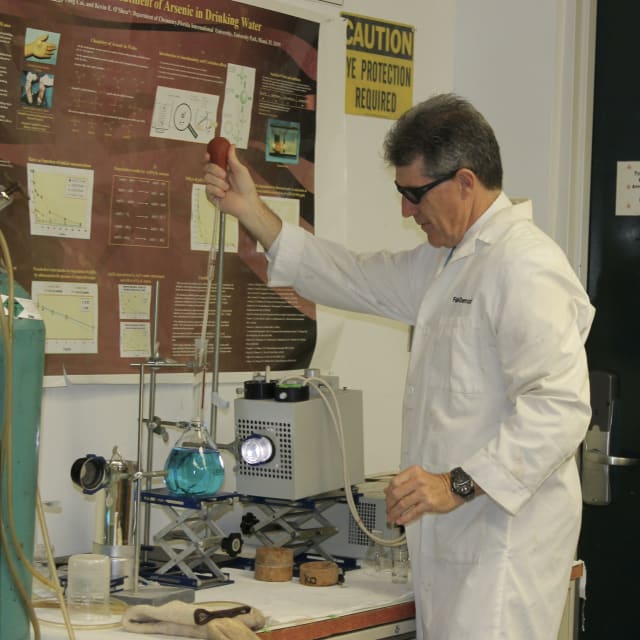
Chemistry professor Kevin O’Shea and PhD candidate Rodrigo Restrepo Osorio have developed a method that can capture PFAS (per- and polyfluoroalkyl substances) and then release them on demand, allowing the cleanup material to be reused instead of thrown away. Their work, published in the Journal of Hazardous Materials Advances, could offer a more practical way to deal with one of today’s most stubborn pollution problems.
The idea builds on earlier discoveries that ring-shaped sugar molecules, think tiny molecular donuts, can trap PFAS in water. These molecules act like handcuffs, grabbing onto the long-chain chemicals. But until now, getting the PFAS out again (so the material could be reused) has been the tricky part.
O’Shea’s insight? Let water chemistry do the work.
At a neutral pH, the sugar-based material holds tightly onto PFAS. But shift the water slightly—make it more alkaline, even with something as simple as baking soda, and both the material and the PFAS develop negative charges. They repel each other, and the chemicals are released.
It’s a bit like a door:
At neutral pH, the door shuts and traps the PFAS inside.
At higher pH, the door opens—and the pollutants are pushed out.
This means the same material can be used again and again, making the system cheaper and more sustainable than many current PFAS treatments, which are often expensive and require processing huge volumes of water.
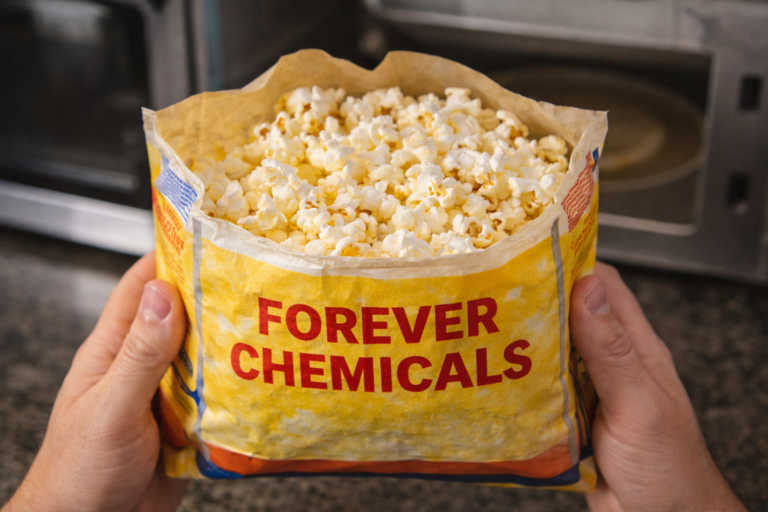
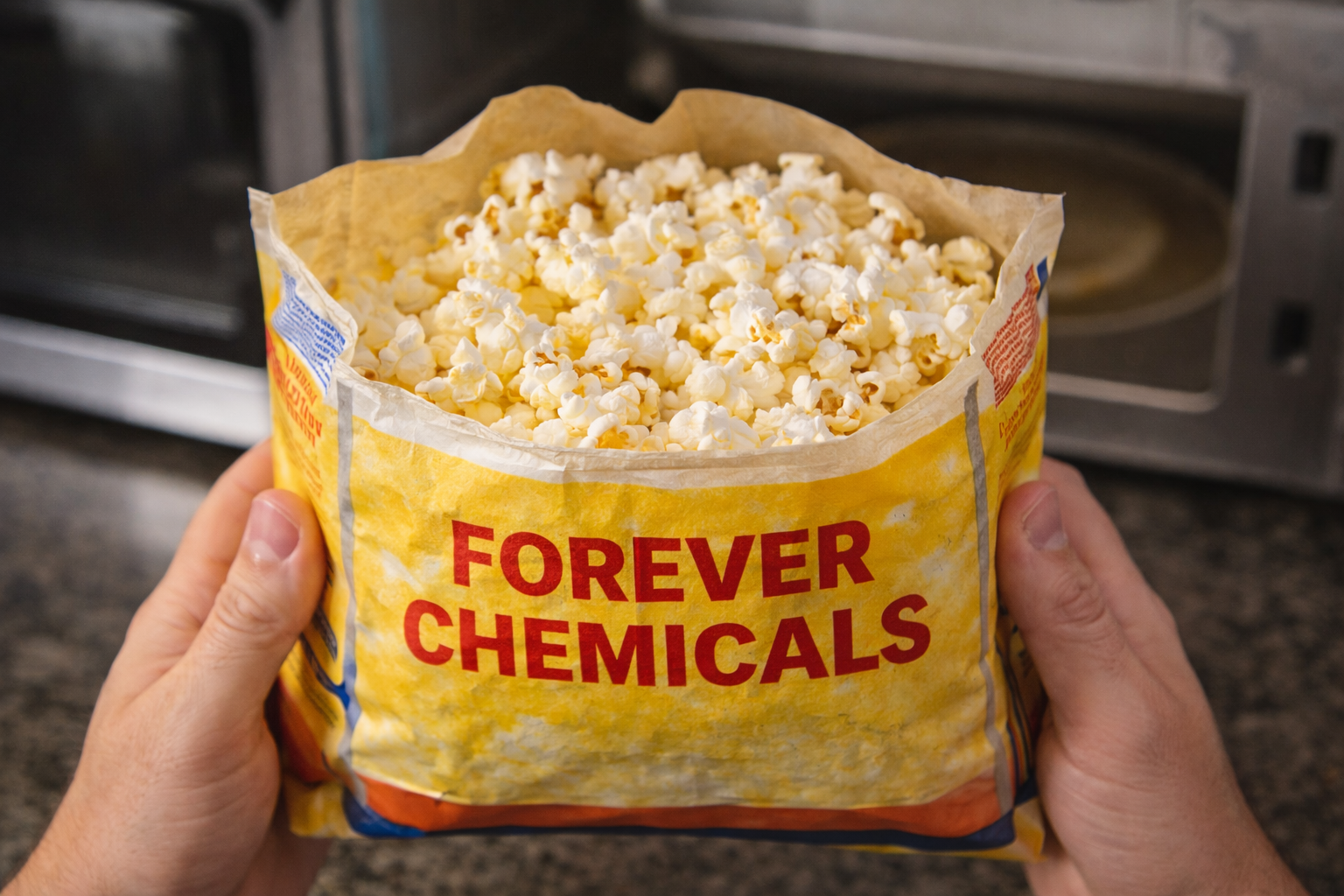
O’Shea’s interest in PFAS started close to home, while looking at microwave popcorn bags his son loved. Many of those bags are coated with PFAS to resist grease and heat. That everyday exposure sparked a deeper dive into how widespread—and persistent—these chemicals really are. He certainly didn’t want his kid eating them!
Many microwave popcorn brands in the US now offer PFAS-free, non-plastic bags, including Black Jewell, SkinnyPop (Sea Salt), and 365 by Whole Foods Market. And as of January 2024, the FDA announced that grease-proofing PFAS are no longer being sold for use in US food packaging. Look for expiration dates on old bags to avoid eating forever chemicals!
An image made with AI to show how forever chemicals, PFAS are inside microwave popcorn bag liners.
(Top Tip: you can make microwave popcorn in a bowl, with some salt, and a plate for a lid. Microwave for 3 to 5 minutes)
According to CEH you can make microwave popcorn in a bowl, with a plate on top. No need for oil ot a bag full of PFAS, forever chemicals.
Now, his team’s work points to a future where we don’t just trap pollution, we control it, concentrate it, and remove it more intelligently.
It’s not a full solution yet. PFAS are still everywhere, from industrial waste to household products. But a reusable, low-cost system like this could become a key tool in cleaning up contaminated water—without creating even more waste in the process.
And sometimes, the answer really does start with something as simple as changing the chemistry of water. And about yoga pants, wear cotton as it’s energetically more compatible to your body, and avoid microwave popcorn. Make it the old fashioned way with vegetable oil in a pot, topped with lots of real melted butter.
from London is getting ready to take Syrup home on this day.
Koh Phangan, an island in Thailand, is sold as a healer’s paradise. Any day of the week you will find Tantra, yoga, breathwork, rope yoga or ecstatic dance under palm trees at Zen Beach in between the full moon parties and half moon parties. You can spend every day of the week trying to fix yourself. If you are single or in a couple, that works, but not so much with teens.
We came to the island paradise with teens. We did what you do when you first arrive: Muay Thai kickboxing, zip lines, swimming pools, ATVs, swimming until sunset, cooking classes. It worked for a week or so, then it didn’t.
Because teens don’t just want stimulation, they want real things, so we went looking and found the island you don’t see on Instagram.
The island you don’t see
This 3-legged lover was found at a Police Station
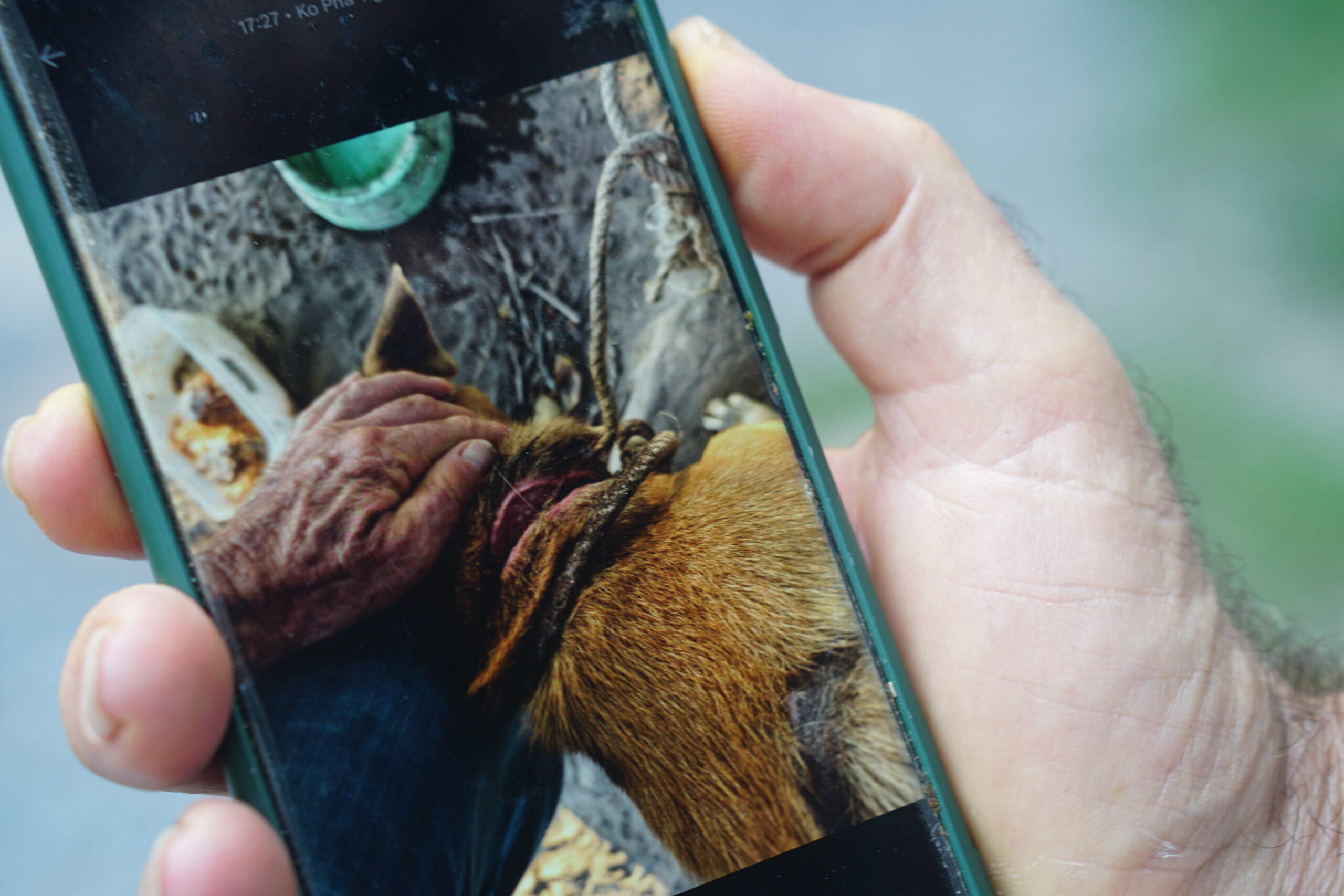
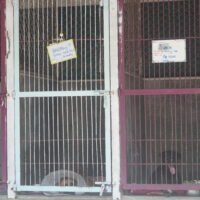
A few turns off the main road and you find another Koh Phangan, one that is not curated. It’s PACS, a center and hospital to heal and rehabilitate stray dogs and cats. There are broken dogs and cats, run over by cars or motorcycles, some neglected by their owners, raw skin exposed on their necks for being chained to a short leash for months.
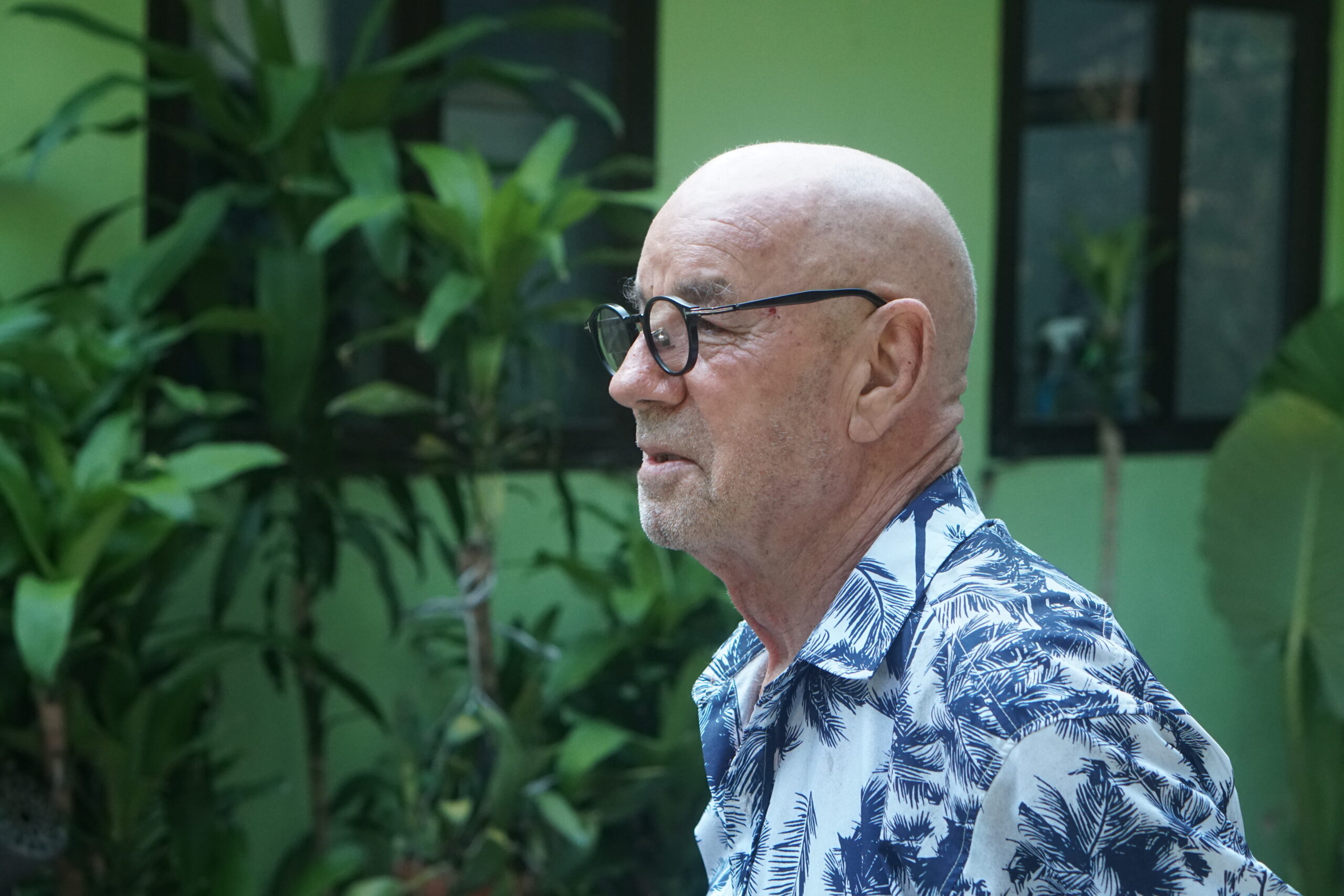
Janina, from Germany, saw the street dogs on the island 4 years ago and has been coming back to PACS once a week to help out for a day each time.
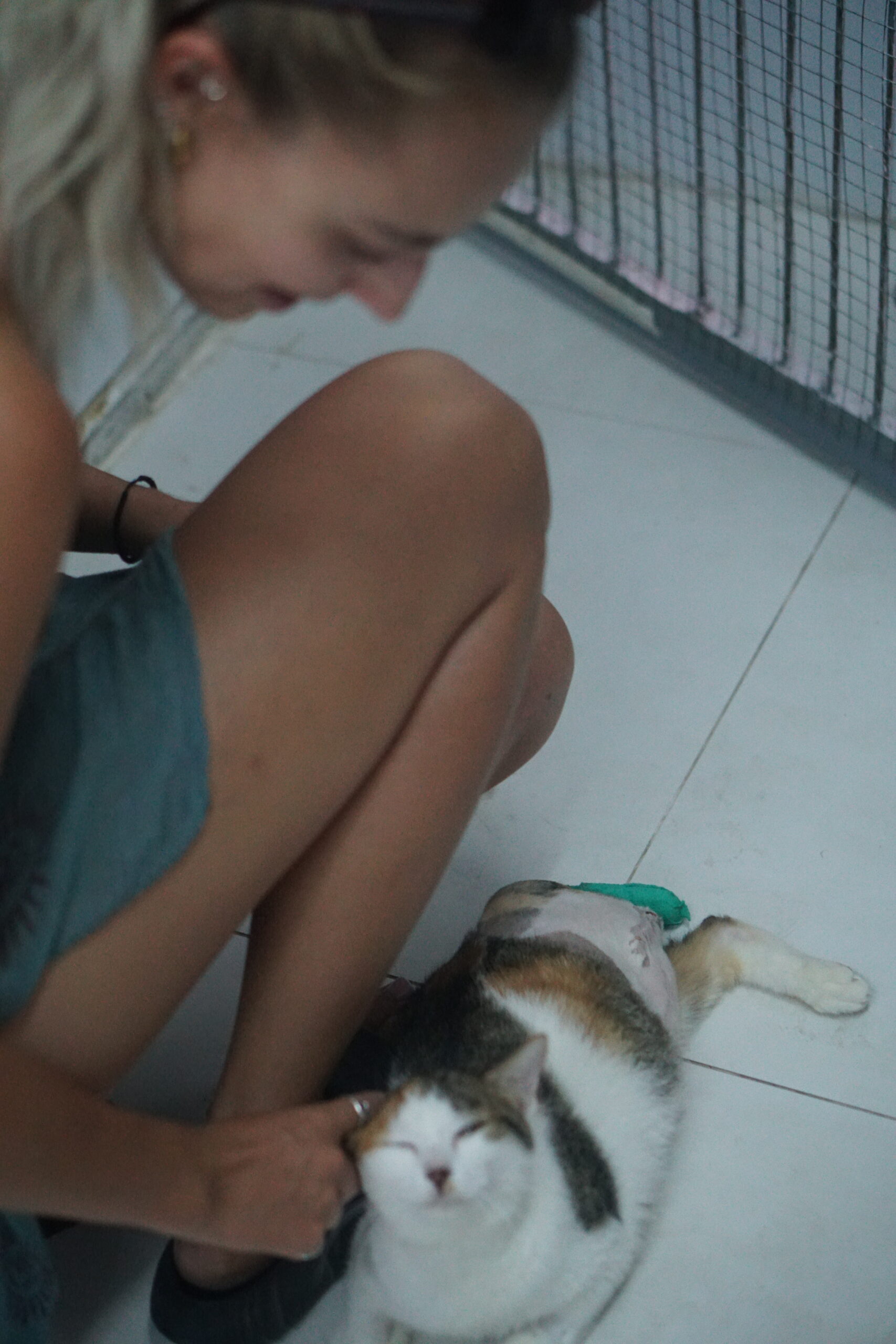
Janina from Germany has been volunteering at PACS for 4 years.Janina petting a rescue who just had a leg and tail amputated.
“I saw them on the streets all the time,” she tells me. “I was angry.”
Now she comes, not to heal herself, but to clean cages, feed animals, wash dogs with skin infections, give company to the cats. The work is repetitive, smelly, physical, and mostly invisible.
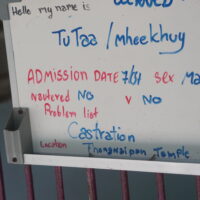
PACS — Phangan Animal Care for Strays has been quietly running a catch, spay/neuter, and release program, working to reduce suffering at the source since 2001. It’s not glamorous but population control, wound care, infection management, and prevention.
The rescue effort here started about 25 years ago, near a local school, when injured dogs kept showing up with nowhere to go. Fifteen years ago it became a proper Thai-run foundation. Today it operates as a hospital, relying on donations, Facebook, Instagram, and a fragile pipeline of adoptions.
At PACS, the idea is simple: the well-being of animals reflects the well-being of the community.
The 7-Eleven dogs
The luck 7/11 dog that is allowed inside.A woman pets a 7/11 dog on Had Yao beach
On this island of Koh Phangan, dogs have territories and they are micro-economies of survival. There are the “7-Eleven dogs” and you see them everywhere. One usually, hanging outside convenience stores, living off scraps and tourists who think a sausage is kindness. I saw one in the town of Thong Sala, drunk on food, lying outside the entrance, belly full with a ring of sausages around him that he couldn’t bother to eat.
“Every day sausage is not good,” one volunteer tells us. “The food they are given is not healthy to eat every day. Not even for us.”
Some 7-11 shops tolerate them. In Had Yao, dogs for some reason are allowed to wander inside like locals. In other places, fights break out because outsiders disrupt a fragile territorial balance that only the dogs understand. Those that support the Strays center hope that the pets they take care of will be adopted. In normal situations they treat the animals and when possible release them back to the location where they were first found.
This is the reality PACS works inside, not removing dogs from the ecosystem entirely, but stabilizing it, one animal at a time. While the 7/11 dogs might be lucky to get regular food, the luckiest ones who get their forever home.
We came to walk the dogs
Meeting soulsVolunteers at PACS
We came to walk the dogs but enough volunteers showed up that day.
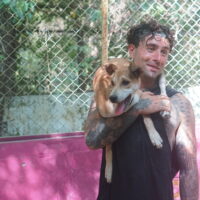
So we stayed and pet cats that leaned into our hands looking for love. We met dogs that barked out of fear but then got close to us over time. One had three legs. Another, Pupita, carries a toy in his mouth when she’s nervous. She is looking for her forever home.
I am Peanut. My legs don’t work but my heart is just fine.
Peanut had a spinal chord injury and now works as an emotional support dog for the other dogs. He drags his two back legs around behind him but his situation doesn’t seem to stop his smiles or passion for life. Peanut is looking for his forever home and he’d make a great emotional support pet, says Kim, the assistant on duty.
You don’t explain this to teenagers. You let them see it and touch it.
The people who stay
Daddy Salem is taking home Syrup today
Salem came from London and works at a retreat on the island. He adopted a dog a few years ago called Mellow, once called Bones. Now he’s adopting another, Syrup. Salem and Syrup were excited about going home together.
“I saw him when he was tiny,” he says. “He came with a bunch of other puppies and one by one they were adopted but he stayed. From the beginning, I liked him.”
That day Syrup, now about 5 months old, was going home. They were going for Syrup’s last walk as a shelter dog. Salem often connects two worlds that don’t usually meet: wellness tourism and animal rescue. He brings his island friends to come to the shelter to walk the dogs.
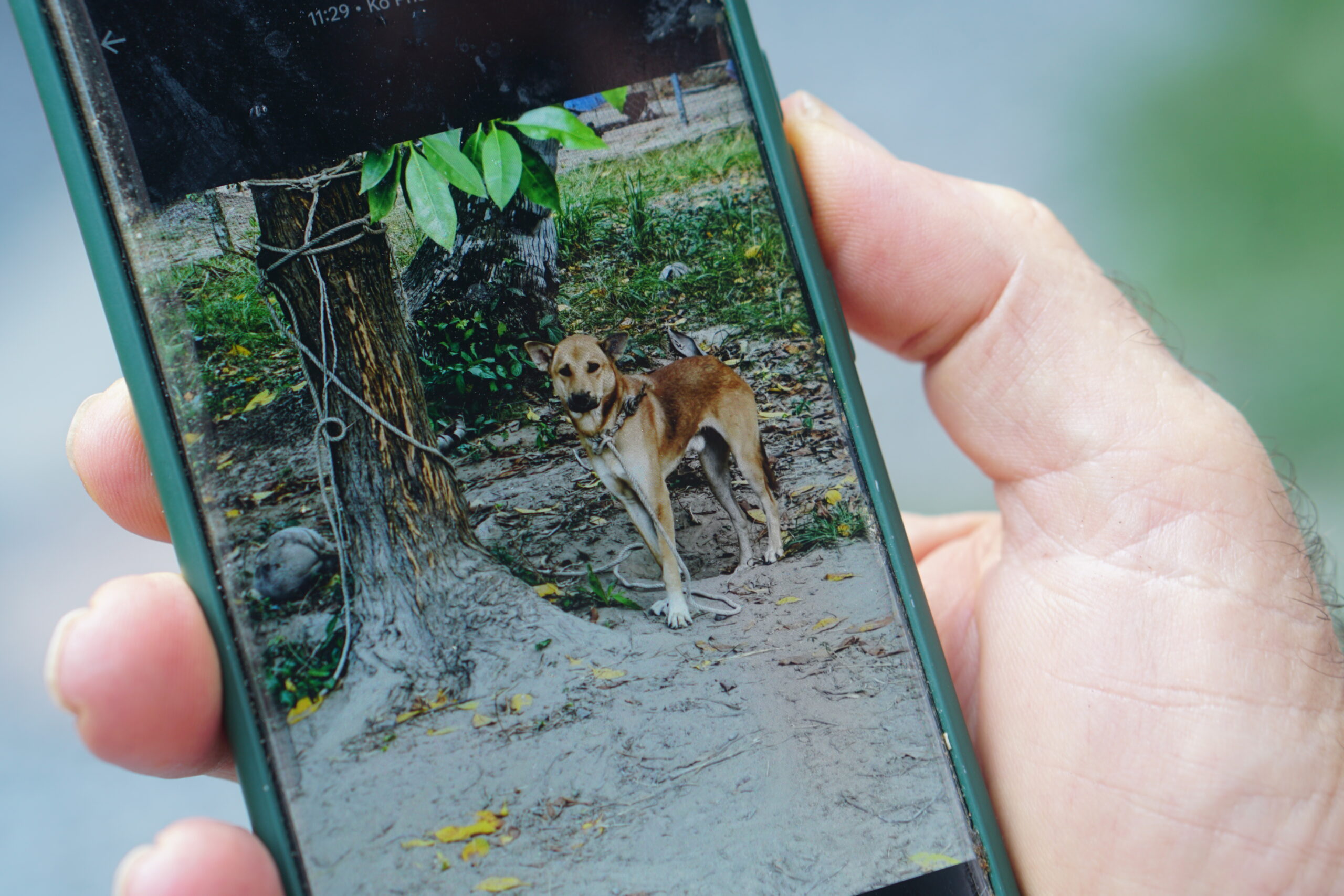
Then there’s a German man Lungs Hai (name means uncle, and probably a Thai name he adopted) who found a dog chained to a tree (named Tongmung, now Clyde), fed him for three months, and watched his neck become raw and infected from his leash and collar.
Clyde’s neck the day he was rescued
At that point the shelter stepped in, according to Thai law, and could take the dog. That was a few months ago and Lungs Hai comes every day for a check in and some cuddles. Clyde’s neck is healing and he is looking for his forever home.
Lungs Hai from Germany found a dog whose neck was infected and full of maggots.This is Clyde and he’s on the mendClyde before he was rescued by Lungs Hai
This is not a place for clean endings and not all stories belong in a brochure. A nurse named Kim who shows us around and welcomes us, tells me about the resident pig (my daughter would water down with a hose) that killed nine dogs and broke a volunteer’s leg.
The myth of healing
Koh Phangan will sell you healing in a coconut wearing Lululemon yoga pants. But healing isn’t always soft or pretty. Washing a dog with a skin disease, feeding a cat that might not survive the week.
We didn’t save anything that day but the center showed our teenagers what compassion looks like. The people working and showing up at PACS did that.
If you travel with kids, especially teens, try to build in something uncurated. Last summer we found volunteer opportunities for them in a forest in Canada. If you are traveling look for a place that’s working in the community to better it: because somewhere between the zip line and the beach, between the dance floor and the detox smoothie, there is a quieter education happening to help those who can’t speak at PACS.
How PACS started
PACS (Phangan Animal Care for Strays) was founded in 2001 by a veterinarian named Shevaun. She arrived on Koh Phangan while traveling and was struck by the condition of the animals: they were injured, untreated, and with no veterinary services on the island at the time. Stray population control was often done through culling (killing, as they do in Hebron), and locals had to travel by ferry to Koh Samui just to treat their pets.
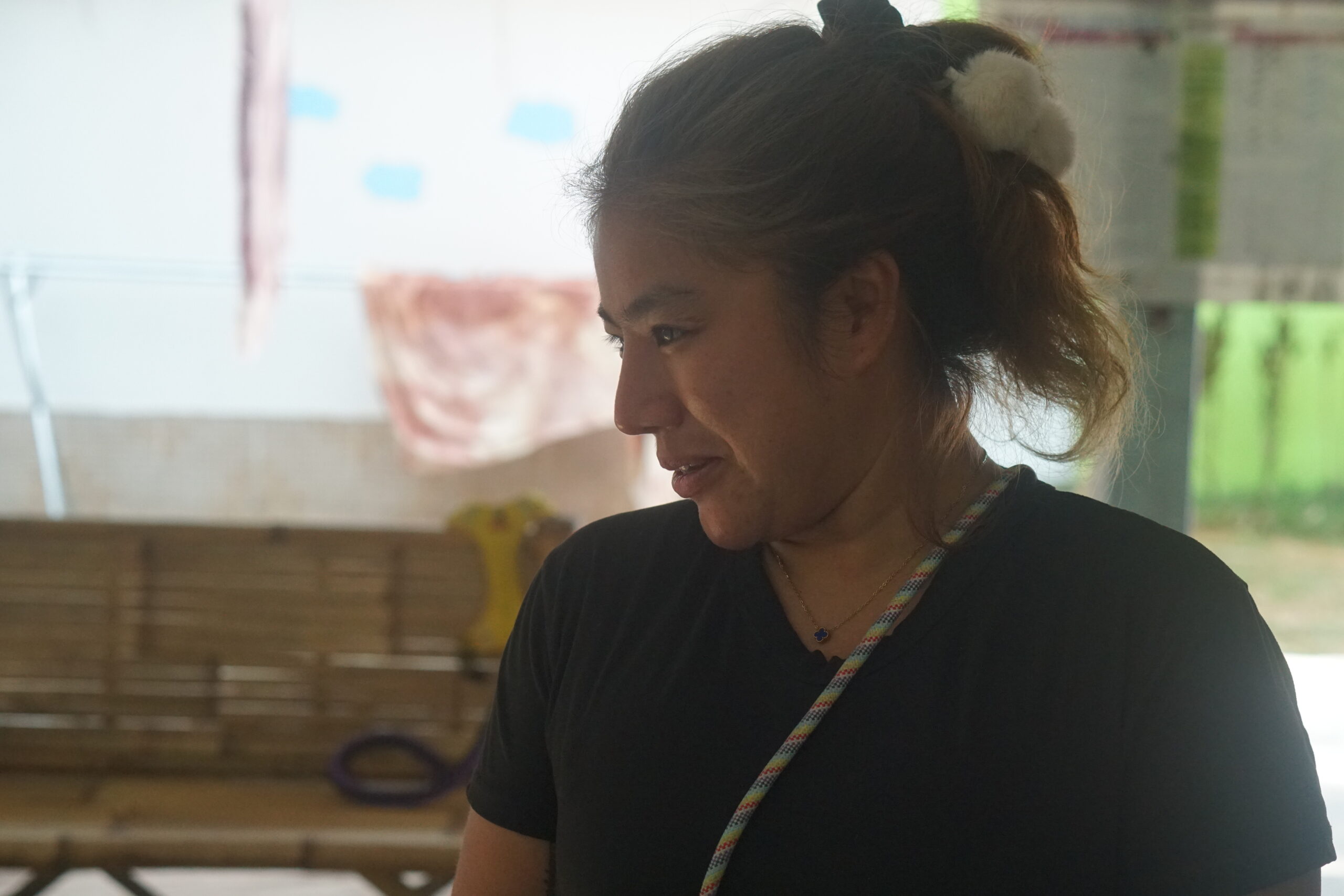
Kim a nurse at PACS who showed us around
So she started small, asking vets back home to send supplies, treating animals for small donations, and using those funds to help strays. From that, PACS grew into what you see today: a hospital, a sterilization program, and a quiet force of nurses, vets and volunteers, trying to stabilize the island’s stray population.
How you can help
Adopt me
PACS runs on small acts that add up.
Donate through their website – this keeps the clinic running, pays for surgeries, medicines, and daily food.
Follow and share on Facebook and Instagram – awareness leads to adoptions and support from outside the island.
Adopt, or help find a home – even sharing a dog or cat’s story can connect them to a forever family. There are people on the island, PACS says, that can help you with pet relocation and adoption to foreign countries much like the cats of Istanbul. Fall in love with a Thai dog or cat? It’s possible to take them home with you.
Not everyone can take a dog home from Koh Phangan. But everyone can do something.
We all experience aging, yet it is often discussed only in the context of decline or medical care. Despite this, aging is a lifelong process that involves physical development, emotional growth, cognitive change, and evolving social roles. From childhood through adulthood, each stage of life presents unique challenges and opportunities that shape our overall well-being.
When we look at aging from beneath the surface, it becomes easier to understand how different stages of life contribute to long-term health and quality of life. Societies that recognize the importance of these stages are better equipped to support individuals through education, healthcare, community planning, and social support systems.
While medical professionals play an essential role in helping individuals age well, understanding aging goes beyond just healthcare. It also involves social awareness, public policy, and a cultural appreciation for every phase of life.
Why understanding aging matters
Aging is not simply a matter of getting older; it is the result of biological, environmental, and lifestyle factors that interact over time.
Researchers who study gerontology emphasize that aging outcomes vary widely between individuals depending on genetics, diet, exercise, stress levels, and access to healthcare throughout their lives. Understanding how these factors influence aging can help people make informed decisions. For example, habits developed during early adulthood, such as maintaining an active lifestyle, managing stress, and building strong social relationships, often have long-term effects on physical and mental health.
Public awareness of aging also helps communities create systems that support individuals across generations. Urban planning, transportation access, healthcare infrastructure, and workplace policies all play a role in helping people remain healthy and independent as they age.
Building a foundation for healthy aging
Inclusive aging
The earliest stages of life, from infancy through childhood, form the foundation for lifelong health and development. During these years, the brain develops rapidly, children learn social and emotional skills, and the body undergoes significant physical growth. Nutrition, safety, and nurturing relationships are particularly important at this stage. Positive early experiences help children develop emotional stability, cognitive skills, and healthy behavioral patterns.
Research consistently shows that supportive childhood environments can reduce the risk of chronic illness later in life and improve educational and social outcomes. Parents, caregivers, and educators play a crucial role in shaping these early experiences. Encouraging physical activity, balanced nutrition, and curiosity about learning can create habits that continue well into adulthood.
On the way to growing up
Adolescence represents one of the most transformative periods of human development. During this time, individuals experience rapid physical growth, hormonal changes, and the gradual development of independence. Teenagers begin to form personal identities as they navigate peer relationships, academic pressures, and new social environments. Emotional development during this stage is particularly important because it shapes how individuals handle stress, relationships, and decision-making later in life.
Young adulthood builds upon these developments as individuals establish careers, relationships, and personal goals. Many important lifestyle habits, such as exercise routines, sleep patterns, and dietary choices, are formed during this period. These habits can influence long-term health outcomes, including the risk of heart disease, obesity, and mental health challenges.
Supporting young adults with education, access to healthcare, and opportunities for personal development helps create a healthier population over time.
Aging in adulthood
Midlife often brings a combination of personal and professional responsibilities. Many adults in their 40s and 50s are balancing careers, raising children, and caring for aging parents simultaneously. While this stage can be demanding, it is also a time when individuals possess valuable life experience and stability.
Physically, midlife may introduce noticeable changes. Metabolism may slow, muscle mass can decline, and hormonal shifts may occur. However, these changes do not necessarily lead to poor health if individuals maintain preventive habits. Regular physical activity, a balanced diet, and routine medical checkups become increasingly important during this stage. Preventive care, including screenings for cardiovascular disease, diabetes, and certain cancers, allows potential health concerns to be addressed early.
Maintaining emotional well-being is equally important. Many adults find that strong friendships, hobbies, and meaningful work help provide balance and reduce stress during this period.
After the peak of adulthood
Older adulthood is often misunderstood as a period defined solely by health challenges. In reality, many older adults remain active, socially engaged, and intellectually curious well into their later years. Physical changes such as reduced bone density, decreased muscle strength, or slower cognitive processing can occur with age. However, these changes vary widely and are influenced by lifestyle choices made throughout life.
Healthcare professionals with specialized training are essential in supporting individuals in this age group. An adult gerontology nurse practitioner focuses on caring for adolescents through older adults, addressing chronic disease management, preventative care, and overall health maintenance for aging populations. Their expertise helps ensure that older adults receive comprehensive care tailored to the unique challenges of aging.
Physical changes associated with aging
As the body ages, gradual biological changes take place across many systems. Some of the most common include reduced muscle mass and bone density, changes in metabolism, cardiovascular changes, and vision and hearing changes. Although these shifts are natural, they can often be managed or slowed through lifestyle choices. Regular exercise, balanced diets rich in nutrients, and preventive healthcare all play a role in promoting healthy aging.
Emotional and cognitive well-being
Mental health and emotional resilience are just as important as physical health throughout the aging process. While some cognitive changes may occur over time, many intellectual abilities remain strong throughout life. Older adults often retain deep knowledge, problem-solving abilities, and emotional intelligence gained through decades of experience. Maintaining mental engagement through reading, learning new skills, or social interaction can help support cognitive health.
Social connection is particularly important. Loneliness and isolation can negatively impact both mental and physical health, making community programs and intergenerational relationships valuable resources. Activities such as volunteering, participating in community organizations, or joining hobby groups can help older adults remain socially connected and mentally stimulated.
Creating age-friendly communities
As life expectancy increases, communities around the world are recognizing the need to support aging populations in new ways. Age-friendly environments make it easier for people of all ages to remain active, engaged, and independent. These environments often include accessible public spaces, safe walking areas, affordable healthcare services, and community programs designed to encourage social participation.
A lifelong perspective on aging
Aging is a continuous process that begins at birth and evolves over decades. Each stage from childhood to old age contributes to the overall health and well-being of individuals and communities.
By understanding the physical, emotional, and social changes that occur throughout life, societies can create systems that support healthier populations and stronger connections between generations. Ultimately, a broader perspective on aging encourages us to value every stage of life. With the right support, resources, and awareness, individuals can experience growth, purpose, and fulfillment at every age.
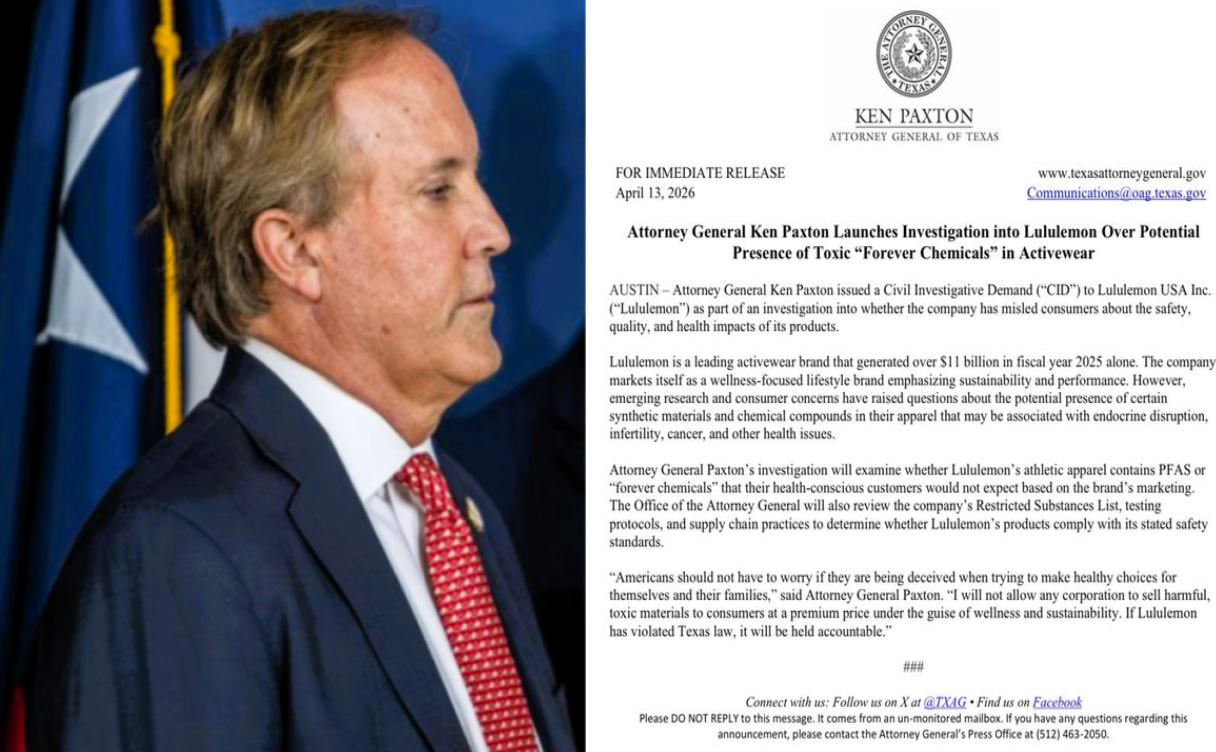
Now, regulators in the United States are catching up. Texas Attorney General Ken Paxton has launched a formal investigation into Lululemon, issuing a Civil Investigative Demand to determine whether the athleisure giant misled consumers about the safety of its products, specifically the potential presence of PFAS, or “forever chemicals.”
Though microplastics, which we wrote about are persistent, PFAS are distinct and often co-occur. PFAS are synthetic chemicals used for waterproofing and non-stick coatings, while microplastics are tiny solid plastic particles.
PFAS chemicals are widely used for water and stain resistance. They also persist in the environment and the human body, and have been linked in scientific studies to cancer, hormone disruption, and reproductive issues. Paxton framed the probe as a consumer protection issue:
“Americans should not have to worry whether the products they purchase are safe for themselves and their families,” he said.
Lululemon store is pictured in Vancouver, B.C, in June 2025
And more sharply, and what’s interesting here is that he is targeting the brand’s positioning: “Companies that market themselves as leaders in health and wellness should not sell harmful, toxic materials under the guise of sustainability or safety.”
Why Lululemon? Dollar store items may use the same microplastics. But this isn’t a random enforcement action.
Attorney General Ken Paxton issued a Civil Investigative Demand (“CID”) to Lululemon USA Inc. (“Lululemon”) as part of an investigation into whether the company has misled consumers about the safety, quality, and health impacts of its products.
Healer Jasper Neil tells Green Prophet, “Synthetic fibres inhibit energy flow. If you’re an energy sensitive practitioner you can feel the difference between natural and synthetic fibres. Nice looks don’t compensate for the fact that these clothes shut your energy down.”
But yoga pant energy is making a lot of cash.
Lululemon is a leading activewear brand that generated over $11 billion in fiscal year 2025 alone. The company markets itself as a wellness-focused lifestyle brand emphasizing sustainability and performance. Brand ambassadors spotted wearing the pants include Oprah Winfrey, Kim Kardashian, Cameron Diaz, Jennifer Aniston, Reese Witherspoon, Kate Middleton, Selena Gomez, and Taylor Swift. Lessor known influencers peddling the brand include Lewis Hamilton, Sidney Crosby, Connor Bedard, Jordan Clarkson, Frances Tiafoe, and Leylah Fernandez.
However, emerging research and consumer concerns have raised questions about the potential presence of certain synthetic materials and chemical compounds in their apparel that may be associated with endocrine disruption, infertility, cancer, and other health issues.
“The health and safety of our guests is paramount, and our products meet or exceed global regulatory, safety, and quality standards,” Lululemon said in a statement. “We require all our vendors to regularly conduct testing for restricted substances, including PFAS, by credible third-party agencies to confirm ongoing compliance.”
Attorney General Ken Paxton Launches Investigation into Lululemon Over Potential Presence of Toxic “Forever Chemicals” in Activewear
According to the Attorney General’s Office, Lululemon occupies a unique space of premium pricing, wellness branding, and direct-to-skin products worn during heat, sweat, and friction. The investigation is expected to examine the company’s restricted substances list, product testing protocols, and global supply chain disclosures.
The company’s response? Lululemon says the issue is already addressed.
In statements it has released on the issue that Green Prophet brought force in 2025, the company has said it phased out PFAS in its products in 2023, and that such chemicals were previously used only in limited applications, such as water-repellent finishes. It maintains that its products meet all applicable safety standards and undergo third-party testing.
The bigger issue: exposure where it matters most. If talcum powder exposure or asbestos exposure happened in the past, consumers have a right going forward to claim damages if a link can be made. The problem is that the source of immune disease such as lupus or cancers are hard to tracer.
How do I know if my leggings have PFAS?
PFAS treatments cause the fabric to strongly repel water. If you drop a water droplet onto a PFAS-treated fabric, it will bead up, roll around, and typically leaves no residue. In contrast, a droplet dropped onto an untreated fabric will soak in.
What regulators are only beginning to explore now is what Green Prophet flagged months ago. They know that synthetic fabrics shed microplastics during wear and washing. And that tight athletic clothing creates heat and friction zones, while hemical finishes may interact with sweat and prolonged skin contact.
This includes areas of the body where absorption risks are highest, such as in the crotch area, which is not abstract, but practical and daily.
Paxton didn’t go after every spandex manufacturer. He chose a category-defining brand called Lululemon which is one that sells not just apparel, but a narrative of health, control, and well-being.
If that narrative proves misleading, the implications extend far beyond one company and can shake up the health and wellness space that makes claims about products and services that are unfounded, or worse, bad for one’s health. My mother can remember a time when smoking was considered good for your health, but we know how that played out. Let’s hope the plastics lobbies aren’t so strong.
Now we ask Green Prophet readers: Can synthetic performance wear ever truly be marketed as “clean”? Green Prophet raised the question first. Now, the regulators are asking it on the record.
Is microplastics and forever chemicals something we can avoid? Basically everything (from food and water to air, from blender for your healthy smoothie to cutting board for your veggies that themselves are chemical by default and salt you season them with) contains microplastics, and as per recent studies, we thought that consuming them is the major source, actually it is inhaling,” says Lilia Khalitova. “So polyester clothes are bad, and washing them only makes them shed more. Plus add heat (UV), friction, your matand here we go… plastic fantastic you. Realistically it is impossible to avoid or cleanse, but can be minimised through mindful exposure.”
“But will natural cotton or bamboo pants keep your ass tight and round like the plastic ones do? That’s a trade off not many are willing to do I suppose,” sums up Ra Sa.
16,000 boxes of archaeological finds are stored in the Valkhof Museum at Nijmegen, the Netherlands. They contain a wealth of Roman artifacts left undisturbed for centuries and waiting to be shown in daylight again.
The Roman governors named the city Noviomagus. It was an important urban center and a key military and administrative hub on the northern border of the Roman Empire. The residents left thousands of everyday artifacts that archaeologist have been excavating and stashing into boxes for the past 70 years.
Researchers are now bringing these remnants of Roman material culture out of storage, in a project aiming to identify and catalog them for future study and preservation.
The 16,000 boxes ended up in the province of Gelderland nearly 20 years ago. The province recently allocated €8 million to inventory the contents of the boxes and repack them. It’s expected that it will take 6 years to sift through every box.
300 of the boxes have been opened. The objects inside are between 1,800 and 2,000 years old. They are things used in everyday life and that reveal a vivid picture of how people lived and interacted when Roman government held sway in Noviomagus (today’s Nijmegen). Several are considered “masterpieces” and are causing a lot of excitement among researchers and specialists.
Fine Roman tableware – intricately decorated cups and bowls – have survived the centuries. The clay pot with a human face sculpted onto it below served two purposes: it was a drinking vessel whose twisted nose and hard-boiled eyes promised a good time for the drinker.
Photo credit: Provincie Gelderland
Among the magical protective objects is a 20-centimeter/8-inch phallus carved from bone.
Photo nltimes.nl
People have used phallic images since ancient times, to bring prosperity and avert bad luck. See our post on Iran’s phallic stones. This example is unusual in that it’s made of bone. Other Roman phalli were made of stone or metal.
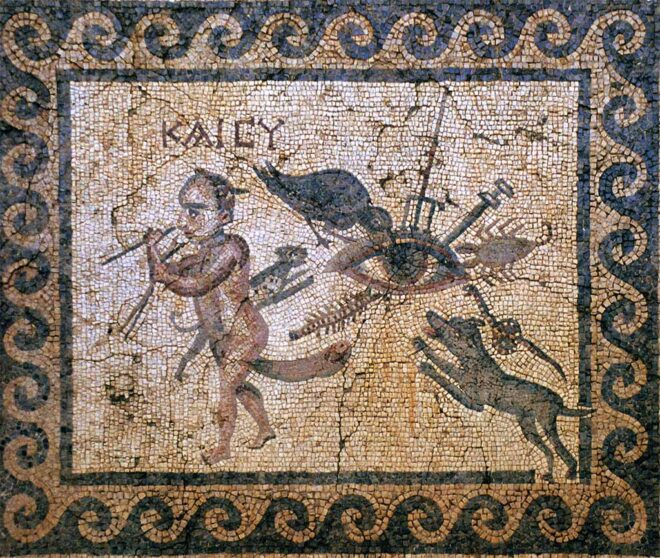
As many other cultures did, the Romans used phallic images in hopes of increasing human and agricultural fertility, but also to deflect the evil eye, a powerful fear in the minds of ancient people. It still exists among some modern communities: see our post on the evil eye in the Middle East.
Mosiacs and wall paintings depicting gods, animals, and men in full erection were displayed in homes. Below you see an eye representing envy and malice being attacked by all sorts of creatures, a dagger, a trident – and the exaggerated penis of a man.
Image via ancientworldmagazine.com
Phalli carved into clay plaques were set over front doors to prevent bad vibes from entering. Wind chimes featuring multiple metal phalli hung over shop doors in the belief that the charm would protect owner from thieves and financial loss.
Photo via the British Museum
A woman might have worn a jeweled phallus in her hair, or a man a phallic pendant around his neck. There were even tiny phallic charms on bracelets meant to fasten on the wrists of newborns, and finger rings with engraved phalli so small that they could only have been meant to be worn by children.
Photo via athenaartfoundation.org
Can we ever enter the minds of people so at home with the arts, international trade, high-level politics and governance – not to mention a military that conquered a large part of the world – yet who lived in superstitious fear of envy and ill-wishing every day? Researchers feel that those 16,000 boxes full of ancient Roman debris contain that possibility and that they will reveal much more about the Roman way of life than we’ve yet seen.
This is an off-grid, sustainability dream in Alaska. It runs on solar power. Batteries keep the power for cloudy days.
Reliable light matters in more places than ever. It matters on a back road after sunset, in a cabin with limited power, and at home during a storm outage. Research across sustainability guidance, preparedness resources, and off-grid living coverage points to one clear takeaway: people want lighting that works well, lasts longer, and creates less waste.
That shift helps explain why eco-friendly flashlights are getting more attention. They support two goals at once. They provide travelers and households with a reliable source of light and reduce the need for piles of disposable batteries. For people trying to live a little lighter or prepare a little better, that is a practical combination.
Why Off-Grid Travel Is Pushing Better Lighting Choices
Stedsans in the woods was an off-grid travel destination in Sweden where they offered food that tasted like Michelin-star meals.
Off-grid travel tends to expose weak gear fast. A flashlight that drains quickly, feels bulky, or depends on a constant stream of fresh batteries becomes a hassle. In that setting, simple design matters. So does efficiency.
That is whyflashlights remain one of the most useful items in a travel kit. A good flashlight handles short tasks, longer nights, and unexpected situations without taking up much room. Green Prophet’s coverage of greener off-grid living has highlighted rechargeable lighting as part of a more thoughtful setup, especially for people who want dependable gear with a lighter footprint.
The eco-friendly case starts with power. Rechargeable flashlights cut down on battery waste and reduce the cycle of buying, storing, and tossing single-use cells. That makes travel easier in a practical sense, but it also supports a more responsible approach to gear. The U.S. Environmental Protection Agency notes that better battery management helps reduce waste, recover materials, and prevent pollution. For people who spend time outdoors, that is not a minor point. It connects a small buying choice to a larger environmental habit.
An off-grid choice for hunters, preppers, survivalists, and traveling in the back bush in case you get caught at night
Efficiency also helps in the field. LED-based lighting uses far less energy than older lighting technology and tends to last much longer. With a flashlight, that can mean fewer charges, less strain on backup power, and more confidence when an outlet is nowhere in sight. A traveler using a small power bank, solar charger, or compact generator benefits from every bit of saved energy.
There is also a comfort factor that often gets overlooked. Off-grid travel already asks people to think about water, power, weather, and storage. Lighting should reduce stress, not add to it. A dependable flashlight that charges easily and performs consistently can make a campsite, cabin, or vehicle setup feel more manageable.
Why Home Preparedness and Sustainability Work Well Together
An off-grid, regenerative roof garden than runs on batteries fueled by renewable energy
Preparedness has become less of a niche concern and more of a basic household habit. People do not need to live far from the grid to understand the value of backup light. Storms, outages, and other disruptions can happen almost anywhere, and they rarely arrive at a convenient time.
That is one reason flashlights still show up on official emergency supply lists. Ready.gov includes flashlights in its kit guidance, and Green Prophet’s own preparedness coverage points readers toward keeping one, or more than one, available. A dedicated flashlight is easier to rely on than a phone light during a longer outage. It keeps a phone battery free for calls, messages, alerts, and maps. It is also usually easier to aim, store, and hand to someone else in the house.
Eco-friendly models bring extra value here. A rechargeable flashlight is easier to keep in regular use, making it more likely to be ready when needed. It can live in a kitchen drawer, near the bed, in a closet, or in a car and be topped off as part of a simple routine. That is very different from the old pattern of finding a flashlight during an outage, only to discover the batteries are dead or missing.
There is a clutter benefit too. Households that rely on disposable batteries often end up managing extras, checking expiration dates, and throwing away old cells. Rechargeable options simplify that process. Fewer loose batteries, less waste, and a more predictable system all make preparedness easier to maintain.
This is where sustainability becomes practical, not abstract. Reducing battery waste is a meaningful goal, but it also makes daily life simpler. An item that supports both readiness and lower waste tends to earn a permanent spot in the home.
What to Look for in an Eco-Friendly Flashlight
Sustainable, re-charchable, LED flashlight
Not every flashlight marketed as eco-friendly will be the right fit. The best choice depends on how it will actually be used. For off-grid travel, portability matters. For home preparedness, ease of access and ease of charging may matter more. In either case, a few features stand out.
Rechargeable power is the obvious one. It cuts battery waste and makes the flashlight easier to maintain over time. LED performance is another strong sign of efficiency. Durability matters too. A product that lasts longer is usually the better environmental choice than one that needs early replacement.
Battery life should also match real use, not just marketing language. Some people need a flashlight for quick household checks. Others need one for longer periods outdoors or during outages. Brightness matters, but so does control. A flashlight that offers practical light levels without draining too fast tends to be more useful than one built only around maximum output.
The larger trend is simple. People want gear that fits everyday life, supports preparedness, and does not create unnecessary waste. Eco-friendly flashlights fit that need well. They are small enough to keep close, useful enough to rely on, and efficient enough to support a lower-waste routine.
A Smarter Light for Uncertain Moments
In Harmoni, an eco-house in Denmark that uses sustainable lighting
A flashlight may seem like a small purchase, but it does a lot of work when conditions are less than ideal. It helps on dark trails, in quiet camp setups, during power failures, and in the everyday moments when dependable light matters most.
That is what makes eco-friendly flashlights stand out. They offer the steady usefulness people expect, while reducing battery waste and supporting a more efficient way to prepare. For anyone building a better home kit or packing for time off-grid, flashlights remain one of the simplest upgrades with the most lasting value.
Reading nutrition advice from 50, 40, and even 20 years ago feels like stepping into an alternate universe. It’s hard to believe how close-minded and definitive those tips were when we look at them in relation to today’s actual scientific studies. To say nutrition advice has changed dramatically over the past five decades would be an understatement. Personal trainer Peter Embiricos explains that understanding this evolution can help people make better choices today. “When you look at how guidance has shifted,” he says, “you start to see patterns, and you learn what actually stands the test of time.”
The 1970s: The Rise of Low-Fat Thinking
If you grew up anywhere near a church potluck, suburban kitchen, or Midwestern dinner table in the 1970s, you’ve seen them: shimmering, wobbly, slightly terrifying Jell-O mold casseroles. These weren’t desserts—they were meals. Suspended in neon gelatin were vegetables, meats, canned fruits, and sometimes mayonnaise (yes, really).
In the 1970s, dietary fat became the primary concern in mainstream nutrition advice. Health authorities and media messaging emphasized reducing fat intake to support heart health. Even today, you’ll still see older generations opt for low-fat products and Diet Coke, even though those foods have been proven to be highly processed and loaded with sugars, making them more unhealthy than full-fat products. This decade laid the groundwork for a long-standing belief that fat was the main dietary problem. While the intention was to reduce cardiovascular risk, the broader picture of overall diet quality was still developing.
One of the key misunderstandings was treating all fats the same. Natural fats found in whole foods were grouped together with heavily processed fats. This led to widespread avoidance of foods like eggs, nuts, and certain oils that can play a valuable role in a balanced diet. Embiricos notes that this era shows how focusing on a single nutrient can oversimplify nutrition. “When people fixate on one thing, they can miss how everything works together,” he explains.
The 1980s: Processed Low-Fat Foods Take Over
The 1980s built on the low-fat movement, with food companies introducing a wide range of reduced-fat products. Grocery shelves were filled with snacks and meals marketed as healthier options simply because they contain less fat. Many of these products compensated for flavor by adding sugar, salt, and artificial ingredients. While calorie awareness increased, overall diet quality often declined due to the rise in ultra-processed foods.
Despite the popularity of low-fat foods, health outcomes did not improve in the way many expected. Rates of obesity and metabolic issues continued to climb. This raised questions about whether reducing fat alone was enough to support long-term health. Embiricos points out that this period highlights the importance of looking beyond labels. “A product can be marketed as healthy, but that does not mean it supports your goals,” he says.
The 1990s: Carbohydrates Come Into Focus
Make pasta and lentils – full of carbs and nutrition!
In the 1990s, attention began shifting toward carbohydrates. Diets that emphasized controlling carb intake gained traction, especially as people looked for new approaches to weight management. At the same time, fitness culture started becoming more mainstream. People began connecting nutrition more closely with performance, energy levels, and body composition.
As more research emerged on blood sugar and insulin, carbohydrates became a focal point in nutrition discussions. Some approaches encouraged limiting carbs significantly, while others promoted balanced intake.
This decade introduced the idea that different macronutrients affect the body in distinct ways. According to Peter Embiricos, this helped move conversations forward. “People started asking better questions about how food impacts performance and recovery,” he explains.
The 2000s: The Rise of Diet Trends and Personalization
Keto diets in New York
The early 2000s saw an explosion of popular diet trends, from low-carb plans to high-protein approaches. Nutrition became more individualized, with people experimenting to find what worked for their bodies. Technology also began playing a role. Online resources, fitness communities, and tracking tools made it easier to access information and monitor progress.
While some individuals found success with structured plans, many struggled with consistency. Strict rules and short-term approaches made it difficult to maintain results over time.
By the 2010s, there was a noticeable shift toward whole foods and balanced nutrition. People began prioritizing minimally processed ingredients, nutrient density, and overall dietary patterns rather than focusing on a single nutrient. Concepts like meal prep, mindful eating, and long-term consistency gained traction. Fitness professionals increasingly emphasized education and habit-building over quick fixes.
There was a growing understanding that health is influenced by multiple factors, including food quality, portion control, and daily habits. Instead of chasing trends, many people started building routines that support energy, recovery, and performance. People began to focus more on how they feel and perform, which is a much more practical way to approach nutrition.
The 2020s: Data, Flexibility, and Long-Term Health
In recent years, nutrition advice has continued to evolve with advances in research and technology. Wearable devices, personalized plans, and a deeper understanding of metabolism have made it easier to tailor nutrition to individual needs. Flexibility has also become a central theme. Many people now aim for balance, allowing room for enjoyment while maintaining consistent habits that support health and fitness goals.
Where Is Nutrition Advice Headed Next?
Looking ahead, nutrition is likely to become even more personalized. As research expands, people will have access to more precise guidance based on their unique biology, lifestyle, and goals.
Embiricos believes the core principles will remain steady. “Consistency, quality food, and awareness of your body will always matter,” he says. “The details may evolve, but those fundamentals stay relevant.”
About Peter Embiricos
Peter Embiricos is a San Diego-based personal fitness trainer who focuses on helping clients build strength, discipline, and sustainable healthy habits. His approach supports both physical performance and long-term well-being, helping individuals develop confidence, resilience, and balance in everyday life.
A fractional CMO can set the tone for your sustainability goals and ambitions, and steer you away from liabilities as you build your brand.
Today, most large companies have established sustainability goals that they pursue both to mitigate their environmental impact and improve their public reputation. But if you want to see the full benefits, you’ll need to promote those goals – and your progress – effectively. This article will explain how to do it.
Why This Strategy Matters
Sustainability progress does not automatically translate into public awareness or brand value. Without thoughtful communication strategies, meaningful achievements can remain largely invisible to customers, partners, and stakeholders. That is why many companies increasingly view sustainability messaging as both a marketing and communications challenge.
In some cases, organizations bring in experienced marketing leadership,such as a fractional CMO, to help develop a structured strategy for promoting sustainability initiatives while maintaining credibility and transparency. When sustainability efforts are communicated thoughtfully, they can strengthen brand reputation, deepen customer trust, and differentiate a company in competitive markets.
Start With Real Substance Before Promotion
A CMO costs the bottom line, but if they are guided by sustainability goals, ESG and CSR they can set the pace before your next raise and talk the language your customers expect. A fractional position helps you scale without bleeding capital.
Before promoting sustainability progress, companies must ensure their initiatives are genuine and measurable. Today’s audiences are increasingly skeptical of vague environmental claims, particularly as awareness of “greenwashing” has grown. Effective sustainability communication begins with real actions. These may include measurable reductions in energy use, responsible sourcing policies, improved recycling programs, or investments in renewable energy.
Documenting progress carefully is essential. Metrics, timelines, and clearly defined goals provide the foundation for credible communication. When organizations can demonstrate specific improvements rather than general intentions, their messaging carries far greater weight.
Align Sustainability With the Brand Narrative
Sustainability messaging is most powerful when it aligns naturally with a company’s broader brand identity. Rather than presenting sustainability as a separate initiative, successful organizations integrate it into their overall story. For example, a manufacturing company might emphasize improvements in energy efficiency and material sourcing. A logistics firm might highlight efforts to reduce transportation emissions. A technology company may focus on energy-efficient infrastructure or responsible product design. The key isensuring that sustainability initiatives feel authentic to the organization’s core mission.
Use Marketing Channels Strategically
Promoting sustainability progress requires more than a single press release or website update. Effective communication uses a range of marketing channels to reinforce the message consistently. Company websites often serve as the central hub for sustainability information. Dedicated sustainability pages, annual reports, and progress dashboards allow stakeholders to explore the details behind the company’s efforts.
Social media can amplify these messages by sharing updates, milestones, and behind-the-scenes insights into sustainability projects. Video content, infographics, and visual storytelling often perform especially well in this context. Email newsletters and blog content provide additional opportunities to explain the company’s initiatives in greater depth. Using multiple channels helps ensure the message reaches diverse audiences.
Make Data Understandable and Engaging
Sustainability progress often involves complex data, likecarbon reduction metrics, waste diversion rates, supply chain certifications, and more. While these numbers are important, they must be presented in ways that audiences can easily understand. Clear visuals, simple explanations, and real-world examples help translate technical achievements into meaningful stories. For example, instead of only reporting a reduction in emissions, a company might explain what that reduction represents in practical terms, such as the equivalent of removing a certain number of vehicles from the road. Making data relatable helps audiences grasp the significance of the progress being made.
Leverage Public Relations Opportunities
Public relations plays a powerful role in amplifying sustainability messaging. Media coverage, industry publications, and speaking opportunities can significantly expand the reach of a company’s story. Journalists and trade publications are often interested in sustainability initiatives that demonstrate genuine innovation or measurable impact. Sharing detailed information about new programs, partnerships, or environmental milestones can attract valuable attention. Participation in industry panels, sustainability conferences, and professional events can further reinforce the company’s commitment.
Be Transparent About Challenges
One of the most effective ways to build credibility in sustainability communication is acknowledging that progress is rarely perfect. Companies that openly discuss both achievements and challenges tend to earn greater trust from their audiences. For example, if certain sustainability goals are still in development or require additional investment, explaining those realities can demonstrate honesty and commitment. Transparency also signals that the organization is engaged in a long-term effort rather than a short-term marketing campaign.
Turning Progress Into Reputation
Sustainability initiatives can deliver real environmental benefits, but they can also strengthen brand reputation when communicated effectively. Organizations that share their progress thoughtfully often gain recognition as responsible and forward-thinking leaders. The key is ensuring that communication reflects genuine achievements rather than marketing slogans. When sustainability messaging is grounded in real data, integrated into the brand story, and shared consistently through multiple channels, it becomes a powerful part of a company’s public identity. By combining meaningful action with thoughtful marketing and PR strategies, companies can ensure that their sustainability progress receives the attention it deserves.
An aerial nighttime view of Sydney Harbour, with the Opera House’s glowing sails and the Harbour Bridge’s arch visible against the skyline
Few sights capture the spirit of Sydney quite like the illuminated sails of the Sydney Opera House and the sweeping arch of the Sydney Harbour Bridge. Over time, I’ve realised that enjoying these icons isn’t limited to sightseeing spots or waterfront walks — some of the most amazing views actually come from a dinner table.
There’s something special about sitting down to a great meal while the harbour glows around you. From elegant waterfront restaurants to unique dining experiences that bring you right onto the water itself, Sydney offers plenty of ways to pair incredible food with unforgettable scenery. If you’re looking for dinner venues in Sydney for a date with the city’s most famous landmarks, here are some of the spots that truly stood out to me.
Bennelong
The iconic pearly sails of the Sydney Opera House
If you want a luxurious restaurant with a great view, Bennelong is the place to go. Nestled within the sails of the Sydney Opera House, you really can’t get any more up-close than this! The dishes you are served are just as dramatic as the architecture around you, and the menu captures the essence of contemporary Australian dining.
While I could go on about the dishes they serve, it’s the views that we’re here for! When you’re seated within a World Heritage listed site, the views are arguably going to be one of the most impressive ones in the city. The extraordinary Opera House architecture, followed by sweeping views across Circular Quay, the Harbour Bridge and all the way to the Royal Botanic Gardens, I believe that Bennelong offers Sydney’s most spectacular dining room.
Harbour Dinner Cruises
One of the dinner cruise options – the ‘Magistic II’
Now that we’ve checked out dining inside an icon, let’s go out a little further – but not too far. Aboard one of theseSydney Harbour dinner cruises, you dine ‘on the water’, with the views of not just the Opera House and the Harbour Bridge, Luna Park, Fort Denison et al – truly what I would call an ‘all-in-one’ experience . While you could choose an authentic paddlewheeler or a premium catamaran, if you don’t want to compromise on the ‘luxury’ element, then there’s the elegant glass-boat option as well – the perfect ‘luxury sightsee and dine’ experience.
Of course, as expected of a Sydney Harbour dinner cruise, you enjoy a delicious dinner. While some cruises come with a buffet, most have multi-course meals with hot dishes of seafood, veggies and local produce. Some experiences even have live entertainment on board, making it more than just a sightseeing cruise. An evening on board a dinner cuisine really blends ambience and iconic harbour views with just one booking.
Cafe Sydney
Don’t get confused by the name, because this is no cafe. Perched atop Customs House, Cafe Sydney is exceptional among dinner venues in Sydney. It captures the very essence of the city with breathtaking views of the iconic Sydney Harbour Bridge and the sails of the Sydney Opera House from its rooftop vantage point. As the harbour stretches out and the skyline begins to glow, the view becomes just as memorable as the meal itself.
Cafe Sydney’s dedicated team curates a dining experience that feels every bit as premium, sophisticated and elegant as its surroundings. With an impressive backdrop setting the scene, every meal here feels like something truly special. The menu is just as impressive—offering everything from à la carte selections to thoughtfully crafted plant-based dishes and a refined three-course set menu, all complemented by a tempting dessert selection. With so many enticing options to choose from, I felt completely spoiled for choice.
The Squire’s Landing
The flagship brewhouse of James Squire, this venue is ideal for all sorts of special occasions — from celebration dinners to casual catch-ups with family and friends. What makes it truly special is its wrap-around, floor-to-ceiling windows that face the waterfront. So, you can dig into a delicious meal while gazing out across picturesque Sydney Harbour toward the iconic Sydney Opera House and the illuminated Harbour Bridge.
The menu, inspired by James Squire, offers bold flavours crafted from the freshest seasonal produce. It was the first time I spotted Moreton Bay bug tails on a menu, so I couldn’t resist trying them — and they were delicious! You’re welcome to pair your meal with a pint of James Squire brew or sample one of their limited releases. With great food, great brews and one of the harbour’s most iconic views, it’s the kind of place where the flavours on your plate and the scenery beyond the glass compete for your attention.
Sails
A view of Sydney Harbour from Lavender Bay
Sails in the Sydney suburb of Lavender Bay is a waterfront retreat that offers front-row views of the iconic Sydney Opera House and Sydney Harbour Bridge. Set along the harbour at Lavender Bay in McMahons Point, the restaurant blends contemporary Australian dining with the relaxed charm of life by the water. Just an 8-minute ferry ride from Circular Quay, it’s a scenic escape that feels effortlessly accessible.
Sails’ menu celebrates Sydney’s coastal flavours, showcasing the finest local seasonal ingredients in beautifully executed dishes. One item that immediately caught my attention was the Swordfish Tataki, and it absolutely lived up to my expectations. The beverage selection is just as thoughtfully curated, with vibrant cocktails and a wine list featuring vintages from Australia and Europe. With delicate coastal flavours on the plate and uninterrupted harbour views all around, dining here feels like a perfect pairing of Sydney’s food and waterfront views.
Wrapping Up In a city like Sydney, dinner can easily become more than just a meal — it can turn into a memorable evening. With the glowing sails of the Sydney Opera House and the towering arch of the Sydney Harbour Bridge as your backdrop, even a simple evening out feels a little more special. Whether you’re celebrating something special or simply want to soak in the harbour’s magic over dinner, these dinner venues in Sydney prove that the view can be just as satisfying as what’s on your plate!
Photo credit: Oriya and Zana/Israel Nature and Parks Authority
Think of truffles, a gourmet wild food. The European tuber commands astronomical prices because of its inimitable flavor, rarity, and difficult harvesting. Oregano-like za’atar herb and thorny akub (Gundelia tournefortii) are desired in the Middle East in the same way. Read our post on the delicious truffles that grow in the desert.
Akoub and za’atar grow wild in the arid hills of Cyprus, Lebanon, Israel, the Sinai Peninsula (Egypt), Syria, and Turkey. In Israel both za’atar and akoub are protected species. Both can be cultivated. Both may be collected from the wild for personal use, in moderate amounts. We even have a recipe for za’atar pesto from chef Moshe Basson.
But traders illegally picking them for sale collect them by hundreds of kilos. Often they uproot the whole za’atar plant. With akoub, taking the edible flower head means no seed left for the next year. As a result, wild za’atar and akub are on the brink of extinction.
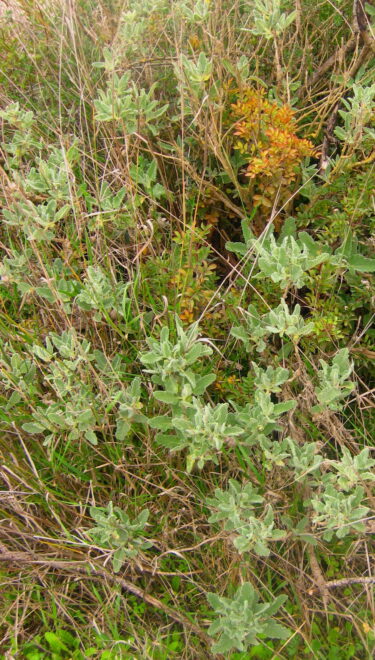
I myself grow za’atar in a container on my balcony; it’s a hardy Mediterranean herb that flourishes from year to year in the same spot. I bought the seedling from a plant nursery. I’ve also seen contraband sacks of the herb in Arab open-air markets.
Photo by Miriam Kresh for Green Prophet
But admittedly you need to be a farmer to grow akoub, because propagation is tricky, the season is short, and the sharp thorns surrounding the delicious leaves and flowers make harvesting hard.
Photo credit: : P. Gomez Barreiro, BG Kew
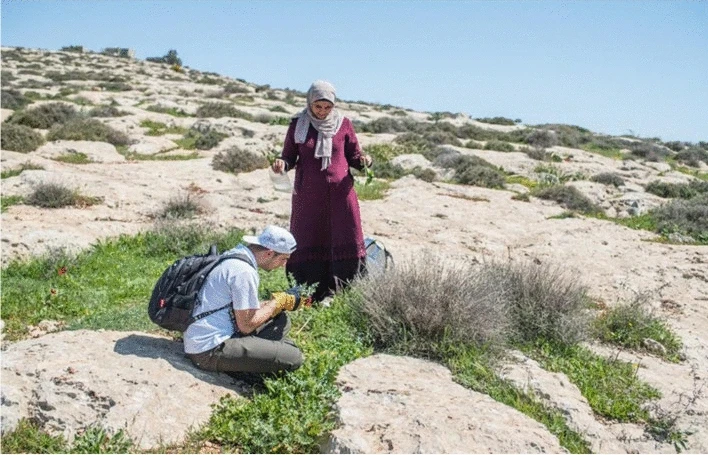
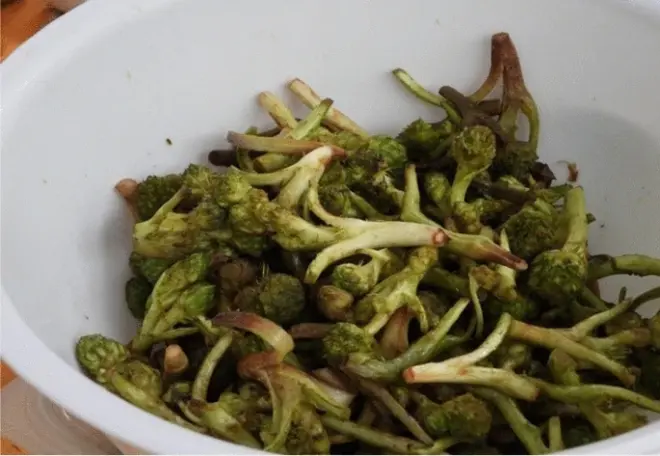
When living in northern Israel, I’d buy fresh akoub from a Beduin vendor in the local open-air market. It was expensive because of the labor involved in harvesting – I’ve seen robed Beduin slowly walking over the hills, stooping to pry the akoub away from the earth with a knife, then stripping the thorns off the edible stems.
I cooked both the flower and the stem. And yes, it was delicious, with its artichoke-like flavor. But now I wonder where that delicious akoub came from, and if I’d contributed to its overharvesting.
fPhoto credit: N. Hani, SBR via Springer Link
The Israel Nature and Parks Authority in the Golan have confiscated hundreds of kilos of za’atar and akoub. Some were meant to be sold in local markets, but much of this illegal produce makes its way across the border to Jordan.
Yaron Maderchi, head of the Investigations Department at the Israel Nature and Parks Authority, states that the fight against the illegal picking of wild plants is first and foremost a struggle to preserve them for future generations.
“We focus on strict enforcement against traders, not on picking for personal use,” said Maderchi. “There’s room for tradition and for responsible use of natural resources, but when picking is carried out on a commercial scale and without oversight, it leads to severe damage and even local extinction of species.”
The Israel Nature and Parks Authority noted that overpicking is driven mostly by financial incentives.
“Akoub is a highly sought-after product in the market, and illegal harvesting can generate profits of thousands of shekels per day,” said Oriya Vazana, a regional inspector in the central Golan for the Israel Nature and Parks Authority.
“Economic pressure leads people to enter these areas in large numbers,” said Vazana. “The entire market operates in cash, without oversight. Beyond the damage to the plant itself, we are also seeing collateral harm: cutting fences, opening gates, damage to grazing lands, and safety risks on roads. This is a complex issue that requires significant resources, manpower, and targeted enforcement throughout the short harvesting season.”
The plant has significant ecological importance, serving as a food source for pollinators and insects and contributing to biodiversity. Left unharvested, the flower head dries up and tumbles on the ground, dispersing seed.
About 240 kilos of akoub and 25 kilos of za’atar were seized by the Israel Nature and Parks Authority in the Golan, working with border police.
Za’atar growing wild in Israel. Photo credit: Miriam Kresh for Green Prophet
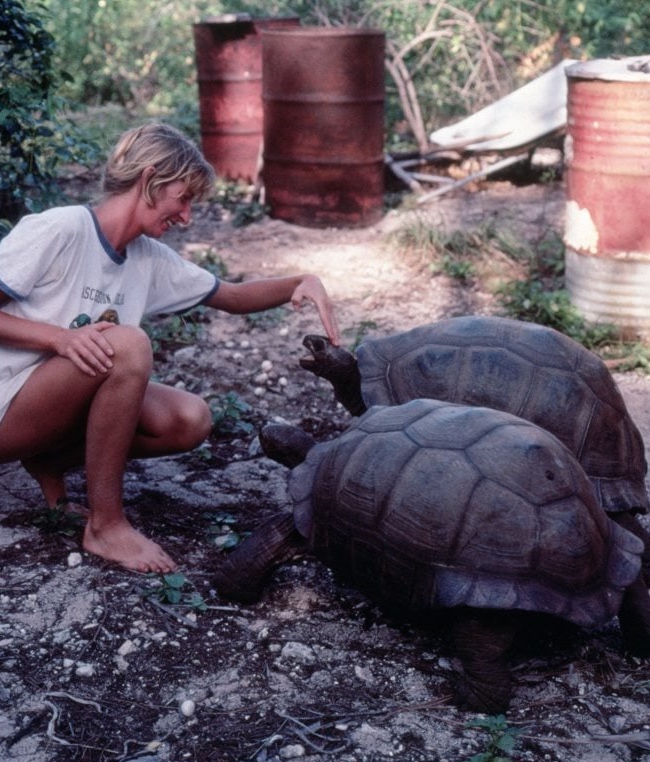
Jeanne Mortimer in her early days with tortoises and turtles in the Seychelles
It’s sea turtles which may in the end save islands in the Seychelles. They may also better help us understand climate change. Like rings on a tree, scientists have found a way to read sea turtle shells and how they are impacted by climate change tells a story.
Using radiocarbon methods from archaeology, researchers show that sea turtle shell plates are biological time capsules that record signs of major environmental disturbances in the ocean.
A new study published in the journalMarine Biology, shows that scutes, the hard plates that make up a turtle’s shell, grow continuously and preserve chemical signals that reflect environmental conditions over time. By analyzing these layers, scientists can determine where turtles have been foraging, what they were eating, and how marine environmental stress events affected them.
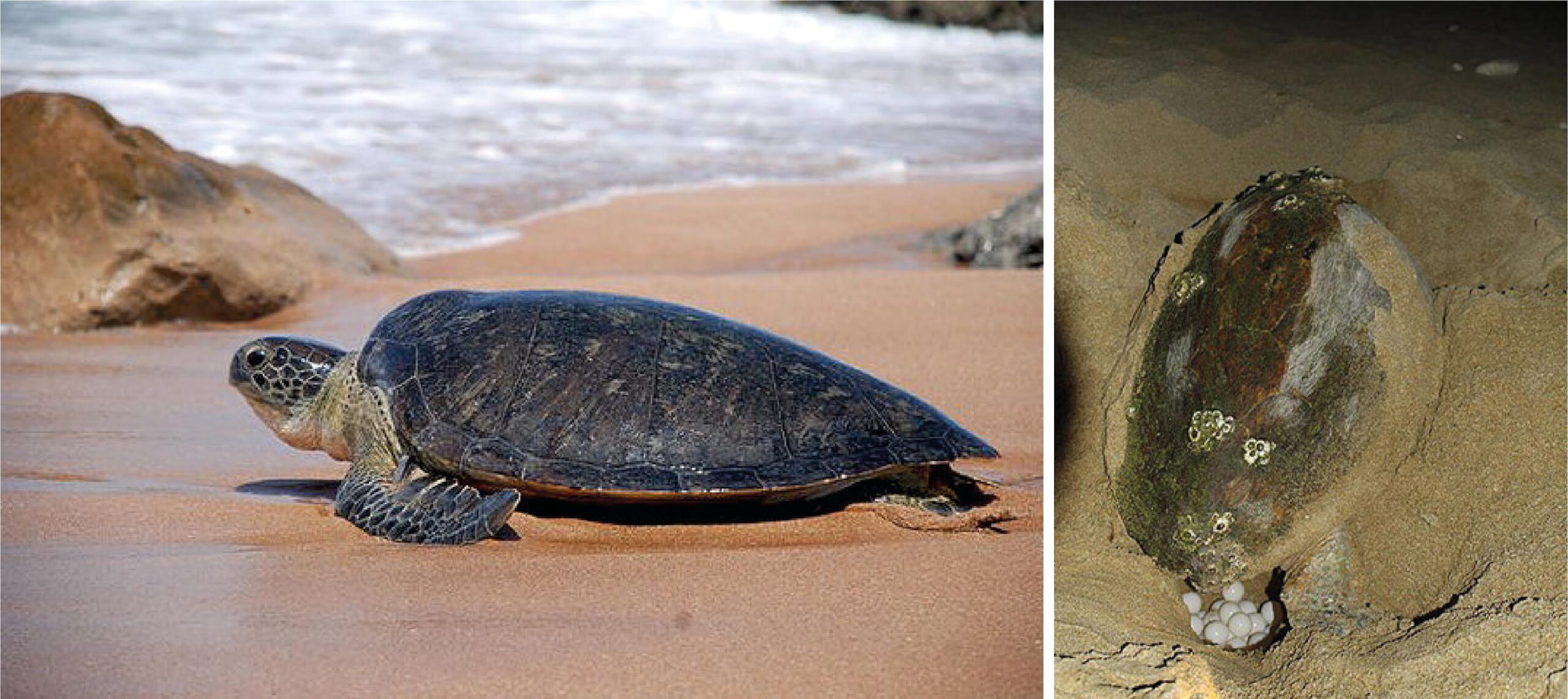
Strait of Hormuz sea turtles
The research was led byBethan Linscott, and Amy Wallace, in collaboration with researchers from the University of Florida.
Sea turtle scutes are made of keratin—the same material found in human hair and nails. Keratin grows in successive layers that capture chemical information about a turtle’s diet and environment when the tissue forms. Scientists have long used stable isotope analysis of scutes to study turtle ecology, but the timescale represented by these layers has remained uncertain.
Sea turtles don’t die from plastic straws. The bags get shredded at sea and the sea turtles get caught in them.
“Sea turtle shells grow continuously throughout their lives, and each layer preserves evidence of past environmental conditions,” said Linscott. “By analyzing these sequential layers, we can reconstruct foraging patterns, diet, and environmental changes over time.”
To determine how quickly the layers form, researchers analyzed shell samples from 24 stranded sea turtles—loggerheads (Caretta caretta) and green turtles (Chelonia mydas)—collected along the Florida coast between 2019 and 2022. The team removed small circular biopsies from the scutes and sliced them into ultra-thin sections approximately 50 microns thick.
Each layer was radiocarbon dated and compared with the mid-20th-century “bomb pulse,” a spike from nuclear weapons testing that serves as an environmental tracer in the marine environment.
The researchers then used Bayesian age-depth modeling, a statistical approach commonly used in archaeology to date sediment layers to estimate how quickly the shell tissue accumulated.
The results showed that scute growth rates vary among turtles, but on average each 50-micron layer represents about seven to nine months of growth.
By reconstructing these timelines, the scientists identified synchronized slowdowns in shell growth across multiple turtles. These slowdowns coincided with major environmental disturbances in Florida waters, includingharmful algal blooms known as “red tides”and large Sargassum seaweed events.
Red Tide in Oman
“These shells are effectively recording environmental stress in the ocean,” Linscott said. “It’s a bit like sea turtle forensics. We can use chemical fingerprints preserved in scutes to detect ecological shifts.”
Understanding where sea turtles forage, how their diets change, and how environmental stress affects their growth can help scientists better protect these threatened marine species. Because sea turtles are long-lived and spend much of their lives in the open ocean, directly observing their life histories is often difficult.
“Our findings can help scientists better understand how marine ecosystems are changing and how species respond to those changes.”
For centuries, the Sámi shaman drum was one of the most powerful sacred objects in northern Europe, and one of the most feared by church and state. If ISIS looks bad to us today for its religious fundamentalism, Christians were just as fervent.
In Denmark-Norway during the 17th and early 18th centuries, Sámi drums were confiscated as part of aggressive Christian missionary campaigns. In some witchcraft and idolatry prosecutions, drum owners faced severe punishment, including death sentences, although the legal reality varied case by case rather than through one simple blanket ban.
One of the most important records of these drums survives because of Knud Leem (1697–1774), a Norwegian priest and linguist who worked in Finnmark and became one of the earliest major documentarians of Sámi life, language, and belief. Leem began missionary work among the Sámi in 1725, learned Sámi language, and closely observed daily life, religion, and reindeer culture.
This ancient drawing depicts demons being consulted by the noaidi.
His landmark work, Beskrivelse over Finmarkens Lapper, was published in Copenhagen in 1767. The book included parallel Danish/Norwegian and Latin text and was illustrated with numerous copperplate engravings, making it one of the most significant 18th-century ethnographic works on the Sámi published in northern Europe. Some of the imagery was engraved by O.H. von Lode from drawings associated with Leem’s documentation.
How the Sámi drum worked
The Sámi drum, also called a runebomme or shaman drum, was used by a noaidi (Sámi ritual specialist or shaman) for divination and spiritual communication.
The drum membrane was often marked with symbolic figures, sometimes painted in red pigment, and these symbols could represent gods, humans, animals, sacred sites, hunting, illness, or the dead. On some North Sámi drums, the surface was structured into symbolic zones representing the upper world, human world, and underworld.
To use the drum, the noaidi placed a small metal pointer or ring, often referred to in sources as a vuorbi, on the skin and beat the drum. The movement of the ring was then interpreted as an answer to a question like a ouija board. Some questions they might ask include
Where a lost reindeer might be found
Whether a hunt would succeed
What kind of offering or ritual action was needed
The Sámi shaman who played his drum in court
An historical photo of a Sami family in Lapland. Date and source unknown.
One of the best-documented cases is that of Anders Poulsen, an elderly Sámi noaidi who was tried in Vadsø, northern Norway, in 1692 after his drum was confiscated.
Court records show that Poulsen was interrogated in detail about the symbols on his drum, making his testimony one of the most important surviving descriptions of Sámi cosmology and drum symbolism. Historians describe the case as part of the wider Finnmark witch trials, among the most intense witch persecutions in northern Europe.
Before any final conviction could be carried out, Poulsen was killed in custody with an axe by Willum (Villum) Gundersen, a servant later described in historical records as mentally unstable. Poulsen is often remembered as one of the last victims of the Finnmark witch trials.
Why did the Christians hunt sami drums?
Shamanism was seen as a type of devil worship. Shaman drumming, and ritual practices put them in league with the devil. Consequently, Christianity characterized Sámi noaidi as witches who consulted demons, and persecuted them mercilessly.
This drawing depicts demons being consulted by the noaidi.
Why so few Sámi drums survived
Many Sámi drums did not survive the missionary era. Missionary Thomas von Westen and his network collected large numbers of drums in the early 1700s as part of the Christianization campaign. Historical sources indicate that around 100 drums were taken, many of them sent to Copenhagen. A large portion of these were later destroyed in the Great Fire of Copenhagen in 1728, where about 70 drums were reportedly lost.
Today, only a small number of original Sámi drums survive in museum and institutional collections around the world. Scholars and museums generally place the number at roughly 70 to 75 known surviving drums, depending on classification and provenance.
The Sámi drum is not just an artifact. It is a surviving record of Indigenous cosmology, resistance, and memory. What church authorities once treated as evidence of “paganism” is now understood as part of a sophisticated spiritual and symbolic system tied to land, reindeer, ancestors, and survival in the Arctic.
And because missionaries, courts, and collectors tried so hard to destroy them, every surviving drum now carries two histories at once, the Sámi world it came from, and the violence used to erase it.
Who are the Sámi?
The Sámi people are an indigenous group of approximately 80,000–100,000 individuals living in Sápmi, a region stretching across the northern parts of Norway, Sweden, Finland, and Russia’s Kola Peninsula. While traditionally nomadic reindeer herders, most modern Sámi live in permanent homes in northern Scandinavia, with the largest population concentrated in Norway.
In a real emergency, romance takes a back seat to physics, panic, and how fast 150 people can squeeze through a narrow tube. The Federal Aviation Administration says every aircraft must be evacuated within 90 seconds. That’s the gold standard. But new research suggests that in the real world, especially as we age, that number might be more aspirational than achievable.
Researchers looked at what happens when things go very wrong: a dual-engine fire on an Airbus A320, one of the most common planes in the sky. Rare? Yes. Ask Captain Sullenberger.
Using simulation software (the same kind used to design safety systems), a team ran 27 different evacuation scenarios. They tested different cabin layouts, different passenger mixes, and crucially different distributions of older passengers.
What they found is quietly unsettling. Even in the best-case scenario, a relatively light cabin with 152 passengers and older travelers evenly spaced, evacuation took 141 seconds. That’s over 50% longer than the FAA requirement.
“While a dual-engine fire scenario is statistically rare, it falls under the broader category of dual-engine failures and critical emergencies in aviation. History has shown that dual-engine failures and emergencies, such as the famous ‘Miracle on the Hudson’ involving Captain Sullenberger, can happen and lead to severe consequences,” says study head Chenyang (Luca) Zhang. “Our study focuses on these low-probability but high-impact events to ensure the highest safety standards.”
As we age, reaction times slow. Decision-making can lag under stress. Physical movement, opening seatbelts, standing, moving quickly – all of this becomes harder. And in an emergencies on board airplanes every second matters because jet-fuel is highly combustable.
It’s not just older passengers. More people are traveling with children, infants, emotional support dogs and all this adds complexity to how people move (or don’t move) in a crisis.
The takeaway is design.
Airlines might need to rethink how they seat passengers. Not for comfort or status, but for survival. Smarter distribution, better briefings, maybe even personalized safety protocols.
According to the computer models they ran based on average times it takes women and men on varying ages to get out of the plane, the shortest total evacuation time was observed in scenario A-I-P1 (top left), which corresponds to Layout A, with 20% elderly passengers, and elderly passengers evenly distributed near the exits.
This scenario required 141.0 s to evacuate all occupants. In contrast, they write, the longest evacuation time occurred in scenario C-III-P1, which involved Layout C, 80% elderly passengers, and the same near-exit elderly distribution pattern.
This scenario resulted in a total evacuation time of 218.5 s.
Layout of plane according to seniors and where they are sat. The study proposes the best way to seat seniors.
Because the future of flying isn’t just about greener fuels or quieter engines. Or upgrading you and your kids to more legroom near the emergency exit. It’s about whether we can all get out when it matters most.
Marine protected areas are supposed to be safe havens for coral reefs, seagrass, fish nurseries and coastal wildlife. But a new global study suggests that many of them are protected in name only.
Research from the Wildlife Conservation Society (WCS) and the University of Queensland, published in Ocean & Coastal Management, found that nearly three out of four marine protected areas (MPAs) worldwide are exposed to sewage pollution. In the tropical ocean regions most vital for coral reefs and marine biodiversity, the situation is even worse: between 87 percent and 92 percent of protected areas are contaminated, often at pollution levels ten times higher than nearby unprotected waters.
The study evaluated more than 16,000 marine protected areas globally, and the findings land at an uncomfortable moment. Governments around the world have committed to protecting 30 percent of the ocean by 2030, under the international “30 by 30” biodiversity target.
But protecting lines on a map means little if polluted wastewater keeps pouring in from land.
Wastewater: used water from homes, businesses and sewage systems, carries nutrients, pathogens and chemicals into rivers and oceans. Those pollutants can fuel harmful algal blooms, weaken coral reefs, damage seagrass meadows and threaten marine wildlife. Scientists have already linked wastewater pollution to coral reef decline around the world and even Alzheimer’s-like brain disease in dolphins.
And this is not just a marine issue. Polluted water is also a human health crisis, contributing to diseases such as cholera and typhoid fever and causing an estimated 1.4 million deaths each year, alongside billions in economic losses.
“What we found was striking,” said lead author David E. Carrasco Rivera, a Ph.D. candidate at the University of Queensland. “In region after region, the areas set aside for conservation were actually receiving more pollution than the areas with no protection at all.”
The researchers closely analyzed 1,855 coastal MPAs in six tropical regions, including East Africa, the Indian Ocean, the Coral Triangle, Mesoamerica and the Caribbean, Australasia and Melanesia, and the Middle East and North Africa.
Algal bloom in the Philipines.
“Even a perfectly managed marine protected area will fail if wastewater keeps flowing in from upstream,” said Dr. Amelia Wenger, WCS Global Water Pollution Lead.
The message is simple: ocean conservation cannot stop at the shoreline. If governments want marine protected areas to actually protect marine life, they need to invest in sewage treatment, land-based pollution control, and smarter coastal planning, before “protected” becomes another empty word.
The question begs to be answered: can private people protect land better than poorly-run government bodies? And ask yourself when you are staying at a tropical resort or visit a nature paradise? Where is all my plastic and poop going?