The CFTC, FINRA, and NASAA have jointly warned retirees about precious metals fraud targeting retirement accounts. This checklist provides a structured framework for evaluating any company before transferring savings — and illustrates what credible providers look like across 7 measurable criteria.
A vast and largely untapped lithium reserve may be hiding beneath one of North America’s oldest landscapes, the Appalachian Mountains, offering a surprising twist in the global race for clean energy materials. According to new findings from the U.S. Geological Survey (USGS), as much as 2.5 million tons of lithium could be buried across the region, stretching from the Carolinas up through New England.
Energy equities are responding unevenly to the evolving landscape. Companies with direct exposure to UAE production growth and infrastructure are benefiting from increased activity expectations, while global oil majors face a more mixed outlook.
All air conditioners release water. That's Physics. Cities like Los Angeles pour billions of water down the drain every year. And while home owners who are savvy to water reuse are finding ways to use AC water in the garden (here are 5 ways to use air con water at home), or in art studios (it's basically free distilled water), cities could save water in meaningful ways by using creative ideas. These are solutions you can send to urban planners and those running smart city accelerator programs. Pick one of them and you might win the grant!
As tensions rise in one of the world’s most critical maritime chokepoints, the ripple effects go far beyond oil—touching food systems, climate pressures, and regional stability
The CFTC, FINRA, and NASAA have jointly warned retirees about precious metals fraud targeting retirement accounts. This checklist provides a structured framework for evaluating any company before transferring savings — and illustrates what credible providers look like across 7 measurable criteria.
A vast and largely untapped lithium reserve may be hiding beneath one of North America’s oldest landscapes, the Appalachian Mountains, offering a surprising twist in the global race for clean energy materials. According to new findings from the U.S. Geological Survey (USGS), as much as 2.5 million tons of lithium could be buried across the region, stretching from the Carolinas up through New England.
Energy equities are responding unevenly to the evolving landscape. Companies with direct exposure to UAE production growth and infrastructure are benefiting from increased activity expectations, while global oil majors face a more mixed outlook.
All air conditioners release water. That's Physics. Cities like Los Angeles pour billions of water down the drain every year. And while home owners who are savvy to water reuse are finding ways to use AC water in the garden (here are 5 ways to use air con water at home), or in art studios (it's basically free distilled water), cities could save water in meaningful ways by using creative ideas. These are solutions you can send to urban planners and those running smart city accelerator programs. Pick one of them and you might win the grant!
As tensions rise in one of the world’s most critical maritime chokepoints, the ripple effects go far beyond oil—touching food systems, climate pressures, and regional stability
The CFTC, FINRA, and NASAA have jointly warned retirees about precious metals fraud targeting retirement accounts. This checklist provides a structured framework for evaluating any company before transferring savings — and illustrates what credible providers look like across 7 measurable criteria.
A vast and largely untapped lithium reserve may be hiding beneath one of North America’s oldest landscapes, the Appalachian Mountains, offering a surprising twist in the global race for clean energy materials. According to new findings from the U.S. Geological Survey (USGS), as much as 2.5 million tons of lithium could be buried across the region, stretching from the Carolinas up through New England.
Energy equities are responding unevenly to the evolving landscape. Companies with direct exposure to UAE production growth and infrastructure are benefiting from increased activity expectations, while global oil majors face a more mixed outlook.
All air conditioners release water. That's Physics. Cities like Los Angeles pour billions of water down the drain every year. And while home owners who are savvy to water reuse are finding ways to use AC water in the garden (here are 5 ways to use air con water at home), or in art studios (it's basically free distilled water), cities could save water in meaningful ways by using creative ideas. These are solutions you can send to urban planners and those running smart city accelerator programs. Pick one of them and you might win the grant!
As tensions rise in one of the world’s most critical maritime chokepoints, the ripple effects go far beyond oil—touching food systems, climate pressures, and regional stability
The CFTC, FINRA, and NASAA have jointly warned retirees about precious metals fraud targeting retirement accounts. This checklist provides a structured framework for evaluating any company before transferring savings — and illustrates what credible providers look like across 7 measurable criteria.
A vast and largely untapped lithium reserve may be hiding beneath one of North America’s oldest landscapes, the Appalachian Mountains, offering a surprising twist in the global race for clean energy materials. According to new findings from the U.S. Geological Survey (USGS), as much as 2.5 million tons of lithium could be buried across the region, stretching from the Carolinas up through New England.
Energy equities are responding unevenly to the evolving landscape. Companies with direct exposure to UAE production growth and infrastructure are benefiting from increased activity expectations, while global oil majors face a more mixed outlook.
All air conditioners release water. That's Physics. Cities like Los Angeles pour billions of water down the drain every year. And while home owners who are savvy to water reuse are finding ways to use AC water in the garden (here are 5 ways to use air con water at home), or in art studios (it's basically free distilled water), cities could save water in meaningful ways by using creative ideas. These are solutions you can send to urban planners and those running smart city accelerator programs. Pick one of them and you might win the grant!
As tensions rise in one of the world’s most critical maritime chokepoints, the ripple effects go far beyond oil—touching food systems, climate pressures, and regional stability
The CFTC, FINRA, and NASAA have jointly warned retirees about precious metals fraud targeting retirement accounts. This checklist provides a structured framework for evaluating any company before transferring savings — and illustrates what credible providers look like across 7 measurable criteria.
A vast and largely untapped lithium reserve may be hiding beneath one of North America’s oldest landscapes, the Appalachian Mountains, offering a surprising twist in the global race for clean energy materials. According to new findings from the U.S. Geological Survey (USGS), as much as 2.5 million tons of lithium could be buried across the region, stretching from the Carolinas up through New England.
Energy equities are responding unevenly to the evolving landscape. Companies with direct exposure to UAE production growth and infrastructure are benefiting from increased activity expectations, while global oil majors face a more mixed outlook.
All air conditioners release water. That's Physics. Cities like Los Angeles pour billions of water down the drain every year. And while home owners who are savvy to water reuse are finding ways to use AC water in the garden (here are 5 ways to use air con water at home), or in art studios (it's basically free distilled water), cities could save water in meaningful ways by using creative ideas. These are solutions you can send to urban planners and those running smart city accelerator programs. Pick one of them and you might win the grant!
As tensions rise in one of the world’s most critical maritime chokepoints, the ripple effects go far beyond oil—touching food systems, climate pressures, and regional stability
The CFTC, FINRA, and NASAA have jointly warned retirees about precious metals fraud targeting retirement accounts. This checklist provides a structured framework for evaluating any company before transferring savings — and illustrates what credible providers look like across 7 measurable criteria.
A vast and largely untapped lithium reserve may be hiding beneath one of North America’s oldest landscapes, the Appalachian Mountains, offering a surprising twist in the global race for clean energy materials. According to new findings from the U.S. Geological Survey (USGS), as much as 2.5 million tons of lithium could be buried across the region, stretching from the Carolinas up through New England.
Energy equities are responding unevenly to the evolving landscape. Companies with direct exposure to UAE production growth and infrastructure are benefiting from increased activity expectations, while global oil majors face a more mixed outlook.
All air conditioners release water. That's Physics. Cities like Los Angeles pour billions of water down the drain every year. And while home owners who are savvy to water reuse are finding ways to use AC water in the garden (here are 5 ways to use air con water at home), or in art studios (it's basically free distilled water), cities could save water in meaningful ways by using creative ideas. These are solutions you can send to urban planners and those running smart city accelerator programs. Pick one of them and you might win the grant!
As tensions rise in one of the world’s most critical maritime chokepoints, the ripple effects go far beyond oil—touching food systems, climate pressures, and regional stability
The CFTC, FINRA, and NASAA have jointly warned retirees about precious metals fraud targeting retirement accounts. This checklist provides a structured framework for evaluating any company before transferring savings — and illustrates what credible providers look like across 7 measurable criteria.
A vast and largely untapped lithium reserve may be hiding beneath one of North America’s oldest landscapes, the Appalachian Mountains, offering a surprising twist in the global race for clean energy materials. According to new findings from the U.S. Geological Survey (USGS), as much as 2.5 million tons of lithium could be buried across the region, stretching from the Carolinas up through New England.
Energy equities are responding unevenly to the evolving landscape. Companies with direct exposure to UAE production growth and infrastructure are benefiting from increased activity expectations, while global oil majors face a more mixed outlook.
All air conditioners release water. That's Physics. Cities like Los Angeles pour billions of water down the drain every year. And while home owners who are savvy to water reuse are finding ways to use AC water in the garden (here are 5 ways to use air con water at home), or in art studios (it's basically free distilled water), cities could save water in meaningful ways by using creative ideas. These are solutions you can send to urban planners and those running smart city accelerator programs. Pick one of them and you might win the grant!
As tensions rise in one of the world’s most critical maritime chokepoints, the ripple effects go far beyond oil—touching food systems, climate pressures, and regional stability
The CFTC, FINRA, and NASAA have jointly warned retirees about precious metals fraud targeting retirement accounts. This checklist provides a structured framework for evaluating any company before transferring savings — and illustrates what credible providers look like across 7 measurable criteria.
A vast and largely untapped lithium reserve may be hiding beneath one of North America’s oldest landscapes, the Appalachian Mountains, offering a surprising twist in the global race for clean energy materials. According to new findings from the U.S. Geological Survey (USGS), as much as 2.5 million tons of lithium could be buried across the region, stretching from the Carolinas up through New England.
Energy equities are responding unevenly to the evolving landscape. Companies with direct exposure to UAE production growth and infrastructure are benefiting from increased activity expectations, while global oil majors face a more mixed outlook.
All air conditioners release water. That's Physics. Cities like Los Angeles pour billions of water down the drain every year. And while home owners who are savvy to water reuse are finding ways to use AC water in the garden (here are 5 ways to use air con water at home), or in art studios (it's basically free distilled water), cities could save water in meaningful ways by using creative ideas. These are solutions you can send to urban planners and those running smart city accelerator programs. Pick one of them and you might win the grant!
As tensions rise in one of the world’s most critical maritime chokepoints, the ripple effects go far beyond oil—touching food systems, climate pressures, and regional stability
At a time when climate anxiety can feel abstract and overwhelming, and being Jewish something people may need to hide in big cities, Adamah Los Angeles is trying something different: turning Jewish values into local climate action with dirt-under-the-fingernails practicality.
This spring, the Los Angeles-based branch of Adamah is inviting the Jewish community to engage climate work not as a distant political slogan, but as a lived spiritual and communal responsibility. Its newly opened LA Sustainability Fund is one of the clearest examples. Jewish nonprofits in the greater Los Angeles area can apply for grants of up to $20,000 to support energy-saving and sustainability projects, provided they are part of the Jewish Climate Leadership Coalition.
That’s real money for real change – the kind of funds that can help schools, synagogues, camps, and community spaces lower emissions and utility bills while becoming more resilient in a warming California.
The initiative arrives alongside LA Climate Week (April 12–16), where Adamah LA is organizing and promoting events rooted in regenerative gardening, volunteering, faith, and climate resilience. Rather than framing environmentalism as gloom and doom, Adamah leans into repair, ritual, and relationship the Jewish way.
This is very much Adamah’s broader model: blending Jewish learning, land connection, food, farming, climate literacy and spiritual renewal into one ecosystem. Even its seasonal offerings reflect that approach. For Passover, which is still ongoing, Adamah has released a sustainability-focused haggadah supplement that brings ecological reflection into the seder through Torah (the Bible), meditation, and climate questions.
There’s also a professional side to the movement so Jewish communal workers can attend “ReTreat Yourself!”, a no-cost June retreat at Camp Ramah in California, designed to strengthen both leadership and spiritual resilience in these hard times.
In a city known for its urban sprawl, wildfires, and climate vulnerability, Adamah LA is building something close to the ground: a Jewish climate culture that is local, networked, and rooted in action.
In Hebrew Adamah is the connection between adam (human) and adamah, the earth.
While Adamah LA has emerged as a strong Jewish climate organizer during LA Climate Week, the broader week also opens space for Christian and Indigenous leadership, two groups whose environmental work often runs deeper than branding or institutional visibility.
For many Christian communities in Los Angeles, climate action is increasingly framed as a matter of stewardship, justice, and care for creation. Churches, faith-based nonprofits, and Catholic organizers often use Climate Week to host conversations around energy, food systems, environmental racism, and resilience in vulnerable neighborhoods. Their language may differ from activist circles, but the mission is often the same: protecting life, land, and future generations.
Indigenous voices, meanwhile, bring something even more foundational. Rather than treating climate as a policy issue alone, Indigenous leaders tend to center land relationship, ancestral responsibility, water protection, and sacred ecology. Their presence in climate events can shift the conversation from sustainability as a technical fix to sustainability as a way of living in right relationship with the earth.
Together, Christian and Indigenous participants help expand LA Climate Week beyond panels and policy. They remind the city that climate action is not only scientific or political, it is also moral, spiritual, and deeply rooted in place.
If you know of other faith-based events happening during the week, drop them in the comments below.
Astroturf on a soccer pitch not only releases chemicals, players don’t take risks on it for the burns
Artificial turf was sold as a low-maintenance dream for dry climate cities like Los Angeles, Dubai, and Tel Aviv: no mowing, no mud, no watering. But for many homeowners, it is starting to look more like a plastic trap. It is leaking microplastics which are a health and eco-hazard. Biohacker Bryan Johnson spoke about the need to get rid of his astroturf for health reasons, but how?
Synthetic grass can get dangerously hot in the sun, cause skin burns, trap chemical dust, and shed microplastics into your soil and drains and these also end up in our air and bodies. Many products also contain crumb rubber infill made from recycled tires, along with plastic fibers and backing materials that do not belong in a healthy backyard.
For families with kids, pets, or anyone trying to build a cleaner outdoor space, removing old astroturf is one of the simplest ways to reduce unnecessary exposure to plastics and heat. Some past studies suggest that if kids have played on these surfaces you need to wash their hands.
The good news is that you do not need to turn your yard into a construction zone, as getting rid of artificial turf is a sooner the better idea. You just need to remove it carefully, contain the mess, and dispose of it responsibly.
5 simple tips to safely remove astroturf from your yard
Is Astro Turf safe?
1. Pick a cool, dry day
Do not remove turf in extreme heat or on a windy day. Hot turf releases more dust and becomes harder to handle. Wind can spread loose fibers and crumb rubber around your yard and into drains.
2. Wear gloves, shoes, and a mask
Old turf can contain dust, rubber particles, sharp staples, sand, and degraded plastic fibers. Wear: work gloves, closed shoes or boots, long sleeves and wear an N95 or dust mask if the turf is old or crumbly. Keep the kids and pets away while you work.
3. Roll it up slowly, don’t rip it apart
Cut the turf into manageable strips with a sharp utility knife if it’s large. Roll each strip carefully instead of dragging it across the yard. This helps stop plastic fibers, infill, and backing crumbs from spreading into your soil. If there is black crumb rubber or sand infill, use a shovel and broom to gather it first before rolling.
4. Bag the loose plastic and vacuum the area if the turf is on a hard surface. If it’s on sand or earth sweep or rake visible plastic bits and use a shop vacuum for small fibers and rubber crumbs. Better to collect some sand with the plastic bits using a shop vac. Collect debris into heavy-duty contractor bags
Do not hose the area down aggressively. That can push microplastics deeper into soil or into storm drains or into your backyard to keep emerging years later. Wait for a week or too. Natural air flow should gather some of the plastic fragments at corners for you to sweep away and contain.
5. Don’t burn it or dump it illegally
It’s not asbestos so you don’t need to bring it to a biohazard site. A local dump will do, or ask your city what to do and how to mark it if they do collection. Never burn artificial turf. It can release toxic, plastic fumes. And do not cut it into tiny pieces and throw it loosely into regular trash if you can avoid it.
Instead:
Ask your municipal waste center if they accept artificial turf. Check for construction and demolition waste disposal sites near you. Ask local landscaping or junk-haul companies if they handle turf removal. If the turf is newer, ask the installer or manufacturer if they have a take-back or recycling option for what you’ve pulled up.
Some places treat artificial turf as bulky plastic or construction waste, not regular yard waste.
How to reduce microplastics left behind from astroturf
There are ways to sustainably care for your backyard, via Bakker.com
You probably will not remove every last plastic fiber, but you can reduce what remains. Try this simple cleanup plan:
Hand-rake gently to collect visible fragments
Shop-vac hard surfaces like patios, pavers, and edges
Remove the top layer of contaminated infill or dust if there’s a heavy buildup
Add fresh compost and mulch to help cover and stabilize remaining particles
Replant with groundcovers, native plants, clover, gravel, or permeable stone
If the turf sat there for years, replacing the top few centimeters of soil in high-use areas may also help, especially where children played barefoot.
What should replace astroturf?
Bakker.com solutions of native grasses, sand and wood
The best replacement depends on your climate, but healthier choices include:
native drought-tolerant plants
clover or low-water living groundcovers
mulch play areas
permeable pavers
gravel with shade trees
tiled or shaded courtyard spaces
The smartest yard is not the greenest-looking one. It is the one that stays cooler, drains properly, and supports life instead of shedding plastic.
Boys playing soccer in the back yard on fake, plastic grass. Artificial Turf Supply, Maryland
Is artificial turf bad for your health? Artificial turf, the green plastic surface designed to look like grass, has been sold to homeowners as a clever compromise: a green-looking yard without mowing. It survives heavy use and, in dry places like the Middle East, California, or Texas, it can replace thirsty lawns. Yeah it paints a nice verdant green cover in dry places or under trees where the grass won’t grow, but if you start using it, it’s function is just tricking your eyes.
But the evidence points to a more inconvenient truth we’ve known all along. Synthetic grass can bring real health and environmental trade-offs.
Some risks are immediate and obvious. Artificial turf can run dramatically hotter than natural grass in full sun, increasing the risk of heat stress, dehydration, blistering, and burns to your skin. Real grass respires and releases moisture throughout the day. Plastic grass does not. Field measurements and reviews have repeatedly found synthetic surfaces can become dangerously hot, especially in direct sunlight. A 2024 study in Frontiers in Sustainable Cities noted that artificial turf can reach very high surface temperatures and worsen urban heat island effects. They’ve even proposed ways for cooling it down in cities using water, the very thing that astroturf was designed to solve.
A 2025 evidence summary from Canada’s National Collaborating Centre for Environmental Health reached similar conclusions, highlighting heat, skin abrasions, and exposure concerns. “Human exposure to chemicals from artificial turf playing fields can be reduced by washing hands and avoiding infill and fibre ingestion by infants and children,” they write. Is that something we want kids playing on?
Biohacker Bryan Johnson, right, and his son. He recently understood that the toxic fake plastic grass in his backyard has to go.
Even Bryan Johnson, the longevity entrepreneur known for trying to optimize every aspect of his life so he can live forever, recently posted on X: “Guys, I’m an idiot. All this time I’ve spent trying not to die, I had toxic turf in my backyard.” He added that artificial turf contains crumb rubber infill made from recycled tires. His phrasing was dramatic, but the underlying point stands: you can spend heavily on health while surrounding yourself with industrial plastics.
He wrote:
“Artificial turf contains crumb rubber infill made from recycled tires, which leaches chemicals including PFAS, heavy metals, and polycyclic aromatic hydrocarbons. These compounds are linked to hormone disruption, carcinogenicity, and systemic inflammation. I don’t know how I missed it. It makes me question my basic competence in life. What gets me is that I try so hard to survey the world of potential idiocy. Then I find out there’s a monument to idiocy sitting right in front of my face that I was blind to. I’m removing the turf, yet I’m still stuck with this seemingly unsolvable problem of how to not be an idiot.”
Then there are injury patterns. Several reviews have found that some lower-extremity injuries, especially certain non-contact injuries, may be more common on artificial turf than on well-maintained natural grass, though results vary by sport, footwear, and field condition. Sliding on astroturf can cause turf burns, which are not only painful but can become infected if not treated properly. Children and athletes are particularly exposed, as they fall, slide, and breathe close to these surfaces.
The harder question is chemical exposure. Many synthetic fields use crumb rubber infill made from recycled tires. A growing body of research shows these materials can contain metals, volatile organic compounds, polycyclic aromatic hydrocarbons (PAHs), phthalates, PFAS, and other chemicals of concern. A 2024 systematic review in Environmental Health Insights and a study by the NIH found potentially hazardous concentrations of chemicals in turf infill and fibres, with exposure pathways raising concern, especially for children.
The NIH writes, “Cancer risks were identified for ingestion exposure to PAH in children with pica and heavy metal exposure via dermal, inhalation and ingestion pathways. Non-carcinogenic risks were identified for the ingestion of cobalt in a child spectator and the ingestion of arsenic, cobalt, thallium and zinc. Potentially hazardous concentrations of chemicals were found across both artificial turf infill and artificial turf fibre samples; bioaccessibility of these chemicals varied.”
A 2022 review in Environmental Pollution was more direct, concluding that chemicals identified in artificial turf include known carcinogens, mutagens, and endocrine disruptors, while noting that human evidence remains limited and under-studied.
Astroturf on a soccer pitch not only releases chemicals, players don’t take risks on it for the burns
It would be false to say science has definitively proven that artificial turf causes cancer in everyday users. It has not. Science is methodical and slow, and long-term effects take years to measure. But it would also be false to say the issue is settled or harmless. Even the US EPA’s crumb rubber research effort, updated in 2024, did not conclude there was no risk; it characterized exposures and acknowledged that a full risk assessment is still incomplete. In plain terms: chemicals are present, exposure happens, and long-term health impacts are not fully understood.
The ecological problem of astroturf
Artificial turf is essentially a plastic carpet. It sheds fibers and dust that can enter drains, soils, and waterways, contributing to microplastic pollution. It also seals the ground. Natural grass supports soil life, cools the air, and participates in ecological cycles. Plastic turf does not. It does not cool like vegetation, does not support biodiversity, and does not age well. When it wears out, disposal becomes another environmental problem.
In arid cities, synthetic turf is often marketed as a “green” alternative to water-hungry lawns. But replacing one ecological problem with a heat-trapping plastic surface is not real progress.
Alternatives include native planting, shaded courtyards, permeable surfaces, gravel, regional groundcovers, and climate-appropriate design.
Artificial turf is not automatically poisoning everyone who touches it, but it is not a neutral surface either. Plant local species, use permeable materials, and design for life—not plastic.
As missiles fly and oil traders panic, one thing is becoming brutally clear: a world powered by more renewables is a world less exposed to political violence, fuel blackmail by Iran and Saudi Aramco, and petro-instability that have long haunted the Middle East.
According to the International Renewable Energy Agency (IRENA), a UN-like energy body based in Abu Dhabi, the world added a record 692 gigawatts (GW) of renewable power capacity in 2025, bringing the global total to 5,149 GW.
Renewables made up 85.6% of all new power capacity added worldwide, while fossil fuel and other non-renewable additions continued to shrink in relative importance. That matters far beyond climate, I believe.
When countries generate more of their own electricity from solar, wind, hydro and bioenergy, they become less vulnerable to oil and gas chokepoints, tanker wars, Red Sea Houthi pirates, Iranian mullahs, price spikes, and the geopolitics of regimes and armed movements that have historically benefited from fossil fuel dependence. Renewables do not solve extremism on their own, but they do weaken the leverage of fuel-dependent systems that have helped finance instability across the region.
“In the midst of uncertain time, renewable energy remains consistent and steadfast in its expansion,” said Francesco La Camera, IRENA’s Director-General. “A more decentralised energy system, with a growing share of renewables and more market players, is structurally more resilient.”
Saas is used in marine logistics
IRENA, headquartered in Abu Dhabi, is the world’s leading intergovernmental agency for the renewable energy transition. It has 171 members and additional countries in accession, and serves as a technical and policy hub for governments trying to decarbonize while improving energy security. Abu Dhabi is its permanent headquarters.
The biggest gains in 2025 came from solar power, which added 511 GW, followed by wind at 159 GW. Together, those two technologies accounted for 96.8% of all new renewable additions globally.
Asia dominated, contributing 74.2% of all new renewable capacity, with 513.3 GW added. China remained the giant, especially in solar, wind, and hydropower, according to IRENA. This doesn’t mean they are a green economy however, because as China grows so does its dependence on fossil fuels. They are not regulated in any way for carbon emissions and tend to do what they want while the rest of the world plants trees and trades carbon credits.
Ormat collects heat energy from the earth’s crust transforming it into electricity. You can buy shares in this company.
India also posted strong wind and hydro gains. In Africa, renewable capacity rose by 15.9%, its fastest jump yet, led by Ethiopia, South Africa, and Egypt. The Middle East recorded its highest annual growth too, rising 28.9%, led by Saudi Arabia. The House of Saud knows they cannot survive on oil alone in the future. They have also been investing in green hydrogen.
The map is wildly uneven. Europe now holds 934 GW in total renewable capacity, while Central America and the Caribbean remain stuck at just 21 GW. That imbalance is not just unfair; it is also dangerous. Countries with low renewable penetration remain more exposed to imported fuel shocks, debt, and fragile grids.
Tesla Powerpacks store energy for grid stability
The world’s next focus should be obvious: grid expansion, battery storage solutions, off-grid solar, and finance for poorer countries. It is not enough to install panels in China as its economy keeps building endless factories and call it a transition.
“This not only indicates market preference but also makes a strong case for renewable energy resilience with brutal clarity,” La Camera said. And in a world where oil routes can still trigger global panic overnight, resilience is no longer a climate luxury, it is national security.
People comparing their healthcare financing options often run into a question with a deceptively short answer: Is Liberty HealthShare insurance? No, it is not. But that single-word answer carries significant weight, and understanding what sits behind it matters far more than the answer itself.
Liberty HealthShare is a non-profit 501(c)(3) Christian medical cost-sharing ministry based in Canton, Ohio. Founded in 1995, the ministry facilitates voluntary sharing of eligible medical expenses among members who share Christian values and a commitment to mutual aid. That structure places it in an entirely different legal and operational category than insurance.
The Legal Difference Is Not Semantic
Health insurance is a regulated financial product. Insurers operate under binding contracts, overseen by state insurance commissioners, that legally obligate them to pay claims meeting policy terms. Policyholders who believe a covered claim was wrongfully denied have legal recourse through state regulatory channels.
Liberty HealthShare functions outside that framework entirely. Voluntary member contributions are assigned to other members with eligible medical expenses that are approved for sharing. Liberty HealthShare facilitates that sharing. No contractual guarantee of payment exists. The ministry states plainly that its sharing programs “do not guarantee or promise that a member’s medical bills will be paid or assigned to others for payment.”
Healthcare sharing ministries are exempt from state insurance regulations precisely because they operate as voluntary member-to-member sharing communities, not as financial products with legally enforceable payment obligations. That exemption reflects a structural difference in how these models are built and governed.
Federal Recognition Under the ACA
Despite not being insurance, Liberty HealthShare holds a meaningful federal designation. The ministry received recognition as an eligible healthcare sharing ministry under the Affordable Care Act in 2014, a status that exempts members from ACA insurance mandates.
That designation creates a third category in American healthcare financing — distinct from being insured and distinct from being uninsured. Members participate in a faith-based sharing community without facing penalties for not carrying insurance. The ACA’s recognition of this category reflects a congressional acknowledgment that healthcare sharing ministries operate according to principles and structures that fall outside the insurance regulatory model.
How the Facilitation Model Works in Practice
“We’re not trying to make a profit on this. Our focus is we facilitate, and that’s it. There’s no other objective on our part. We just want to help our members get the best care possible at the best value,” posts Liberty HealthShare Chief Executive Officer Dorsey Morrow.
That facilitation model shapes member interactions from the beginning. Liberty HealthShare’s Care Navigation team works directly with members to help them understand proposed treatments, question provider charges, and make informed decisions before bills are finalized. Members track their contributions and sharing activity through their personal ShareBox, a secure online portal that shows how monthly shares support others in the community. That degree of financial transparency is uncommon in insurance arrangements, where members rarely see how their premiums are distributed.
Morrow explains that one of the ministry’s core goals is encouraging members to engage actively with their healthcare decisions rather than approaching the system passively: “We want our members to take back that control.”
Six Programs, No Open Enrollment Window
Liberty HealthShare offers six medical cost-sharing programs designed to accommodate different household sizes and budgets, as well as supplemental dental and vision sharing programs. Suggested monthly share amounts for individuals range from $87 to $369, with family options starting at $319 per month. Members can switch between programs or leave without annual commitments.
Enrollment is available year-round, with no qualifying life event required. That open enrollment structure contrasts with insurance models governed by ACA open enrollment periods or employer plan windows, and it reflects the ministry’s status as a non-insurance sharing community rather than a regulated financial product.
What the Distinction Requires of Members
Understanding that Liberty HealthShare is not insurance is not a footnote — it is foundational to making an informed decision about membership. Sharing is voluntary. No guarantee of payment exists. Members who join do so within a community built on shared Christian values, mutual aid, and personal engagement with healthcare decisions.
For those whose values and circumstances fit that model, the ministry has operated for 30 years and facilitated nearly $5 billion in eligible, repriced medical expenses for its members since 2014. For those who need contractual payment guarantees, insurance is the appropriate path. Liberty HealthShare has never claimed otherwise.
More information is available at LibertyHealthShare.org or by calling 855-585-4237.
One worker callously said that instead of providing care for sick or struggling sheep, it was “easier” when they died “out of sight, out of mind.”
The problem with outsourcing ethically-farmed anything to third party companies. This news should shift how ethical fashion operates and considers liability for wrongful marketing.
The New Zealand Merino Company, now rebranded as Zentera, has quietly removed the phrase “world’s leading ethical wool brand” from its website, a notable change that comes after a disturbing investigation by PETA Asia-Pacific into the company’s ZQ-certified wool supply chain, PETA reports to Green Prophet. Zentara, according to its website, supplies wool for 30 leading fashion brands. They are a supplier that CSR VPs have come to rely on for annual and quarterly reports.
They have changed wording on their website and say that their wool is “grown with care.”
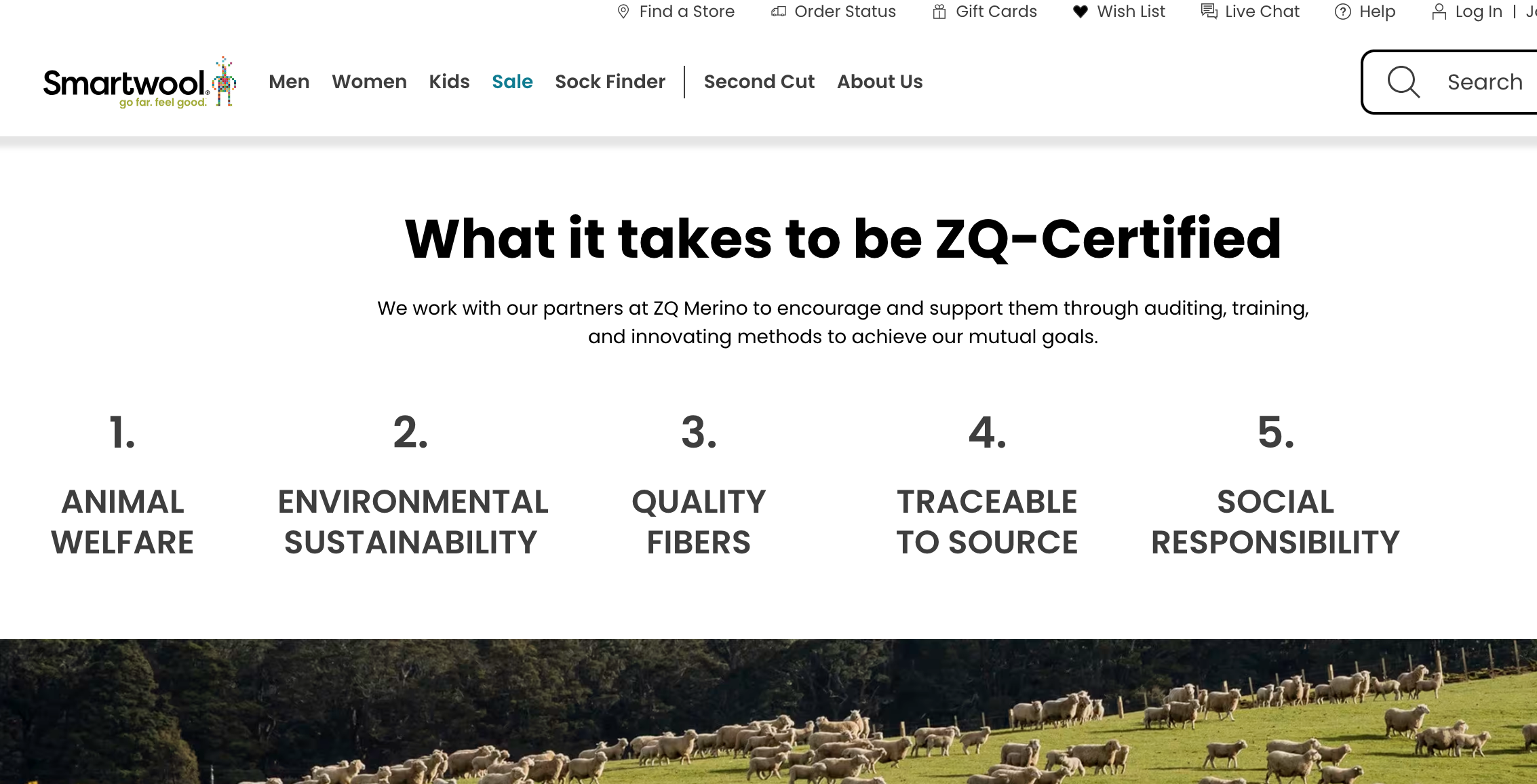
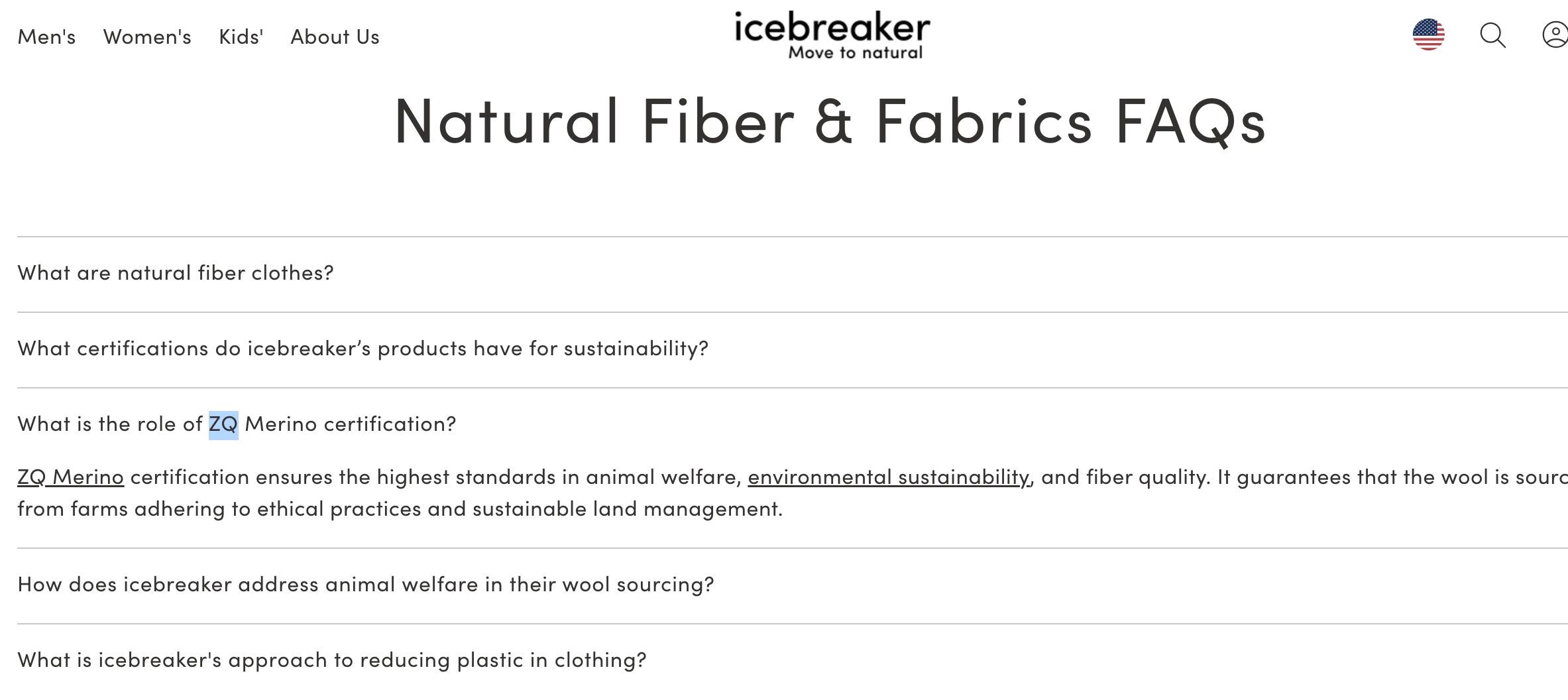
ZQ, which now stands for “Zentera Quality,” is Zentera’s official wool certification label, marketed as a standard for animal welfare, traceability, environmental stewardship and social responsibility. Big brands which feature their products as ethical and “kind” are sold by brands including Allbirds, icebreaker, Smartwool (I love their socks), Mons Royale who touts “we are going regenerative!”; and Untouched World, all of which publicly market items made with ZQ- or ZQRX-certified wool.
Zentera offers a “superior” unstressed wool
For years, wool has been sold to consumers as the natural, sustainable alternative to synthetic fibers. But when “ethical” becomes a marketing shield rather than a measurable reality, the industry has a serious credibility problem. (We buy sweaters from babaa in Spain).
If you go to some of the companies that use ZQ wool they are still celebrating the “eco credentials of their suppliers, like with SmartWool, this screen capture taken April 1. This is not April Fool’s.
SmartWool uses ZQ-certified wool
PETA Asia-Pacific says it went inside 11 farms and shearing sheds in New Zealand that produce ZQ-certified wool, which it describes as “a sham certification standard developed and owned by The New Zealand Merino Company.” According to the animal rights group, investigators found that “shearers kicked, beat, and stomped on sheep and threw them down chutes. One worker slammed a sheep’s head against a hard wooden board three times.”
Green Prophet reached out to Zentera 24 hours ago and there has since been no reply for our request to comment.
All Birds advertise ZQ wool on their website: April 1, 2026
The allegations do not stop at the shearing shed.
Despite PETA putting out an alarm about Zentera wool in December, 2026 companies like icebreaker still advertise their supplier’s eco-credentials. April 1, 2026
PETA says that sheep from ZQ-certified farms whose fleece production had declined were later sent to slaughter, including to a slaughterhouse owned by Silver Fern Farms. There, according to the organization, sheep were “forced onto conveyer belts, electroshocked in the head, and violently killed.” In its account of the footage, PETA says the stunning process was at times inadequate and that some sheep appeared to show signs of consciousness after their throats were cut. One worker laughed at dying sheep when blood was pouring from its eyes.
Mons Royale uses “regenerative” wool
The group says it has submitted evidence from the farms to New Zealand’s Ministry for Primary Industries, calling for investigation and charges over what it describes as apparent violations of animal cruelty laws. Green Prophet has not independently verified the footage or the full scope of the allegations, but the claims are serious enough to put pressure on every brand still using ZQ wool as a reassurance label. We have reached out to Zentera for a comment.
Untouched World touts using ZQ-certified cashmere from possums (Screengrab April 1)
Among the most shocking findings documented by PETA Asia-Pacific were claims that “workers whipped, tackled, and hit sheep with various objects, including a ski pole,” and that “sheep were left with gaping wounds that were stitched up without painkillers.”
“One worker laughed at a sheep as blood ran down their face from an eye injury,” PETA told Green Prophet.
The investigation also describes overcrowding so severe that one sheep was allegedly “smothered to death,” after which “her wool was still shorn to be prepared for sale.” In another alleged incident, “a farmer slit the throat of a conscious sheep after the animal spent days struggling and collapsing. Her body was dumped into a trash pit.”
These are not the kinds of images consumers picture when they buy a merino sweater labeled “ethical.”
And that may be the larger story here.
Fashion has become adept at swapping one moral language for another. “Natural.” “Regenerative.” “Ethical.” “Responsible.” These words can reassure shoppers who want to avoid petroleum-based fast fashion, but they can also obscure what is happening to animals in industrial supply chains. Wool may biodegrade but that does not automatically make it humane.
For brands relying on ZQ-certified wool, the Zentera rebrand raises uncomfortable questions. Was the removal of the “ethical wool” claim a routine repositioning, or a quiet retreat from language that no longer withstands scrutiny?
Either way, the burden now falls on fashion labels, outdoor brands, and luxury houses using certified merino to explain what exactly they mean when they ask consumers to trust them.
Because if “ethical wool” can include animals who are, in PETA’s words, “kicked, punched, killed,” then the label may not mean much at all.
Big, gnarly fava bean pods are in season right now, just as winter gives way from cool nights to bright, warm days. Heaps of the greens loved in the Middle East appear in the shouks (Arabic word for market): peas, string beans, asparagus, and for a short while, these fresh fava beans.
Somehow vegetables with short seasons excite the imagination and appetite more sharply than produce that’s available all year around. Good Middle Eastern cooks have many recipes for delicate fava beans, and this turmeric-fragrant soup is one.
Fresh beans are peeled twice: once when when you slide them out of their pods, and again when you squish each bean out from its rubbery covering. True; a little extra work. But it’s a restful task, and the soup is wonderfully herby, and redolent of green Springtime.
Image via thehappylentil.com
The preparation time listed relates to fresh beans. Frozen beans won’t need the peeling.
You’ll notice that the recipe calls for a fair amount of cilantro, but you can easily swap parsley for it if you prefer.
Fava Bean Soup Recipe
Ingredients
2 cups fresh or frozen fava bean pods
1 large leek, well washed and sliced into thin rings (about 2 cups)
2 celery stalks sliced
2 carrots, sliced thinly
2 zucchini, diced
2 large potatoes, diced
2 tablespoons olive oil
1/2 teaspoon turmeric
1 teaspoon salt or more to taste
1/2 teaspoon black pepper
A bunch of coarsely chopped cilantro (about a cup)
8 cups/2 liters water or more as needed
Pull the strings off each pod and open it along the slit to expose the green beans. Use your thumbnail or a small knife. Push the beans out. Make a small cut in each bean, along the black stripe on its side, and squish it free of its sheath.
Image by amirmasoud via unsplash
If using frozen beans, skip this step.
Heat olive oil in a deep pot over medium heat. Add the leeks, celery, carrots, zucchini and potatoes. Add turmeric, salt and black pepper, stir and let the vegetables cook gently for about 10 minutes, stirring occasionally.
Add 8 cups of water, stir and bring to a boil. Cook, covered, for 45 minutes over medium heat until all the vegetables are tender.
Add the peeled fava beans, bring back to a boil and continue cooking for another 45 minutes. Check the soup once or twice: if necessary, add a little water.
Using a potato masher, mash the vegetables very coarsely.
Taste for seasoning and add a little more salt and pepper if needed.
Turn off the heat and add a bunch of finely chopped cilantro or parsley.
Serve right away, and enjoy.
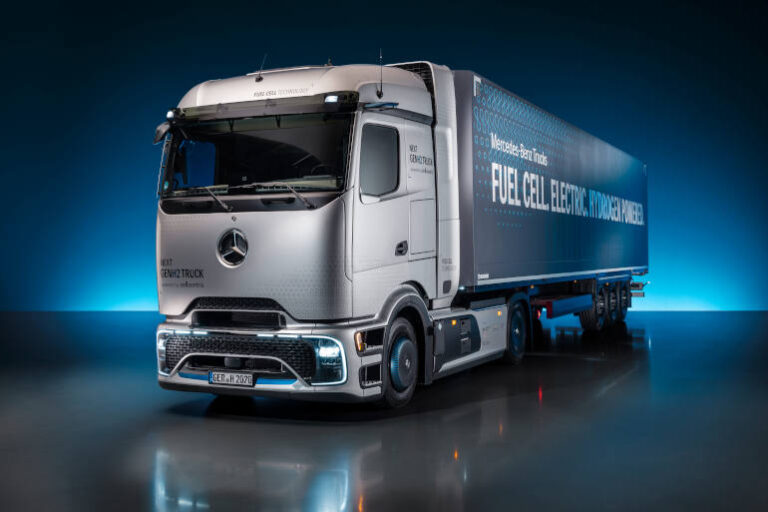
For years the freight industry tried to force a false choice. Battery-electric or hydrogen. Back the right horse. Ignore the rest. Daimler Truck’s new Mercedes-Benz NextGenH2 Truck gives Tesla Semis a run for their money and suggests that the argument is already getting old.
Daimler says its new liquid-hydrogen fuel cell truck will enter small-series production from the end of 2026, with 100 trucks planned for customer operations. The truck is designed for ranges of well over 800 miles on a single fill and borrows major components from the battery-electric eActros 600, including the integrated e-axle, digital cockpit and latest safety systems. That matters because it points to something more realistic than a clean-tech cage match: the future of freight is likely to be electric and hydrogen, depending on route logic, geography, infrastructure and what is actually being hauled.
This is not a small distinction. It changes how ports, logistics firms, governments and even investors should think about decarbonizing freight. A battery-electric truck and a hydrogen truck are not moral rivals. They are tools for different jobs.
Battery-electric trucks are rapidly becoming the better answer for repeatable, corridor-based freight. Think port-to-warehouse routes, retail distribution loops, industrial zones and regional supply chains where trucks can charge during planned dwell times. They are quieter, simpler, mechanically cleaner and increasingly economical where charging can be controlled. That is why Daimler has already been pushing the eActros 600 hard into the market and why other manufacturers are racing to scale their own heavy-duty electric fleets. In those settings, batteries make obvious sense.
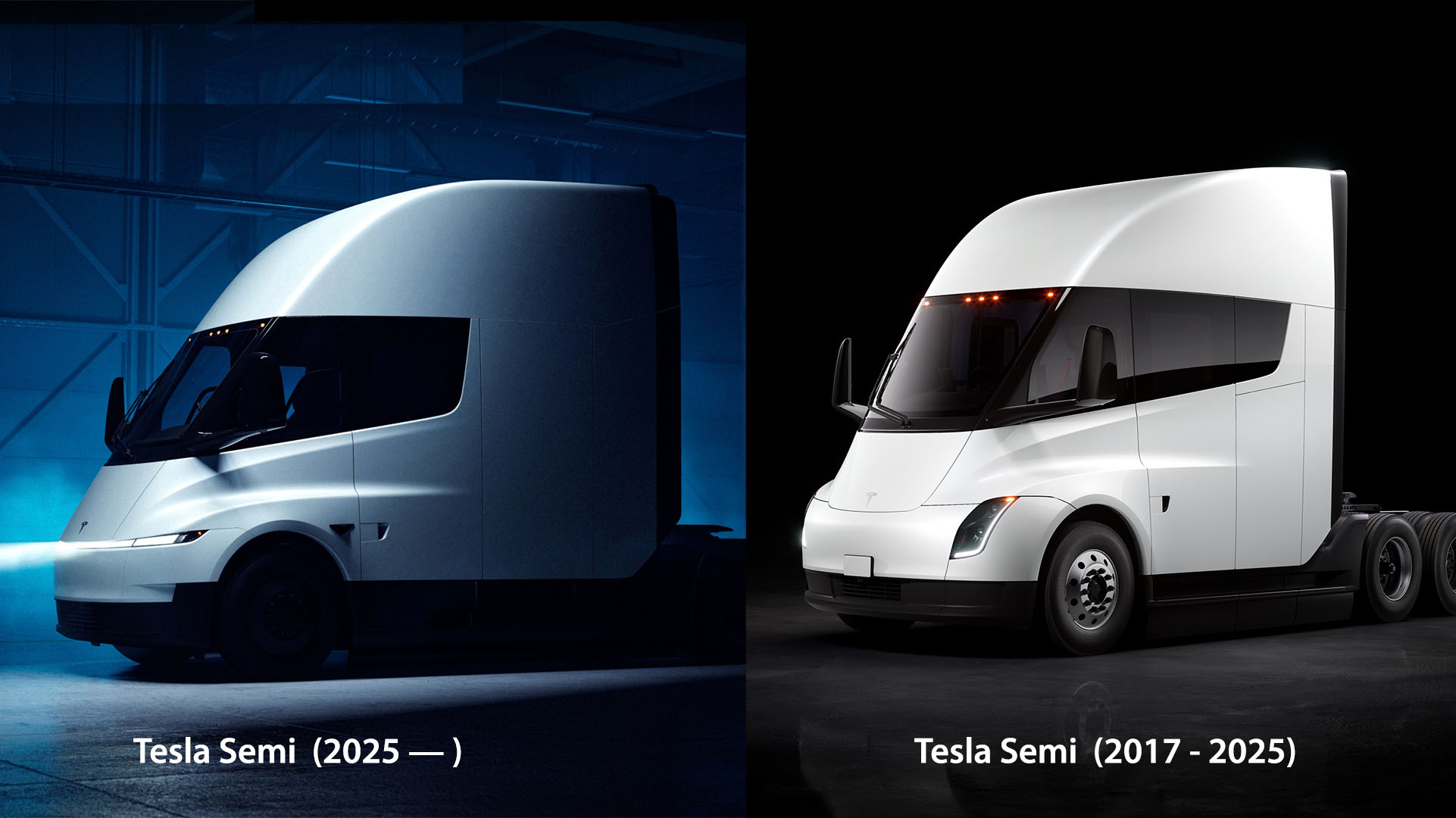
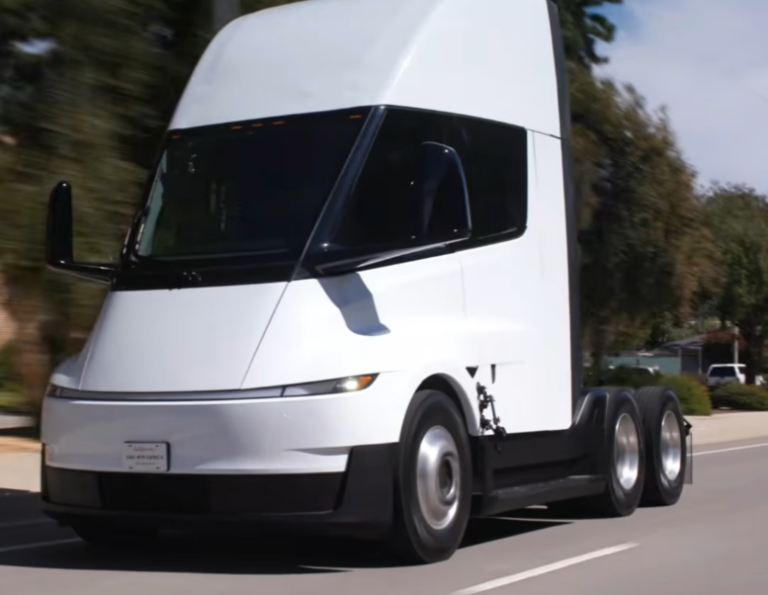
A Tesla Semi, an all-electric freight truck
Hydrogen comes into its own where the route gets longer, the payload gets heavier and the downtime becomes more expensive. That is exactly the space Daimler is targeting with the NextGenH2. Liquid hydrogen allows the truck to carry more energy on board than compressed gaseous hydrogen, and much more usable long-haul range than many battery systems can currently offer without weight and charging tradeoffs.
Daimler says the truck can be refueled in 10 to 15 minutes using its sLH2 liquid hydrogen standard and that the system is designed to make the vehicle more comparable to diesel in real operations. That is the real benchmark in freight. Not whether the truck is futuristic, but whether it can actually replace a diesel workhorse on the routes that matter.
That also explains why the truck shares so much DNA with the eActros 600. Daimler is not building two completely separate futures. It is building one freight architecture with two energy pathways. The e-axle, digital cockpit, battery buffer, assistance systems and even aerodynamic elements are converging. The truck may store energy differently, but the logic of the vehicle is becoming unified. That is important because the clean freight revolution will not happen if every technology lives in its own expensive silo. It has to become modular, scalable and familiar enough for fleet operators to trust.
Trust is not a small issue in trucking. Freight operators are not early adopters in the consumer-tech sense. They are skeptical for good reason. Their margins are thin and their routes are punishing. Their equipment, which requires a massive upfront investment, like the cost of a house, has to work in the rain, the heat, the cold and the dark, often on deadlines that leave little room for idealism or climate values. The promise of zero-emission trucking only becomes real when it fits the brutal rhythm of actual logistics.
That is why Daimler’s move matters beyond Germany. It arrives at a moment when the global shipping and trucking system looks increasingly exposed. Wars in and around the Middle East, Red Sea disruptions from Houthi pirates, bottlenecks at ports, and the continued vulnerability of the Strait of Hormuz all remind us that diesel is not just dirty. It is geopolitically fragile. A logistics system that can increasingly run on domestic electricity or locally produced hydrogen is not only cleaner. It is harder to destabilize. Saudi Aramco, the world’s richest company, and which controls endless oil reserves knows that the cost of oil can flatten in a minute once local hydrogen fuel production is figured out. That’s why they are investing in it too in Indonesia.
Sonol builds a hydrogen fuel station in Israel’s Haifa Bay
And yes, there is still a serious caveat. Hydrogen is only as green as the way it is made. If it comes from fossil gas without real carbon controls, the emissions story weakens quickly. The same is true of electric trucks charged from dirty grids. A zero-emission vehicle is only truly low-carbon if the energy behind it is also getting cleaner. But that does not make the transition less important. It makes the surrounding energy system more important too.
There is another reason the industry is moving this way, and it has less to do with climate than with safety. Daimler says the NextGenH2 will carry over the latest assistance systems from the eActros 600, including Active Brake Assist 6, Front Guard Assist and Active Sideguard Assist 2. These are not marketing flourishes. Heavy trucks remain among the most dangerous machines on public roads, and any serious upgrade in crash prevention matters. The more freight becomes software-defined, sensor-rich and digitally governed, the more it can move away from the old diesel model built around fatigue, blind spots and brute force.
Battery-electric trucks will likely dominate repeatable routes where charging is easy and economics are already starting to work. Hydrogen trucks will likely serve the heavier, longer and more demanding lanes where batteries still struggle in countries like Australia, Canada, and the US. In the future: Rail will matter more. Ports will become smarter. Road trains and platooning may return in digital form and freight itself will slowly become less about individual vehicles and more about coordinated systems like how airlines collaborate at airports around the world. Everyone has a space and a time for refueling, cleaning, loading, taxi-ing and take-off.
For now, Daimler’s NextGenH2 is not proof that hydrogen has won. It is proof that freight is finally getting more honest. The future was never going to be battery-only or hydrogen-only. The future is electric and hydrogen for shipping.
When wars in Iran threaten oil routes, and Saudi Aramco jacks up prices because it can, the weakness of global freight becomes impossible to ignore. The latest tensions tied to Iran and the Strait of Hormuz have exposed, again, how fragile it is to move food, medicine, fuel, industrial goods and consumer products through a logistics system still built around diesel.
A single chokepoint can raise prices across continents. A single delay or boat of Houthi pirates attempting to blow up an oil tanker ripples from port to warehouse to supermarket shelf. The lesson is no longer abstract. Freight needs to become more electric, more local, more automated, more resilient and, above all, safer. And all that needs to be linked to battery storage microgrids and renewable energy produced close to home. My goal is to see the share price of Saudi Aramco sink.
The symbol most people recognize is the Tesla Semi, Tesla’s battery-electric Class 8 truck which we wrote about more than 5 years ago. Tesla says the Semi can travel up to 500 miles on a charge, use about 1.7 kWh per mile, and recover up to 70% of range in 30 minutes with its 1 MW charging system. Those are no longer vague concept-car numbers. They are logistics numbers that matter because freight does not need novelty: it needs predictable routes, lower operating costs, better energy security and fewer people dying on the road.
But Tesla is only one part of the story. The more interesting shift is that long-haul trucking is now splitting into two serious zero-emission paths: battery-electric for predictable corridors and depot-based logistics, and hydrogen fuel cell for longer ranges, faster refueling and heavier-duty freight where batteries may still be too limiting.
Why electric trucks are finally becoming real
The Tesla Semi interior
Battery-electric trucks make the most sense where routes are repetitive and tightly managed: ports to warehouses, regional distribution centers, industrial parks, airport freight corridors and retail supply loops. These trucks can charge during planned dwell times, brake regeneratively in traffic and increasingly move as part of coordinated fleets rather than as isolated machines.
This is where Green Prophet’s old fascination with road trains starts to look less eccentric and more prescient. The old Australian road train was about linking trailers together for remote hauling. The new version is software-driven and possibly fueled by green hydrogen: platooned electric trucks traveling in synchronized formation to reduce aerodynamic drag, save energy and move freight more efficiently between hubs.
Research published in 2025 suggests electric truck platooning can reduce total operating costs when charging, routing and convoy formation are optimized together. That may sound technical, but it points to something simple: the next road train is not a dusty outback oddity. It is a digitally managed freight system.
Companies like Einride are already operating electric and autonomous freight systems in Europe and the United States. Volvo Trucks, Daimler Truck, PACCAR and others are all pushing battery-electric heavy-duty platforms into real-world operations. The market is still young, but it is no longer imaginary.
Where hydrogen enters the picture
If battery-electric trucks are best suited to fixed and repeatable corridors, hydrogen fuel cell trucks are being positioned for the stretches where battery weight, charging time and infrastructure become harder to manage. Think Canada, inner states in the US and Australia. Even wide parts of the Middle East desert where the price of oil costs less than water. This is where the argument gets serious.
Mercedes-Benz NextGenH2 Truck
Daimler Truck says its new Mercedes-Benz NextGenH2 Truck will enter small-series production from the end of 2026, with 100 trucks planned for customer operations. Daimler says the liquid hydrogen truck is designed for ranges well over 800 miles on a single fill and uses components shared with its battery-electric eActros 600, including safety systems and digital cockpit architecture. That matters because it suggests the future may not be electric or hydrogen, but electric and hydrogen depending on route logic.
That same dual-path logic is why truckmakers are hedging across both technologies. Nikola, despite its damaged reputation and corporate instability, has still pushed hydrogen fuel cell trucks into commercial trials. The technology itself should not be dismissed because one company handled it badly. Hydrogen trucks offer compelling advantages where time-sensitive freight, high utilization and diesel-like refueling rhythms still matter.
There is a catch, of course. Hydrogen is only as clean as the way it is made. If it comes from fossil gas without meaningful carbon capture, the climate case weakens. If it comes from renewable electrolysis, the case improves dramatically. The same critique applies to battery-electric trucks. They are only as green as the grid charging them. If fossil fuels are running the battery charging stations, the whole point becomes ridiculous. We need an all-systems effort here. But even when it’s not green, electric drivetrains and fuel cells shift freight away from combustion at the point of use, which is still a major health and air quality gain for the roads cities around them.
Why safety may be the strongest argument of all
This is not only a climate story. It is a safety story, and trucking badly needs one. According to the Federal Motor Carrier Safety Administration, there were about 503,000 police-reported crashes involving large trucks in the United States in 2022, including 5,279 fatal crashes. The agency also notes that 82% of fatalities in fatal large-truck crashes were not occupants of the large truck. The Insurance Institute for Highway Safety has repeatedly shown that large trucks create disproportionate danger for people in smaller vehicles.
That is the context in which electric and hydrogen trucks need to be judged. Not against some fantasy of perfect roads, but against the current freight system, which still depends too heavily on fatigue, weak oversight, inconsistent training and vehicles operating under deadline pressure.
Advanced safety systems are already proving useful. IIHS has reported that forward collision warning and automatic emergency braking reduce rear-end crash rates for large trucks. These are not distant future gains. They are available gains. Battery-electric and hydrogen trucks are both well positioned to integrate these systems more deeply because they are increasingly software-first platforms. Their cameras, sensors, telemetry, braking logic and route controls can be managed at fleet level rather than left to the limits of human judgment alone.
That is where the promise lies. A truck that is digitally supervised from depot to destination is harder to fake, easier to monitor and easier to discipline. Its speed, route, braking behavior, maintenance events and charging or fueling cycles can all be tracked. It is not a moral solution to human failure, but it is a technical one, and freight needs more of that.
The dirty secret of freight is not just diesel
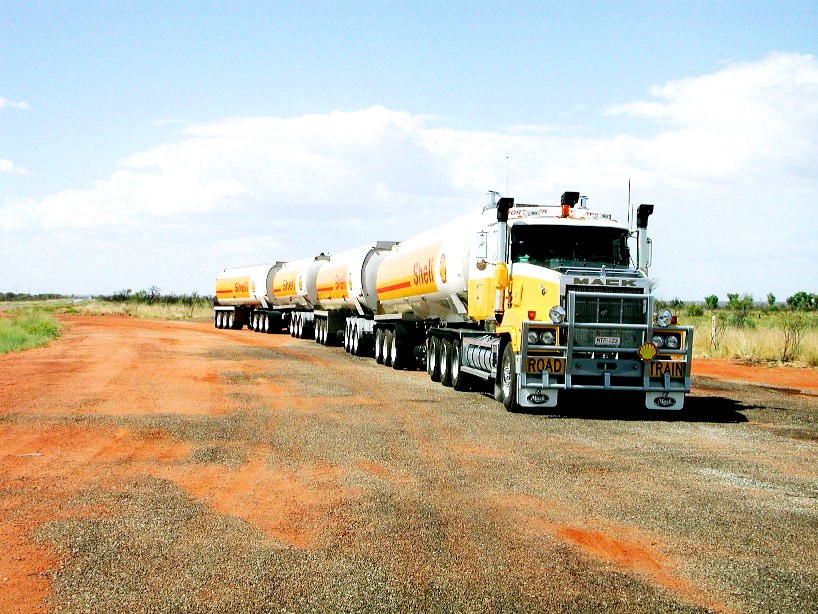
A road train in Australia. Long-distance hauling on flat surfaces can hook multiple loads together like a train.
There is another reason the trucking sector is ripe for change: too much of it is held together with bad labor conditions, training shortcuts and dangerous corner-cutting. Canada has become a cautionary example. Ontario authorities suspended truckers’ licences after uncovering dishonest testing and training practices, according to TruckNews. Alberta also shut down unsafe truck driver training schools and targeted carriers linked to poor safety practices, again reported by TruckNews. A few years ago, a trucker from India killed an entire hockey team when he was driving on a suspended license from infractions. He should not have been on the road. But lack of government oversight with unsustainable immigration goals have put Canadian roads at risk. Make it electric!
This is where the public conversation often goes off the rails. The issue is not “foreign drivers” as a lazy culture-war talking point. The issue is licensing integrity, labor exploitation, poor oversight and freight systems that reward cost-cutting until people die. If electric and hydrogen trucks are managed through better software, better route discipline and better oversight, they can help reduce those failure points. They will not erase human corruption, but they can make dangerous operations more visible and easier to regulate.
The next road train may move at night
One of the least discussed advantages of electric and hydrogen freight is when it can move. The future of long-haul logistics is not just about propulsion. It is about timing of the drive.
Night freight may become one of the biggest advantages of automated and electrified trucking. Roads are less congested at night. Temperatures are lower. Delivery windows are easier to manage. Noise is lower with electric drivetrains. Human fatigue has always made night trucking dangerous, but digitally managed freight corridors, better sensors, automatic braking and lane support change that equation. A future fleet of trucks moving quietly between depots after midnight may turn out to be one of the safest ways to keep cities and supply chains functioning.
Aurora tests self-driving trucks in Texas
This is also where autonomy enters the picture. Companies like Aurora are already running driverless freight routes in Texas and have expanded their network as confidence in the systems grows. That does not mean human drivers disappear tomorrow, and it certainly does not mean the technology is risk-free. But it does suggest that the future freight vehicle may be less like a cowboy truck and more like a rolling logistics node, with the human gradually shifting from driver to supervisor.
The Middle East should care more than most
For the Gulf and other regions exposed to oil-route instability, this transition is not just environmental. It is strategic. Green Prophet recently reported how Etihad Rail is using solar power at a freight terminal, a small but important signal that logistics is beginning to decouple from diesel. Rail, electric trucking, hydrogen corridors and distributed renewable energy can begin to work together as one freight architecture.
That is the real post-oil freight future. Not a single silver bullet, but a layered system: electric trucks on predictable routes, hydrogen trucks on heavier and longer hauls, autonomous convoying where it makes sense, rail where possible, and maybe even tunnels where cities become too congested to keep pretending surface freight is enough.
That last idea sounds absurd until you look at what Elon Musk’s Boring Company is trying to do. Green Prophet recently covered its proposed Dubai Loop. Most of the discussion focuses on passenger transport, but the freight implications may be more important. Underground logistics corridors for high-value goods, airport freight, port distribution and urban delivery are no longer science fiction. They are expensive, yes, but so are crashes, congestion, diesel pollution, road wear and lost time.
What could go wrong
There are real pitfalls and they should not be brushed aside.
Charging infrastructure is still thin for heavy trucks. Hydrogen refueling infrastructure is even thinner. Grid readiness is uneven. Green hydrogen is still expensive. Battery weight remains a payload issue. Autonomous regulation is inconsistent across jurisdictions. Public trust can collapse after a single bad crash.
And then there are jobs. Better electric and hydrogen logistics will almost certainly mean fewer traditional long-haul driving jobs over time, especially on repetitive corridor freight. Some of those jobs will shift into fleet management, charging and fueling infrastructure, maintenance, software operations and remote supervision. Some will not. Governments and unions should be preparing for that reality now, not pretending it will sort itself out.
The real promise
The real promise of electric and hydrogen long-haul trucks is not that they are trendy. It is that they make freight less stupid.
They offer a path away from a system built on diesel dependency, poor air quality, avoidable crashes, labor strain and geopolitical fragility. They will not replace every truck overnight. They do not need to. Freight changes corridor by corridor, depot by depot, terminal by terminal. That is how this transition will happen too.
The old diesel model gave us pollution, fatigue, noise, vulnerability and too many deaths on the road. The next freight era should be quieter, cleaner, more disciplined and harder to destabilize. Battery-electric and hydrogen trucks are not a fantasy anymore. They are beginning to look like the most practical answer we have.
When the US-Israel-Iran war rattles oil routes and sends stocks linked to oil prices in chaos, we remember how vulnerable freight really is. From Houthis blowing up shipping containers in the Red Sea to the IRGC regime stopping traffic in the Strait of Hormuz.
The latest instability tied to Iran and the Strait of Hormuz has again exposed a truth that should have been obvious years ago: moving fuel, food, medicine and industrial goods with diesel trucks from source points around the world is not only dirty and expensive, it is strategically brittle.
A single chokepoint can raise costs across continents. A single delay can ripple through ports, warehouses and supermarket shelves. If there is a serious transportation lesson from this latest era of conflict, but also from the COVID era and the beginning of the Ukraine-Russia war, it is that freight has to become more electric, more automated, more distributed and much safer.
The most visible symbol of that future is the Tesla Semi, but it is only one part of a wider shift that includes platooning, electric road trains, tunnel logistics (the Boring Company) and autonomous overnight freight. Tesla says their new Semi can travel up to 500 miles on a single charge, potentially charge itself, use just 1.7 kWh per mile, and recover up to 60% of range in 30 minutes using Tesla’s dedicated Semi chargers. These are no longer vague promises from a concept vehicle. They are operational logistics numbers, and they matter because freight does not need novelty. It needs reliability, lower costs, cleaner energy and fewer funerals on the road.
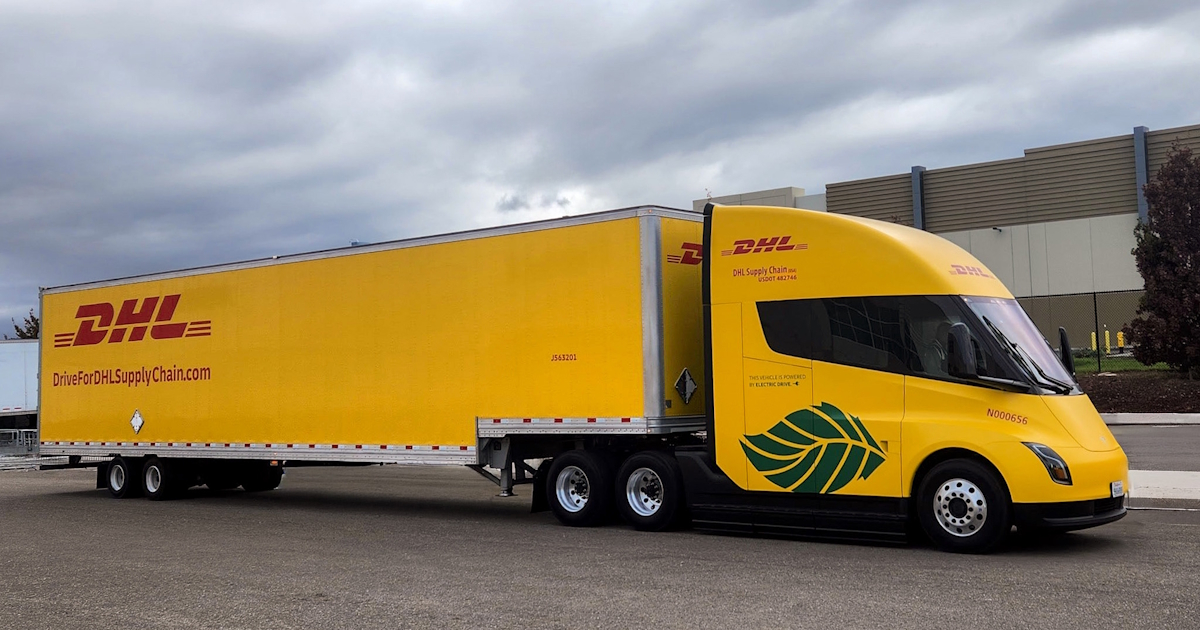
DHL tests a Tesla Semi on the road
The real story is not just battery range. It is what electric trucks can do to the geometry of freight itself. Electric heavy vehicles are better suited to repeatable, software-managed routes than diesel trucks, especially on corridors between ports, warehouses, data centers, industrial parks and distribution hubs. They can charge during planned dwell time, brake regeneratively in traffic, and eventually move in synchronized convoys. That is where an old Green Prophet idea suddenly feels new again.
A road train in Australia. Long-distance hauling on flat surfaces can hook multiple loads together like a train.
Years ago Green Prophet wrote about road trains as a way to reduce energy use and pollution on major corridors. Back then it sounded slightly utopian. Today it looks practical. Road trains are already used in places like Australia for long-haul freight, where multiple trailers are linked in controlled formation. The next version is more sophisticated: platooned electric trucks using software, automation and vehicle-to-vehicle coordination to move with less drag, better braking and tighter control. If war has reminded us how fragile fuel supply can be, then electrified road trains offer a direct answer. They move goods using power that can increasingly come from domestic grids rather than imported oil.
“Well said,” says Mark Russell, from Eco Trilogy, “Unfortunately, every new idea introduced in the West right now seems to be met with “that’ll never work” instead of “we can make this happen.” Somewhere along the way we’ve shifted from practical, solutions-focused thinking to a culture that resists improvement.
“Healthy debate is one thing—I can respect that. What’s harder to accept is the deliberate misinformation and outright falsehoods that cloud real progress. Take electric motors for example—they’re vastly more efficient than diesel, and that’s only the beginning of what’s possible when we choose to move forward instead of hold back.”
The Tesla Semi interior
This is not just a climate story. It is also a safety story, and trucking badly needs one. According to the Federal Motor Carrier Safety Administration, 6,050 large trucks and buses were involved in fatal crashes in 2022. The Insurance Institute for Highway Safety notes that most deaths in large truck crashes are not truck occupants but people in smaller vehicles. Canadians have experienced this too well. A recent high-profile case is about an Indian truck driver with dozens of traffic offenses who wiped out an entire hockey team. Truckers themselves, though happy for the jobs that require unskilled labor, lead to back problems, opiode use and addiction. My brother-in-law got addicted to crack on this path. But in society, the danger comes from mass, height, visibility problems and human error. Trucks are essential to modern life, but the diesel freight system we tolerate is still one of the most physically unforgiving machines in daily public use. If you live in rural areas in Canada for instance, it’s fairly common to hear stories of people who have been hit by logging trucks out on old lonely logging roads.
That context matters when people dismiss autonomous or semi-autonomous freight as “experimental.” The current system is experimental too. It is just old enough that we stopped calling it that. Human fatigue, poor training, distracted driving, mechanical neglect and congested road conditions are still doing terrible work every day. The case for electric freight is not that software is magic. It is that electric and digitally managed fleets can reduce some of the oldest failure points in trucking if they are deployed honestly and regulated properly.
Mercedes-Benz NextGenH2 (coming 2026) and Nikola Tre FCEV, feature dedicated sleeper cabins designed for driver comfort and safety with advanced hydrogen monitoring systems. They aren’t electric, but run on green hydrogen fuel. Remember electric cars are ony as “green” as the power stations charging them.
There is strong evidence that advanced safety systems already help. A study highlighted by the IIHS found that forward collision warning and automatic emergency braking greatly reduce crash risk for large trucks. Another transportation safety summary reported that forward collision warning reduced rear-end crash rates for large trucks by 44% and automatic emergency braking cut them by 41%. These are not futuristic gains. They are available gains, and electric trucks are especially well positioned to integrate them deeply because they are software-first vehicles from the start.
This is where the Tesla Semi has real promise beyond the brand mythology. A truck that is built around sensors, cameras, digital controls, active safety systems and fleet-level telemetry is not just a cleaner truck. It is a more governable truck. That matters because freight safety is often less about one great driver and more about whether the entire system is designed to reduce bad decisions. Electric fleets can be routed to avoid dangerous congestion, scheduled for lower-risk windows and monitored continuously for maintenance, speed, route adherence and braking behavior.
Canada has already shown what happens when freight systems become too loose and too dependent on low-cost labor with weak oversight. Ontario authorities suspended truckers’ licences after uncovering dishonest testing and training practices in the commercial driving pipeline, mainly through Indian and Pakistani new immigrants, a scandal that has raised concerns about how unqualified drivers can end up operating very large vehicles on public roads. The report in TruckNews made clear that the issue was not theoretical.
There have also been wider crackdowns in western Canada. In Alberta, regulators shut down unsafe truck driver training schools and targeted carriers linked to poor safety practices, according to another TruckNews report. This is where the so-called Indian trucker scam story belongs: not in xenophobic shorthand, but in a larger, documented failure of training quality, licensing integrity and freight oversight. The public safety issue is real and the solution is better standards, better enforcement and eventually fewer opportunities for dangerous human error in the first place.
Electric and autonomous freight systems can help close that gap. A truck that is digitally supervised from depot to destination is much harder to fake than a paper credential. Its route, braking profile, charging pattern, maintenance logs and safety events are all visible. Its blind spots can be monitored more effectively. Its lane keeping can be assisted. Its speed can be constrained. Its night operation can be managed more intelligently than traditional diesel trucking, where too much depends on exhausted people trying to survive punishing schedules.
Night freight, in particular, deserves more attention. Most people think of night driving as inherently more dangerous, and for tired human drivers that is often true. But electric freight paired with high-grade sensors, automatic braking, lane support and controlled corridors changes that equation. Roads are less congested at night. Temperatures are lower and delivery windows are easier to manage. A future fleet of electric trucks moving through dedicated logistics lanes or semi-autonomous convoy corridors after midnight may actually be one of the safest ways to move goods through and between cities of Boston and New York. As my design prof friend Tom Klinkowstein said while driving through Soho on his electric BMW, “wheeeeee.”
That is especially important in hot countries and regions vulnerable to fuel disruption. In the Gulf, for instance, the logic is already visible. Green Prophet recently covered how Etihad Rail is using solar power at a freight terminal, which points to a larger truth: logistics is beginning to decouple from diesel. Rail, electric trucking and distributed renewable power can work together to make freight less exposed to global oil shocks. If you can move a growing share of cargo using electricity generated at home, then conflict in a shipping chokepoint matters a little less.
And then there is the tunnel idea. Elon Musk’s Boring Company is usually treated as either a curiosity or a vanity project, but its freight implications are worth taking seriously. The company explicitly positions itself around transportation, utility and freight tunnels, and Green Prophet recently looked at its proposed Dubai Loop. Most public discussion focuses on moving people, but the more consequential long game may be underground logistics around ports, airports, industrial districts and city delivery corridors.
Imagine what that means in practical terms. Instead of forcing every container, parcel or pallet through surface congestion, cities could build dedicated electric freight arteries below grade. Not for everything, but for enough high-frequency, high-value freight to change the economics of last-mile logistics. Tunnels are expensive, but so are collisions, delays, diesel pollution, road wear and lost time. If electrified trucking is the first phase of cleaner freight, then freight tunneling may become the second.
There is also a strategic military and civil defense logic to all this. When surface infrastructure is exposed, tunnel logistics and electrified transport corridors become more than just sustainability projects. They become resilience infrastructure. A society that can move food, medicine, construction materials and even emergency fuel with less dependence on imported diesel is not only cleaner: it is harder to destabilize.
There will be labor consequences and they should not be brushed aside. Better electric logistics will almost certainly mean fewer traditional long-haul driving jobs over time, especially on repetitive corridor freight. Some of those jobs will be replaced by fleet management, remote operations, charging infrastructure, maintenance, software supervision and tunnel logistics, but not all of them. That is a real social cost and governments should be planning for it now. But it should not be used as an excuse to defend a freight model that is dangerous, polluting and geopolitically fragile.
The bigger truth is simple. If the world wants safer freight after the Iran war, it should stop talking only about oil supply and start talking about transport design around renewable energy nodes and battery storage stations. Electric trucks like the Tesla Semi, road-train logic, managed night freight, autonomous convoying and freight tunnels are not fringe ideas anymore. They are pieces of a practical, lower-risk logistics future.
The old diesel model gave us pollution, dependency, fatigue and too many deaths on the road. The next freight era should be quieter, cleaner and much less lethal. That would be a technological upgrade worth taking seriously.
The big question I have is if the first versions will include sleeper cabins. Can a trucker just put the vehicle on automatic mode and write poetry from his cabin behind the wheel?
Why the governance framework designed to protect shareholders so often fails them
There is a pattern Regan McGee has watched repeat itself across industries, company sizes, and market cycles. A business reaches a certain scale. The founding hunger fades. A professional management layer arrives. The board fills with credentialed names who attend meetings, approve budgets, and collect fees. Shareholder returns flatten. Then, quietly, they begin to erode.
McGee, founder and CEO of Nobul, has spent the better part of two decades working across capital markets, private equity, and technology. That experience has produced a view on corporate governance that most governance commentators would rather not engage with directly: the framework that is supposed to protect shareholders is often the very thing that guarantees their mediocrity.
“I think complacency is the silent killer,” McGee says. “It just takes a long time for the market to recognize it.”
The Complacency Premium
Research from Bain & Company found that founder-led S&P 500 companies performed 3.1 times better than all other S&P 500 companies over the 25-year period from 1990 to 2014.
That is not a marginal difference. That is a fundamentally different outcome for the people who own the shares.
The companies producing those returns include Amazon, Apple, Microsoft, Oracle, and Dell, which are precisely the ones that conventional governance frameworks have flagged most often for concentrated control, founders who resist ceding authority, and compensation structures that draw scrutiny. But by the metric that actually matters to the people who own the shares, they have been transformational.
A study by Professor Rüdiger Fahlenbrach of the Swiss Federal Technology Institute of Lausanne found that an investment strategy tracking founder-CEO firms from 1993 to 2002 would have earned a benchmark-adjusted return of 8.3% annually. After controlling for firm size, industry, and other variables, the abnormal outperformance held at 4.4% annually. The research also found that founder-CEO firms consistently outinvested their peers in R&D and capital expenditure.
Taken together, the data points to the same conclusion: the governance structures often celebrated by proxy advisors and institutional consultants don’t necessarily correlate with the best shareholder outcomes.
What distinguishes the outperforming companies is not luck or sector tailwinds alone. It is, as McGee describes it, a culture of hunger. A refusal to treat existing scale as a destination rather than a starting point. A willingness to make bold, sometimes uncomfortable decisions that a committee-driven board may have voted down.
“Once you get into so-called good governance,” McGee observes, “you’re going to perform at the same as the market, unfortunately.”
When Compensation Structure Isn’t Tied to Results
Before examining how boards fail quietly, it is worth examining a case where the failure was structural and precise.
McGee recalled a compensation arrangement where the incentive to underperform was not a side effect but a feature.
The CEO made himself the biggest shareholder in the company,” he explained. “The company had actually created his comps package so that the more he lowered the stock price, the more the company would control. He was actually incentivized to drive the stock price down.”
Pause on that for a moment. This was not a misaligned incentive that slipped through a governance gap. It was a structure that was reviewed, approved, and put in place by a board with full access to the terms. The CEO was not merely failing to grow shareholder value. He was being paid to shrink it. The board that existed to prevent exactly that outcome had instead encoded it into his contract.
The shareholders in this company woke up every day owning shares in a business whose leadership had a direct financial interest in those shares being worth less tomorrow than they were today. The board knew this. The compensation committee signed off on it. And the governance framework that was supposed to catch arrangements like this did not catch it. The boxes were checked, the committees were functioning, and nothing in the formal structure required anyone to ask whether the incentives actually pointed in the right direction.
That is not a governance failure in the abstract. It is a precise, documented betrayal of the people the board existed to protect.
How Boards Fail Without Anyone Noticing
The more insidious problem, in McGee’s view, is not the dramatic governance failure. It is the slow, entirely unremarkable kind that never makes headlines because nothing obviously wrong has occurred.
McGee identified a consistent set of early warning signs. The first: board members who confuse their own importance with actual value creation. Directors who treat their seats as status rather than responsibility.
The second is the rubber-stamp dynamic that emerges when boards defer entirely to advisors rather than applying independent judgment. The scale of that deference is significant: research published by Stanford’s Corporate Governance Research Initiative notes that a negative recommendation from proxy advisory firm ISS on a management proposal can sway as much as 20% of the vote on a given proposal.
But consider what that influence looks like when applied to a situation like the one McGee described above. A board presides over a company whose stock falls more than 99%. Management extracts millions in above-market compensation over the same period. The CEO’s incentive structure is explicitly designed to reward share price destruction. The assets of the company are systematically sold off. All of this is on the public record.
ISS reviewed that record and recommended the reelection of the board anyway, over a qualified turnaround slate that had the legal proxies to win.
That is not a structural critique of proxy advisory influence. It is an example of what that influence costs shareholders when it is applied without adequate judgment. The Stanford stat tells you how much power ISS has over a given vote. This tells you what happens when that power is exercised badly.
What Works
McGee’s prescription is specific and structural. Boards should be evaluated on what they produce, not on how they look. Executive compensation should be tied directly to total shareholder return over defined periods, not benchmarked to peer compensation regardless of outcomes. That single structural change would eliminate much of the incentive architecture that currently rewards underperformance.
Beyond compensation, he says the cultural standard matters as much as the structural one. The founder-led companies that have defined the modern economy did not get there by following every detail of the governance playbook. They got there by being relentlessly focused on growth, willing to be uncomfortable, and unwilling to let scale become an excuse for standing still. Replicating that culture, or protecting it where it exists, is not a governance question. It is a leadership one.
For McGee, there are clear solutions to the silent killer of complacency. Tie pay to outcomes. Put builders in the room. Keep the hunger that built the company from being managed away by the people who arrived after it was already worth protecting. The difficulty is not in understanding it. It is in maintaining it when institutional pressure is pushing in the other direction.
The livestock and pasture management sector is currently facing several challenges, including rising operational expenditures and labor shortages, compounded by the demand for sustainable, efficient food production. The pressures they face require a radical transformation driven by technological expansion. These combined factors strain traditional farming methods, making technological adoption a matter of survival.
Autonomous systems have emerged as a solution, changing the agricultural landscape through unprecedented precision and insight. From intelligent herd tracking to automated land care, the equipment is unlocking new possibilities in agriculture.
The New Era of Agricultural Automation
The adoption of agricultural automation marks a transition from strictly mechanical labor to data-driven farming, backed by artificial intelligence (AI), machine learning and the Internet of Things. It is not merely about the emergence of new gadgets but a necessary response to global pressures for food security and sustainability.
The approach utilizes a wave of technological innovation, including aerial drones, sophisticated robotics and analytics, to gather and interpret information with precision. For example, sensors and global positioning systems (GPS) collect data on animal health and land conditions.
The information undergoes processing by computer vision and AI algorithms before delivering actionable insights. Ranchers can then improve resource, husbandry and operational management before more critical issues arise.
Intelligent Monitoring for Superior Livestock Health
According to experts, the global livestock monitoring market is growing exponentially, with a compound annual growth rate of 12.82% from 2026 to 2033.
One company, Advantech Co. Ltd., developed a system that uses AI and infrared vision to measure cattle’s body temperature as part of daily health screenings. The Universitat Autònoma de Barcelona has also designed sensors to observe livestock behavior, productivity, environmental impacts, and physical and mental well-being.
The platforms process data from camera networks and sensors worn by the animals, including devices like GPS, thermometers and accelerometers. Ranchers can establish a baseline for each animal and monitor changes over time. For instance, the systems might send an alert if they detect abnormalities, such as illness or distress.
Receiving a warning about potential disease helps farmers intervene early on, providing rapid treatment that prevents the rest of the herd from falling ill. Overall, the proactive approach reduces economic losses from disease outbreaks and the high labor costs associated with manual assessments.
Optimizing Pastures with Autonomous Ground and Air Systems
The Treetoscope sensor collects information about water and soil nutrients to turn on irrigation systems at the right time
On the ground, robotic mowers maintain pasture quality, mitigate invasive weeds and ensure optimal vegetation for grazing animals. Their operational performance typically covers 1 to 3 acres per hour, depending on the terrain. Implementing this technology can dramatically reduce labor costs and boost worker safety by eliminating the need for manual machine functions.
Complementing these efforts, autonomous drones enable more precise and effective field mapping and surveying, crop and animal monitoring, disease detection, and fertilizer and pesticide applications. Farmers who grow high-rise date palms and walnut trees might use drones for pollination, which is a labor-intensive task.
The multi-rotor unmanned aerial vehicles cover 4 to 20 hectares per hour or about 30 to 150 hectares a day. For spraying, they usually come equipped with liquid tanks holding 5 to 50 liters. The targeted application decreases chemical waste and environmental impacts.
Farmers also reap a financial benefit. With an initial investment of $40,000 to $50,000, drones help growers recoup costs in just four to six weeks, making it a profitable and validating system for modern pasture management.
Integrating Autonomous Systems for Long-Term ROI
Those interested in integrating autonomous systems must carefully consider the return on investment. Although up-front costs often present a financial barrier, the long-term economic and operational benefits usually outweigh the initial price tag.
Ranchers can reduce labor hours and input costs for feed and treatments by employing data-driven decision-making to improve animal welfare and land productivity. Still, initial investments in these technologies often make them out of reach for many professionals.
Purchasing a GPS tracker for every cow might be unaffordable and impractical, depending on the herd’s size. Fortunately, industry innovations are helping overcome the financial barriers as researchers develop less expensive solutions.
Researchers developed a method for fitting GPS collars to select animals and tagging the rest with low-cost Bluetooth devices. The collars, which connected to the Sigfox network, enabled cost-effective tracking while delivering essential information about the herd.
The decision to invest in autonomous systems hinges on the unique needs of individual operations. Fortunately, these solutions are often scalable, so farmers can target the areas where automation will benefit them most. This allows them to phase implementation in a manner they can afford and still attain significant long-term returns.
The Future of Farming is Autonomous
Autonomous developments have proven practical and accessible for modern livestock and pasture management operations, addressing some of the more pressing challenges today’s farmers face. Although the tools require an initial investment, professionals cannot deny the economic benefits of embracing the technology. As the equipment continues to evolve, it will become increasingly necessary for secure and sustainable farming.
Children need warm, sustainably-made play mats that offer comfort and security.
Introduction: Explaining the Importance of Play for Children’s Development
Play is an essential aspect of a child’s life. It is through play that children learn and develop various skills that are crucial for their physical, cognitive, emotional, and social growth. Play allows children to discover and explore the world around them, express themselves creatively, build relationships with others, and develop problem-solving abilities.
As parents or caregivers, it is important to create a conducive environment for children to engage in play. This includes having designated play areas within the house where children can freely move around and use their imagination. One way to achieve this is by incorporating rugs and play mats into kids’ rooms.
Why Rugs and Play Mats Are Essential for Kids’ Rooms
Made from recycled PET bottles, this rug is a river of good luxury
Rugs and play mats not only add aesthetic value to a child’s room but also serve as practical tools for promoting a child’s development. These soft and comfortable floor coverings provide a safe space for children to crawl, roll, sit, or stand while playing. They offer protection against hard surfaces such as hardwood floors or tiles, reducing the risk of injuries during rough play.
In addition to safety, rugs and play mats also aid in sensory development. The textures of these floor coverings stimulate a child’s senses as they touch, feel, crawl, or walk on them. These sensory experiences are important in building neural connections in the brain that support learning and development.
Benefits of Using Baby Play Mats for Daily Play
Providing a Safe and Comfortable Space for Play: For infants who spend most of their time on their backs or tummies when playing, baby play mats for daily play offer a soft surface that supports their delicate bodies. The cushioned material provides comfort while preventing bumps or bruises. Many mats also include anti-slip backing for added stability.
Promoting Sensory Development: Baby play mats offer different textures and materials that promote sensory development. Bright colors and patterns also stimulate visual curiosity and exploration.
Adding a Playful Touch to the Room: Available in various designs and themes, baby play mats can serve as both a functional and decorative element while supporting early learning.
Incorporating rugs and play mats into kids’ rooms creates a safe and stimulating environment for children to learn through play.
Types of Baby Play Mats: Foam Mats, Interlocking Tiles, Activity Gyms, Etc.
When it comes to creating a safe and comfortable play area, baby play mats are essential. Below are common types:
Foam Mats: Made from soft foam that provides cushioning and support. Lightweight and portable, easy to store or travel with.
Interlocking Tiles: Puzzle-style tiles that connect to create larger play areas. Stable and visually engaging.
Activity Gyms: Include hanging toys and sensory elements that support motor skills and coordination, with padded bases for comfort.
Choosing the Perfect Kids’ Room Rug
When selecting a baby play mat for your child’s room, consider:
Size: Ensure the mat fits the available space and allows room for movement.
Material: Choose non-toxic, hypoallergenic, and soft materials suitable for sensitive skin.
Quilted Play Mat: Sew layers of fabric or blankets for added cushioning and warmth.
Sensory Play Mat: Incorporate varied textures like faux grass or soft fabrics, plus interactive elements like zippers or pockets.
Conclusion
Having a dedicated play area supports children’s physical and mental development. Rugs and play mats provide both safety and comfort while enhancing the room’s design. Choosing the right option ensures your child has a secure and engaging space to grow and thrive.
Women’s health care is a vital component of public health, yet it remains one of the most under-addressed and misunderstood areas in medicine.
From adolescence through menopause and beyond, women face unique health challenges that call for specialised attention, informed care, and ongoing support. A strong medical team, one that includes both general practitioners and gynecologists, is key to ensuring women’s well-being across all stages of life.
This article explores why women’s health care matters, what comprehensive care looks like, and how evolving roles in medicine are helping to close gaps in access and quality.
The Complexity of Women’s Health
Women’s health is not limited to reproductive care. It encompasses a wide range of physical, mental, and emotional needs that are shaped by biological, social, and environmental factors. Women are more likely than men to experience autoimmune disorders, osteoporosis, and certain mental health conditions such as anxiety and depression. They also metabolize medication differently and may present atypical symptoms for conditions like heart disease, which has historically been underdiagnosed in women due to male-centric research models.
Reproductive health itself is multifaceted, involving menstrual health, contraception, fertility, pregnancy, childbirth, menopause, and gynecological cancers. These issues are deeply interconnected with other aspects of health. For example, untreated polycystic ovary syndrome (PCOS) can lead to insulin resistance and increase the risk of type 2 diabetes. Similarly, lack of access to prenatal care can result in complications for both mother and baby, including preterm birth and low birth weight.
Why a Strong Medical Team Matters
Navigating these complexities requires a coordinated, multidisciplinary approach. A good medical team doesn’t just treat symptoms; it builds relationships, monitors long-term health trends, and empowers women to make informed decisions.
Key members of this team include:
General Practitioners (GPs): These providers offer routine checkups, manage chronic conditions, and serve as the first point of contact for most health concerns. They play a critical role in preventive care and early detection.
Gynecologists: Specialists in reproductive health, gynecologists provide essential services such as Pap smears, breast exams, contraception counseling, and menopause management. Regular visits can lead to early diagnosis of conditions like cervical cancer or endometriosis.
Advanced Practice Nurses: Nurses who have completed relevant programs can continue to specialize in areas like women’s health. Their advanced training equips them to deliver high-quality, patient-centered care and to serve as trusted members of a woman’s medical care team.
Mental Health Professionals: Given the strong link between hormonal changes and mental health, therapists and psychiatrists are often vital in managing conditions like postpartum depression or premenstrual dysphoric disorder (PMDD).
This collaborative model ensures that women receive holistic care; care that sees the whole person, not just isolated symptoms.
The Power of Preventative Care
Preventive care is one of the most effective tools in women’s health. Annual wellness visits, mammograms, pap tests, and bone density scans can detect issues before they become serious.
According to the Centers for Disease Control and Prevention (CDC), heart disease is the leading cause of death for women in the United States, yet many women are unaware of their risk factors. Regular checkups with a trusted provider can help monitor blood pressure, cholesterol, and lifestyle habits that contribute to cardiovascular health.
Vaccinations also play a key role. The HPV vaccine, for example, has significantly reduced the prevalence of the virus that causes most cervical cancers. Yet uptake remains uneven, especially in underserved communities. A well-informed medical team can help educate patients and ensure they receive timely immunizations to prevent disease.
Addressing Health Disparities
Despite the importance of women’s health care, access remains uneven across racial, geographic, and socioeconomic lines. Black women in the U.S. are three times more likely to die from pregnancy-related causes than white women. Native American women face higher rates of cervical cancer and lower screening rates. Rural women often struggle to find nearby providers, especially specialists.
These disparities reflect systemic issues that demand systemic solutions. Expanding telehealth services, increasing funding for community health centers, and supporting culturally competent care are all steps in the right direction. Nurses trained through flexible, accessible courses such as online DNP programs can help bridge these gaps by bringing advanced care to underserved areas and populations.
Building Trust and Communication
One of the most overlooked aspects of women’s health care is the importance of trust. Many women report feeling dismissed or not taken seriously by their providers, especially when discussing pain, fatigue, or mental health concerns. This can lead to delayed diagnoses and worsening outcomes.
A good medical team listens. They validate concerns, explain options clearly, and involve patients in decision-making. This kind of relationship is especially important in women’s health, where stigma and silence have historically surrounded topics like menstruation, sexual health, and menopause.
Advanced practice nurses often excel in this area. Their training emphasizes patient education, empathy, and long-term care relationships. Whether it’s helping a teenager navigate her first gynecological visit or supporting a woman through perimenopause, these professionals can offer both clinical expertise and emotional support.
Empowering Women Through Education
Health literacy is a powerful form of self-advocacy. When women understand their bodies, their risks, and their options, they’re better equipped to make informed decisions. This includes knowing when to seek care, how to interpret symptoms, and what questions to ask during appointments.
Medical teams that prioritize education through workshops, digital resources, or one-on-one counseling help empower women to take charge of their health. This is especially important in an era of misinformation, where social media can spread myths about everything from birth control to vaccines.
The Role of Nurses in Expanding Access
As the health care landscape evolves, nurses are playing an increasingly vital role in expanding access and improving quality. Nurses who have completed online DNP programs are uniquely positioned to specialize in women’s health and contribute meaningfully to care teams. Their advanced clinical training, combined with a focus on leadership and systems thinking, allows them to address both individual and community health needs.
These nurses often work in primary care settings, OB/GYN clinics, and community health centers, where they provide preventive services, manage chronic conditions, and offer reproductive health counseling. Their presence helps reduce wait times, improve patient satisfaction, and ensure continuity of care.
The future of women’s health care depends on our ability to build inclusive, responsive, and well-resourced systems. This means investing in research that reflects women’s experiences, training providers in gender-sensitive care, and expanding the roles of nurses and other professionals who can meet women where they are.
It also means recognizing that women’s health is not just a medical issue, it’s a social one. When women have access to comprehensive care, they are better able to participate in the workforce, care for their families, and contribute to their communities. Health equity for women is health equity for all. By prioritizing preventive care, addressing disparities, and fostering trust, we can build a health care system that truly supports women’s wellbeing through every stage of life.
Have we forgotten about global warming when the world is getting increasingly hotter? The planet has just passed through the hottest 11-year stretch ever measured, and scientists say the pattern is no longer a temporary spike.
A new report from the World Meteorological Organization (WMO) confirms that the last 11 years from 2015 to 2025 are the warmest on record for Planet Earth. This aligns with independent analyses from groups such as the National Oceanic and Atmospheric Administration (NOAA) and NASA, all pointing to the same conclusion: global temperatures are rising steadily. This is not a blip or an episode we can blame on El Niño alone.
For the first time, the WMO report highlights a key metric that explains why and it’s about Earth’s energy imbalance. Scientists have measured the difference between incoming solar radiation and the heat Earth emits back into space. That imbalance is now at its highest level since observations began around 1960.
“The energy imbalance is the most fundamental measure of climate change,” says James Hansen, one of the first scientists to warn publicly about global warming.
James Hansen
Research published in Nature Climate Change and related journals shows that this imbalance has been accelerating, driven primarily by greenhouse gas emissions. Hansen says this year will be particularly warm because of a projected Super El Niño.
In practical terms, Earth is absorbing more heat than it can release. The excess energy doesn’t disappear it accumulates, and right now that is mostly happening in the oceans. This leads to coral bleaching, and other effects that can kill great deals of fish and important sea life.
At the same time, atmospheric carbon dioxide has reached unprecedented levels. According to data compiled by the WMO and NOAA, CO₂ concentrations in 2024 were higher than at any point in at least two million years, based on ice core and sediment records. This sharp increase is directly linked to the continued burning of fossil fuels and land-use changes.
Great Barrier Reef coral bleaching an effect of climate change and warming seas
The consequences are already visible. A growing body of research in journals such as Nature and Nature Geoscience shows that more than 90% of the excess heat trapped by greenhouse gases is stored in the oceans. This hidden warming drives marine heatwaves, coral bleaching, and changes in ocean circulation.
It also amplifies extreme weather on land. Warmer oceans feed more powerful storms, while higher atmospheric temperatures increase the intensity of rainfall and drought cycles. Wildfire seasons are lengthening, and heatwaves are becoming more frequent and severe.
Scientists emphasize that the concept of energy imbalance helps explain why warming continues even when year-to-year temperatures fluctuate. “As long as the planet is out of energy balance, more warming is in the pipeline,” Hansen and colleagues have noted in recent studies.
This means the last decade is a new baseline and there will be cascading effects across ecosystems, water systems, agriculture and human health.
As the world fights over oil dominance and terror in the Strait of Hormuz we should see this as a distraction for big oil and big money. We should be investing in companies like Peak (creating batteries from salt) and Helion Energy, to usher in a dawn of abundance and prosperity that doesn’t need to offset from the get-go.