
I’ve been cooking nonstop out of Nawal Nasrallah’s majestic cookbook, Delights From The Garden of Eden. And my family loves it, because every recipe yields a delicious dish. Like this one.
I’ve been cooking nonstop out of Nawal Nasrallah’s majestic cookbook, Delights From The Garden of Eden. And my family loves it, because every recipe yields a delicious dish. Like this one.
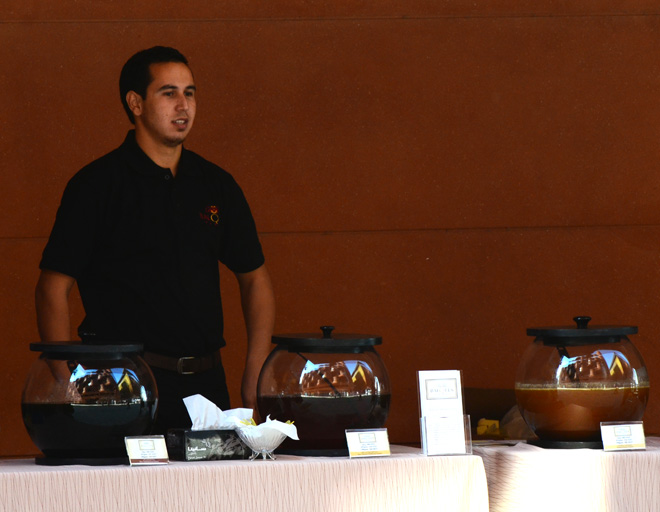

Terrorists and Houthi pirates probably come to mind long before honey when people think of Yemen, but the raw Yemeni honey Balqees had for sale at the recent Masdar Festival in Dubai we visited was far and away the yummiest honey I ever put in my mouth.
Read below to learn more about 8 varieties of Balqees company sells and what makes them so special.
1. Yemeni Sidr Do’ani from the Sidr tree is “Allah’s honey”
The Sidr tree, also known as Christ’s Thorn or the Jujube tree, has featured prominently in the Middle East region – the Pharaohs even used its wood to build some of their historically brilliant structures; it is also ubiquitous in Southern Yemen, particularly in Wadi Do’an. According to Balqees, thousands of semi-nomadic beekeepers gather twice a year to collect Sidr honey from the mountains in this remote desert region
2. Yemini Sidr Usaimi
Cooler than Wadi Do’ani, Usaimat is located in northern Yemen, where the resilient Sidr tree also grows en masse. But because the soil and climate are different, this honey with the same medicinal properties has a slightly different flavor.

3. Yemeni Sumar Honey
As you might have guessed, this honey is named after the Sumar tree in the Hadramout region. Said to be one of Balqees’ more popular varieties, Sumar honey is said to have more of a caramel tone without being excessively sweet.
4. Yemeni Sidr Wasabi
It isn’t green and it isn’t spicy, but Sidr Wasabi honey from the Wasab region between the north and south of Yemen has a very rich toffee and butterfly flavor that distinguishes it from Baqees’ other honey types. This is thanks to the area’s unique soil and climate. The Sidr tree goes wild here.
5. Yemeni Wildflower Honey
Wildflowers grow in one of the remaining areas in Yemen that is not polluted – also in the Hadramout region, which means honey harvested in this region takes its unique flavor not only from the flowers combined with the climate. This may be one of the most delicate and sweet smelling of the company’s offerings.
6. Yemeni Herbal Honey Fusion
This fusion is comprised of royal jelly, propolis, ginseng and ginger with a Sumar honey base. Balqees claims this mix has “amazing healing properties and strengthens the immune system” and delivers a “powerhouse of energy, vitamins and minerals.”

7. Raw Honey, Cinnamon and Sesame Seed Fusion
Commonly used as an alternative treatment in both oriental and Ayurvedic medicine, both honey and cinnamon are known to have a plethora of healing properties. Combined, they are potent. Raw Yemini honey is combined with Organic Ceylon cinnamon from Sri Lanka and a few sesame seeds to deliver a sweet spread with a nutty flavor.
8. Raw Honey and Royal Jelly Fusion
Balqees enriches Raw Yemeni Honey with Royal Jelly, which is left unprocessed in order to retain all of its organic attributes. This appears to be the company’s most nutritiously potent fusion. “It is an instant energy building food containing remarkable amounts of vitamins, proteins, lipids, glucides, enzymes, mineral substances, amino acids, antibacterial and antibiotic components,” the company states in their brochure. It is also said to help cell regeneration and preserve youth.
(Not featured here is a Saffron honey mix that Balqees had for sale at the Masdar City Festival. The saffron comes from Iran and gives the raw honey such a gentle but distinctive flavor – so subtle, so delicious.)
(Related: Baloyolu – Turkey’s first honey tasting tour)
Founded by Riath Hamed, who has spent a lifetime cultivating his sweet tooth and who traces his roots to and spent a year in Yemen, Balqees works with local apiaries and small scale beekeepers – ensuring not only superior quality, but also a sustainable development.
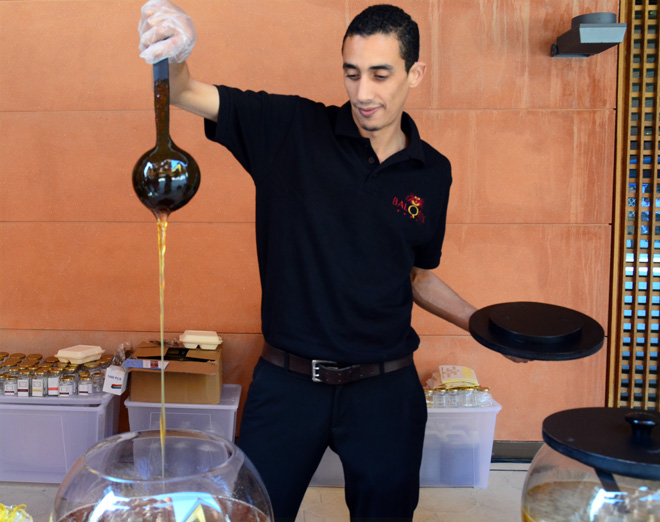
“What experience taught me is that to guarantee the quality of my honey, I needed to have my own apiaries. I went into business with a Yemeni honey producer, who is renowned in the industry and made an exclusive deal with him and his farms. That way I know I am going to get the very best,” Hamed said.
“I’ve spent a lot of time in Yemen with the beekeepers, tasting the honey and learning from beekeepers who have been in the industry for generations. They helped me to understand the nuances of the honey, the regional variations, how to know when the honey has been adulterated or when it is absolutely pure.”

Some images via Tafline Laylin for Green Prophet
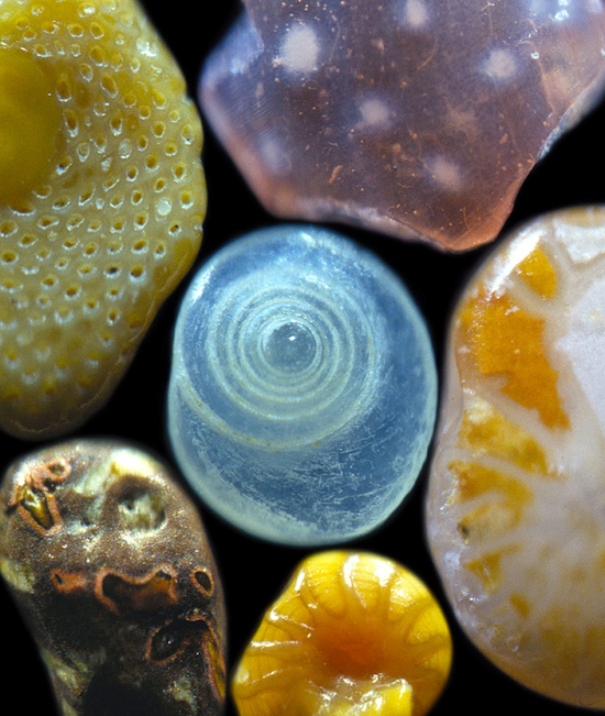
Drop some sand under a high-definition, three-dimensional light microscope and you’ll never look at a beach the same way again. Magnified 250 times, the tiny grains are shockingly gorgeous! Brilliantly colored or crystal-clear, the origins of each speck emerges; spiral shell fragments, petrified corals, gem-like minerals or crumbs of volcanic rock.
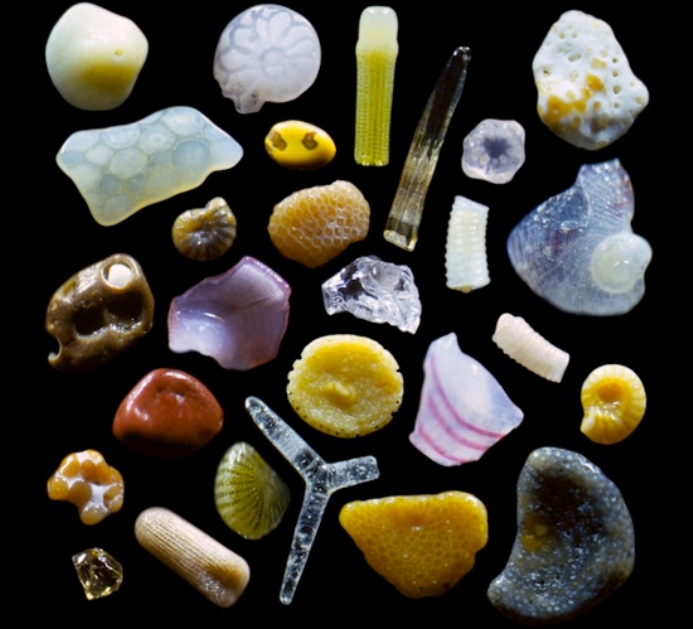
Photographer and scientist Gary Greenberg has devoted his life to revealing the secret beauty of nature. “My real passion in life is to explore the intersection between art and science”, he says in a TedX talk.
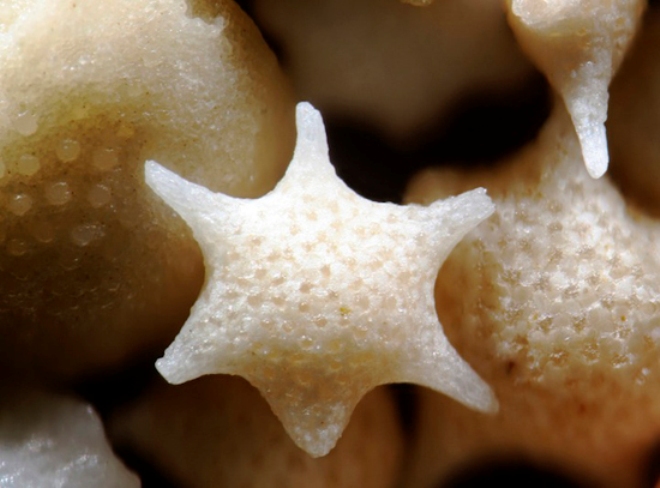
Creating the images is a painstakingly lengthy process, first photographing the grains from several angles then combining them into a single composition using computer software.
“It is incredible to think when you are walking on the beach you are standing on these tiny treasures,” says Greenberg.
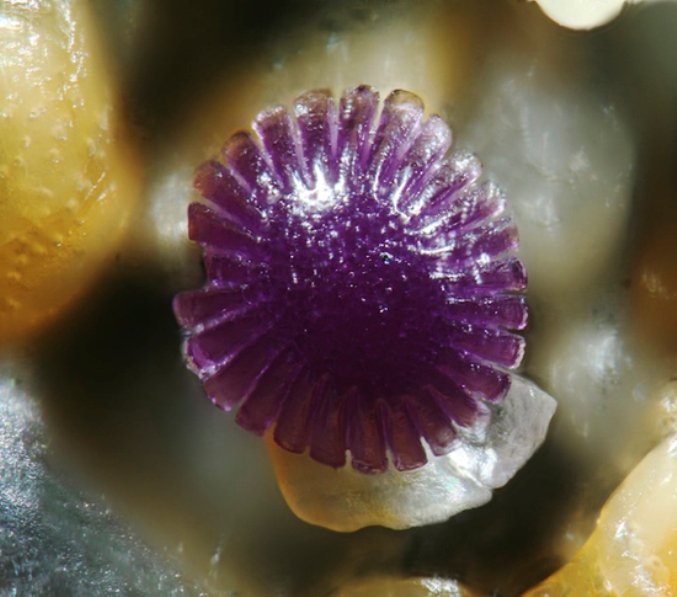
Greenberg began his career as photographer and filmmaker, then went on to earn a doctorate in biomedical research. He’s also an inventor of specialized microscopes, for which he was issued eighteen US patents. And on top of it all, he’s authored a book called A Grain of Sand Nature’s Secret Wonder, which features these images and many more.
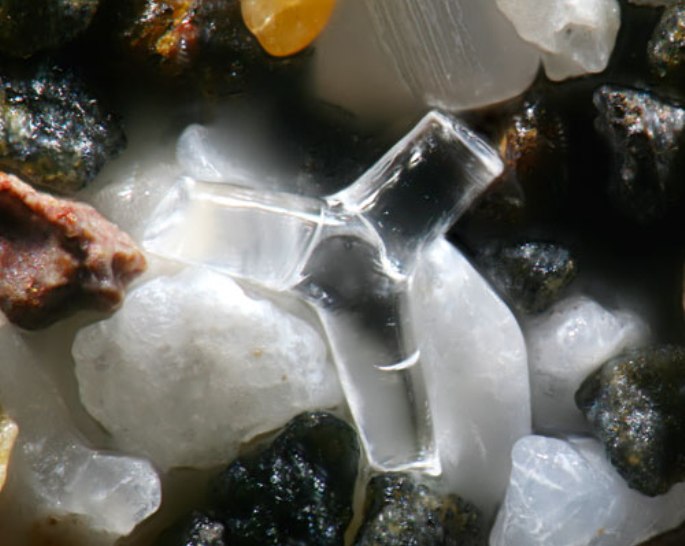
“Each grain of sand represents a moment captured in time. It is somewhere on its path from its creation to erosion and recycling back into the earth. When we walk along the beach we are strolling atop millions of years of biological and geological history,” he says on his website.
 You can order prints of Greenberg’s astounding images on his website (link here).
Too much eye candy? Need a factual takeaway? People who collect sand as a hobby are known as arenophiles. Those who study foraminifera, also called forams are heros. They can help researchers figure out if a desalination plant is releasing heavy metals.

 Five years following its ban on smoking in restaurants and other public spaces, the Hashemite Kingdom of Jordan will start enforcing the rules. By year end, government will also revoke licenses which allow an estimated 6,000 coffee shops to serve sheesha (the Middle Eastern water pipe used for tobacco smokes).

An all-women team of Qatari students won the first GCC hybrid electric vehicle competition held in Abu Dhabi over the weekend. Showing some serious girl power, Gernas 114 from Qatar University beat 10 other teams to become the 2014 TAQA GCC Hybrid-Electric Challenge champions.

 Bob Hale, of Rios Clementi Hale Studios, wrapped his house in LA’s Cheviot Hills neighborhood in a perforated-metal screen like the Arabian screens the mashrabiya, which provide shade and privacy. But Hale’s home is punched with “ahava” – the Hebrew word for love.

Millions of bioluminescent phytoplankton set a stretch of Maldives beach aglow, captured in these gorgeous photos by Taiwanese photographer Will Ho. These tiny organisms emit an eerie green-blue light when agitated by breaking waves or objects moving through water.


The world’s first 3D printed guns (like the 3D printed gun that breached Israeli security) have landed in London’s acclaimed Victoria & Albert Museum. Two prototype Liberator guns developed by self described “crypto-anarchist” Cody Wilson are now permanently displayed as – and I type this last word with difficulty – art.
The artifacts are groundbreaking. The technology is stunning. And debate sparked by these “wiki weapons” is intense. The plastic 3D guns pulled in sensational headlines for the world’s largest design museum, injecting this Victorian bastion with an incongruous dose of edginess. Brilliant marketing or an art world epic fail?
“Ugly and sinister objects demand the museum’s attention just as much as beautiful and beneficial ones do,” wrote Kieran Long, V&A senior curator of contemporary architecture, design and digital, in his monthly column for Dezeen.
So the guns demanded their attention. And, in turn, got ours. It’s fascinating to observe how some things are deemed cool and others are not. Sanctifying weaponry as art is provocative, but what follows?

Wilson admits that while his project isn’t art, “it has an artistic sensibility about it… it’s a kind of demonstration, proof of the direction of our technical future,” he told Forbes Magazine.
Wilson in his early 30s is a self-described anarchist once named one of the most dangerous men in the world because of his attempts to disseminate information showing how to make a printable and untraceable gun.
His company, Defense Distributed, creates gun designs that can be downloaded by anyone anywhere, constructed on a 3D printer. Download computer aided design (CAD) files, press print, and fire away the latest and most lethal output of the “additive manufacturing” process.
A suitable printer can be had for as little as $2,000; a plastic gun can be yours for about $25.
Last May, the US government forced Wilson to remove his blueprints from the internet. By then the files had been downloaded over 100,000 times and shared on countless websites worldwide. Elvis had left the building, fully armed.
3D printing is poised to become a routine part of modern life. The idea of freely available designs for guns that are undetectable (by-passing metal detectors) and untraceable (no licensing or purchase trail) and that can be cheaply “printed” by anyone anywhere has terrifying implications.
Last summer a local Israeli TV show managed to get one past security into the Knesset, the country’s parliament building in Jerusalem; a shocking wake-up call to the risks this technology presents.
People love guns.

Americans more than others, but in the Middle East, where governments typically set strict regulations for arms possession, civilians are also impressively armed.
According to the 2007 Small Arms Survey (links to PDF), Yemen is third in world rankings.
Saudi Arabia is 6th
Iraq is 7th
Oman is 17th
Bahrain and Kuwait share 18th place.
United Arab Emirates trails at 24th
Qatar is 31st
Iran is 79th and Egypt is 115th.
Tunisia is the 178th nation largely due to strict rules of gun ownership imposed by deposed President Zine El Abidine Ben Ali.
All bets are off when self-manufacture joins the market. Stats such as these become obsolete, and quaint.
We have a tendency to apply our intellectual power to violence and destruction. “When MakerBot and others developed 3-D printers, they imagined people making wonderful things that make the world a better place. They had no concept these would be used to create weapons,” said NY Times writer Nick Bilton following his interview with Wilson, “Then you have people like Cody who come along and looks at this cute little kitten and realizes he can reprogram it to kill people.”
Is it a monstrous perversion of technology or a boon to personal freedom? It absolutely is not art.

Update 2020, Cody Wilson probably thinks if he can show the world how to be an anarchist he can do whatever he likes outside the bounds of social norms. He was arrested last year for having sex with a minor and is currently barred from carrying his own gun. His Austin-based business is still running, and now he has produced a machine that can mass manufacture guns and nothing will get in his way, including the law, he has told various news outlets.

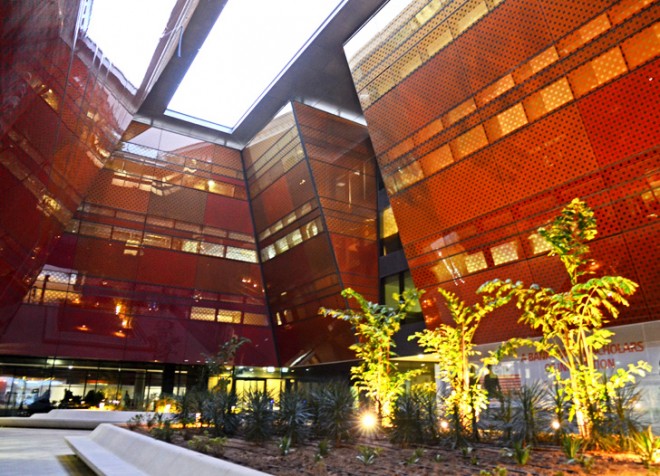 Masdar City is starting to shape up with a roster of new buildings. Siemens recently completed their LEED Platinum headquarters, the new IRENA headquarters is in progress, and GE just opened their first Ecomagination Center in the city’s first commercial building – the Incubator Building.

Iran offers some of the world’s most epic rock climbing, but only a small handful of hard core international rock climbers have tested their courage and skill on its beautiful rock faces. Meanwhile, the less intrepid among us might settle for this awesome climbing gym designed for the Irianian village of Polur by New Wave Architecture.

Colombia and Egypt share at least one unfortunate plague: land mines. Nearly 20 percent of the world’s land mines are strewn throughout Egypt’s western desert and the Sinai peninsula, while in Colombia, they have killed 2,000 people over the last two decades. Lemur Studio designed a life-saving solution – SaveOneLife.
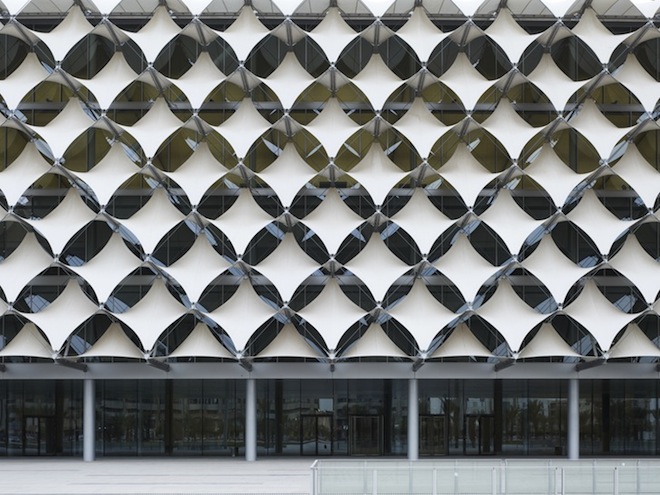
Saudi Arabia isn’t well known for its architectural subtlety, but Gerber Architekten’s renovation of the King Fahad National Library in Riyadh suggests that the Kingdom may be open to a new approach.
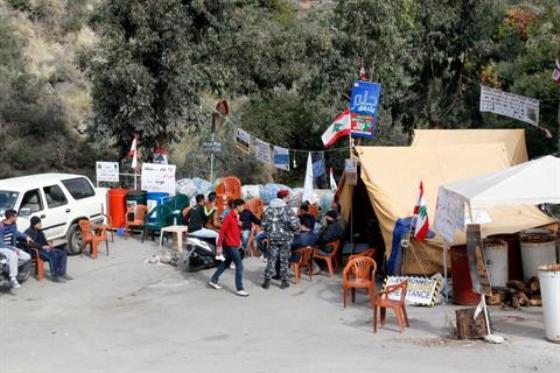
Lebanon has had its share of pollution and garbage issues laundered out on Green Prophet. There have been stories of garbage trucks dumping their loads straight into the sea, or those on Sidon’s notorious garbage mound, where local residents used to say: “It’s horrible isn’t it? You smell it before you can see it.”
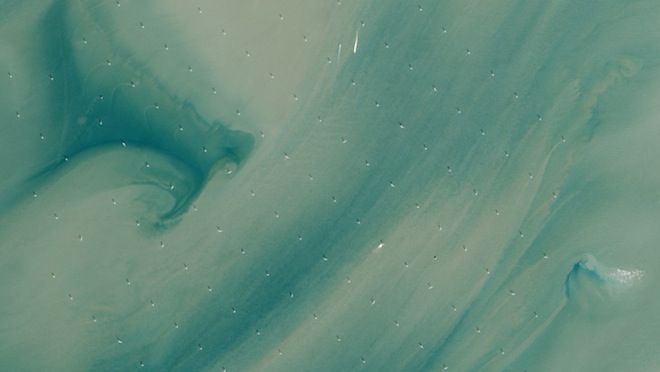
The world’s largest wind farm in the outer Thames estuary has the capacity to deliver power to 500,000 homes and offset 925,000 tonnes of carbon dioxide emissions from the atmosphere. NASA reveals photos of the London Array taken from space – seen after the jump.

Have news to share? Renewable energy news, architectural, artificial intelligence, biotech, sustainable design ideas, eco-architecture, green travel?
Email us: [email protected]
Get important news delivered directly to your inbox and stay connected!
© 2007 to 2026 Green Prophet, All Rights Reserved