
Earth. Energy. Everything next.

Anti-Tobacco Images Fail to Sway Jordanian Smokers


If new anti-smoking images slapped on Jordan’s smokes don’t help puffers kick the habit, maybe Jordan should look Down Under for greater motivation: Beginning this year, as part of Jordan’s obligations to the World Health Organization’s Framework Convention on Tobacco Control (FCTC), the Ministry of Health asked cigarette companies to feature graphic anti-smoking images on cigarette packs. These images are too graphic for us to post. Google will ban our ads here if we do.
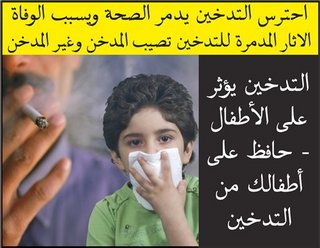
ANti-Smoking Campaign in JordanSo packs sold in Kingdom now contain very small pictures of a damaged lung, or a coughing child (see image at left), or a cartoony-fetus in its mama’s womb.

The change aims to sharply raise awareness of  tobacco-caused diseases and the dangers of second-hand smoke.

According to smokers interviewed by The Jordan Times, it’s not working.

Musa, who’s smoked for 16 years, told the paper, “Whatever they are going to place on the tobacco packs, I will not quit smoking, unless I want to.”  George, another interviewee, said, “These pictorials have no effect. I open the pack and smoke without paying any attention to the images.”

Cigarettes sold in duty-free shops or on the black market don’t bear the no-smoking imagery.

A study conducted by the King Hussein Cancer Center’s cancer control office had indicated that the graphics would motivate an estimated 25% percent of smokers to quit.

“I don’t care what pictures they put on the cigarette packet,” Mohammed told the Times.  “I started smoking when I was 18, and I haven’t stopped since. I don’t think a picture would make me stop smoking.”

Female smokers said they weren’t put off by the  photos. Raeda noted that kicking the habit was a personal choice,  saying, “Nothing, neither placing ugly images nor increasing cigarette prices would encourage me to quit smoking unless I want to.”So she says, but steeply raising cigarette prices with hefty taxation does prompt even long-term users to kick the habit.

Last year the Department of Statistics reported that Jordan’s cigarette spending was on the rise, with total spending on tobacco products reaching $678.7 million in 2010 (compared with $497.4 million in 2008). The Heath Ministry reports that smoking cost the country $1.4 billion last year, including money spent on money spent smoke-related diseases.

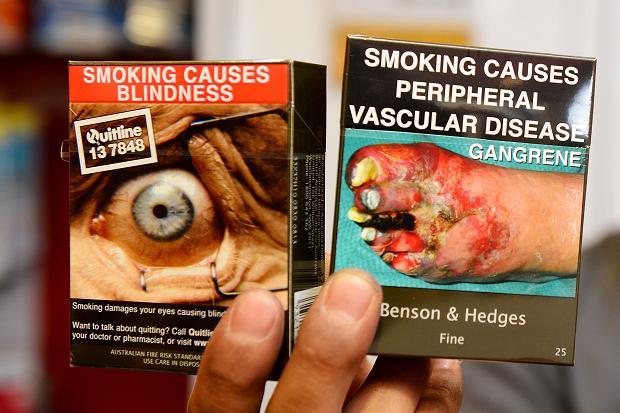
Smoking similarly smacked the Australian economy, with annual health costs at $33 billion and an estimated death toll of 900,000 over the last 60 years. So in 2012, Australia took it up a notch: the High Court ruled that all smokes must be sold in uniform packaging with minimal branding or logos on a drab brown background. The packs feature a range of eye-popping (and stomach-turning) imagery of a gangrenous foot, a cancerous mouth, or a cadaverous cancer sufferer;  in-your-face reminders of the risks of lighting up. See image above for an example.

“They’re so horrifyingly ugly that they are magnificent,” Fiona Sharkie, executive director of anti-smoking campaigner Quit Victoria told Bloomberg News.  She said callers to its hotline said the packaging was the “final push” they needed to stop smoking.

Approximately 29% of Jordanians above 18 are smokers, in addition to 14% of kids between ages 13-15, one quarter of whom smoke sheesha. According to WHO, tobacco  is killing about 6 million people each year. It contains over 4,000 chemicals of which 60 are carcinogens, in addition to addictive nicotine.

Scary statistics warrant scary warnings. Jordan would be wise to adopt the new Australian packaging and pull no punches when it comes to tobacco addiction.

Read More

TRENDING

Cities promise net zero. A new UN-aligned checklist asks them to prove it

At COP31 in Türkiye, a new climate checklist challenges cities to prove their net-zero promises with measurable action, transparent reporting and real emissions cuts.

Petra by Night returns as Jordan tries brings tourists back to Wadi Rum

The Nabataeans understood that prosperity in the desert depended on respecting environmental limits. Two thousand years later, Petra's greatest attraction may still be the wisdom of the people who learned to live within them.

The pulsing planet and the earthquakes that shape our world

One of the most persistent questions in seismology concerns whether scientists will eventually be able to predict major earthquakes before they happen.

Amman’s traffic crisis is about more than cars. It’s about how we think

I believe Jordan needs a cultural transformation alongside its infrastructure investments. We must begin by redefining social prestige. Why should ownership of an expensive car be considered a greater achievement than making an environmentally responsible transportation choice? Why should travelling by bus carry a social stigma?

Why water-starved Amman keeps flooding and how underground rain tanks could help

Jordan's capital faces a troubling paradox: chronic water shortages and destructive winter floods. Hydrogeological expert Dr. Osama MN Gazal explains how underground rainwater tanks and green infrastructure could help Amman capture precious rainfall, reduce flooding and build a more water-secure future.

Why Bronwyn Finnegan Chose the Nonprofit Sector Over Politics or Corporate Life

Bronwyn Finnegan could have pursued a career in politics or corporate leadership. Instead, she chose the nonprofit sector, where she focuses on financial sustainability, governance and helping mission-driven organizations build the capacity to survive and grow.

Scientists make lead-free perovskite solar cells that can weather the elements

Scientists have developed a “raincoat” for lead-free tin perovskite solar cells, helping them withstand air, moisture and heat while maintaining high efficiency.

The Essential Guide To Sustainability in Project Management

Sustainability is an approach where businesses and individuals balance the environmental, social, and economic aspects of a project such that current and future stakeholders are not overburdened with the impacts of the project in future.

Yerukim Forms a New Green Economy Where the Money is Really Green

The Yerukim members who pick up the recyclables get to keep the monetary reward, the public earns "green" bills that can be used in shops, and business owners get to be associated with environmentalism.

Choosing Riyadh over Dubai? What Investors Should Know

Saudi Arabia is deploying capital at unmatched scale to catalyze tourism and advanced industry while rewiring its power-and-water backbone. The investable frontier is widening—especially in renewables, grid storage, water efficiency/desal retrofits, and hospitality operating platforms. Prudent investors will insist on phased delivery, enforceable KPIs (energy, water, biodiversity), and RHQ/zone compliance—while pricing political-economy and reputational risks alongside growth upside.

Sell your cooking oil for biodiesel money

Want to make money on old french fry oil? Sell it.

Qatar Alternative Energy Summit Pairs Investors And Innovators

Alternative energy investors and innovators can meet n' greet in Doha, Qatar March 16 and 17.

Here’s How To Implement The Four Pillars Of Employee Engagement

If you throw a party for your work team and they are vegans, don't make it a barbecue. Know the sustainability values of your team to boost moral and retain good people.

Popular Categories