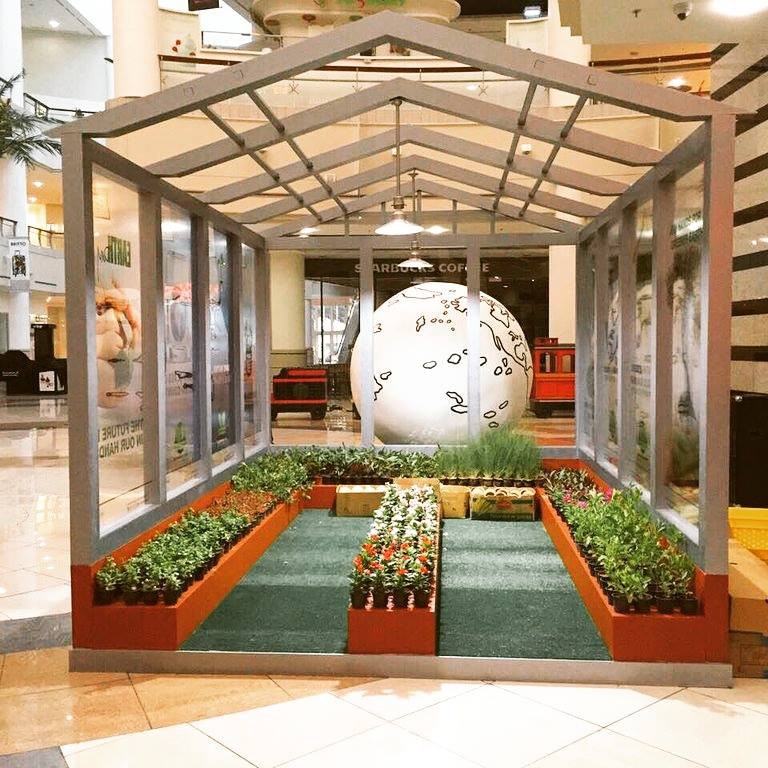
 In the large atrium of Al Wahda Mall in Abu Dhabi, parents, children, staff and tourists are just some of the shoppers that can be found. Only they aren’t shopping – they’re planting small trees.
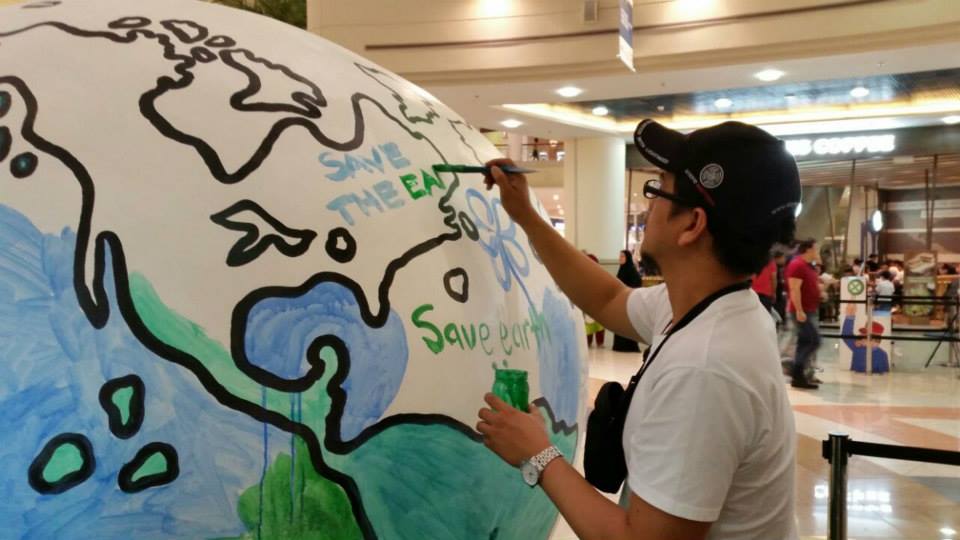
Close by, other visitors stand armed with paint brushes a paint pots, coloring in a large globe.
The activities all part of the mall’s campaign, Make Our Planet Green, to encourage people to be more environmentally aware.
Shoppers can take a break from retail stress and take part in a range of events as part of the initiative. A giant globe on the atrium floor has gradually been colored in by curious passers-by by ahead of Earth Day next week on April 22.
If they’ve spent a healthy amount shopping( AED 250 or US$68), they get to plant a sapling for free in a specially erected greenhouse before taking their young tree home. Alternatively if they’ve resisted from spending their money shopping or just been dragged along for a family outing they can pay a small fee to take a sapling home to plant.
Many art and environment lovers have also been participating in the Green Earth Sketching Contest. The competition requires them to sketch their version of an eco-friendly earth on eco-friendly paper. The winners of the contest will be announced on April 30 and the person who scoops first prize will get an Al Wahda Mall shopping voucher worth AED 5,000 (US$1,361!)
“We want to educate people about how they could contribute towards a greener planet by organizing activities they will enjoy taking part in,” said Mohammad Nauman Thakur, General Manager of Al Wahda Mall.
“With such initiatives, we believe in connecting with the community and we would like everyone to come here and take part in the ‘green drive’. Everyone should be responsible and do their bit for a cleaner planet,” he added.
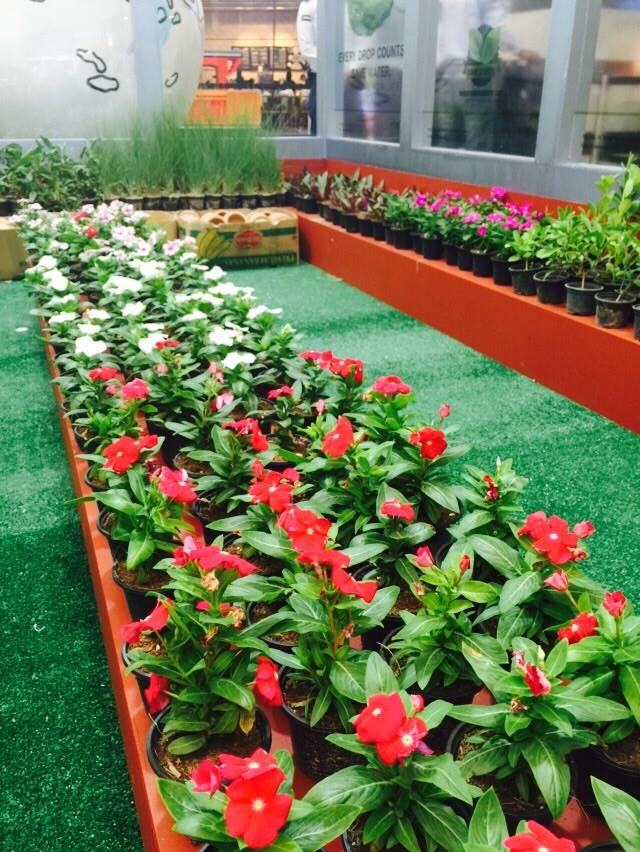
Hundreds of visitors descended on the activity areas on the opening day of the Make Our Planet Green initiative.
“I had visited the mall with my young ones. It was nice to see them getting close to nature and learning about their responsibility towards a greener planet. They had fun planting saplings, it is not something they usually get to do,” said Filipino Maria Guiterez, an Abu Dhabi resident who works in the marketing department of a multinational company.
Aside from this latest green campaign, the mall already has in place environmentally friendly measures to help reduce its carbon footprint and use energy efficiently. The skylight on the roof has sun reflective films to help reduce overheating in order to save power.
LED bulbs have replaced 20 percent of the lights in the mall, and by 2017, the mall hopes that the entire building’s lighting will be using the energy saving LEDs instead of regular bulbs.
Al Wahda also uses an adiabatic cooling system to cut down on electricity consumption of the air conditioning system by reducing heat through a change in air pressure.
Even the restrooms are green! Waterless urinals have been in installed to help save over 400, 000 gallons of water each year.
The Make Our Planet Green event started on April 9 and is running for another week until its final day on April 25.
Images courtesy of Al Wahda Mall.
 The population at Jordan’s
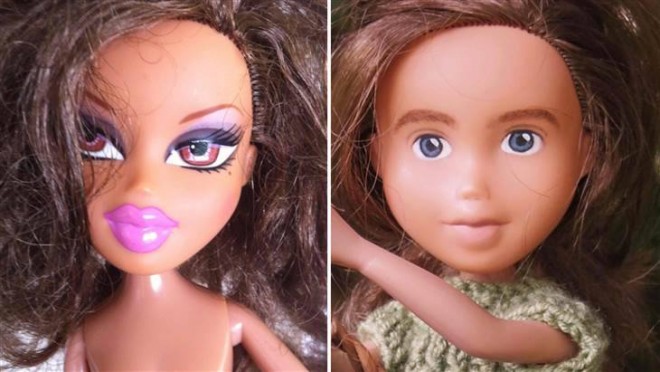 There’s a new toy on the shelf that’s been whipping up online comments that accuse its maker of radically





 Seven designers teamed up on a project to transform
 Vive la France! The country recently passed legislation that requires rooftops on all new commercial buildings to be at least partly

 Dubai has taken a giant step forward in greening up the city with its decision to move away from ordinary Portland cement (OPC) for all new buildings. As of April 1, OPC use is limited across the emirate; building permissions are reliant on developers specifying eco-friendly Supplementary Cementing Materials (SCMs). The new requirement aims to give residents a clean and pollution-free environment.


 Travel to the Middle East has never been a better deal than now – in terms of economics (deep-discounted hotels and holiday packages), weather (
 Finding greener ways to bury our dead is nothing new. In both Judaism and Islam, people are