Home Blog Page 264

Global warming expert fine tunes weather predictions

0

weather-forecast

The night before the Israel Defense Forces’ 1976 mission rescuing over 200 hostages from hijackers in Entebbe, Uganda, Tel Aviv University’s Prof. Pinhas Alpert, then head of an Israel Air Force base forecasting unit, provided intelligence that was critical to the success of the operation — the weather conditions commandos were likely to encounter en route and on the ground. Had his information been incorrect, the mission might have ended quite differently.

Related: Pinhas Alpert shows how cell phone towers predict the next big flood

The inaccuracy of forecasts also has personal implications for people around the world, leaving them stranded without umbrellas, snowed in, or stuck in airports. But considering the technology available today, why do meteorologists continue to miss the mark?

New research published in the journal Land by Prof. Alpert of the Department of Geosciences at TAU’s Faculty of Exact Sciences prioritizes, for the first time, reasons for forecast failures across different regions of the world. Using multi-regression-based statistics on data collected between 1979-1993 on tens of thousands of forecast points, Prof. Alpert and his team were able to quantify the causes — man-made and natural — for weather prediction inaccuracies.

Studying geographic and topographic changes

Pinhas Alpert“Considering my background in forecasting, weather prediction fallacies bothered me for a long time,” said Prof. Alpert. “Since joining TAU in 1982, I have been looking for a way to quantify the dominant factors that cause errors in forecasting. Until now, there has been no comprehensive analysis of these factors. They have been studied separately, but not in combination. I decided to quantify and prioritize the dominant factors for different regions, and provide this valuable information to the world scientific community.”

Using statistical analysis of meteorological data over thousands of locations and the course of 15 years, Prof. Alpert identified unique factors affecting forecasts in Europe, North Africa, the Mediterranean, Asia, and East Asia. The researchers found the dominant factors clouding the accuracy of predictions comprised land-use changes (i.e. an area that had been covered in forest is suddenly bare), topography, particles in the atmosphere and population density.

“For example, when Israel’s national water pipeline crossed the northern Negev in June 1964, it changed the lay of the land,” said Prof. Alpert. “After a relatively short period of time, the desert was blooming, affecting the generation of clouds, precipitation, and temperature extremes. It is difficult for forecasters to incorporate changes like this. In effect, this single land-cover change altered the entire local climate over the Northern Negev, and existing forecast models had difficulty accommodating this, leading to erroneous predictions.”

Weather forecasting with grades

The researchers incorporated the dominant factors within a single equation and then monitored the model’s ability to accurately predict monthly weather conditions in different regions over 15 years. Prof. Alpert and his team also created a table of “factor prioritization” — gold, silver, and bronze labels to identify dominant and less dominant factors for different regions in the world. For example, they found that in the eastern Mediterranean, particles in the atmosphere were the most important cause of forecast fallacies, followed by land cover change. They also found topography to be the most influential factor affecting weather around the world.

“The only tool the weather forecaster has is his model, and the only choice he or she has is to look at different models, each of which has strengths and weaknesses,” said Prof. Alpert. “Several hundred research groups are trying to improve forecasting models all the time. These groups also seek to improve predictions of climate change and global warming. Our study provides them with information about the right topics of research to address for each region.”

Prof. Alpert is continuing to investigate factors that damage the quality of forecasts, hoping to devise new methods of improving weather and climate models.

Image of woman weatherman from Shutterstock

How Alan Shackelford changed cannabis as medicine

2
Alan Shackelford, medicinal cannabis doctor Charlotte's Web, CBD, THC
Dr. Alan Shackelford was among the first to prescribe medical cannabis in the United States to a child. Her seizures stopped. 

Thirty-five years ago an Israeli researcher documented the case for medicinal cannabis to treat epilepsy. It was one of these studies by a Prof. Raphael Mechoulam that Denver-based physician Dr. Alan Shackelford read when he was debating one of the hardest questions of his career. He was prescribing medical cannabis already in Colorado to help people with occupational injuries. 

A desperate couple came to him. Their daughter Charlotte Figi was having 300 seizures a week. They read about an Israeli study that suggested cannabis might help. They implored him to try it on their daughter who was put on a do-not resucitate list in the hospital. Every seizure she had from Dravet’s Syndrome could potentially cause a heart attack.

Figi’s parents were heart-broken by the situation. They asked Shackelford: could he give their 5-year-old medical marijuana?

Charlotte had about 300 seizures a week. They read cannabis might work.

Charlotte Figi with her father, cannabis plants high in CBD for CBD oil
Charlotte Figi suffers from a rare form of epilepsy called Dravet’s Syndrome. Medical cannabis in the form of CBD oil was the only medicine that helped.

“I wasn’t intending on seeing her,” Shackelford tells me when we sat down to talk. “I had no experience with children. My oldest patient was 103, andthe majority of them were older people with back pain, and the treatments were working well on older patients, including some with seizures, but I wasn’t sure it would be appropriate for a child of five.”

Medical cannabis physician Alan Shackelford led the way of the use of CBD oil in children
Dr. Alan Shackelford

Shackelford then poured over a stack of Charlotte’s medical records: “I decided that Charlotte would surely die if we didn’t do something to help her,” he tells Green Prophet. “As a doctor we take an oath that if we can help someone we must do what we can –– ‘cure when possible, comfort always’.”

Charlotte’s mother had brought to him a stack of convincing medical records. Then Shackelford made an appointment at his office: “There I met a girl just over a meter tall. On the way she’d had a seizure in the car, two in the waiting room and two while I was evaluating her.

“These were grand mal seizures. I made extensive notes. Charlotte was unresponsive to questions. She couldn’t eat, couldn’t drink and because nothing was working for her, she was no longer on any medicines.”

Shackelford was educated at Heidelberg Medical School in Germany and Harvard and certainly looks and plays the part of a conservative and evidence-based physician. He wasn’t the kind of doctor who gave prescriptions for cannabis out loosely. In fact, over the years he’d developed a pretty effective protocol he used by phone to screen out recreational users and over the stateline pilgrims looking for a free license to get high.

The lab that started cannabis research in the world

He went back to the research papers and poured over them again. It was the 1980 paper by Mechoulam that caught his eye: in it Mechoulam from the Hebrew University discussed the effectiveness of giving synthesized cannabidiol or CBD to patients with seizures–– in fact it was this particular molecule found in cannabis that shows therapeutic effects, without getting people high. In this paper 4 out of 8 people that used the CBD became seizure free.

Shackelford understood it was worth a shot.

Now the question was how to dose and administer marijuana to a little girl. And where to find plants with high levels of CBD (cannabidiol), but only with small amounts of THC (tetrahydrocannabinol), the primary psychoactive compound found in cannabis.

How to dose a child with CBD

Based on ratios presented in the study Shackelford decided on 6mg/kilo (or 3 mg/pound) of Charlotte.

But Charlotte couldn’t smoke a pipe or a joint.

Normally growers in the Colorado area pride themselves on plants very high in THC, or the molecule that gets you high. This is not what the doctor wanted to give to a small child.

Shackelford found a local grower that could supply a small amount to try. The ratios were 17 molecules of CBD to one molecule of THC but it cost an extraordinary $800 an ounce. This is 4 times the price of high-quality medical grade cannabis, which costs about $200 an ounce.

From this precious bit of plant Charlotte’s mom helped make an extract to give to her daughter.

Miraculously, “after the first dose the seizures stopped,” Shackelford told me. “She went from 300 seizures a week to none. But the family was concerned that they would have no more access to the drug.”

How cannabis strain Charlotte’s Web was born

Then a local group of marijuana growers, the Stanley Brothers from the area, heard about the potential for CBD to treat children and agreed to create an extract with the same high CBD content and low THC. Today this extract is called Charlotte’s Web and parents are moving to the Colorado area to access this treatment for children in similar situations.

USing CBD to treat children was a controversial treatment in 2012 and he knew it. Shackelford discussed the idea of using cannabis with Charlotte’s current doctor who thought it was worth a try, and met with in-house counsel at the Colorado Department of Public Health, which administers the medical cannabis program, and with the Department’s medical director to advise them of his decision.

It eventually took one full year for the Health Department to approve the unconventional but effective treatment, with a big part of the convincing coming by way of Mechoulam’s paper.

Why it took 35 years for neurologists to accept cannabis

When I spoke with Mechoulam about it he expressed a confusion as to why it took neurologists 35 years to understand that cannabis could work to treat seizures.

He continues important research on cannabis compounds from his laboratory at the Hebrew University in Jerusalem. 

Raphael Mechoulam, chemist TCH, medical cannabis, CBD
Raphael Mechoulam, discoverer of THC, CBD in medicinal cannabis

There are about dozens of active research teams in Israel directly working with cannabis as a medicine. These teams are associated with government-funded hospitals and universities. One just found that cannabis treats autism

Over in the US, it was late and 2012 CNN was on the line: Sanjay Gupta, previously anti-cannabis, would go on to create a moving video about the medical benefits of cannabis featuring Charlotte and Shackelford. But by the time CNN called, Shackelford who was not looking for fame or “people moving here” had already decided that he would be immigrating to Israel.

Shackelford, who is Jewish and naturally drawn to Israel, says: “I was frustrated. I saw patients taking narcotics and know that thousands of people a year suffer from the side effects of opiate use. Over the counter aspirin causes 1,000 people a year to die from stomach bleeding.

“I wanted to see if I could do research on cannabis in Israel – with Prof. Yehuda Baruch.”

While cannabis is now legal to use in some form in 23 US states, it is a federally prohibited substance when it comes to researching it. As a research physician by training, “I knew I had to go somewhere else,” Shackelford says. “I was very encouraged by my trip to Israel in early 2013 and decided I would come back.”

In the US, committees that should be helping researchers find funding are essentially “looking at the consequences of cannabis abuse rather than at potential benefits, and I went back to find funding in the US so I could do research here in Israel.

“I’d fallen in love with Israel in 2007 and decided I didn’t want to do research from the US, in absentia.”

And that’s what he has done. But it’s not been easy. Back on a trip to Israel in late December 2014 Shackelford knew he had patients back in Denver counting on him. So for now it’s a shuffle: a few weeks in Israel, a few weeks in Denver.

Karin Kloosterman, Dr. Alan Shackelford organizing cannatech
Karin Kloosterman organizes Israel’s first cannabis conference, CannaTech. Dr. Alan Shackelford will be the guest speaker.

“Now I have found people who have my shared vision.”

For Shackelford, a tall statured man, distinguished certainly – almost enlightened? – he knows it’s wildly inappropriate to tell his patients to take a ‘two puffs and call me in the morning”.

Formulating marijuana for medicine

What he’s referring to is the “medical formulations” available to medical cannabis patients in the US and elsewhere. Of course most are not remotely medical and they are not really formulations. Patients currently take medicinal cannabis by smoking it in joints, inhaling it through bongs and vaporizers, or ingesting it as baklava, gummy bears, brownies, hard candies or as drinks: “The inconsistencies are the problem and people don’t really know what’s in them,” Shackelford explains.

And therein lies the solution –– in Israel. Mechoulam and about ten other academic research teams are profiling cannabis strains by medical condition.

Some new companies like BreedIT are working on standardized breeding software for growers, while others like Cannabics are developing medical-grade slow-release pills to administer a reliable and even dose of oils.

Shackelford too has found his own “medicine” – in the halls of Israeli medical wards. Shackelford is now the medical advisor for a company he co-founded called OWC Pharmaceutical Research Corp. The company is publicly traded in the US. And this way he can live his true passion in Israel in the research arena.

OWC, or One World Cannabis, is now matching dosages and strains of cannabis to conditions and are testing them in clinical trials in Israel.

Cannabis research in Israel has been ongoing for the last 50 years. Patients have been using it legally for the last ten. An open source medical records system in Israel helps research doctors understand the effects of cannabis on conditions.

From this kind of data the One World Cannabis team started planning their trials and is now conducting clinical research studies with investigators at several renowned medical centers in Israel on a number of different serious medical conditions for which cannabis may be beneficial.

The history of cannabis as medicine

Shackelford’s journey started in Texas where was born; then in studies at the Heidelberg Medical School where he got the chance to do research as a student. After that Harvard for seven years shaped his “conservative attitude perspective on therapeutics and what is known as evidence-based medicine.”

By 2003 he was in Colorado practicing occupational medicine and in 2009 his story with cannabis began when he gave his first recommendation for medical cannabis to a patient suffering from work force inflicted pain.

All around him at the time the city of Denver was going through a big change with dispensaries opening everywhere like it was the Wild West. Of course in the beginning it was frustrating to hear from scared “soccer moms concerned that their children were going to start and shoot up heroin.”

It was equally annoying seeing women in bikinis in front of dispensaries swinging signs and competing for foot traffic from the streets.

Shackelford recalls: “Growing was haphazard. People would show up to dispensaries with their harvest in socks. And they would dump it out on the table, along with sand saying, ‘dude I’ve got some really good weed’.”

By 2010 Shackelford was getting involved in legislation and joined Senate hearings about why he thought cannabis was an important treatment for certain people. “I thought it was important to regulate it so the benefits would be there for patient use.”

He’s fought with judges, argued in tribunals, and led senators pushing for cannabis reform with scientific evidence and professional experience to back his claims. At one point he even had the law try and bust him: undercover cops had come to his clinic seeking “prescriptions” but the medical records never matched the story. So he denied them.

From seeing stark results in a leukemia patient to cannabis changing the lives of people with chronic pain in a few short months, then the story of Charlotte, Shackelford is convinced that medical cannabis works, and is planning a series of scientific investigations in Israel to study its treatment potential in many more conditions.

The next chapter of his life and career is now being written in Israel, and Shackelford is currently looking for a set of electric wheels to get around.

Dr. Alan Shackelford will be headlining Israel’s first ever CannaTech, a high-level networking event on February 5, that will connect Israeli startups in cannabis technologies to investors locally and globally. Investor spots still open. The event is founded by me – Karin Kloosterman – founder of Green Prophet, the CEO of the medical cannabis growing robot flux, and will be invite only. 

Read more on cannabis technologies and research from Israel:

Raphael Mechoulam changes medical cannabis globally
Cannabis makes PTSD effects disappear

Images: Dr. Alan Shackelford top, via Twitter; Charlotte Figi, News.com; Raphael Mechoulam, Courtesy; Lower Dr. Shackelford, Green Prophet

Negev oil spill will take years to clean up

0

AP photo of cleanup efforts at Arava oil spill

Oil spills are bad enough themselves. When they occur in fragile ecological regions like Israel’s Arava desert, they can be catastrophic.  Such is the case of the recent Negev Desert-Arava oil spill, which occurred as a result of a break in a large oil pipeline during renovation work.

This spill, occurring in early December, caused an estimated 600,000 gallons or 3 million liters of crude oil to run in virtual torrents through some of the Arava Valley’s most unique desert nature reserves. The spill has caused incalculable damage to fragile desert ecosystems. Environmentalists estimate that cleaning up this oil spill will cost more than $7.6 million USD to clean up and take years to do so.

This recent spill is not unique to the area, as other large spills have occurred during the shadowy history of this controversial pipeline.

In 2011, a massive jet fuel spill occurred when a tractor struck a portion of the Eilat Ashkelon pipeline, causing more than 1.5 million liters of aviation jet fuel to spill into the Nahal Zin stream, severely damaging a nearby nature reserve.

That spill alone took weeks to clean up; and resulting damage to the nature reserve and its fragile ecosystem has never been fully corrected. At that time, the Nahal Zin spill was referred to as “Israel’s worst ecological disaster.” So has the recent oil spill as well.

The Eilat Ashkelon oil pipeline was originally constructed in the 1960’s to bring oil purchased from Iran to refineries located on Israel’s Mediterranean seacoast. With Israel still in a state of war with Egypt, Israeli oil tankers and other ocean vessels could not use the Suez Canal.

The Eilat Ashkelon Pipeline Company, which originally constructed the oil pipeline when Israel still had diplomatic and commercial ties with Iran, has enjoyed a “veil of secrecy” that has been so tight and far reaching that numerous incidents of oil leaks and subsequent environmental and public health damage have been quietly covered up; until now anyway.

A legal petition has  been filed by the Israel Union for Environmental Defence (called Adam Teva V’din in Hebrew) with the High Court of Justice that asks that the pipeline company be forced to  release all available information on the oil spill; and to release all the audits and critical reports written about the company that were banned from publication by the military censor since a confidentiality order went into effect in 1968.

A January 5 article in Haaretz reported that activities by the Eilat Ashkelon Pipeline Company have been kept secret under a gag order that is no longer relevant due to Israeli/Iranian relations being severed in 1979.

Lawsuits against the pipeline company are now in the process of being filed on damage caused to the Evrona Nature Reserve,  the communal settlement of Be’er Ora (where the oil spill took place); and by environmental activist Yoel Hadida, who demands “that the Israeli public get 820 million shekels ($210 million USD) in compensation for the damage done to public lands and natural assets, as well as 151.5 million shekels ($39 million USD) in compensation to area residents.”

Whether or not these lawsuits are successful, the damage caused by this recent pipeline rupture incident will have a serious effect on the Arava Desert environment and health of area residents for years to come.

Dubai fog and urban canyons through the lens of Daniel Cheong

0

Heavenly_Photographs_of_Dubai_Skyscrapers_in_a_Sea_of_Clouds_by_Daniel_Cheong_2014_01

Winter storms hammered much of the Middle East last week with strong winds that rose seas and dropped snow from Egypt all the way to Turkey. Meteorologists claimed it was the most severe December storm since 1953 to hit Israel, northern Lebanon’s roads were paralyzed, and the Sea of Galilee rose 10 centimeters in a day. But the balmy Gulf states do storms in style, their gentler weather stunningly captured by Dubai-based photographer Daniel Cheong.

Green Prophet caught up with this self-described photography “hobbyist” (he works in the telecom industry) to ask how someone who only recently got serious about cameras can consistently produce such  knock-out portraits of his adopted city.

Daniel CheongCheong captures the interplay of nature with Dubai’s aggressive urban canyons. These pictures vividly illustrate the free verse of American poet Carl Sandburg’s Fog:  “It comes in on little cat feet. It sits looking over harbor and city on silent haunches and then moves on.”

Daniel Cheong

Cheong began shooting in earnest nine years ago after he bought his first digital single-lens reflex camera. That’s also when he also discovered the world of “high dynamic range photography”, a technique of manipulating multiple exposures of the same subject. This allows the images to seem fully in focus, regardless of distance. Color and light have a clarity and brightness not found in real-world scenes.

He told us, “‘Straight Out Of the Camera’ is a concept which I am not familiar with. I don’t pretend to show reality, but more an idealized vision of it.”

Daniel Cheong

This French national, born in Mauritius, told us he is most attracted to the “blue hour”, which he described as, “This very short moment when the sky turns to a beautiful blue color. This happens about 20 minutes after sunset, or 30 minutes before sunrise. I prefer the blue hour after sunset because at that time the city lights turn on, and make a great contrast with the blue sky.”

His gorgeous portraits of his adopted city are painterly and surreal.  They magically bring nature to the forefront in the Middle East’s most unnatural city, Dubai.

Interested in seeing more of these stunning images? Wish to buy prints? Check out his website (link here). Keep up with his new projects and exhibitions on his Facebook page (link here). Interested in learning this art? The photographer is available for workshops in Dubai, and offers private lessons.

All images from Daniel Cheong

Oil fracking protestors in Algeria rise up against their regime, Total and Shell

1


fracking-algeria

Big demonstrations have spread from the Sahara to Algiers, after Algerian authorities announced the drilling of the first shale gas well in the country. With world’s oil prices plummeting people are starting to wonder: why frack? Can the environmental cost outweigh the benefits of energy security now that prices are falling and renewables within reach. Now virgin deserts are at risk in Algeria as people rise up against the regime and companies with big stakes in oil.

Related: The fall-out after France tested nuclear

“Fracking will have disastrous consequences for the Algerian desert. It threatens scarce water reserves and provides a new rent for the authoritarian Algerian regime that oppressed and imprisons the Algerian people,” says Hamza Hamouchene, President of Algeria Solidarity Campaign (ASC) that signed a collective solidarity statement by more than 80 organisations worldwide.

fracking-alergia-Elwatan-gas de schite-In salah

He adds: “The British government and British companies are supporting this push to exploit Algerian shale gas. No multinationals should be allowed to frack in Algeria and we stand in solidarity with the inspiring resistance movement in Algeria.”

Tens of thousands joined anti-fracking protests and marches across Algeria, after the government announced the drilling of the first shale gas well by Total near In Salah.

Protests spread from there to Tamenrasset, Ouargla, Ghardaia, Illizi, Adrar, Timimoun, Bordj Baji Mokhtar, Ain Beida, Oum El Bouaghi and Algiers.

Against foreigners in Algerian oil

The scale of the public opposition took the government by surprise, and threatens future plans to frack by multinationals including Total and Shell. A sit-in in Algiers was forcibly dispersed and a dozen protestors arrested. Discontent with fracking has been bubbling in Algeria for some time, but these are the first large-scale protests.

News reports have emerged that President Bouteflika might have announced a moratorium on drilling. This remains unconfirmed, and government announcements are often manipulative and unreliable.

Initial anger is focused on the government and Total, Sonatrach and Partex, the oil companies involved in the first well in the Ahnet basin.

There is frustration that while Total is banned from fracking in France, the French government is encouraging fracking in Algeria.

BP and Statoil are also affected, as the oasis town also hosts their In Salah joint venture with Sonatrach, one of the largest gas projects in the country.

The huge protests are demanding the halt of all shale gas operations and a national debate on the issue. This was an existing demand before the Jan 2013 amendments to the hydrocarbon law, that enabled exploitation of unconventional hydrocarbons in Algeria.

The demonstrations reflect a deeper discontent at the ongoing exclusion of the Algerian people from public decision-making, and the long-standing socio-economic marginalisation of inhabitants of the oil and gas-rich Sahara, which provides the bulk of Algeria’s resources and income.

Making the mining industry greener: an environmentally-safe way to extract gold

0

gold-miner-green

Cyanide – a highly-toxic chemical compound – is being used by mining companies in the extraction of gold from the soil. While the compound is safe for humans wearing protective coverings, the same cannot be said for the environment that absorbs traces of the chemical that are left in the process of extraction. The hazardous nature of the mining business is the reason why the industry is being heavily criticized by environmentalists all over the world.

The face of the mining industry, however, might change with the groundbreaking discovery of some scientists from the Northwestern University.

Sir Fraser Stoddart, a professor of chemistry, and his team were able to discover a non-toxic method to isolate gold from the soil with the help of a common baking ingredient: cornstarch.

“The elimination of cyanide from the gold industry is of the utmost importance environmentally,” said Stoddart. “We have replaced nasty reagents with a cheap, biologically friendly-material derived from starch.”

The new material made with cornstarch was discovered purely by accident. Stoddart’s team originally intended to create a three-dimensional structure that can be used for storing gases and molecules.

The mining industry is facing a lot of challenges today. Apart from the pressure given by environmental activists, mining companies are now facing a “drought” due to the fact that most of the easy-to-mine gold has already been extracted from the Earth.

Bullionvault mentions that gold outputs from some of the biggest mines in North America, South Africa, and Zimbabwe have fallen to very low levels.

Stoddart and his team’s findings were documented in the online journal of Nature Communications.


Solar Impulse 2 plane set to circle Earth on sun power

1

solar plane to circumnavigate the world in 2015

The experimental flying lab better known as Solar Impulse 2 was launched today in Abu Dhabi.  The groundbreaking airplane will circumnavigate the world flying both day and night without using a single drop of fossil fuel.  Said co-pilot Betrand Piccard, “You can achieve miracles with renewable energy and clean technologies.”

Environmental “rights” and wrongs when you are injured at home or work

0


asbestos-roof-cancer

Asbestos poisoning, exposure to chemicals or dangerous situations at work which put you at risk, or worse in the hospital and out of work.

In the United States laws are pretty defined on how people can approach the law and their rights. In the Middle East our basic rights to be protected from environmental hazards and toxins are poor in the best case scenarios in countries like Turkey and Israel. As each of our country grows towards better environmental awareness, know your basic rights and how to protect yourself if exposure or accidents happen. The infographic below might help.


Via: SchoolMatters Los Angeles

Architecture For Humanity Shuts Down

2

Cameron SinclairI woke up to find an email from Cameron Sinclair thanking me for “designing like you give a damn.”  Sinclair is the executive director of the Jolie-Pitt Foundation and, yeah, celebrities and politicians email me all the time. I’m also popular with Nigerians who need help cashing checks. I need to figure out how to block spam, but ’til then – I am happy/sad that I got this note from Sinclair. He was reporting the shut-down of Architecture for Humanity, probably the best thing to emerge from an architect’s imagination.

Solar retreat in the Liwa Desert: futuristic functionality or lipstick-on-a-pig?

0

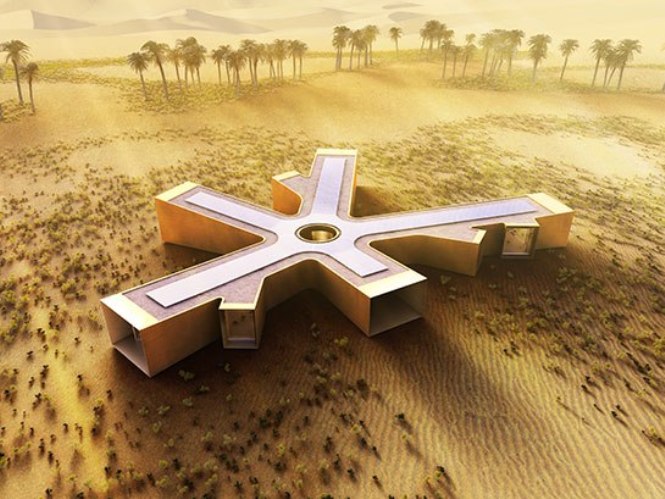
UAE builds solar powered retreatAn unnamed client hired London-based Baharash Architecture to design a luxury home that could fully function off the energy grid. That’s a tall order for any residence in Abu Dhabi, now consider the challenges for one sited in the punishing clime of the hyper-arid Liwa Desert where summer temperatures top 100°F.

The star-shaped structure is modestly sized at about 6,000 square feet and will feature a living room, kitchen, two bedrooms, and central “great room”.  Floor-to-ceiling glass walls permit panoramic views of the surrounding desert scenery. These fixed-glass “windows” will be electrochromic; mechanically tinted for shade and privacy with a press of a button that activates ionic motion within layers of glass, quickly changing the glass panels from clear to opaque.

Baharash Bagherian, founder of the design firm that bears his name, said in a statement, “We are seeing a new generation of Emiratis who are looking to lead a more sustainable lifestyle, in line with UAE’s vision to become one of the most sustainable countries in the world.”

solar-power-desert-retreat-02

The project press release did not define other sustainability features planned for the estimated $2 million vacation home. Simple technology for solar energy production can readily supply the building with all its daytime electricity needs, but there is no information about nighttime power consumption.  Similarly, there is scant info on planned efficiencies for building systems and appliances.  Will the structure be insulated to reduce heat gain and loss?

Eco-friendly construction is becoming prioritized in the UAE, specifically as relates to energy consumption, and the nation is a regional leader in renewable energy generation and municipal recycling. But in the Middle East, water is a greater priority. Many modern MENA municipalities still run on a pumped water procedure, where homes feed off personal water storage tanks which are periodically replenished from a city supply.  Said differently, there isn’t always water when you turn on a tap.  How will potable water be conveyed to this structure?  And – on the flip side – how will sewage and waste be removed?

There’s an outside chance that green specifications are lost in translation; that press coverage of purportedly “green” buildings is selective, overlooking system technology and focusing on structural form instead.  But by glossing over the fuller environmental impacts of a new building (how will it be accessed? does it need new roads? will it encourage more development in an otherwise pristine and ancient natural setting?), projects like these resemble little more than “lipstick on a pig”.

Photography courtesy of Baharash Architecture

10 ways to let your death be ever-green

0

eternal reef burialsChaucer said, “Time and tide wait for no man.”  He should’ve added “death”. Just like the American postal system, neither rain, nor snow, nor sleet nor hail shall keep death from its appointed rounds. Christians whose numbers come up during inclement weather are put on ice in a mortuary until the roads reopen – but other religions don’t permit such patience.

Jewish and Muslim customs require the body to be buried within 24 hours,  a very sensible custom born in the hot Middle East climate where decomposition began quickly. So when an elderly neighbor of a neighbor passed away last week, we got to talking about the added misery of dealing with traditional burial requirements in the midst of a powerful storm in Amman, Jordan where I live.

Let’s not get too – well – grave, but with world population passing seven billion and an estimated 150,000 people dying daily, we ought to take a closer look at how we celebrate life’s end. Maybe explore new options that respect and celebrate the deceased as well as the planet they leave behind.

Talking about death is uncomfortable. Doubly so when modern funeral practices increasingly jeopardize the environment. Did you know most Middle Eastern funerals are inherently “green”? Ancient nomadic people with limited resources developed the simplest methods of dealing with their dead. Over centuries, traditions evolved – varying by region – but all following basic rituals that are some of the most earth-friendly practices around. So while the Western funeral industry scrambles to become less polluting, they could instead take a few pages from the burial playbook of Muslims and Jews.

Both faiths prescribe that, within hours of death, the body is carefully bathed and wrapped in a modest cloth shroud. Well-wishers pay their respects and bury the deceased in a grave, without a casket.

Cremation and embalming are forbidden – wisely, as both are proven pollutants to our air and water. In the parched Middle East, water-guzzling cemeteries carpeted with grass (kept artificially lush with toxic pesticides and weed killers) are a rare exception, and Islam tends to skip extravagant headstones.

But what if you live outside of this region? How can you buck Western trends (and in some cases, mandatory burial regulations) and stay close to planet-friendly practices? You may already be living a green lifestyle, so why not check out a more sustainable deathstyle too? Welcome to the world of green burials, where an entirely new industry competes for your funeral budget.

1. Turn your loved one into a coral reef. Cremation is forbidden in both Islam and Orthodox Judaism. But for those who embrace it, they can offset the serious pollutants it dumps in the air by using the ashes to form artificial reefs. Eternal Reefs create “grief balls” (lead image above) mix your loved one’s remains with concrete to make new habitat for marine life. Perfect for “crabby” people.

turn the deceased into a planter
2. Turn your father into a tree. Green-up cremation by burying the remains in a special flower-pot that converts ashes into a tree – just bury the fully biodegradable Bios Urna (pre-planted with soil, seeds, and human remains). The decomposing urn acts as fertilizer, literally allowing the loved one to live on in nature. That mighty oak was once a nut called Abu Ahmed!

bury your loved on in a garden planter3. Prefer a grave marker? Memorialize the deceased with a Poetree Burial Planter. Pop ashes in a biodegradable cork pot, planted with a boxwood sapling and ringed with the deceased’s inscription in ceramic. It’s a low-maintenance memorial and gentle reminder of the cycle of life.

Holy Smoke ammunition4. Fire away. Take your dearly departed to one last Arab wedding, where they can go out with a bang. A company called Holy Smoke turns the deceased’s ashes into live ammunition for pistols, rifles or shotguns. Aimed at gun enthusiasts, they offer discounts to active and retired military, law enforcement and firefighters. What a blast!

bury your loved on in a  vinyl record5. Spin yourself into a record. How about becoming an album of klezmer tunes – for eternity? A company called Vinyly (website is down) will press your remains into a vinyl disc containing your fave tunes, jacketed in bespoke cover art (the deceased’s portrait!). Make multiple records from body parts: making more to share with the music lovers in your life (or death?)!

add photos to your coffin6. Designer coffin from sustainable wood. Sticking with burial? Fancy pictures of your last Petra visit on your casket lid? Skip high-end coffins made from exotic wood or never-degrading metal & pick one made from sustainably sourced wood. Reflections Coffins are 80% waste wood & 20% FSC-certified wood. Personalize your box with their (I’m not kidding) “design a coffin” web app.

wool coffins7. A woollen coffin to rest in fleece. The coffin market is making biodegradable coffins to die for. Bamboo and cardboard, linen and banana leaf are now common casket materials. Wool is also rising in popularity – Hainsworth, a leading British textile mill, reported a 700% rise in demand for its woollen coffins in 2011 to 2012. A brilliant way to “rest in fleece”.

woven wicker coffins8. Woven willow coffins are a popular green alternative, made from a highly renewable and carbon neutral crop that’s harvested annually with minimal machine and chemical processing. Willow also degrades rapidly in soil, and can be jazzed up in bright colors, making any funeral feel like a roadside picnic.

design a paper coffin9. Personalized images. Tragedy links to comedy when you send your loved one off in a flat-pack coffin printed with personalized images. Celebrate their life or go for big laughs (how about a box of veg that reads “Rest in Peas”?). Creative Coffins are made from non-toxic carton-board and natural glues. Guaranteed the funeral guests will howl, “Stop, you’re killing me!”

jewelry made from dead people10. Turn them into a diamond. Arab royals love their bling! Why not turn that special person into a gem for eternity? LifeGem diamonds and gemstones are created from the carbon in cremated ashes or a lock of hair. Reset your loved one into “cremation jewelry” – rings, earrings and pendants commemorate their original sparkle. (Hey, did anyone see where I left mom?)

I mean no disrespect by this story, but have you ever noticed, the first three letters of “funeral” are FUN?

Frozen Middle East needs some “global warming”

0

 snowman in jerusalem 2015 winter stormA winter storm is banging around much of the Middle East.  Precip’s teamed up with gale force winds, causing first-world headaches like clogged transport, school closures, power outages and the promise of steep heating bills. But mostly people are rocking a few days respite from the usual grind, and – judging from the flood of snowy selfies on social media – having fun. But society is bifurcated; it’s no winter wonderland if you’re poor or displaced.  Check out these ways to help others survive the cold snap. By no means exhaustive, but maybe enough info to get you in a giving mood.  It’s so cool to help someone get warm.

Portraits of the world’s oldest trees

2

Beth Moon Portrait of Time

Photographer Beth Moon spent 14 years traveling to almost every continent taking pictures of the world’s oldest trees. Sixty of the resulting photos – printed with luminous results using a labor-intensive platinum/palladium process  – form her book Ancient Trees: Portraits of Time (Abbeville Press).  It’s a stunning record of nature’s majesty.

“Standing as the earth’s largest and oldest living monuments, I believe these symbolic trees will take on a greater significance, especially at a time when our focus is directed at finding better ways to live with the environment, celebrating the wonders of nature that have survived throughout the centuries. I cannot imagine a better way to commemorate the lives of the world’s most dramatic trees, many which are in danger of destruction, than by exhibiting their portraits,” she said in her artist’s statement.

Beth Moon Portrait of Time

Moon adventured to the Middle East where she spent two weeks camping on Yemen’s Socotra Island. Located in the Arabian Sea off the horn of Africa, the island is home to 50,000 natives, and over 700 plants and animals found nowhere else on earth. Socotra has been geographically isolated from mainland Africa for the past 7 million years.

Socotra is also where the ethereal “Dragon’s Blood Trees” grow (lead image). Named for its scarlet colored resin with alleged medicinal qualities.  These trees, with their astonishing umbrella-like canopies, can live up to 500 years.

They are now classified as endangered as once-vast forests have been decimated by over-grazing and climate change (cloud cover is insufficient to protect young saplings).

“The place was just amazing. Desert-like, dry and blazing hot, with the beautiful white sands of the Arabian Sea and the Indian Ocean to the north. One night I slept under the trees of the Frankincense Forest, another in the Haggler Mountains under the Dragon’s Blood Trees.

“It was perfect, a dream come true,” Moon told the Daily Mail.

Incense that burned in ancient Egyptian and Greek temples was once harvested from this island; nine species of the frankincense tree (image above) are unique to Socotra.

Beth Moon Portrait of TimeBottle trees, also called “Desert Rose” also sprout from the island’s alien-like landscape (image above). Bulbous and leathery, with roots that auger into rocky soil, they store water much like cacti.

beth moon ancient trees starlight

Moon explored the baobabs of Madagascar, sometimes called “upside-down trees” because of their disproportionately slim branches atop massive trunk structures. This massive example pictured above is one of South Africa’s five biggest baobab, one of which is at least 1,275 years old.

Beth Moon Portrait of Time

Moon taps three criteria for selecting her subjects: age, immense size or notable history.  She researches locations using historical and botanical books, tree registers, newspaper articles and information gleaned from friends and travelers.

England offered a forest of tangled yew trees (above), century-old roots gripping rocky perches. Britain’s churchyards provided some of her oldest subjects. A pair of yews named “The Sentinals” frame St. Edwards church in the Cotswolds (below), said to have inspired J.R.R. Tolkien’s imagining of hobbit houses.

beth moon

In Wales, this ancient chestnut tree (below) found on the grounds of Croft Castle date between 400 and 500 years old.

“Many of the trees I have photographed have survived because they are out of reach of civilization; on mountainsides, private estates, or on protected land. Certain species exist only in a few isolated areas of the world”, she says on her website.

Beth Moon Portrait of TimeWith an estimated age exceeding 1,000 years, The Bowthorpe Oak in Lincolnshire (below) could be England’s oldest oak tree. It’s featured in the Guinness Book of Records and starred in a TV documentary about its impressive size and longevity.

Beth Moon Portrait of Time

Images of nature, particularly when rendered in black and white, offer powerful opportunities for momentary escape.  These scenes are akin to visual poetry – open to interpretation by each viewer, revealing new information with each examination.

Trees not your thing? Try gazing into the faces of Kevin Horan’s barnyard beauties. Or for a darker experience, pour over Nick Brandt’s ghostly images of Tanzania’s Lake Natron.

beth moon trees

Nature photography can convey important an environmental message, but can also be a salve for stressed existence.

beth moon trees

Moon had previously published another series called – pictures of creepy-yet-elegant meat-eating plants.  She is working on a new trees series, this time captured in starlight, called Diamond Nights – a couple of photos are above. You can follow her on Facebook, and check out her work on her website.

Storms forecasted – stop energy leaks

1

jordan snow citadel

The Levante is gearing up for a massive winter storm. Laurie over in Amman, Jordan is battening down the hatch and (lucky duck!) is preparing for a snow day (see the above image from last year); while me over in Israel, I am just wondering how to seal those pesky leaks blowing cold air through my poorly insulated 100-year-old home with zero insulation at modern standards.

Turns out there are some tips to stopping energy leaks in your home. The infographic below sums it up. Stay warm Middle East, and be eco-cool!


Via: Spray Foam Insulation Kit Manufacturer

Dubai urges private firms to join Car-Free Day

1

Dubai Car Free DayDubai Municipality has invited businesses and individuals to take part in its annual Car-Free Day on February 4 to lower city-wide vehicle emissions while commemorating the United Arab Emirates’s (UAE) National Environment Day.  Last year, 7,000 employees from 65 government and private organizations participated. The bait they’ll use to incite more action this year? A chance to win another world record as the biggest planetary initiative to create environmental awareness with the largest number of participants. #Only in Dubai.