
Home Blog Page 197

7 things you can learn from the best restaurant marketing

0
vegawarian, flexitarian vegan sandwich, black bread with vegetables held by a woman wearing a vegan t shirt
We love vegan burgers. New research shows how good veganism is for land use. Want to make your new vegan restaurant a hit? Learn marketing and grow a sustainable business.


As the world becomes smaller and competition becomes larger, marketing is becoming an increasingly crucial tool for the success of any business. With trends like eating local or eating even vegan food, you need to stay aware to changing and evolving customer tastes. 

For restaurants especially, using the right tricks & tactics has become more important than ever with new spots to feed hungry customers popping up almost every day. Creating a distinct brand & identity has become a restaurant’s only saving grace in this overcrowded environment. Though every business works differently, there are certain things that every restaurant must keep in mind while devising their marketing strategies. Here are 7 sure-fire tips to give your restaurant’s marketing a much-needed boost.

Seamless User Experience:

Your customers are what make you, and also what can break you. User experience is often neglected by restaurants as they think they have bigger fish to fry, but here’s the “secret” – no matter how trendy your restaurant or how delicious your food is, if it’s not simple, convenient and accessible for the users, it’s going nowhere.

Ensuring that customers have easy access to details and information about the restaurant is the best way to create brand awareness & enable conversions. Customers are much more likely to visit a restaurant they can find everything about in a matter of minutes.

One of the best way to increase user accessibility for your restaurant is to set up a restaurant reservation system. Nowadays, consumers are on a lookout for everything instant – instant food, instant delivery and similarly – instant restaurant reservations. By having an instant reservation system, you are giving your customers an easy and quick channel to reach you, therefore creating a seamless user experience leading to a higher conversion rate.

Make your restaurant “Insta-Friendly”

foods from eucalyptus cookbook
How to make sustainable food choices Instagram friendly

The rise of the digital age or the “Instagram age” has peaked the importance of a restaurant’s visual appeal. “Insta-worthy” has officially become a term used to categorize restaurants and not spotting someone snapping their food at a restaurant has become a rare occurrence. Food & restaurant photos dominate the world of social media, which is why paying attention to how your food & restaurant looks has become more important than ever.

Be on top of trends at all times to ensure your restaurant remains visually relevant while standing out in crowded social feeds. Catering business owners often look into options for sustainable marketing for restaurants as eco-consciousness shapes customer expectations and influences where people choose to dine. Aligning visual branding with responsible practices can strengthen credibility and encourage repeat visits from values-driven customers. Consistency between presentation, messaging, and actions helps restaurants build a lasting impression beyond a single photo moment.

User-Generated Content

The popularity of platforms like Instagram & Snapchat has given rise to a new marketing tool: user-generated content. Customers all over the world are sharing information and images of their food via these platforms, indirectly creating valuable content for the restaurants.

This user generated content is one of the best sources of e-WOM for the business. Ensure that you use this content to it’s maximum potential by integrating it into your restaurant’s marketing strategies and combining it with other social media marketing tools like #hashtags to create a powerful marketing tool at essentially no cost

Focus on customer loyalty

The challenge for any restaurant is not to acquire customers, but to retain them. How can you guarantee that a customer comes back? That’s the golden ticket.

Loyalty comes from a lot of things – great customer service, delicious food, enjoyable environment. But a real sense of loyalty is enabled through loyalty programs – these are point based programs for customers that reward them with offers, deals and discounts leading to repetitive returns from customers resulting in higher customer retention.

Features like special birthday offers, cashback on every purchase and regular discounts are great for encouraging customers to visit your restaurant again and again.

Get on board the Influencer train

Influencers are the new celebrities, except that they are one of the consumers, which makes them that extra bit relatable. This relatability is the reason why influencer opinions have become so impactful. Growing number of industries are hiring influencers to market their products, F&B being on top of that chart.

Influencers are a great way to gain traction and increase brand awareness for your restaurant. It’s important to ensure that the influencers you partner with reflect your brand well and will help you reach your target market. Using them strategically can give your restaurant a huge leap.

Run Ads!

Ads have become the driving force for businesses – everywhere you go, you see ads. Online Ads may seem complicated but are easy to set up and have a low barrier to entry.

Try your hands on Facebook, Instagram & Google Ads for your restaurant. The key to running successful ads is to have a targeted ROI and to monitor your ads carefully for ensuring that you are reaching the right people and not spending too much

Don’t forget discovery websites!

Restaurant discovery websites like TripAdvisor and Zomato are becoming increasingly popular with customers. Thousands of users use these websites to find the right places to dine in.

Make sure that your restaurant is listed in all the discovery platforms in your region and keep it updated with relevant information and images to make sure that you are reaching as many potential customers as possible.  You can also hire a press release distribution service to announce your ground opening for your restaurant to get the best result.

The plant that transforms wastewater into clean water

2

genetically modified food, Israel, Haifa Technion, global hunger, plants for arid regions, super plants, world water week, water scarcity

An Israeli researcher has come up with a biomimicry method for solving the wastewater problem by using nature’s wisdom.

Due to the low availability of water in the Middle East, Israel has become one of the world leaders in water reuse, recycling nearly 90% of its entire wastewater, primarily for agricultural purposes. Recently, a novel system has emerged aiming to further advance Israel’s efforts to supply its rapidly growing population with enough water.

“We gathered several existing technologies into a very efficient biomimicry method to treat this water,” said Dr. Ezra Orlofsky, an Israeli researcher of the Ben-Gurion University of the Negev.

Biomimicry is an approach to innovation seeking sustainable solutions to human challenges by emulating nature’s time-tested patterns and strategies. In the process developed by Orlofsky and his colleagues, the draining properties of the soil and the absorptive capacities of the plants are used to purify the brownish residual water produced by livestock industries, leaving it crystal clear and ready to reuse.

Aside from meat, milk, and eggs, livestock industries produce wastes that are harmful to the environment if not well managed. The production and accumulation of large volumes of waste have increased as a result of the quest for profit maximization by farmers in the face of the growing demand for their products. However, the disposal of these wastes continues to be a challenge from the standpoints of cost, environmental safety, and biosecurity.

The amount of waste produced by livestock and poultry in factory farms in the United States, for example, is almost 13 times higher than that of the entire human population. In the United Kingdom, every year, 150 million tons of livestock waste is dumped directly in the environment. But where does all of this waste end up?

Wastewater treatment facility

Orlofsky’s research takes place in Kiryat Shmona, in the North of Israel at a wastewater treatment facility that consists of a series of physical and biological stages. During the first steps, solid waste is filtered from the wastewater and separated for composting, while the liquid part flows through three individual artificial wetlands and eventually comes out as clean irrigation water.

Artificial wetlands are engineered systems that use natural functions from the soil, vegetation, and other organisms and are typically used to treat wastewater, greywater or stormwater runoff.

In a case study, Orlofsky’s and his team focused on the elimination of sodium in the wastewater. At the outset, the raw wastewater appeared brownish and cloudy, but after it went through the wetlands, it is crystal clear and odorless.

So how does it work? The plant roots acidify the soil with their eliminated carbon dioxide, which leads to sodium removal, while the plant itself takes up sodium from the soil for its own vital processes.

Orlofsky’s objective is to provide a closed system to circulate agro-industrial wastewater on the site on which it is produced while also complying with the standards for the reuse of treated wastewater.

The scientists believe that the new system might help solve the problem of wastewater treatment in regions with lower levels of infrastructure while simultaneously creating a source of clean water for crop irrigation.

The project was first presented at the Dahlia Greidinger International Symposium on March 2019 at the Israel Institute of Technology. This annual conference, organized and supported by The Dahlia Greidinger Memorial Fund, focuses on topics around sustainable food production, in this case, soil-water and environmental conservation. Every year, researchers from all over the world attend the international symposium.

One of the most significant findings of the study is the plant that the researchers found to be most suitable for the wastewater recycling process. This plant (Sesuvium portulacastrum, commonly known as shoreline purslane) – a succulent plant that grows in coastal areas throughout many parts of the world – turned out to also have cosmetic and pharmaceutical applications.

Value-added byproducts

In addition to cleaning wastewater and producing a source of irrigation water, there are some value-added byproducts generated by the plant during the purification process: antioxidant and emollients.

Seventeen bioactive compounds were identified, including squalene and vitamin E (emollients). “Truly one of nature’s greatest emollients, squalene is quickly and efficiently absorbed deep into the skin, restoring healthy suppleness and flexibility without leaving an oily residue” repeated Orlofsky from what Zih-Rou Huang had previously written in his scientific publication. “We are trying to find out if we can make a commercial value out of this byproducts as the plant itself is basically a no-cost crop,” stated Dr. Orlofsky.

“What we are proposing is a change of paradigm, from a linear to a circular agro-industrial economy,” says Orlofsky, who is interested in avoiding the dumping of wastewater. “In the linear concept there is a food input so that a product is made, and consequently there is a solid or liquid waste; while in the circular approach, farm animals are fed to generate the main product (meat, milk, eggs, etc.), which later leads to resource mining and waste valorization, and you also get a value-added byproduct”. 

The problem: untreated wastewater

Orlofsky’s biomimicry method may not only be a solution to the intractable problems of wastewater treatment but, it could also have a positive effect on public health.

The disposal of municipal wastewater poses a threat to human health as drinking water sources potentially become contaminated by pathogenic microorganisms and toxic chemicals.

Transmission of diseases to humans through meat or dairy products from cattle or sheep grazing on wastewater-irrigated fields may happen. Also, irrigating crops that are often consumed uncooked, with raw untreated wastewater may lead to parasite infections in humans. Health problems can appear among sewage farm workers and population groups residing near wastewater-irrigated fields.

Therefore, the proper treatment and sanitary handling of wastewater should be of high priority if we are to protect public health and preserve the ecosystem services.

Yet, Orlofsky’s solution is simple: “the cattle are fed, the main product is created, and the residue is resource-mined. Thus, waste is valorized, and value-added byproducts are generated”.

ZAVIT – Science and Environment News Agency

5 Factors to Consider When Deciding on a Countertop Material

There’s a time in every homeowner’s life that he or she must face: The remodel.

If you’re looking at homeowner statistics, you’ll see that the two rooms that are remodeled the most are the kitchen and bathroom; this probably has something to do with the amount you and your significant other, family member, or roommate use these rooms. Here, we’re going to focus on the kitchen remodel. The further we get into the article; the more detail we’ll find.

What’s the Focal Point to Your Remodel?

Remodels start with two components: Budget and focal points. We’ll tackle budgets a little later in the article, and we’ll focus on focal points now.

Every kitchen is unique, and all the current trends change almost yearly. With that being said, you’ll have to consider flooring, cabinet materials, backsplash, and countertops for your kitchen remodel. The decisions you make should fit together as a unit to display a sufficient and sophisticated look (how in-depth you get is your choice).

For the remainder of this article, we’re going to get into countertop material selection. Countertops are incredibly vital to your kitchen, considering most of your prepping, cooking, and eating happen on these surfaces. Let’s start to answer the basic questions before we begin discussing the materialistic options we have.

The Beginning: Questions to Ask Yourself

Before diving headfirst into your remodeling project, you’ll want to ask yourself a few questions regarding your countertops. First, start with this one: How do you choose what’s right for you? To determine what’s right for you, you’ll have to consider things like durability, cost, appearance, and maintenance of these surfaces. Ask yourself these questions:

–   How much am I willing to spend?

–   How much material will I need?

–   Who typically uses the kitchen?

–  What’s the maintenance like?

–   Is what I’m choosing eco-friendly? Does this matter?

These questions and answers will guide you in the right direction. Jot them down on a piece of notebook paper and always consider your first answers from the beginning of the remodeling project. We’ll tackle each question with potential solutions separately below.

  1. Durability – What Surface is Right for Me?

The most common surfaces that homeowners choose from are granite, marble, quartz, soapstone, and laminate. Each option has their pros and cons that you’ll have to consider before purchasing.

Granite is a hard, one of a kind stone. The surface will not burn, scratch or stain, but the size of the pieces are unique and limited, resulting in sporadic seams across the top. Fortunately, the stone is also heat and wear resistant. If you have a high traffic kitchen, you’ll want to lean away from this option, as you’ll have to seal its surface at least once a year. Granite requires sealing because of its porous surface.

Marble is extremely versatile and offers an array of colors. On the con side of things, marble is vulnerable to scratching and stains.

Quartz can withstand high traffic in your kitchen. This countertop does not require sealing as often as granite does and does not scratch and stain quickly, as it’s made from engineered stone. A quartz surface is long-lasting.

Soapstone countertops are known for their heavy-duty durability. Typically, these surfaces have a honed finish. Honed finishes do not have a high gloss shine as most granite countertops do. Most of the time, soapstone comes in a dark gray color, and over time it may darken and/or crack. These countertops are susceptible to stains without polish and can easily scratch by a fingernail.

Laminate is an old favorite that’s super easy to keep clean. Unfortunately, if you scratch these surfaces, you will not be able to sand or buffer the marks out; the scratch will be present until you replace the entire countertop.

  1. Cost – What’s Your Budget Like?

Don’t break the bank with this one; stick to your initial budget and don’t go over it. The worst thing about remodeling is the unfortunate outcome of debt. Plan out the materials you’ll need and the square footage before you make your purchase, don’t just go to a remodeling store and pick out the prettiest surface that catches your eye.

Granite is very affordable, especially in comparison to marble and quartz countertops, which are the most expensive. Soapstone is comparable in price to granite, and laminates are constructed to look like some of the more expensive granite options. If you’re looking to cut costs where you can, lean towards the solid surface countertops; these creative man-made surfaces are made from natural materials and acrylic polymer. The result is a durable, nonporous countertop that is easily fixable if stains or scratches appear. What’s more, is that this option is 20% less expensive than any stone option you were considering.

  1. Visual Appearance – What Design Do You Want in Your Kitchen?

The visual appearance should focus on complimenting the kitchen cabinets and appliances throughout the room. Some homeowners prefer to have a unique kitchen look, whereas others prefer to adopt a more natural look.

If you’re aiming to create a clean and natural look, go with granite. If you’d rather have a contrast in your kitchen, choose dark countertops and make your kitchen cabinets white.

  1. Maintenance – How Much Work Are You Willing to Put in?

Ask yourself this question first: Do you have a busy kitchen?

If you do have a busy kitchen, you may want to consider the amount of maintenance you’re willing to put into your countertops. We suggest you choose a countertop that requires minimal maintenance when you have a busy kitchen.

Granite countertops require the most maintenance, considering they’ll need a yearly sealing to keep the stains and bacteria out of their porous surfaces. On the other hand, engineered stone countertops like marble and quartz do not require sealing processes. Natural wood countertops will require an oil sealant every six months to a year, too.

  1. Eco-Friendly – Does This Matter to You?

Some homeowners like to consider eco-friendly options for their countertops. If this sounds like an option you’d be willing to lean towards, you might want to start considering surfaces like recycled glass and reclaimed wood.

Keep in mind, these materials do require a lot more maintenance than traditional countertop surfaces.

Start Remodeling

Weigh all your options carefully. Take notes if you think that will help out. Once you’ve concluded, you can start your remodeling.

One final hint: You don’t need to use the same countertop options throughout your kitchen. If you’re trying to make a statement or save some extra money, you can switch up your countertop styles. Use one option for your island and another underneath your cabinets; believe it or not, mixing materials is in style for the 21st century! Have fun with it and don’t be shy; kitchens can be as creative as you’d like.

EaseUS Data Recovery Software Review

0

It can happen to anyone. What happens when your hard drive fails and you lose precious vacation photos and videos?

They say the most valuable commodity in today’s world is data, and with the permeation of computers into every sphere of life, the claim certainly feels like a legitimate one. We use computers to store every kind of data today, from our memories to business data to even some incredible images and videos (*cough cough), our reliance on data has never been greater in all of history than it is today. Which is why it’s especially important that we safeguard our data from all potential threats, even loss.

Losing important data can prove to be quite troublesome what with all the damage the absence of the data can end up causing. This is why we have data recovery software on the market to help us recover data stored in the deep archives of our hard drives and storage media, invisible to us but not truly lost. And perhaps the best data recovery software out in the market today is EaseUS Data Recovery.

What can you do with the software?

Data loss can occur in several ways, but it seems that whatever the cause of data loss was, EaseUS is packed with all the functionalities needed to handle any data loss situation. More specifically, EaseUS data recovery software lets you recover data in all of the following scenarios:

1 – Accidentally deleted files

We’ve all done this at least once in our lives. For example, you spend hours on end writing that article on EaseUS data recovery software, but when it comes to posting the article finally, you end up accidentally pressing SHIFT + DELETE (because you’re so used to permanently deleting files). Now, if a utility like EaseUS data recovery software weren’t by your side, you’d be in a pretty tight spot, won’t you?

2 – Formatted hard drive and RAW partition recovery

We like to think of formatting our hard drives as wiping the slate completely clean and starting with a completely new hard drive. In reality, the formatted data is never truly lost, which is lucky if you accidentally formatted the wrong drive, since EaseUS data recovery lets you recover entire formatted sections (as well as unassigned RAW sections) with, well, ease.

3 – Damaged hard drive or bad sectors

These two scenarios can be a little tough to re-extract data from since it is the physical hardware that has been compromised causing data loss or inability to access. Most people may give up hope in these cases, but with EaseUS you have a real shot of recovering valuable data from the damaged drive.

4 – Virus attack recovery

While antivirus have become quite robust over the years, there are still a few viruses that avoid detection and can cause major data loss to your system. Not to worry though, since EaseUS has your back in this case too, helping you recover any data that was lost or corrupted in the event of a malware attack.

5 – OS crash recovery

Don’t you hate it when your system crashes? Even more so when it happens right as you were saving an important file or editing a document. Well, with EaseUS data recovery by your side, you won’t have to worry about permanent data loss from these crashes (though you should get your OS checked out for bugs and issues).

To conclude

EaseUS has got your back no matter what your data recovery needs. It’s no wonder that so many people use it around the world, and even businesses rely on the software to help keep their data safe. By the way, users can get the Pro version at the lowest price now 50% off for all users.

Discover Miami’s Best Outdoor Group Retreats

0

Miami offers some great scenery for everyone. Whether it’s the calming beaches or the thriving party district, Miami offers a great excuse for you to pack your bags and go for a long drive. Group retreats were borne out of this exact idea. A vacation with your friends and colleagues where you get to know each other personally and end up building a team, without people even knowing about it.

So, how do you go about arranging for the group retreat? Keep the following checklist in handy

1.   Book a transportation

Do you want to go in a long stretch of cars? Do you want a Miami charter tour bus rental? Bus rentals are amazing for larger groups, while, a stretch of cars might be more suited to a group of close family. Remember to check out maps in advance and plan whether you want a driver or not. Remember Miami drives can become unbearably hot and can take hours, so, you might need some professional help at the end of the day.

Whatever transport you book, remember to plan ahead and map out plans. Miami can get pretty busy during the holidays and you don’t want to be stuck in a jam for long hours.

2. Don’t miss these places

Miami is filled with pockets where you can party and let your hair down, and with serene beaches all along the way. Here are some attractions you won’t want to miss.

  1. Art Deco Historic District – A unique experience with art deco buildings and neon signs which grew around the 1930s still attracts visitors today. It’s the sunny side of the city, where everything is colorful. You’ll be greeted with posh hotels and buildings, all restored after the hurricane of 1926, you can even choose to stay at one of these spots if you’re planning an overnight stay. Or if in the Middle East, Miami recommends this!
  2. Vizcaya Museum – Built by James Deering, this is a prestigious National Landmark. With art and furniture dating back to the 15th century, check out the ultra luxurious lives the rich people lived back in the day. Check out the various styles of fountains and pools in the gardens too.
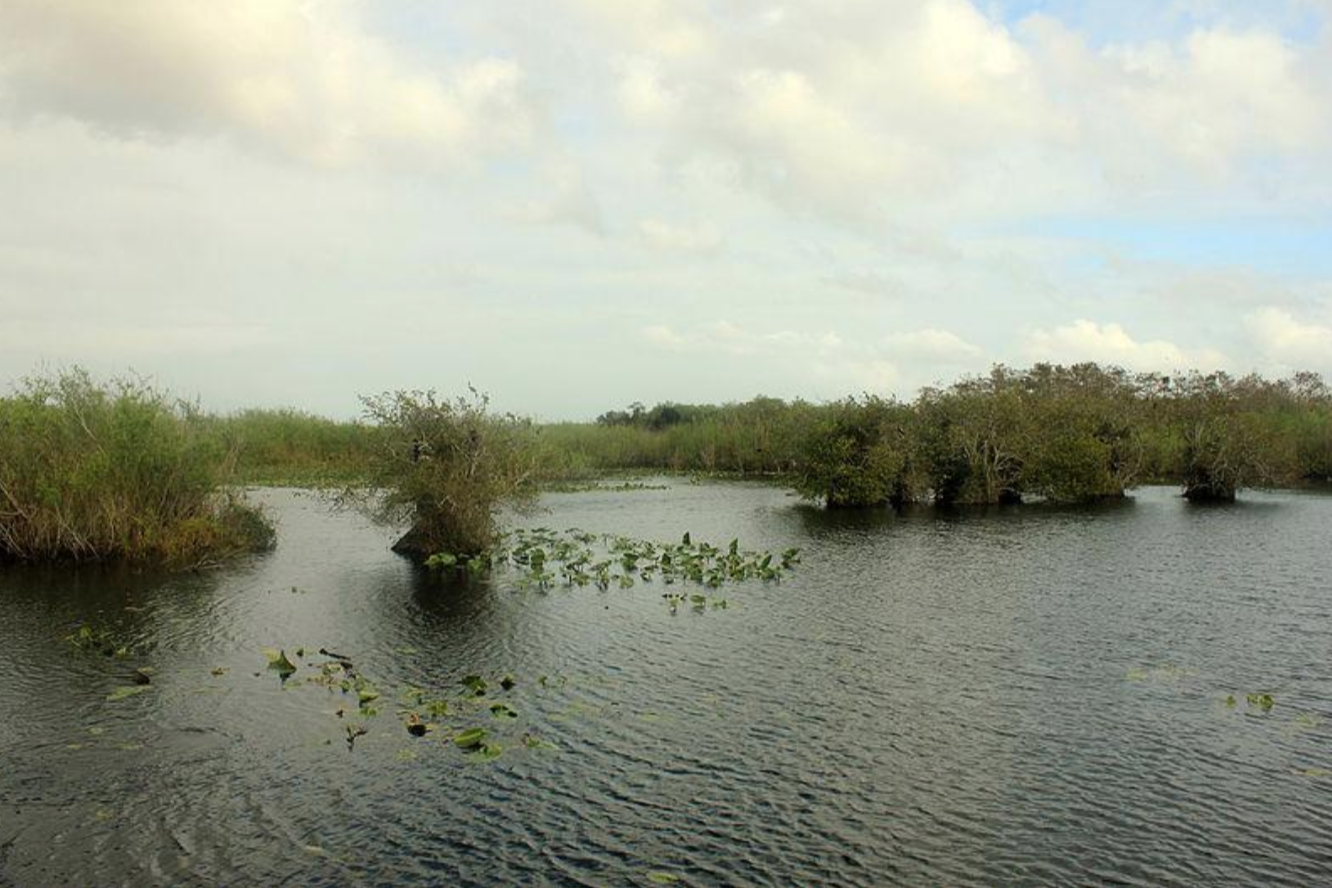
  3. Everglades – Everglades is a National Park dedicated to protecting swamplands. If you plan to visit the area, we recommend taking some time to trek through the terrain and discover the local attractions that distinguish this park. The green and clean atmosphere is a welcome break from the claustrophobic cities.
  4. Little Havana – If you’re looking some unique restaurant experience and some enjoyment with a cultural extravaganza thrown in, Little Havana would be your Cuban Heaven. Dotted with Cuban restaurants and specialized merchandise, this is the space where you can learn more about our neighbors and their lifestyles.
  5. Miami Zoo – Let’s face it. Having a group retreat without kids is a little bit cruel. The zoo is one of the places where you can bond with the kids in your group and have some fun time with your friends as well. There are play areas for the kids to play too if you want to talk shop here.

Check out other places too. Mix up your Miami adventure and keep the beach as a focus for the end of the day when you can just let your hair down and party.

3. Book ahead

So, you’re planning to visit the great outdoors and enjoy more things. To make your experience more seamless, plan ahead and book the tours from ahead. Most websites have booking options available for guides and other things. Also, remember to reserve the food table from ahead, since, a large group can cause problems.


How to Save Energy When Living in an Apartment

0

Mahallat Apartment, Iran, Aga Khan, recycled stone, natural materials, daylighting, natural ventilation, 2013 Architecture Awards, sustainable design, green design

Whether you’re moving into a new apartment in Berlin or California, or you’re just inspired to go green, there are many ways to save energy and money. Small, practical steps can help you cut your bills down substantially while also saving the environment. Want to get started?

Choose the most eco friendly city

If you live in a city like Toronto in Canada, for instance, you will need to rely on heavy heating for the winter and to make your humid house liveable in the summer near the lake, air conditioning. LA, for instance, you will save on heating costs in the winter, a huge plus, and if you find a home with passive cooling you can also save on cooling it in the summer. Looking? See apartments for rent in California.

Replace your Light Bulbs

Whenever you move into a new apartment, check the light fixtures for incandescent lights. Swap these out for more efficient, longer lasting LED lights. You can save up to 70% on electric costs and save more money because you’ll replace the bulbs far less frequently.

Air Dry your Clothes

When you live in a dry climate, air-drying your clothes is a simple, logical, money-saving step. You can make a few clothing lines in your yard or home, or you can hang your clothes on a drying rack. If you need to dry your clothes in the dryer, make sure that the lint collector has been cleaned to increase efficiency.

Start an Indoor Garden

If you live in a spacious modern apartment, you can dedicate an area or an entire room to healthy eating. You’ll save money at the grocery store, transportation energy, and more while also learning a great new skill. Scallions, radishes, spinach, tomatoes, and strawberries all grow great indoors with sufficient light and water.

Cut Down on Water Usage

To use less water in your toilet, you can either use a small brick or a plastic bottle filled with gravel. Place the object in the back of your toilet tank, and it will save its area worth of water with each flush.

A low-flow showerhead can also save money by decreasing the amount of water it expels with each shower. It saves energy and will pay for itself over time.

Finally, don’t forget to turn off the water when you’re brushing your teeth. That water use adds up when you brush your teeth twice daily, and you can save hundreds of gallons of water each year.

Turn Down your Thermostat

The amount of energy we use to heat our homes each year continues to rise. You can make a huge difference by dropping your heat down a few degrees—as much as 2% of your heating bill with each degree lowered. If you can bundle up with blankets and hoodies, you’ll be able to drop your thermostat even more.

Properly Insulate your Windows

If you have an apartment with outdated windows, you’ll find yourself up against a draft, but even the best windows tend to let in some cold air. You can easily insulate your windows using a convenient draft stopper. Alternatively, you can line your window with plastic wrap and use double-sided tape to hold it in place to keep out the heat or cold.

Tips for More Efficient Business Travel

0

PlanetSolar, world's largest solar-powered boat, Morocco, Rabat, clean tech, clean energy, renewable energy, 

While travelling for your job can appear extremely glamorous from an outsider’s point of view, the reality can be far from it. Experiencing new destinations, dining in fancy restaurants on the business and being paid to do it. Sounds like a good deal, doesn’t it? Except, it most cases, travelling for work can be stressful, tiring and consist of all work and very little play.

Early morning flights, a jam-packed schedule, minimal downtime and a list of work waiting on your desk for your return are all common when it comes to business travel. That being said, there are ways in which you can efficiently manage your work trips, so you aren’t left feeling burnt out and overworked.

Book your travel in advance

Booking your travel in advance has many benefits, not only will you be able to enjoy cheap flights (leaving you more company expenses to enjoy on your trip), it will relieve the stress and last-minute panic of trying to organise timings and avoid having to reschedule any meetings due to a full flight. It’s also worth pre-booking your transfer from the airport too, this will save you a lot of time and hassle once you land, giving you more time to get to the hotel and freshen up before heading to your first meeting.

Ace your packing

Are you guilty of over-packing when you head away? We often have a habit of taking unnecessary items ‘just in case’ and this needs to be avoided where possible. For efficient business travel, it’s best to condense your items down to hand-luggage size so that you don’t have to check any suitcases in.

This will save a great amount of time each side of your flight, and you won’t risk any lost baggage issues which could really throw a spanner in the works. Pack neutral colours, your favourite staple items, and roll don’t fold for extra room. Have your liquids pre-packed in a clear zip-lock bag for a smooth journey from check-in to boarding.

Download handy travel apps

In a world of a million apps, it’s hard to know which ones are worthy of precious storage on your smartphone. There are a select number of travel apps which are a must-have for efficient business travel and will help to ensure your trip is as smooth as possible.

Tripit is a great app which will allow you to take your organisation to the next level with daily itineraries, flight alerts and maps. Another useful app for if you’re heading to a country where you’re not familiar with the native language is TripLingo, which teaches you basic phrases and can greatly improve your trip.

Join a Frequent Flyer Programme

If business travel becomes a regular occurrence for you, then it’s well worth joining a frequent flyer programme to unlock a host of benefits. In exchange for your brand loyalty, you can benefit from a number of perks such as access to a comfortable business lounge, free upgrades and special offers. You’ll soon rack up the air miles, and perhaps you can enjoy free flights on your next holiday abroad.

5 Things You Need to Know About Mobile Security

0

Paris love locks
Whistleblowers or anyone critical of their governments and who live in regimes like China, Russia or Iran — if you can read this then you should be using a VPN.

According to Statista, the number of smartphone users in the world will pass the five billion mark this year. It’s not difficult to see why – both smart and connected, these pocket devices have become the epitome of accessibility and convenience. But because of this, they are also treasure troves of sensitive information.

Every device that is connected to the internet is vulnerable to cyberattacks, including smartphones. When it comes to malware infections, PC outnumbers mobile 40:1, but the number of affected phones has been growing at an alarming rate with a 27% increase in 2017. However, there are ways to protect your Android device and here’s five of them.

Third-Party Apps Are the Biggest Threat to Mobile Security

The majority of mobile cyberattacks happen due to third-party apps.

Third-party Android apps are the ones that are not in the official Google Play Store. They are not all malicious, of course. The problem is, with no one to oversee their distribution, there’s no surefire way of telling if an app is malicious.

A common cybercriminal trick is to copycat and pirate an app from the Google Play Store, infect it with hidden malware, and list it somewhere else for free download. This is how cybercriminals exploit the fact that Android is an open system that allows devices to run third-party apps.

Through this crack in the wall, intruders can record your location, monitor your activity, and steal sensitive information. They can do so unnoticed for days, which is why prevention is the best cure. Avoid using third-party apps at all cost and download apps only from the Google Play Store.

Dangerous Mobile Malware Can Stay Unnoticed for Weeks

Finally, you need to know that it is very difficult to spot infection on your smartphone. An unusual spike in data usage, short battery life, or sudden slow performance are the three most common telltale signs that your phone has been infected with malware.

Removing malware is not a problem. The problem is that a bug might remain rooted in your device for weeks without you realizing. While there, it may steal all kinds of sensitive information: your passwords, contacts, or business documents.

That’s why prevention is the only viable protection. Keep your Android smartphone safe and secure by following the tips mentioned above. Stay away from third-party apps, be wary of phishing attempts, try implementing a mobile American VPN in your daily browsing activities, keep your OS up-to-date, and make sure to check your device for malware from time to time. Changing your location can also help you get discounts on travel when booking a hotel, renting a car. In some cases, choosing a VPN in countries like Japan might even get you better rates.

Fraudulent Phishing Attacks Target Smartphone Users Too

Phishing is a type of cyberattack that targets gullible users with fraudulent links and dummy websites to steal their passwords. Intruders mainly use email, where they introduce themselves as reps working for a bank or any other company that has you as their client.

Falling for such scams leads to all types of consequences. For instance, a combination of third-party apps and phishing is used to trick victims into leaving their credentials in a fake app. Those apps are called mobile banking Trojans.

The best way to avoid phishing via email or SMS is to stay informed and vigilant. Don’t trust any strangers that email or text you, especially if they ask you to follow a link to a suspicious website. Also, only use the official app or a browser to access your mobile banking account.

Public WiFi Hotspots Make You Vulnerable to Intruders

Public WiFi networks are usually unencrypted. This means that virtually anyone can see all the data you send, even if they are not connected to the network. It’s extremely dangerous to share sensitive information while connected to public WiFi. But it’s also risky to even browse the web or use social media – it can lead to identity theft and other attacks.

There’s a lot of undetected snooping on public networks, so never use them for any online activity that involves your name and passwords. If you absolutely need to make yourself vulnerable, use a reliable mobile VPN.

Virtual private networks mask your IP address and encrypt your data. This allows you to use public WiFi on your smartphone and minimize the risk of being exposed to intruders.

Android Patches Are Known to Lag Behind Cybercriminals

Unlike iOS, which runs only on Apple devices, Android is used by many different smartphone brands. HTC, Huawei, LG, Samsung, and Xiaomi all use Android OS and rely on Google’s official patches and updates for security.

Unfortunately, it takes time for these Android patches to get to a Xiaomi device, for instance. In that time, the Xiaomi phone runs on an outdated OS that isn’t able to withstand new types of cyberattacks.

Android users can do two things about this. First is to opt for Google’s own devices, such as Pixel. The second is to buy smartphones from brands that release Android patches quickly. From quickest to slowest, they are LG, Motorola, HTC, Sony, Xiaomi, OnePlus, and Samsung.

Innovative new toolkit to fill gaps in missing shark and ray data

0

whale shark red sea, woman swimming with sharks

WWF and the Centre for Sustainable Tropical Fisheries & Aquaculture (CSTFA) at James Cook University have developed the first toolkit of its kind that provides a variety of ways to collect scientific data on sharks and rays to help conserve and manage these species, many of which are threatened.

GET THE TOOLKIT HERE

Sharks and rays are in a deepening crisis, with a quarter of all species threatened with extinction and many in significant decline, mostly due to overfishing. Exacerbating the situation is that nearly half of the species lack sufficient data to assess their conservation status.

The Rapid Assessment Toolkit for Sharks and Rays (the Toolkit) is aimed primarily at countries with insufficient species-specific data to allow science-based management. Such nations may have limited capacity and resources to gather data that could help them accurately determine the true states of their coastal environments, a situation common among marine-based communities. The Toolkit is designed to help remedy the dearth of basic information on movements, biodiversity and catch trends in many countries in Africa, Asia Pacific and Latin America.

“Having data is crucial for us to conserve and sustainably manage shark and ray populations,” said Dr. Andy Cornish, Leader of the WWF’s Sharks: Restoring the Balance initiative. “Without knowing what shark and ray species are in coastal waters, as well as how many are being caught and by whom, managers will not be able to take effective steps to reverse declines.”

Dr. Cornish noted that the deterioration of ocean health around the world has enormous implications for coastal communities in particular. “Sharks and rays perform a wide array of essential ecosystem functions, which means their conservation is even more urgent. The more we know about the status of shark and ray populations, the more we can focus conservation efforts where they are most needed,” he said.

The Toolkit consists of practical and simple step-by-step guidelines for collecting data by using six tools or methods contained in a 70-page manual. Appropriate tools can be selected depending on the knowledge gap of the particular waters where it may be used. They consist of how-to guidance in the areas of: taxonomy, genetics, creel and market surveys, baited remote underwater video systems (commonly known as BRUVS), tagging and tracking, and citizen science.

“The six tools are each broken into sections that explain why one would use a particular tool, what is the tool and detailed steps on how to use the tool,” said Dr. Cassandra Rigby, a CSTFA Research Fellow and chief author of the Toolkit. “Divers, for instance, can find useful ways to contribute information in the section on Citizen Science, or field operators can learn how to take a photo of a shark so it is useful for later accurate species identification.”

Increased Rain Gives the Golan Heights Sea of Galilee new life

0

Israel’s Sea of Galilee (Lake Kinneret) was still at critical water levels as recently as January, when a previous article depicted the then dire condition of the biblical lake. So critical in fact was the crisis that the lake’s water level had decreased so low that it nearly reached the dreaded “black line” of 214.7 meters below sea level  when the water becomes saline, due to underground salt springs.

The overall situation of the Kinneret has now improved significantly due to recent heavy rains which have also fallen on the Golan Heights, one of the Kinneret’s sources of fresh water. This situation prompted me to go on a day trip to the “Heights” and check out the situation there; especially the beautiful waterfalls of the Saar Stream, also known as Nahal Saar.

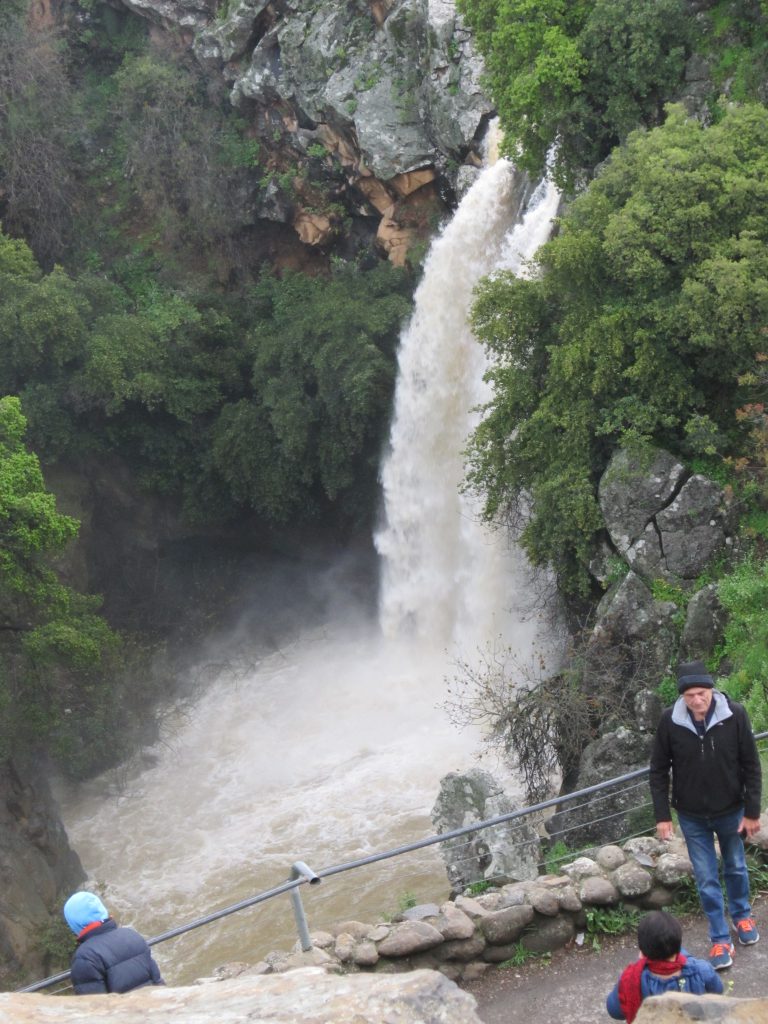
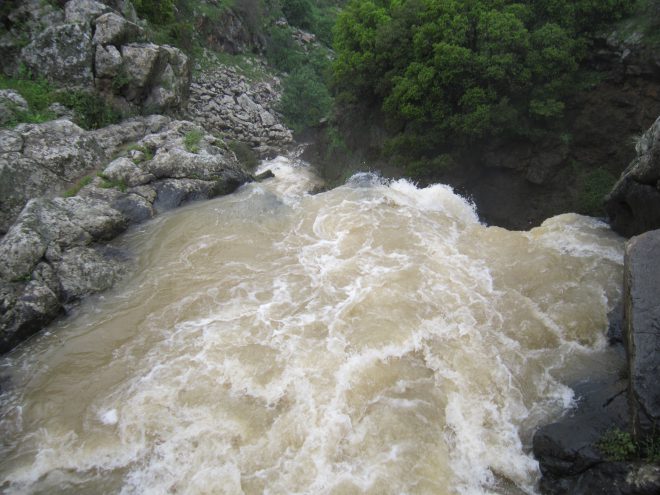
Starting out from central Israel on a rainy April 1, a virtual April fools joke in itself in drought plagued Israel, our group’s first nature stop was none other than Nahal Saar itself, to view the now swollen stream and truly spectacular water falls. As we approached the stream on foot, a near-deafening noise of rushing and falling water was emanating from it, as shown in a close-up view  of the top of the falls (photo).

The sheer power of the rushing water in this stream gives an indication of how much rainfall and snowfall has occurred on the Golan Heights and Mt. Hermon, a mountain range located on the northern section of the Golan . The cascading water in Nahal Saar flows eventually into the Jordan River and then into the Kinneret. The falls are located below the ruins of the Nimrod Fortress, built originally in 1229 by Al-Aziz Uthman, the younger son of the Muslim
Mamkuke conqueror Saladin.

Before reaching the Jordan, Nahal Saar flows through the historic site known as the Banias Nature Reserve, itself a natural wonder with smaller waterfalls and ruins of ancient settlements; including a site said to have been a place of worship to the Greek god Pan.

Mt. Hermon, the Golan Height’s highest mountain range, is a major source of water for the streams that eventually feed into area rivers, including the Jordan and Yarmuk rivers. This season’s precipitation have added considerably to the snow accumulation atop Mt. Hermon, from which the melting snowfalls feed into these streams.

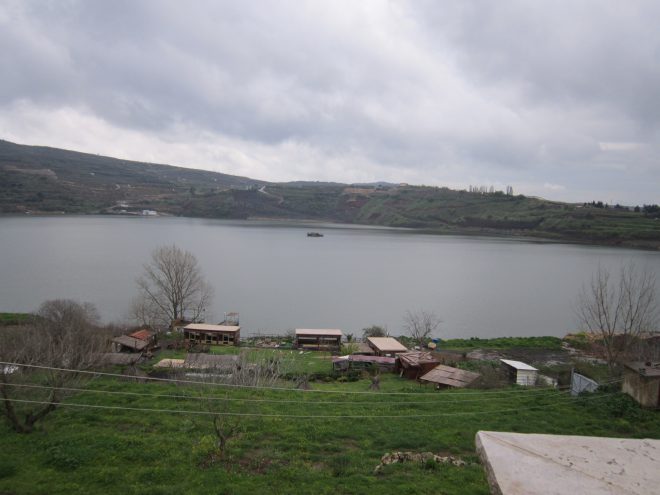
Our tour included a visit to a small lake called Birkat Al-Ram, called Bherkat Ram in Hebrew. The picturesque lake is actually the flooded cone of an extinct volcano. The lake has been in danger of drying up due to excessive pumping for agricultural use.

The tour ended with a visit to a site called Mizpah HaShalom or Peace Vista, which gives visitors a spectacular view of the entire Lake Kinneret below. Viewing the lake after this season’s above average rainfall indicated that while some parts of the shoreline are still exposed, the rising of the lake’s water level by nearly three meters has
greatly improved the Kinneret’s situation over what it was previously.

Currently, the lake is only supplying water to neighboring Jordan, as part of the 1994 peace agreement with Israel. “Israel’s fresh water now comes from mountain and coastal aquifers and desalination” our guide said. The current lake level of -211.8 meters below sea level is still about 3 meters short of being completely full and reaching the “upper red level” of -208.8 meters below sea level, when excessive water is sent into the lower Jordan River.

The lower Jordan, now not much more than a thin trickle of “unholy water” from sewage and saline runoff, can use a bit of  Kinneret lake water as well.

More about the Sea of Galilee and Jordan River:

Sea of Galilee still critical water levels despite winter rains

Water crises at Sea of Galilee. What would Jesus say?

Unholy waters: the Jordan River is Nearly Dead

Must-Visit Destinations in Central Europe

0

Set between the blue Baltic Sea and the alluring Alps is is one of Europe’s most populous regions. The cultural and political history of the region is one of the key reasons the countries in Central Europe are so close knit – not just geographically, but also culturally. So, if your private escorted tours of France are ending but you don’t want to say goodbye, this is a quick guide to help you choose the next stop of your journey.

Must-Visit Destinations in Central Europe

1. Austria

 Boasting its Baroque embellishments and imperial palaces is the capital of Austria – Vienna. Having cradled musical maestros like Mozart and Beethoven, a visit to this city promises to retune your monotonous weekdays by hitting the right note. With mountain villages overlooking perennial lakes lined by conifers, no one has ever taken a bad picture in Vienna. Don’t believe us? Ask the makers of the popular movie “Sound of Music” or try it yourself!

2. Switzerland

Wade through the waters of Lake Zurich or ski at the Zermatt Resort – Switzerland has something in store for everyone. The mountainous terrain keeps it windy for most part of the year, allowing mountaineers of all levels of experience to trek the peaks of the infamous Alps. If you run out of energy, there is always some Swiss chocolate! An alternate mode of transportation is the cable car running across the peaks which offers a bird’s eye view of the Alps.

3. Hungary

 Hungary shares its borders with seven different countries, thus providing the unique opportunity to experience the fusion of these cultures. Budapest, the capital of Hungary, is believed to be one of the most beautiful cities in Europe. The Hungarian Crown Jewels, the pride of the late Hungarian rulers, sit in the biggest building in Budapest – The Neo Gothic Parliament. Another popular spot to relax is the largest medicinal bath in Europe – Széchenyi thermal bath. With two thermal springs with temperatures in the range of 74 to 77°C, this is the perfect alternative to a warm shower.

4. Germany

Blending the European-Mediterranean mixed forests with the Northeast-Atlantic shelf marine, the geography of Germany is a reflection of its people. Strong sturdy castles stand tall amidst biospheres even today and to enhance their accessibility, you can choose one from the Top 21 Germany Tours based on your interest. The most common ones include the Castle Road, German Wine Road and Romantic Road.

They say “variety adds spice to life” and Central Europe is indeed a vibrant mix of people with a unique style. Under the influence of numerous empires, cultures, and backgrounds, the Central Europeans have evolved and continue to adapt with a warm and welcoming smile and a spirit of humanity. From historic architecture to public baths, you never know what you may come across on this trip to Central Europe. Don’t keep waiting for the right time, pack your bags now!

Tips for Using Your Voicemail System Without Being Intrusive

0

Dictaphone Group Beirut

As companies strive to integrate the benefits of technology while retaining personalized service for clients, one way to do this is by utilizing the best features of call center software. Here are a few tips for doing just that.

Utilizing IVR

When customers contact a company with a call center, they often start by dealing with an interactive voice response (IVR) system. An IVR is designed to help them navigate a number of options before they are connected with a staff person who can help them. Callers respond to prompts to help the system determine why they are calling and which agent can best help them.

In some cases, people may have very unique personal needs that don’t fit in a typical menu. To accommodate this, companies with call centers need to structure their IVR systems to ensure prompt assistance to all callers. For example, they should always have an option that allows the caller to be connected directly to an agent without the need to navigate the menu.

An example of where this may be necessary would be insurance companies. A person who was just in an accident may need assistance, but they may not be in the best state of mind to follow verbal prompts on an IVR. They may also feel uncomfortable interacting with an impersonal software system when faced with a personal crisis.

Ensuring that callers can connect with a live person as quickly as possible when necessary is a simple way to retain a personalized touch and assist those callers meaningfully.

Call back options

Sometimes, a customer calls a company, but no call center agent is available to help them immediately. Customers may be given different options, such as staying on the line and waiting or being called back.

When callers choose the “call back” option, the voicemail can help personalize service by allowing the person to record their name and even the reason for their call. This can help the business determine who is best suited to address the caller’s needs. When they call back, they can also address the customer by name and have a head start on identifying their problem and any relevant information that may help them resolve the caller’s needs.

Customers can also be given the option of leaving their name without the reason for their call. This ensures that they do not feel like they have to divulge sensitive or personal information if they choose not to. Many people do not wish to provide personal details, particularly if they are recording a message, so they should have the option of skipping this step if they prefer. This enables them to receive service without feeling like the IVR has been intrusive.

Communication options

One way that businesses have improved customer service is by providing omnichannel communications options to their customers. This means that companies empower customers to choose between a number of methods to address their issues, including chat and text.

When a call center agent isn’t available to take a person’s call in a timely manner, the caller may be given the option of requesting a call back. But the voicemail system can also be designed to provide them with other useful information. Instead of expecting a caller to leave personal information on a recording, they can hear options presented and elect a different communication method.

This could mean engaging in a chat with an agent. For example, a person who’s at a noisy accident scene and unable to withdraw to a quiet place for a phone conversation may learn that they can communicate by email or text instead.

Whenever clients are given options and empowered to make their own choices, they are more likely to feel that the company is striving to meet their needs. Customers are less likely to feel that the company’s systems are invasive or impersonal, because the customer retains control by choosing from multiple options.

When companies try to tailor their services to meet the personal needs and preferences of their customers, they are more likely to establish customer loyalty and increase customer satisfaction.

Reasons For Sudden Rise In CBD Appreciation

0

If you are like most people there was probably a time when you didn’t know what CBD meant. You probably also didn’t even know what the term stood for or what it was used for. Most people still don’t understand that CBD comes from both the hemp and marijuana plants. Whatever the situation is, there is a good chance that you know a lot more about CBD now. Even though there is no scientific or medical evidence backing the claims made by many CBD manufacturers it seems that that substance is all the rage. Not only are there a number of topical products available, but there are also tinctures available. So, why all the rage?

It Offers Multi Uses

One of the reasons that CBD is so popular is because it can be consumed in a number of ways. The most traditional method of consuming marijuana is smoking. Sure, marijuana can be infused with edibles, but most people tend to smoke it. That is not entirely the case with CBD. You will find a wide range of CBD products available on the market. Not only are there tinctures and topical products, but there are also edibles, shampoos, bath bombs, dog treats, and ointments. CBD can also be smoked, but the different methods of consumption provide non-smokers with a whole new level of delivery systems.

Cannabis For Non-Stoners

CBD is growing in popularity because it is a substance that is like cannabis for non-stoners. What does this mean? Well, CBD products are extracted from the hemp plant. The hemp plant only contains minute amounts of THC, which is the active ingredient in marijuana that gets your high. In fact, in order for CBD products to be legally manufactured and sold they must contain 0.3 percent THC or less. This is such a small amount that you won’t even get high, but you will be able to reap all the medical and soothing benefits. There is even a white label CBD provider that produces products that contain zero THC.

Less Hassle And Cheaper

Medical marijuana has been growing in popularity due to all the benefits that it can provide one with. However, in order to get a medical marijuana license, you have to go through a long, drawn-out process. In addition to this, it can be quite expensive if you don’t have insurance. Heck, it is still somewhat expensive if you do have insurance. This is where CBD can counter that. Not only can you walk into a CVS and purchase the substance without a prescription, but you can do so at fairly affordable prices.

Little To No Side Effects

Probably one of the best things about CBD and CBD products is that consumption comes along with little to no side effects. It is not an addictive substance and some of the most severe reports of side effects only include mild nausea or upset stomachs. When you weigh this potential side effects against the benefits of the substance there really is no comparison. And, if the substance is taken as prescribed there is a good chance there won’t be any negative effects at all.

Time to eat trees? Change the planet with Agroforestry

0

forest bathing, woman hipster contemplating nature in dark green forest

The global community faces unprecedented challenges due to climate change and unsustainable farming and land use practices. Land degradation, social disruption, inequality, depletion of natural capital . . . these are just some of the issues that need to be addressed, now. Agroforestry, the practice of trees on farms, offers one of the most effective methods for addressing these interrelated challenges. But to make it effective, there needs to be a strong connection between the science of agroforestry and how it is incorporated into public policy to effect positive social and environmental gains.

The 4th World Agroforestry Congress will bring together more than 1,200 agroforesters, researchers, decision-makers, students, business leaders, NGOs and farmers from more than 100 countries to discuss, debate, and share best practices in an effort to bridge the science-policy gap.

The Congress, under Mr Emmanuel Macron, President of the French Republic, will be held from 20 to 22 May 2019. And for the first time, it will be hosted in Europe, in Montpellier, one of France’s oldest cities and home to the country’s first formal research into agroforestry. The event is organized by CIRAD and INRA, in partnership with World Agroforestry (ICRAF), Agropolis International and Montpellier University of Excellence.

Launching the Congress will be Sustainable Agriculture, a Food Issue: Trees on our Plates, an exploration of the ways agroforestry practices can, and do, positively influence agricultural practices and as a result the food we eat. The day-long event, to be held Sunday 19 May, is open to the public and will feature discussions, exhibitions, entertainment, a products corner and more. It is made possible by the Fondation de France and the French Association of Agroforestry.

“We wanted, through this public day ahead of the Congress, to raise awareness of agroforestry with civil society”, said Emmanuel Torquebiau, Agroforestry Correspondent at CIRAD and Chair of the Organizing Committee of the Congress.

Grounding the Congress’ goals is the need for a substantial societal debate around agriculture and its role in land and climate decay. By strengthening links between science, society and policy, the Congress offers a timely opportunity to evaluate agroforestry’s vital contribution to the agroecological transition of world agriculture.

“It is time for technical solutions to be discussed within civil society and that they become part of public policy”, said Christian Dupraz, INRA Research Director and Chair of the Congress Scientific Committee.

Monday, 20 May will serve as the official launch of the International Union of Agroforestry (IUAF), the first global association devoted to furthering the work of agroforestry.

On May 23, participants will be able to visit the oldest European experimental agroforestry site at Domaine de Restinclières in Prades-le-Lez (11 km north of Montpellier). Here, cereals (such as durum wheat and barley rotated with protein peas) are grown, with many species of trees, especially walnuts. In more stony soils, vineyards are grown with pines and cormiers. This agricultural domain of 50 ha belongs to the departmental council of Hérault and is scientifically piloted by the INRA center of Montpellier.

Conceptualised in the 1970s by international think-tanks seeking solutions to the problem of tropical deforestation, agroforestry is now recognized as a vital practice for protecting soil, responding to climate change issues and contributing to global food security. Its applications are quite diverse and include: hedges and alignment of trees or shrubs in and around plots; multilayer agriculture; production of timber or fruit in cropland; fodder trees; trees for honey; shade trees for perennial crops (coffee, cocoa, vine) or livestock; multistoried agroforests; and agroforestry gardens. Today, agroforestry has become a subject of international research and is part of the agronomic education curriculum of higher education institutions around the world.

In keeping with its green mission, the Congress has enacted several initiatives including voluntary climate compensation for participant’s trips the funds from which will be devoted to agroforestry research and development projects related to soil protection, and a concerted effort to limit the ecological footprint.

NASDAQ seed gene company Evogene jumps into cannabis

0

Evogene to Develop Next Generation Medical Cannabis Products through New Subsidiary – Canonic Ltd

Evogene Ltd. dual-listed on the NASDAQ and the Tel Aviv Stock Exchange (NASDAQ, TASE: EVGN), a leading biotechnology company developing novel products for life science markets, announced last week that it has established  a new subsidiary – Canonic Ltd – to develop next generation medical cannabis products.Evogene has been evaluating the medical cannabis field for more than a year, including market evaluation, obtaining governmental approvals for its research program and the establishment of a research facility, technology assessment and initial product line planning.

Canonic’s initial activities will focus on creating improved cannabis varieties by addressing the current developmental roadblocks of yield, stability and specific metabolite composition. These development efforts will be based on the utilization of Evogene’s broadly applicable leading Computational Predictive Biology (CPB) platform, which has in the past demonstrated success in addressing similar objectives for other crops.

The current cannabis market is estimated at ~$13 billion and is expected to grow to ~$24 billion by 2025. Although the cannabis market is growing rapidly, it is well recognized that next generation products will need to address the current limitations of: (i) low metabolite yield – causing high costs for patients, (ii) low variety stability – causing inconsistent products that have become unreliable as a medical treatment and (iii) uncertainty in connecting cannabis metabolite profile to specific medical indications.

Evogene is uniquely positioned to provide a significant competitive advantage in the resolution of these development roadblocks through its CPB platform and its recognized capabilities as a leader in the area of plant genomics. These capabilities have been developed and utilized for more than a decade through multiple collaborations with world leading ag-companies such as BASF, Bayer, Corteva, ICL and Monsanto focusing on crop improvement via plant genomics and are now expected to allow Evogene’s newly established subsidiary, Canonic, to not only meet the challenges but also to accelerate the product development process through its predictive science driven approach.

Canonic’s current workplan focuses on three main product types, through a non-GMO approach: (i) high metabolite yield cannabis varieties (ii) stable varieties with consistent metabolite performance and (iii) cannabis varieties with a unique metabolite profile tailored to specific medical indications. The indications that the company will currently address are: post-traumatic stress disorder (PTSD), severe chronic pain and cancer.

Dr. Arnon Heyman, Canonic CEO stated: “Having led Evogene’s Ag-Seeds division for the past few years, I am proud to now lead Evogene’s cannabis activity as Canonic’s CEO. Evogene’s cutting edge genomic technology, alongside our multidisciplinary team of professionals, uniquely positions Canonic to bring to market the most advanced, stable and consistent next-generation medical cannabis products, and I am confident we can make a significant impact in the world of medical grade cannabis.”

Ofer Haviv, Evogene President and CEO: “The field of medical cannabis fits perfectly within both our plant genomics activities and our human therapeutics activities. We have been evaluating this field and our relevant competitive advantages for over a year, and now, with the establishment of Canonic, we expect the new company to advance rapidly in executing its mission of developing next generation medical cannabis products and to create substantial value in a relatively short time.

“This expectation is based largely on Evogene’s capabilities in plant genomics and computational know-how that will allow Canonic to uniquely address the major challenges in this large and rapidly growing field. We look forward to updating you with respect to Canonic’s progress.”

As Evogene has previously reported, in order to take full advantage of its broadly applicable CPB platform, Evogene focuses – either as an Evogene division or a subsidiary – on a number of significant life science based markets in which its technology can serve as the key differentiator in the development of next generation products. As with each of Evogene’s market focused subsidiaries, Canonic, as a wholly owned Evogene subsidiary, will have full corporate capabilities while continuing to have access to Evogene’s CPB platform for its market area of medical cannabis.  In addition, Canonic will have the right to pursue its own business strategy and secure additional financial resources at appropriate times in the future.

The global seed market is valued at $37B , as of 2016, of which 53% is attributed to available biotech seeds, seeds which have been improved by gene transformation, in crops such as corn, soy and cotton. Currently available biotech seed traits capture approximately $8B and it is expected that as additional traits become available, the market may reach $14B, thus attempting to provide a solution to improve traits such as yield, abiotic stress, disease resistance, insect control and herbicide tolerance.

As global seed companies constantly aim to reach beyond current limitations to address the world’s growing need for feed, food and fuel, Evogene forges collaborations with these global companies to discover genes and genomic elements to develop improved seed traits.

The key traits Evogene targets are:

  • Improved yield
  • Resistance to abiotic/environmental stress (e.g. drought…)
  • Nutrient uptake (N2)
  • Insect control
  • Disease resistance