Hey Elon – can you solve the problem of mining for lithium needed to run Teslas?
Electric cars are becoming more popular every day, with one of the most important reasons being that they’re better for the environment. They produce zero emissions, which means they don’t contribute to air pollution. This is a huge benefit, especially in cities where air quality is a significant issue. This blog post will discuss electric cars’ other benefits and why they are a better choice for you.
Lower Emissions
Electric cars are powered by electricity, which can be generated from various sources, including solar, wind, nuclear, and hydropower. This means that electric cars have the potential to produce zero emissions. In contrast, petrol and diesel cars emit harmful pollutants such as carbon dioxide and nitrogen oxides. These pollutants contribute to climate change and can cause respiratory problems. Electric cars also have the potential to be cheaper to operate than petrol or diesel cars.
Less Maintenance
While it is true that electric cars can require a higher initial investment, they save money in the long run due to lower maintenance costs. Electric cars have far fewer moving parts than gas cars, which means there are fewer opportunities for something to go wrong. In addition, electric cars don’t require tune-ups or oil changes, and the brakes last longer because electric motors generate braking power more efficiently than gas engines. As a result, electric car owners enjoy significant savings on maintenance and repairs.
Lower Insurance
Regarding car insurance, electric vehicles have a clear advantage over their gasoline-powered counterparts. For one, electric cars are much less likely to be involved in an accident. This is due to several factors, including their quiet operation and the fact that they can be equipped with advanced safety features such as automatic emergency braking. As a result, auto insurance quotes for electric cars are often significantly lower than for traditional cars.
Instant Torque
In an electric car, the motor is connected directly to the wheels, so there is no need for a gearbox. When you hit the accelerator, the car will respond immediately. A petrol or diesel car, where the engine needs to spin up to high revs before it can start moving the wheels. The gearing in a petrol or diesel car also means that there is always some engine braking, even when you are not touching the brakes. In an electric car, however, the motor acts as a generator when you lift off the throttle, which helps to slow the car down. The lack of gear shifting also makes for a much smoother ride.
Better Resale Value
Because they are still relatively new technology, electric cars tend to hold their value better than traditional cars. This is especially true of luxury electric cars, which can fetch a high price on the used market. This makes electric cars a smart choice for anyone looking to get the most out of their investment.
Electric cars are an excellent choice for a more efficient, environmentally-friendly, and economical vehicle. While they may require a higher initial investment, they offer significant savings in the long run. Electric cars are also much safer and easier to maintain than traditional cars. If you’re in the market for a new car, an electric car should be on your list.
Do you have an ancient, vintage boiler you can’t part with? Maybe it’s time to buy a new boiler?
Your boiler is the heart of your home. It’s responsible for everything, from heating your home in winter to running your hot water after a long day. A boiler failure can cause disruption and inconvenience in your day.
It is important to choose the right product and an experienced installer in order to get a reliable boiler.
The complexity of the job can affect the time it takes to install a boiler. Most simple swaps between like-for-like boilers can be completed in a matter of hours. Your requirements will determine the length and process of installation.
After your installer is done, you can start using your heating and hot water as you need them.
Annual boiler service is necessary to preserve the guarantee. An annual boiler service is required to maintain the guarantee. It involves a check of the boiler’s performance, safety, and installation. To schedule a service, we recommend that you contact the boiler installer to make arrangements. This can be done in the summer to avoid being caught cold during winter.
What about if you are moving home?
When you move house, the boiler should be one of your last thoughts.
However, replacing your boiler could increase the value of your home by up to £8,000. If you move into a house that has a new boiler, your heating bills will be very low.
This guide will help you remember all about heating, boilers, and energy when you are ready to move.
Before you buy, make sure to inspect the boiler
You’ll want to move into a house with a brand new boiler. Anything installed less than four years ago is an advantage.
You don’t want to have the boiler replaced as the first job in the new house.
Ask when the boiler was installed. These questions can be followed up on while you are talking about the boiler:
Who installed it?
What type boiler do you have?
When was the last time it was serviced? Get certificates to prove each service.
Is it still covered by warranty
Are you Gas Safe certified?
These questions will reveal how efficient and reliable your boiler is. You’ll also find the time you will need to replace.
To ensure that you don’t forget the date of the next boiler servicing, it is a good idea to write it down.
The vendor should be able provide you with a certificate indicating compliance to building regulations. This certificate was issued by the Gas Safe Register (OFTEC) at the time the boiler was installed. This will allow you to verify that the boiler was installed safely and in compliance with regulations.
You should make sure that you are covered
Another important consideration is to ensure that your boiler and central heating are properly covered.
For specific instructions, check with the company that offers your current coverage. It is a smart idea to purchase boiler insurance if you’re moving to a home you own. It will provide support in the event of a boiler breaking down or causing problems
Can my boiler be moved to my new home?
This could theoretically be possible. However, it is not the best idea.
It’s better to make sure the house you are moving into has an updated condensing boiler. It is important that your property has an efficient and reliable heating system. A new boiler can help increase the property’s value.
What can a new boiler do for your house?
A new condensing boiler can add up to £8,000 to your home’s value.
Potential buyers will be attracted to a new boiler. Potential buyers won’t need to replace their boiler for many years. A more efficient boiler will also mean lower heating bills.
It’s definitely worth it. It’s especially attractive when you consider that you would only need to pay between £1,000-£3,500 to replace a boiler.
Can I sell my house because my boiler is in danger?
Boilers that have been condemned can pose a danger to your health. If you live with a condemned boiler, replace it.
Even if your boiler is condemned, you can still sell your home. However, this could reduce the property’s value by a significant amount. You must inform the buyer that it is illegal to do so.
A cross between a sci-fi post-apocalyptic city and a Moshe Safdie rendition of Expo 67, the Line becomes Saudi Arabia’s crown prince Mohammed bin Salman’s vision to modernize Saudi Arabia.
The Line is a 150-mile long belt of futuristic “living” in the middle of the desert, jutting out into the Red Sea. The new city will be part of the Saudi ruler’s vision for a modern Saudi Arabia in order to subvert decades of the nation’s intolerance for western society and its repression of women.
Of course bin Salman, on the board of directors for The Line didn’t design it, but has pledged billions of oil money for a non-local architecture firm to “dream” up the future. It’s the pattern in the Middle East where “starchitect” firms are happy to take on indulgent projects even foregoing eco or low-carbon policies.
And of course if you are making endless millions off of Saudi Arabia’s oil money, you will never disappoint, especially when it comes to marketing terms you can also throw to techs doing the Photoshop graphics: Net gravity! Net zero! Carless! but without any consideration of local wildlife, the Huwaitat indigenous tribespeople already living there, local building materials, 115 degree summers and a pristine marine environment of the Red Sea, already at risk.
Want to see some more excess? How about the Four Seasons Riyadh and its hotel built on stilts?
Whenever I see a new idea released from Saudi Arabia, it’s like the hired architecture firm in England (often Fosters + Partners) is playing a joke on the Saudis to see how bombastic they can build the next dream. Does no one in England’s architecture world have common sense any more? Activists are already set to re-wild England, Scotland and Ireland after several millennia of England clearcutting forests – at home and elsewhere. It’s the same colonising spirit breaking ground and ruining the environment today in pristine ecosystems of Saudi Arabia: The Line! Neom! Four Seasons!
Location for proposed Neom City, on the Red Sea.
As for the press materials released, the architect firm is not mentioned.
What’s on The Line?
So what’s The Line? Back in 2021 Saudi Arabia announced its plan for The Line, a car-less belt of built habitat. To be built in the Tabuk Province in northwestern Saudi Arabia, this proposed “smart city” will be a little over 200 yards wide and at some parts 550 yards above sea level.
“I never seen something more dystopian,” one commenter wrote in reply to a video of The Line posted by the Saudi Press Agency.
You can read our past coverage of Neom starting here: it’s another new planned megacity hosting visions of grandiose cities and towns for work and play in Saudi Arabia. Take into consideration that local Saudis don’t work or play like Westerners so these cities are being built for …
us. These dystopian cities are being built for westerners.
So far any attempts to encourage Middle East locals to live in such modern “net-zero” developments have failed –– see our coverage of Masdar in the United Arab Emirates –– and the foreigners that stay at such residences are banned from speaking publicly about the experience.
The Middle East can build ideas that might mention the future and look like the future, but in practice foreigners are usually only living in the Gulf’s golden cage because they are lured with wealth and large homes, cars and status.
Saudi Arabia’s Mohammed bin Salman proudly boasts that he’s “committed to a civilizational revolution that puts humans first based on a radical change in urban planning. The designs revealed today for the city’s vertically layered communities will challenge the traditional flat, horizontal cities and create a model for nature preservation and enhanced human livability. The Line will tackle the challenges facing humanity in urban life today and will shine a light on alternative ways to live,” he said.
So how did great ideas like The High Line in New York City get so muddled into the nightmare of The Line of Saudi Arabia? Set to accommodate 9 million people, and about 30 square miles in size, The Line (says it marketing material) will promise to run on renewable energy, with amenities within a 5-minute walk, or end to end transport to visit your friends at the other end of the line within 20 minutes. It will “prioritize people’s health and well-being over transportation and infrastructure.”
A vertical city called Zero Gravity
In 1967 Israeli architect Moshe Safdie created Habitat ‘67 as a model for modest city. It housed participants of the Olympics that year and it’s returned to citygoers. It remains a historic site in the city near the water and people live in it today. The cubed structure with each block the same but somewhat different, offers a concept for modular living in the city, but it’s in human scale with nature outside every window, privacy a priority.
The Line however has taken that idea and crossed it with the Borg’s Cube (from Star Trek) and thrown in some renderings of cities after an apocalypse, and calls it Zero Gravity Urbanism.
The Line’s public parks and pedestrian areas, schools, homes and places for work, they say, are layered vertically, allowing citizens to move effortlessly and reach all daily needs within five minutes. The city’s exterior will be one giant mirror facade (something Saudi Arabia has done well in this mirror museum Maraya in the desert) to allow The Line to “blend” with nature for “magical moments”.
Environmental artist Pablo Solomon, from Texas, comments: “While the billionaires can do what they choose to do with their money [the solution is]: planting trees, conserving water, developing ways to clean emissions from reliable fossil fuels, desalinating water, developing hydroelectric and small nuclear reactors, finding ways to effectively/efficiently store electricity, etc.
“I have to give the Saudis an A for creativity—but a D for practicality. However, it will be fun to watch the sand pile up on either side of their 21st Century Hadrian’s wall,” Solomon adds.
Touted as a smart city that will be digitized and cost hundreds of billions to build, there is no mention of the real future, the future of a decentralized city where people own access to their own data and financial freedom. A future will people will be able to have a small plot of land, grow their own food, barter, and live with prosperity of their own making. The Line will just make you a soldier for capitalists.
Is it more ecological to buy sustainably harvested bamboo that lasts 3 years outside or vintage plastic lawn chairs that were used by someone’s grandma? Sometimes the one that lasts longer is the best solution. Think hard before you invest in patio furniture.
Your outdoor furniture needs protection just like indoor furniture. Usually when we buy furniture, we expect it to last long enough. Most of us want to invest in such a type of material that is durable and comes with the guarantee to last long. Plus the longer it lasts, the less you need to replace it, which means it’s more sustainable if it can last as long as you or longer. We also need to take care of our outdoor patio so that it remains protected come rain or shine.
Let us see some best tips to follow for protecting our furniture:
Use covers:
It is very important to cover the furniture when we are not using it. Some people have a storage room where they keep the patio when it is no longer in use. However, if you don’t have a storage room or you find it a strain to pull it back to storage every time you finish using it, you can buy covers. As a matter of fact, outdoor furniture adds beauty to your living space. Therefore, covers should be used to protect the beauty of the patio also and find some marvellous black outdoor chairs to place in your yard.
Keep it under the shade:
Sometimes, covering the patio is not enough and you want to do more about protecting it. In this case, you can keep it under the shade. While the cover protects the furniture from dirt, keeping it under the shade will keep it safe from rain, scorching sun, snowfall and every other extreme weather condition. Considering the sudden changes in the weather, some people install benches in the shade.
Apply furniture protector:
There is a furniture protector designed for patios of different types to protect them in case they are exposed to extreme weather conditions. For instance, you can keep your patio from rust if you apply a furniture protector on it. In the same way, the patio protector for the wooden furniture protects it against the harmful sun radiation in the hot weather.
Make some place for storage:
There is a period in every year when you cannot sit outdoors and enjoy the weather because the weather is either too hot or too cold. In that time, you should provide a room to your patio where it can be placed safely. Off season storage keeps the patio protected against the harmful weather conditions and you can keep it there as long as you want it. For this purpose, you will need to dedicate a small space to your patio storage where you can store it for the off season period.
Conclusion:
Outdoor furniture is also very expensive and you cannot afford to lose in a few months or years. You will need to take care of it to make it stay with you for a longer period of time. Keep its original color and sparkle in place by taking necessary measures to protect it from everything that has a potential to damage it.
Thailand is a great place to travel for comfort. There are glorious mangoes –– just picked and still holding warmth from the sun: they fall right into your hands or onto a plate of sticky rice. You will find that eating a great pad thai or going for a massage is as easy as breathing or going for a walk.
How can I describe Thailand quickly? Like your body is falling into the womb of nature –– it’s just a blessed place.
Traveling to Chiang Mai with the Family
It’s easy to travel to Thailand for comfort whether you are single or with a family. I have never met an easier place for that and have been there 5 times before my most recent trip. Thailand was there for me when I was freshly in love. It was there after a breakup. Thailand was there for me when I was pregnant with my first and it is where my second just started growing in my womb. We’d take them back there to play in the sand and jungle as infants and toddlers. We’d release turtles in their name. Send out lanterns to the sea with their hopes and dreams and blessings.
This spring after an isolating Covid period and with the kids at the perfect age for adventure traveling, we decided to take them away for family time and really invest in our experiences. This time we were going to go outside our comfort zone – we’d go outside the Thailand we knew: beaches, floating markets, temples, and beaches of Samui and Phuket. This time we would rely on my husband’s old memories from the early 90s to take us back to the mountains in the north.
Meeting the Akha People
Over the years my husband recalled traveling and meeting the Akha people three decades before. This was a trip to a paradise where you entered by elephant and came out leaving nothing behind. There was opium smoking, loads of smiles, and an innocence of mankind he experienced then.
He remembers it like a dream. And as an ecological ideal: Every scrap of paper, plastic – every bit – was saved and repurposed into something else.
We should go back, he says, but how?
I found Frans online, a fellow from Holland who is running an adventure tour company called Green Trails. He’d fallen in love with Thailand around the same time as my husband’s first trip. It was when Thailand was just opening to the world and the visitors couldn’t believe the bounty they’d discovered. Frans was easy to access and answered my query quickly: could you help us meet the Akha people?
Frans told me his company was providing accessible nature-based trips to Chiang Rai and Chiang Mai areas, along with itineraries that enable an extraordinary adventure in a short time. We could meet tribes people, even stay with them, but still have moments of comfort between the simple settings by staying in hotels during our stay. We had 6 days to spend in the north before our connecting flight back home. Frans jumped to help us plan a trip of a lifetime.
Authentic Family Experiences in Nature
Frans came back to us with a trip that would let us meet the various Hill Tribe people in a way that would be pleasant for everyone in our family, a girl 11, and boy 9 and two adults, one who can agree to hiking but who doesn’t love it much. Some people on the internet complain that these days visiting Hill Tribe people can feel exploitative like you are visiting a zoo. This is not at all what we encountered on our trip.
Frans arranged that we’d have an English speaking guide, Rung, who was from the region and who could communicate with the Hill Tribe people. Years’ long friendships and cooperation with Frans made our arrival welcoming without any suspicion. Thai people were still wearing masks at this time and many villages were no longer interested in meeting tourists, out of fear. But Frans knew who he could approach.
What to do along the way
We flew into Chiang Mai from Phuket and early the next day met Rung and Joe, our guide and driver. While driving to the areas of Chiang Rai and the hill tribe people we would have adventures along the way –– visiting avant garde museums, white water rafting, longboat sailing down rivers, visiting local markets and temples that are an art exhibit or spiritual exercise –– choose your own adventure. But it was planned and perfected by Frans, who over the years has learned what adventurous tourists would like to see. We were even able to add on adventures and make time for them if we saw something along the way that caught our eye.
But the blueprint of the trip was solid. Frans built us a trip that helped us experience the wild nature in Thailand that you would only find if you had a few months and a backpack. You could tell that the hill tribes he works with are coming from a long and trusting relationship that goes back decades, not years. For that, we were welcomed to these tiny villages even while the rest of Thailand was in semi lockdown wearing masks and keeping a safe distance.
Stocking up at a local market in Northern Thailand before we head to the Hill Tribes
Meeting the Palong People
The first encounter with the Palong tribe near Chiang Dao was meeting our guide and with him holding a machete we hiked from one Palong village Lahu to Pang How. We walked a few hours along trails he had carved out the day before, while he picked native plants showing us what they are and how they can be used in cooking. We got inside the jungle, his land, where agriculture and eco-tourism are the mainstays.
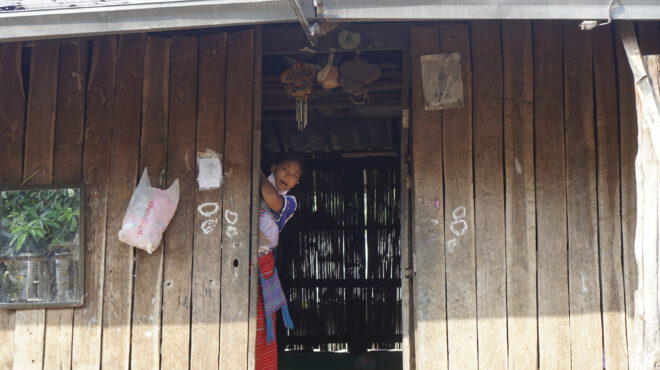
After pointing out plants such as wild rattan and ginger and making us walking sticks from bamboo, we entered the village. His family and extended tribe offered us shy hellos and greetings and after time my kids and their kids started to mingle, my daughter making a friend with a girl her age.
They picked papayas, fed the pigs and got accustomed to village life which is basic but comfortable. Outdoor toilets and sleeping in small bamboo huts is the accommodation. The floor is made from dirt, but it’s packed tight like it would be in a clay house.
Some of the women taught us about the old ways of husking rice, and we were given a loom-weaving lesson –– my biggest take home is that they worked hard, sometimes days, to string together a meter of fabric that they assemble by hand.
Dinner was cooked by our host and our guide, and it was absolutely delicious and over-the-top. Our host and Rung worked for a couple of hours making sure it was perfect and exactly to our specifications: no seafood, meat or gluten. That’s a tall order in Thailand but our hosts arranged it with care.
At night the village girls of the village put on a show and my husband and our host took turns on a handmade instrument that kind of looked like a 3-string guitar. My family sang, we danced some and laughed our faces off at how the simplest, unusual encounters can make your soul expand wide. This is why we wanted to come here, It was for this. I was thanking Frans in my heart.
The Palong tribe, we learn, has its own colorful background. Not long ago they moved from Myanmar to Thailand and are distinguished by their rattan hoops and silver belt worn around the waist. The costume is a reminder of a bird, a mystical creature from which the Palong people are believed to be derived.
Meeting with the Akha People
An early morning with the dogs barking and roosters about, then we break-fasted and hiked around the village where Rung taught us about the village heart, the huja rawl. Up into the hills we visited the gardens of Sukhum, where fruits like mangoes grow. We trekked through to a Lahu village and then a Karen village –– and then started our drive to Thaton. We overnighted in a hotel and woke the next day to meet the Akha Tribe.
Along the way and cooling down in a cave temple – think ancient mystical cave where people seek immortality in Jitterbug Perfume? – we took a boat ride to a Lahu tribe village called Phatai.
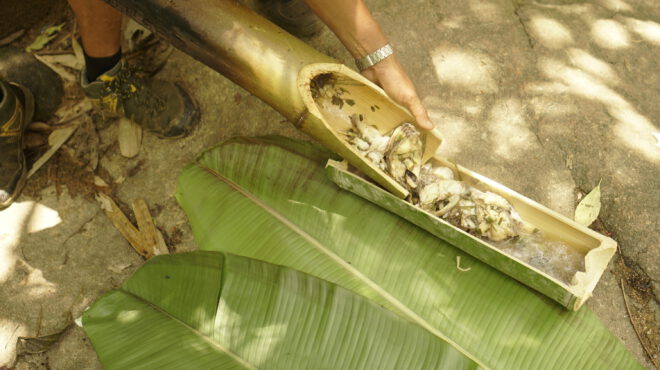
We then continued to Chiang Rai and then to the Huay Mae Sai Waterfall where we met our local Akha guide from the village Ban Apha. When we arrived our guide Armue prepared our lunch, “jungle style” in a bamboo rod steamer he’d shucked from the forest. It felt like a Michelin Star experience. We dug in. High from the food and the waterfalls (only) we would learn that there is no more opium cultivation in the hills. That the tribespeople were eventually trained to manage agriculture and fruit trees to make a living. That living is now supplemented with homestays and eco tourism.
After lunch we hiked to the Akha village which was a pleasant walk through the forest and where our host and guide showed us native plants and told us folklore stories.
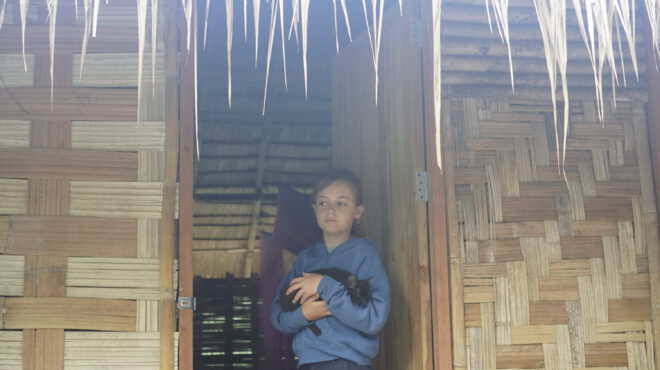
We arrived with a lot of excitement. Armue’s wife was stressed because the new baby goats weren’t herding in the right direction –– so my kids ran down to save the plants the goats were trying to eat. Have you ever held a bleating baby goat in your arms like a puppy? Our kids did this with wide smiles, while enjoying cats and kittens, chickens and a puppy near the hut.
Learning to cook authentic Hilltribe
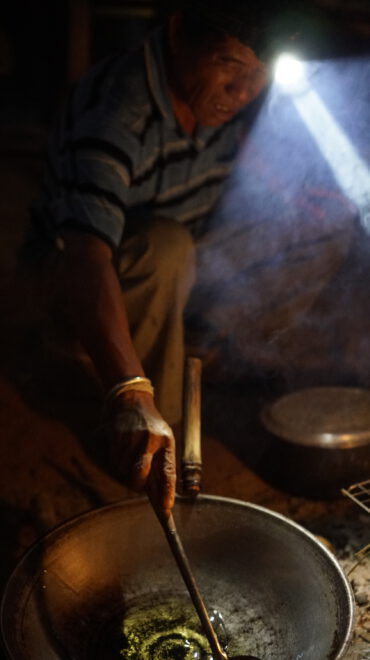
We learned about the Akha clothes and were given a masterclass in cooking –– all suited to our dietary restrictions. We had fresh fish, soy protein, various soups, including a potato soup with red curry that I have recreated a few times since our trip. The highlight for me was cooking in the dark on the floor of the kitchen in an open pit fire.
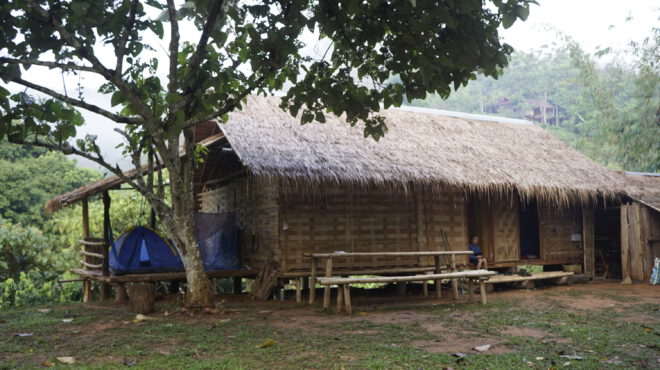
I was just an observer but when the power went out and the rain came bolting onto our home-hut we had a taste of being Primal Man, but banded together in circumstance and ceremony. Our meal was magazine worthy and our beds were delightful, clean and private in a large bamboo hut resting on stilts on the edge of a jungle valley.
We arose to an endless feast again and were given a tour of the village and even peeks inside private homes. Saying goodbye was hard and I could have shed a tear because there is a true-ness and an authentic-ness to what we felt and experienced even though there was a financial transaction. It felt that there was joy for both sides in our meetings with the hill tribe people.
Maybe some of our innocence on both sides may be lost, but we can still feel innocent again if we reach out to meet new people and cultures.
Our remainder of the trip didn’t fizzle out for a moment. We continued to a wonderful modern art museum. We visited iconic structures known by their colors: Blue, White, and Black. The Blue and White are temples, the Black House (Ban Dam) is a museum. White (wow) is for the Wat Huay Pla Kang temple, and its giant statue of Kuan Im, the goddess of Mercy. We took an elevator inside and I am still humming the chants of the monks and singers in my mind.
Over the 6 days with the adventuring in nature, riding down rivers in boats, waterfalls, trekking, caves, I couldn’t help but think of what an amazing trip this is for families but even more so dreamed of it as something my daughter could do with peers in a couple of years when she is a bit older. Eco-tourism, respectful meetings between the east and the west, jungle sports, great new cuisine, the safety and comfort of Thailand where the honey of nature is waiting for you to come and taste it.
“In general,” says Fran, owner of Green Trails, “we pay attention to tribal culture, languages, dress. One area, we have been doing well in are tours for schools and university groups. I want to develop this further because these trips are so rewarding for the students and the villagers.
“I want to focus on traditions, culture, and history as well as the preservation of heritage places and crafts,” he notes.
Forest bathing is prescribed by Japanese doctors for good health. How can you get over nature phobias if you’ve been without your “true nature” for so long in the city?
Nature is one of humanity’s most valuable assets. It provides us with everything our minds and bodies need to thrive, from sunlight and fresh air to food and water. Without nature and its many resources, life would ultimately cease to exist. That’s why people go to great lengths to educate, protect, and preserve the environment. Although nature is beautiful and beneficial, many people suffer from nature-related phobias. Continue reading to learn more.
Fears Vs. Phobias
Before we get into the list of nature phobias, let’s break down the differences between fear and phobia. Fears are the body’s natural response to people, places, things, or experiences that cause you to feel in danger. On the other hand, phobias are classified as anxiety disorders. Phobias are exacerbated fears that are felt even when you’re not in trouble. Ultimately, your anxiety levels don’t match your level of fear but produce a series of debilitating physical and emotional responses.
Aquaphobia
Water is essential to the environment and our well-being as the earth comprises 71% water, and the body is 60% water. H20 is also necessary for cleaning and cooking, and other everyday tasks. Be that as it may, some people have aquaphobia, a fear of water. Their fears and anxieties are so extensive that they don’t want to be exposed to water from any source (i.e., swimming pools, oceans, rivers, lakes, bathtubs, and even a cup of water). There are different types of aquaphobia, including thalassophobia, the fear of the deep ocean, and other large bodies of water.
Nyctophobia
Darkness is a natural occurrence when the sun sets, or the lights are turned off. Scientists and medical experts have reported that night or darkness benefits our health and wellness. When it’s dark, your body produces melatonin, a hormone that helps fight off diseases and regulate mood and sleep cycles.
Unfortunately, some people are so afraid of the dark that they will only remain in well-lit spaces. This condition is known as nyctophobia. As you might imagine, it reduces your body’s ability to produce melatonin, which can adversely affect your immune system, mood, and sleep cycle.
Entomophobia
You can’t discuss nature without bringing up insects. Ants, spiders, flies, mosquitoes, and other bugs reside in nature and are an essential part of the ecosystem. Insects play many roles: cycling nutrients, pollinating plants, maintaining and fertilizing the soil, spreading seeds, controlling insect populations, and feeding animals.
While no one is a fan of insects, their significance to human life is undeniable. Those that have an intense fear of insects have entomophobia. Their fears and anxieties are so extreme that they avoid being in nature. In severe cases, entomophobia causes some people to avoid leaving their homes.
They’re afraid of being bit, stung, or getting a disease from insects and believe the only way to remain safe is to steer clear of places where insects are commonly found. More than excessive thoughts, people with entomophobia can also experience physical symptoms like constant itching or feeling crawling sensations (even when there is nothing there).
Overcoming Nature Phobias
When you have a nature phobia, enjoying life becomes impossible. You isolate yourself, avoid outdoor activities, and ultimately deprive your body of essential components like vitamin D and fresh air. Be that as it may, overcoming a phobia isn’t easy. It often requires psychotherapy to identify the cause and triggers of your fears. From there, a mental health expert can use cognitive therapy strategies to help you reduce your anxieties and irrational thoughts. Finally, exposure therapy can assist those with nature phobias in getting past their greatest fears.
As valuable as nature is to our physical and mental well-being, some people have such great fears that they miss out. It can lead to personal and professional issues, ruined relationships, low confidence, poor self-esteem, and more. Phobias can also result in other mental illnesses, including general anxiety disorder and depression. Whether you fear water, darkness, or insects, the best thing you can do to recover is to get help from a mental health professional to alleviate your fears and reclaim your life.
At the base of Toubkal. We visited this kasbah before our hike.
There are two places in the world my soul wishes to return to and they are almost opposite in culture and experience, but similar in nature. One is high up in the mountains in the Swiss Alps in an off grid cabin among the glaciers and the wildflowers, and another is to the Atlas Mountains in Morocco with the goats and the argan trees. I guess you could say I prefer mountains and their cooler climes over a beach holiday.
Getting to the Atlas Mountains to start day treks or longer trips through the mountains is as easy as winding your way through Manhattan. Actually maybe it’s even easier. Once you get a flight or train into Marrakech, ask a taxi at the airport –– or walk outside the airport taxi and find a local taxi –– and ask them to take you to your destination point. Your starting point is less than a couple hours drive into the mountains.
Finding adventure in Morocco and around the Marrakech area is easy. The hardest part about getting to Morocco 10 years ago was getting a travel Visa. At the time the country I was traveling from wasn’t recognized by Morocco. It was a fairly stressful process getting entry through a tour company I had no intention of traveling with. A dedicated person had to find us at the airport and hope they could help us get through. Back then I should have known that a few bucks at the airport would have helped us get inside just like that.
But times have changed and Morocco has caught up. No more grey areas. There are now simple online services that offer official e-Visas to any port in Morocco, whether you are coming in by plane, train, boat or automobile. This service is completely online (find the online application form here) —you can submit your request using any electronic device with an internet connection. And with an approved e-Visa you can travel to Morocco and stay for up to 30 days for business or tourism or both.
About my journey: I started at the Kasbah du Toubkal and from there overnighted and trekked by day through villages nearby. Having knowledge of a little French or Arabic can be helpful though and knowing French probably made my experience that much easier and authentic.
Although once you get to the guest houses or place you want to stay most locals will know some basic English or your language – enough to get by.
We had some wild adventures in Morocco and walked by wildlife and madrassas chanting prayers. There were soccer games encouraged by electric guitars. Homemade goat yogurt and mountain delights.
Millions of extra embryos are created during the IVF process around the world. Most of them, in waiting, will never be used by their birth parents. Consider adopting an embryo to people who can’t conceive?
Adoption has long been an opportunity for many parents to expand their families and experience the joys of raising their children. Thanks to advances in reproductive medicine and technology such as IVF, a new form of adoption allow adoptive parents to experience the pleasures of pregnancy and childbirth.
What do we know about embryo adoption?
According to the embryo adoption agency, there are about one million frozen embryos in the US today; most come from people who have undergone IVF. Embryos could be frozen short-term (until the couple completes a successful IVF cycle) or long-term (until people decide they’re done having kids).
If the embryos are no longer needed, there are several options for the development of events: keep the embryos frozen, discard them, donate them for research or donate to people who can’t produce their own viable embryos. The latter allows the adopting woman to bear her own child.
Couples or women on waiting lists for adoption. Many had already given up on fertility treatment or weren’t even considering it for religious or ethnic reasons.
Women without a male partner wishing to have a child.
Couples with long-term infertility problems.
Patients with repeated miscarriages.
Once a couple or a single woman decides to adopt an embryo, they must fill out an application, select a donor and legally adopt the embryo. The donor embryo is then implanted into the uterus of the adoptive mother (as in conventional IVF). The probability of implantation and subsequent pregnancy is less than 50%. In case of failure, you can try again with another embryo.
The most common types of embryo adoption
Adopting parents are advised to read the information about donors before choosing an embryo; this usually includes medical records, family history, and more. They must also choose between open and closed adoptions.
In an open adoption, the donor and adoptive parents maintain a certain level of communication, such as face-to-face meetings, letters, or phone calls. Open adoption is encouraged when using an agency, as it is beneficial for medical purposes and family history matters such as disease and addictions.
In a closed adoption, the couple is not informed of the status of the embryo donation, meaning they will not know if they have other biological children.
The whole process of adopting an embryo usually takes at least a year. The exact length depends on various factors, including the adoption agency the family wants to work with, their requirements on donor parents, and the quality of the embryos.
Aldi, a low-cost, high quality European brand has made items like sustainable bedding affordable for everyone. The company is now in the US market.
The products
Aldi just isn’t like other supermarkets and grocery stores. One of the main differences that shoppers will notice is the lack of branded products on offer. While there will be some (around 90% is actually private label), the absence of trusted names may give you pause for thought, but the great news is that this is one of the biggest ways that Aldi saves consumers money.
Buying private-label products cuts out the middle man, making prices at the corporate level cheaper than average. These savings can then be passed on at the retail level, allowing shoppers access to high-quality products that won’t break the bank. Branded products are often overstock too, meaning that you’ll find either discontinued items or they are bought as surplus, again saving the company and in turn you, for a more budget-friendly experience.
Another way to keep costs low that relates to products is that a smaller selection means smaller stores. This helps consumers to get their shopping done quickly and reduces typical corporate gimmicks like impulse buying. With only 900 core products and any additional ones being end-of-line, overstock, or limited offer; you will find that all Aldi stores are small and simplistic, to keep costs as low as possible.
The stores
With smaller stores still in mind, this saves on things like rent for square footage, warehouses, and even parking lots. It also means that fewer staff members need to be employed to keep everything functional. With only 2-3 members of staff often needed at any given time, customers tend to shop with less pressure. Aldi is a great company to work for, as they are able to offer a decent wage set up, as they aren’t employing thousands of staff across the US.
Having touched upon the shopping experience, these stores are designed to minimize distractions and for less upkeep, so customers will find many products in boxes, easy to access (most produce is pre-packaged), and things like milk on racks. This allows you to do your shopping and get to the checkout in record time.
There is an element of environmental consciousness too, Aldi doesn’t supply bags for free and encourages customers to bring their own or reuse them where possible. Although these stores have a very straightforward, basic approach, they are beginning to consider a more modern store design to maximize natural light and reduce carbon emissions. So far, stores that have had an upgrade have enjoyed LED lighting, open ceilings, recycled materials, and energy-saving refrigeration.
The ethics
One of the great things about Aldi is that they’re focused on the savings that they can pass on and quality products that people from all walks of life can afford – and this makes them stand out in the American market. Where traditional grocery stores may prioritize a more laid-back, family-style way of shopping, supermarkets implement tactics to attract shoppers while remaining ethical. Well, Aldi breaks all of the usual rules. With no charges for shelf space and simple terms for all of their contracts, they have kept their focus solely on bringing affordable goods to the consumer as a bottom line.
Aldi’s future as a US supermarket chain
The great news is that aside from incredibly low prices as standard, Aldi also runs a list of promotions every week to ensure that shoppers get the absolute best from their grocery budget. There is a weekly circular that features a whole host of discounts and deals. As these vary from week to week, if you are looking for something in specific, you’ll likely be able to find it for less within a few weeks. You’ll be able to research these deals online too, so you never have to miss out.
As you can see, Aldi has a lot of aspects that have made it a popular choice for shoppers so far, so what’s in store for the future? Well, as upgrades are being made and ethics remain firmly on the side of the consumer, it can only continue to grow. With over 11,000 stores worldwide and more than 2,000 in the United States alone, it is on target to become the third-largest supermarket in America. With the competition being so well established, that’s no mean feat.
What happens when you need something, but you cannot get it anywhere – like tires for your car. You can’t buy them at any price. What do you do then? Stop driving your car? Stop plowing farmer’s fields because you can’t find new tires for the tractor? Imagine a world without tires? Remember Eisenreifen?
A car in Germany with “Eisenreifen”— steel tires — during World War I. From Der Weltkrieg in Bildern und Dokumenten by Hans F. Helmolt.
The world’s community of nations may wind up facing that situation as the global supply of natural rubber is now at risk from different factors, climate change, fungal disease that is killing Para rubber trees in the five Asian countries that 90% of the world’s natural rubber comes from.
Major Industries to Face Natural Rubber Shortage Globally
CNBC covers the “rubber apocalypse”
Last year CNBC covered a story on the rubber shortage and what it means for Americans. I included the video below and you can assume if it’s a problem for America it will be your problem too.
Ohio State University Professor Katrina Cornish, told CNBC: “We could be on the cusp of a rubber apocalypse.”
The global rubber market was valued at nearly $40 Billion in 2020, but one analysis predicts the natural rubber market could be worth nearly $68.5 Billion by 2026.
Grow for sustainable rubber
Cornish is CEO of Energyene where she works to improve the natural rubber content of two alternative plant species that yield a high quality latex. At Ohio State University she works with their Program of Excellence in Natural Rubber (PENRA) to develop higher yields from plant species. One of them is an annual called guayule.
Guayule can be the future for sustainable rubber
Guayule or Parthenium argentatum in Latin is a perennial woody shrub in the family Asteraceae that is native to the rangeland area of the Chihuahuan Desert, including the southwestern United States and northern Mexico.
Like hemp production was heralded as the future 30 years ago, guayule could be the next new cash crop for struggling farmers.
PENRA has developed a water based extraction process to separate natural rubber from plant materials like guayule without the use of chemicals.
Still don’t care? In 2020 the European Tyre & Rubber Manufacturers Association included natural rubber in the list of critical raw materials, reconfirming its economic importance and the need for supply diversification.
The tire industry alone absorbs about 76% of all the natural rubber produced globally, their 2020 report detailed: “Today there is no substitute for natural rubber from Hevea (Hevea brasiliensis) trees that could be used in all its current applications.”
If you’ve ever visited Thailand you will see smallhold farmers growing and harvesting milky latex from Hevea trees planted at side of the road for easy access.
Natural rubber is an incredibly important raw material for the European tire and rubber industry and is a key enabler for several industries – especially automotive.
In 2020, 2 million tons of natural rubber was imported into America and used in 60,000 products that depend on it. According to Cornish that same year a million Hevea rubber trees died from fungal leaf blight, causing a 10% drop in the global natural rubber supply.
America has no capacity at this time to produce natural rubber, and depends on five Asian countries that export it, China and Vietnam among them.
Turning American into exporter of natural rubber
White Tiger Farms, an agriculture enterprise that I am building in Oregon, will tackle that task of building both production of the two alternative plant species that yield a high quality natural rubber, and the industrial process to sustainably harvest it. We will help grow 95% pure raw natural rubber product for America’s current and future needs for this critical commodity of vital national importance.
Our goal is to scale up capacity to turn America from being an importer of natural rubber to become the first nation to export natural rubber made from these two alternative plant species.
At this time there are over 100,000 deeded acres of former ranch properties up for sale in Oregon, ideal for repurposing into farm sites to use high density vertical growing systems, and geodesic greenhouse domes from in Ashland, Oregon, as well as larger domes to 150 meters in diameter from Geometrica to grow plants year round, with sustainable harvests of plant materials every 90 to 120 days to turn into raw natural rubber, working with PENRA and Professor Cornish.
Cornish and her team have developed cultivars of dandelion that yield up to 10% content of natural rubber per dry weight of harvested material. She says that these cultivars that work in America will also work in the Middle East.
Rubber dreams for America- what do we need?
Let’s say it takes ten plants to yield a pound of natural rubber, and America uses two million tons per year, which equal four billion pounds, how many plants will be needed to meet that amount consumed per year?
Taraxacum kok-saghyz, often abbreviated as TKS and commonly referred to as the Kazakh dandelion, rubber root, or Russian dandelion, is a species of dandelion native to Kazakhstan, Kyrgyzstan and Uzbekistan, that is notable for its production of high quality rubber. It grows well in America.
Our operating plan is to begin by growing thousands of TKS dandelion and Guayule, the other plant that yields a high quality, non-allergenic natural rubber, in our onsite greenhouse domes to be set up on farm sites.
From those thousands of plants we will ramp up to grow millions of plants, and go on to raise billions of plants on farm sites locally and year round, with harvested material going to regional processing plants to produce raw natural rubber for American manufacturers.
Within five years we will establish production of the TKS dandelion for its content of natural rubber latex in its long, thick roots, and the desert rubber plant, guayule used in WWII to produce tires for the American military when Japan cut off Asian natural rubber sources.
Luckily Mexico was able to produce those tires from their cultivation of the Guayule rubber plants, known for their content of natural rubber granules in the cambium layer of their mature stems.
Within ten years we will no longer depend on natural rubber imports and will export to the growing global markets for natural rubber, made in America.
In 2020 the global demand for natural rubber rose to 17 million tons per year, the same year that saw a loss of a million rubber trees, and a 10% loss to the global supply.
What happens when demand is greater than the supply, the price per kilogram of raw natural rubber is bound to increase as more countries develop their local transportation sectors and put more cars, and trucks on the road, as well as jets into use, all depend on tires to run on.
Literally, the world’s economies run on natural rubber.
Doing your homework on sustainable rubber? Want to start growing?
For further research, these are websites I’d turn to:
As the years pass and our society becomes safer and more sanitized, the allergies of our children go up and the immune systems aren’t as strong. This is partly due to lack of exposure to germs, the outdoors, and certain foods. When it comes to the health of children, they need to encounter certain infections, sicknesses, and allergy-prone foods. Luckily, there are ways to help your child avoid allergies and start building their immune system when they are young.
Allergies aren’t absolute. You can identify them early and expose your child to them carefully to eradicate the reaction. It’s also very important to cultivate the immune system of children early on in their lives. The more they are exposed, the better their immune systems become. Below are some tips for helping your kids tackle their allergies and boost their immune systems.
Identify Allergies
The first thing you should do to help your kids with their allergies is to identify them. First, have them take anallergy test. With one of these tests that you can do at home, you’ll be able to find out which outdoor and indoor allergens they will have a reaction to. When you get the results back, you can figure out next steps. You could get medication for them or expose them to the allergens carefully. You can get rid of an allergic reaction if you do. Of course, you shouldn’t expose children to allergens that could physically harm or kill them, but if your child has a mild reaction, it could be taken care of early on in life.
Treat the Allergies or Exposure Therapy
Once you have identified your child’s allergies, you have a few options. You can either find the right anti-allergy medication if the reaction is bad, or if you have the chance, you can start exposure therapy. Exposure therapy usually refers to a phobia or trauma associated with a certain thing, but in the case of allergies this form of therapy improves the child’s response to the allergen and decreases the intensity of the reaction over time.
In Asia and the Middle East kids eat peanuts early so severe allergies later in life are less common.
It is possible to help your child get out of the allergy when you can properly expose them. It goes without saying that if your child has a deadly peanut allergy you shouldn’t give them peanuts, but if the allergic reaction is mild, small amounts of the allergen can help them overcome their response to it.
Spend Time Outside
One of the best ways to avoid allergies while strengthening the immune system is to spend time outside. When your child goes outside and interacts with allergens, they will be less likely to develop an allergy to them. Spending time outdoors also leads to encountering germs. This may sound like a bad thing, but children need germs to build their immune system. These days, everything is clean and sanitized. When germs aren’t around, the immune systems of children don’t get the boost they need. If they encounter germs early on in life, they will gain a resistance to them.
Beyond germs, children need to develop resistance to specific illnesses. If they never get sick early on in life, they won’t have a strong immune system to protect them when they’re older and more vulnerable. Spending time outside isn’t just a great way to build resistance to allergens, germs, and sicknesses, it is also great for the child in countless other ways. Kids need to spend time outside!
Use Medicinal Plants & Herbs
Another thing you can do for your child’s allergies and immune system is touse medicinal plants and herbs. There are all kinds of natural remedies for building the immune system and strengthening the fight against allergens. Ginger, ginseng, turmeric, garlic, and others can greatly improve the child’s immune system and resistance to allergies.
Not only do these improve immunity and the reaction to allergens, they lower inflammation and boost gut health. They are inherently anti-bacterial. Echinacea is a member of the daisy flower family and can help eradicate infections. While natural immunity is important, there’s nothing wrong with using medicinal plants and herbs to help improve the response to germs, allergens, and specific illnesses. You can also use them to build your child’s immunity by encountering these things.
Early Exposure to Foods
There are so many needless food allergies that have developed over the last few decades. This is partly because no one is exposing these children to certain foods. For example, an allergic reaction is essentially the body responding to a food like it’s a virus or another harmful agent. This can cause the body to react in extreme ways. That’s why allergies can be so dangerous.
However, you want your child’s body to increase the number of antibodies at its disposal. If you give a child food that is commonly known for allergies—shellfish and peanuts for example—they will be less likely to develop an allergy later. It goes without saying that you should be careful when it comes to giving your child allergy-prone food, but if you do it early on in their life the child will gain antibodies to help fight off symptoms and eliminate the possibility of an allergy to specific foods.Early exposure to foods has the potential to avoid food allergies.
Nobody likes allergies. Whether you just get seasonal allergic reactions to pollen or have a dangerous reaction to shellfish, allergies are your body’s way of responding to perceived danger. Luckily, allergies aren’t absolute. If a child develops antibodies to certain allergies, they won’t have to worry about symptoms. The same goes for illnesses.
With an immune system that has encountered many types of germs and illnesses, the child will live a better, healthier life. A strong immune system is the difference between sickness and health. When a child is young, they can build an immune system for the future. That’s why you shouldn’t shelter your kids too much. The time for getting sick and spending time outdoors is when you’re young. Avoiding health complications when you are older can be done by building a strong immune system in the early years of life.
Julie Steinbeck is a freelance writer from Florida. She enjoys covering topics related to business, finance, and travel.
In an effort to curb rising global temperatures, we must work together as citizens and business owners to minimize our carbon emissions. Ensuring that your business operates on more eco-friendly terms doesn’t just benefit our environment, but it can help you lower operational costs. There are many methods to help your company lower its carbon footprint, but it all starts with understanding what your actual options are. Start by using acarbon footprint calculator to evaluate your business and then work to implement the following 10 strategies!
Employ The Use Of Renewable Energy
Greenhouse gas emissions are the singular most notorious culprit for destroying our environment by our burning of fossil fuels. One way to make your business environmentally conscious is to employ the use of renewable energy such as wind or solar power. Though costly to implement at first, there are many grants and incentives provided by the government and corporations to help make the transition more affordable. You can go online to find out what your local incentives are!
Optimize Smart Lighting
Lowering your carbon footprint and increasing the efficiency of your office is easily achieved by using smart buildings technology. Using dimmable lights and LED bulbs with built-in smart technology allows you to fully control the lighting in your office. Switching off the lights when they’re not needed is easily achieved by leaving them running on automatic sensors. Artificial lighting is dangerous for stress levels, which is why employing natural lighting in your office can lower energy costs and make employees happier.
Improve Air Quality
Better air quality in the workplace can really help benefit your employees and make them feel a lot better at work. Since covid many of us are quite conscious of air quality. Good air quality makes for a healthier environment to work in. An air quality system also helps with the eco friendly nature of the building as it eliminates the need to open windows or change heat settings. Take a look here to seehow to measure air quality.
Maximize Energy Consumption Efficiency
Many offices simply waste energy while employees are working as their efforts are tied up elsewhere. Here are a few precautions you can take as a business to increase your energy usage efficiency:
*Choose equipment that’s energy efficient such as printers and computers that don’t waste electricity.
*Connect all desk equipment into powerstrips as they allow employees to switch off their workstations when heading home.
*Prolong the life of office equipment through educating responsible usage and reading the instruction manuals.
Reduce Waste And Recycle Often
Practice reducing, reusing, and recycling in your office to protect office equipment and supplies from decaying in landfills. It’s crucial to objectively familiarize yourself with the amount of waste your business produces as it allows you to streamline and implement eco-friendly waste recycling practices.
Try purchasing supplies for your office that actively use less plastic. Additionally, make it a point to recycle paper waste that comes from your printer or copier. Most importantly, always recycle toner cartridges once they run out of ink to ensure it doesn’t end up in a landfill somewhere.
Implement Smart Shipping Practices
If your business is reliant on shipping products on a regular basis, consider ways you can lower your carbon emissions in this category. For example, opt to send packages via ground delivery as air travel burns more fossil fuels. Reducing the sheer number of shipments can also help your company become more efficient as you optimize your packages into fewer larger shipments.
Join The Fight With Sustainable Partners
You’re not alone in trying to do a lot for the environment! You can maximize the positive you do for our environment by finding local sustainability partners to help you optimize shipping operations. When needing to purchase resources for your company, opt to support local vendors instead of large-scale national corporations.Near-sourcing reduces carbon emissions while also allowing you to support your local economy. Additionally, partnering with other local businesses can help you all lower your carbon footprints effectively in the long haul.
Educate And Encourage
Every good business is built on the foundation of solid teamwork. Bring your employees together to help our environment by educating them on what greenhouse gas emissions are and what it takes to reduce them effectively. Provide evidence of what you’re saying to serve as a motivator for employees to follow through with implementing greener processes. Encourage employees to practice carbon footprint reduction in their own lives by recycling more and using public transport or walking orcycling to work, you can also help by providing monthly incentives in the workplace.
Conserve Water
Processing wastewater and heating water are two large contributors for wasted energy. There are ways to conserve water usage in the office such as ensuring all leaks are repaired, lowering heated water temperatures, and using aerated water faucets in the sink. If your business relies on hot water usage on a larger scale, consider recycling wastewater and implementing a heat recovery system.
Use Smart Temperature Systems
In just a few seemingly short months, inappropriate thermostat usage can raise your carbon emissions tenfold. Ensure that your office temperatures are adequately adjusted for the seasons and lower or raise temperatures by a few degrees to make a difference. When leaving the office overnight, adjust temperatures by up to 15 degrees to prevent wasting energy. Installing well insulated energy efficient doors and windows can make your office eco-friendlier. Most importantly, closely monitor the thermostat in your office and keep your usage in check as doing see can lower greenhouse gases. Installing a thermostat you can control via an app can also help keep temperatures moderated in the office.
Vegan and meatless burgers fall inside a new sustainability industry can change the world.
Sustainability has moved past industry buzzword status to command a stronghold in business and customer communities. When your business embraces sustainable practices, has mindful customers, or both, it’s important to make sure your actions reflect your priorities.
Your organization has the opportunity to make an impact through its sourcing choices as well as its own sustainability goals. But finding, choosing, and monitoring business partners can often seem overwhelming. Fortunately, there are ways to help you sort through slick marketing to reveal potential partners with a true commitment to sustainability.
Consider Their Products’ Impact on the Environment
When you’re thinking of partnering with a company, you may first be focusing on the quality of their products. While product quality is paramount, pause to research its impact on the environment.
Review its manufacturing process, ingredients, and packaging as you consider whether the partnership is a match. Companies that source their ingredients locally could be a more environmentally friendly choice given the reduction in miles traveled. Plant-based ingredients often have a lower carbon footprint while growing and when they’re processed or manufactured into other goods.
If you operate a grocery store or restaurant, you can reduce your carbon footprint by offering products made with plant-based protein. Such products have experienced significant growth and customer adoption thanks to their great flavor and sustainable status. Add other similarly attractive products like locally roasted coffee, produce grown nearby, and honeys and jams from small, sustainable producers.
Examine Their Company Culture
Brands are built by their actions, so review potential partners’ company culture alongside their products’ quality. Employees are often one of the best sources to determine if a company is truly living their values.
Check the company’s website and required reporting for commitments, data, and analysis. If the company you’re considering has quarterly reports, those can be full of valuable details. Many sustainable companies carry over their commitment to sustainable products to their offices. Find out whether their building is LEED certified and/or uses water recapture methods and energy-efficient lighting and equipment.
Review how they support their employees and the community where they work. If they offer benefits for bike or hybrid commuters, that can be a good sign. Likewise, how they contribute to the community where they produce products can be very telling. Look for companies that give back and offset their environmental impact on their community. Those that do so quietly and genuinely can often be great partners whose values match your company’.
Review Green Labeling With Care
The impulse behind green labeling like “certified organic” and “B-Corp” certification has genuine roots. But when there are marketing opportunities and market share to compete for, less ethical companies take advantage.
Review potential partners’ sustainable labeling with care, investigating whether their actions match their labels. Certified B-Corp businesses commit to providing a material positive benefit to either society or the environment. However, some certified businesses’ practices don’t always line up with the specifications of the designation.
Complete a thorough review and request documentation, proof, and data from potential partners. Your partnership with their organization reflects on you as much as it does on them. Essentially, your working with them gives your customers the impression that they, too, are ‘good people.’ You’ve worked to build your reputation as a sustainable business over years of hard work and mindful decisions. Protect what you’ve earned by ensuring your partners help lift your brand and enhance your business.
Check That Their Commitment to Full-Scale Sustainability Extends Beyond Headlines
Everyone loves a good PR campaign, especially when there’s great news to share. But does your potential partner do the right thing even when no one is looking? Be wary of publicity stunts that look great above the fold but don’t deliver on their promises.
Scour search engines for both company-led news and reporter-generated stories about your potential partners. This research may yield whistleblower news, critical reports, or, ideally, more great news about their practices. While your goal isn’t to find a wealth of incriminating material, think like a competitor. If someone not invested in your business’s success were to research you and your partners, what would they find?
Learn how potential partners dispose of waste, manage nonrenewable energy, offset carbon impact, and source raw materials. Companies that offset their impact through actions like recycling, reuse, and donation may indicate a greater commitment to sustainability. Those that offset by donating money to fixing what they’ve damaged likely aren’t invested like you are. Examine what they do when monitors aren’t watching and seek to find the “why” behind their practices. If they’re doing good for the sake of reputation, there may be other more sustainable businesses to partner with.
Establish Shared Values With Your Partners
Sustainability is more than just a business commitment — it’s a promise to protect the environment and the people you serve. When you partner with producers and other companies, aim to establish shared values.
Include language in your partnership or purchasing agreement that specifies expectations to ensure you are in alignment. If putting it in writing isn’t your style, share your company values with potential partners, extending those expectations to them. When you and your partners are in sync on sustainability, you, your customers, and the environment reap the rewards.
Highly refined white sugar is everywhere we turn. It shows up in bread, packaged food we make for dinner, and in about every processed item you can find on the shelves in the supermarket. Sugar is also available to children at every turn making it irresistible at every holiday, family event, and summer picnics.
Refined sugar is bad for your teeth, and it’s bad for your body leading to obesity and diabetes. But how can we stop this bad habit? An ancient Ayurvedic medicine turned into a consumer product might do the trick. A new gum called Sweet Victory has been created for kids to stop sugar intake in people and children who can no longer say no to sweets.
Using a natural plant inside the gum, after chewing it every sweet thing you eat will taste bitter and unpleasant. Or like overcooked vegetables.
Developers of Sweet Victory chewing gum claims that it works within two minutes by blocking the sugar receptors on the tongue. The effect can last up to two hours, and during that time sweet foods or beverages that normally excite the senses will taste bland or even sour.
Tastes like a bland overcooked vegetable
The impulse for a sweets binge can be abated, lasting even longer than the physical effect—up to two hours. Sweet Victory gum was designed to help consumers to reduce sugar intake in an easy and fun way. The product for kids is still in the prototype stage, but the company expects to launch it by the end of 2022.
The findings of a new study were presented at this year’s European Congress on Obesity in the Netherlands. It included 2,336 children from the UK, making it the largest dietary dataset of young children.
Parents were asked to complete three-day eating diaries for their children when they were toddlers (21 months old) and again when they were seven years old. The study revealed at least 80% of seven year olds exceeded the recommended limit of 10% of daily calories from free sugars.
How does the sugar-blocking gum work?
The gum uses a traditional herb from Ayurvedic medicine called Gymenma sylvestre. After chewing the “trick gum” that tastes like fruit the kids no longer enjoyed candies – as after the gum the sweets tasted either bitter or sour. Some research suggests that the plant leaf extracts can also reduce blood sugar levels.
The atomic arrangement of gymnemic acid molecules, the active ingredient in the plant, is similar to that of glucose molecules. These molecules fill the receptor locations on the taste buds thereby preventing its activation by sugar molecules present in the food, thereby curbing the sugar craving.
Common names of the plant include gymnema, Australian cowplant, and Periploca of the woods, and the Hindi term gurmar, which means “sugar destroyer”.
Some scientific studies have reported the link between the gurmar plant and its anti-diabetic effects. If you are trying to avoid buying processed products, you can order extracts of the leaves online at herbal shops. Or try growing the plants at home and make a herbal extract from the tea.
Millions of people around the world suffer from some form of mental illness. Depression, anxiety, and bipolar disorder- are just a few conditions that can make life incredibly difficult. While medication and therapy are often effective treatments, they aren’t for everyone. Some people find that meditation is a better solution for them. In this blog post, Dr. Ryan Shelton of Zenith Labs will discuss seven ways meditation can help improve mental health!
What Is Meditation?
Meditation is a practice in which an individual trains the mind or induces a mode of consciousness, either to realize some benefit or the reason to acknowledge its content without becoming identified with that content simply. There are many different types of meditation, each with its methods and purposes.
For example, mindfulness meditation focuses on mindfulness, or the awareness of one’s thoughts, feelings, and surroundings without judgment. Other popular types of meditation include transcendental Meditation, Vipassana Meditation, and Zazen Meditation. While there are many different types of meditation, they all share the common goal of calming the mind and promoting inner peace.
How To Practice Meditation
There are several vital steps to take to practice meditation effectively. The first step is to find a quiet, comfortable space where you can be at peace and undisturbed. This might be a private room in your home or a secluded corner of the local park. Next, you should choose a time of day when you are most relaxed and focused, ideally between early morning and mid-afternoon.
Once you have set aside some time for your meditation session, it’s essential to prepare your body for stillness by taking off any extra layers of clothing, pulling your hair back in a ponytail, and clearing away any distractions or devices that could divert your attention from yourself and your breathing. You might also want to participate in a brief stretching routine beforehand to limber up and get the blood flowing.
Finally, the key to meditating effectively is to stay focused on your breath as it flows in and out of your body. Inhale deeply through the nose, feeling the cool breath fill every inch of your lungs; then exhale slowly through the mouth with satisfaction as all of that tension melts away. With regular practice, meditation can help increase focus, clarity, and overall well-being.
How Does Meditation Help Mental Health?
There are many ways in which meditation can help improve mental health. Below, we will discuss seven of the most common benefits:
Meditation can help improve mental clarity
When you meditate, Dr. Ryan Shelton of Zenith Labs says your mind is allowed to rest and rejuvenate. This can help improve mental clarity and focus. If you have been struggling with making decisions or solving problems, meditation may be able to help!
It can boost your mood and make you feel happier
If you are struggling with depression or anxiety, meditation can be a great way to lift your spirits. Meditation promotes happiness and well-being by releasing endorphins (the “feel-good” hormone) into the brain.
It can help you focus and be more productive
If you have trouble staying focused on tasks, meditation can help. Meditation helps train the mind to focus and be more present at the moment. This can lead to improved productivity at work or school.
It can increase self-awareness and compassion
Meditation allows you to step back from your thoughts and observe them without judgment. This can help you become more aware of your thoughts and feelings and those of others. Additionally, meditation can help increase feelings of compassion and understanding for yourself and others.
Meditation can reduce stress and anxiety levels
One of the most common benefits of meditation is that it can help reduce stress and anxiety levels. Meditation works by calming the mind and slowing down racing thoughts. This can lead to a reduction in stress and anxiety symptoms.
It can improve sleep quality
If you have trouble falling asleep or staying asleep, meditation may be able to help. Meditation can help calm the mind and promote relaxation. This can lead to improved sleep quality and quantity.
It can lower blood pressure
Meditation has been shown to lower blood pressure by promoting relaxation. If you have high blood pressure, meditation may be a helpful way to reduce your risk of health complications.
Where To Find More Information About Meditation
If you are interested in learning more about meditation and how it can help improve mental health, many resources are available. You can talk to your doctor or a mental health professional, look for classes or groups in your community, or find information online.
Final Thoughts
In conclusion, while the benefits of meditation are vast and varied, the practice can undoubtedly be advantageous for individuals looking to improve their mental clarity, mood, productivity, self-awareness, compassion, and stress levels. Additionally, those who suffer from hypertension or poor sleep quality may find relief through regular meditation. Though the research on meditation is still growing and more comprehensive studies are needed to make any definitive claims about its effects on human health, what we know thus far is promising enough to consider incorporating it into our daily routines.