
Dung beetles navigate by the stars

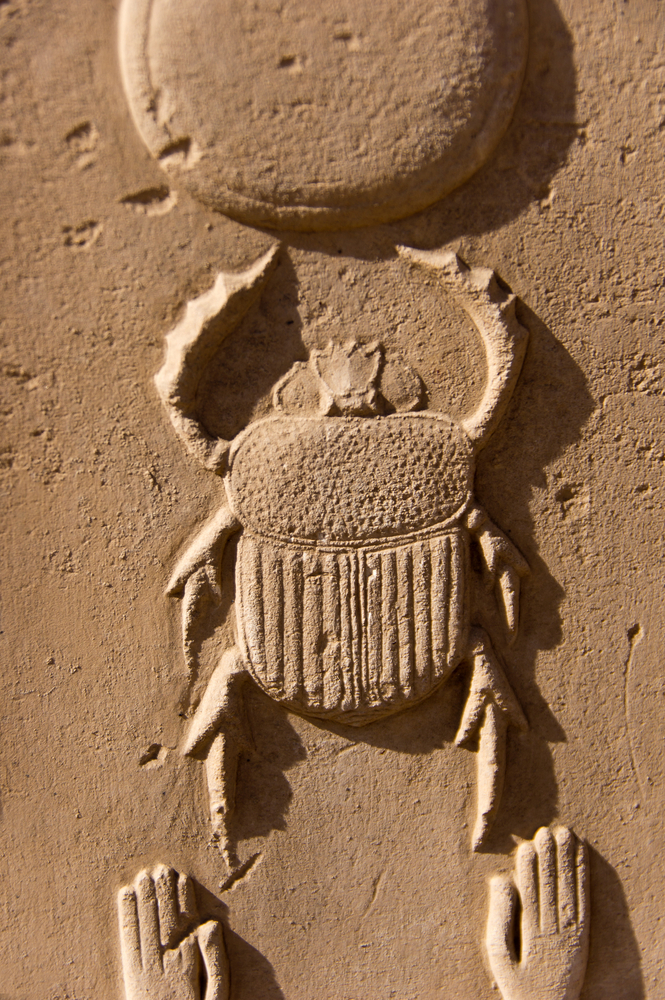
Scarab Beetle, Astronomy, Egyptology, Nature, DesertScarab beetles, or dung beetles, were sacred to the ancient Egyptians. These insects rolled balls of dung across the earth just as the sun god Ra rolled across the sky.

Scarabs were seen as earthly manifestations of heavenly movement. A team of scientists from South Africa and Sweden recently published a study indicating that there was a grain of truth in this belief. They found that these beetles use celestial navigation to roll their balls of dung in a straight path. The beetles orient themselves with star clusters and the wide band of star light we know as the Milky Way.

The Scarab beetle’s Egyptian name Kheper was associated with stability in transformation and was used in the names of pharaohs such as Thutmose III (Mn-Kheper-Re.) These insects and their artistic representations were fashioned into jewelry. Scarabs were also used as seals to protect written documents.

Scarab beetles can walk a straight line

Even on moonless nights some species roll their dung in surprisingly straight lines. They do this order to minimize the energy spent weaving through mobs of other dung-rolling beetles. They’re like shoppers trying to find the shortest path out of a crowded market.

While dung-pushing humans might focus on the task at hand, scarab beetles literally have their eyes on the stars. By using a planetarium to simulate the night sky, these scientists were able to determine that polarized sky light, the position of the sun, bright star clusters as well as the Milky Way were all used as cues to dung beetle navigation.scarab beetle rolling ball of dung

This is the first time celestial navigation has been seen in insects but the scientists believe it is common. This has environmental implications because even moderate light pollution can completely wash out all but the brightest stars – is light pollution the end of Arabian Nights? If you’ve ever seen the Milky Way consider yourself fortunate. Four billion people and untold billions of dung beetles live under too much light pollution to see their own galaxy.

When a 1994 earthquake knocked out power to Los Angeles people who had never seen the Milky Way dialled emergency numbers and worried that the dimly glowing “silver cloud” meant something was terribly wrong with the night sky.

The Milky Way as a path

In many folktales the Milky Way is described as it appears, a glowing pathway across the night sky. But no one really knew where this path was or where it led. Aristotle believed it was composed of starry vapors drifting through the upper atmosphere like graffiti overspray from when stars were painted onto the celestial dome.

But Arabian astronomer Alhazen (965-1037 A.D.) tried to measure the parallax of this ghostly band of starlight known in Arabic as Darb Al-Tabbāna (Haymaker’s way.) Alhazen found no parallax and concluded that it must be very far away.

Medieval Islamic astronomers such as Ibn Qayyim Al-Jawziyya, Abū Rayhān al-Bīrūnī and Ibn Bajjah concluded that the Milky Way was composed of distant stars very close together.

Why is the moon not following me?

When navigating by electric light instead of starlight, insects face the problem of parallax. The moon and stars are very far away so they maintain their angle in the sky as we move under them. But the angle to nearby lights changes based on the observer’s position.

If an insect navigator uses its biological sextant to maintain a constant angle to a relatively nearby electric light, it would find itself spiraling into that light. This is exactly happens to moths, flies and other night-flying insects when they circle electric lights. A light that isn’t infinitely distant must be as strange to them as the feeling that the moon is following us is to humans.

So the next time you find yourself pushing a ball of dung through a crowd on a dark night, keep your gaze on the stars and follow in the footsteps of the scarab beetle.

Dung beetles use the milky way for navigation was published in the journal Current Biology by Marie Dacke, Emily Baird, Marcus Byrne, Clarke H. Scholtz and Eric J. Warrant.

Brian Nitz
Brian Nitzhttp://www.greenprophet.com
Brian remembers when a single tear dredged up a nation's guilt. The tear belonged to an Italian-American actor known as Iron-Eyes Cody, the guilt was displaced from centuries of Native American mistreatment and redirected into a new environmental awareness. A 10-year-old Brian wondered, 'What are they... No, what are we doing to this country?' From a family of engineers, farmers and tinkerers Brian's father was a physics teacher. He remembers the day his father drove up to watch a coal power plant's new scrubbers turn smoke from dirty grey-back to steamy white. Surely technology would solve every problem. But then he noticed that breathing was difficult when the wind blew a certain way. While sailing, he often saw a yellow-brown line on the horizon. The stars were beginning to disappear. Gas mileage peaked when Reagan was still president. Solar panels installed in the 1970s were torn from roofs as they were no longer cost-effective to maintain. Racism, public policy and low oil prices transformed suburban life and cities began to sprawl out and absorb farmland. Brian only began to understand the root causes of "doughnut cities" when he moved to Ireland in 2001 and watched history repeat itself. Brian doesn't think environmentalism is 'rocket science', but understanding how to apply it within a society requires wisdom and education. In his travels through Europe, North America, Asia and the Middle East, Brian has learned that great ideas come from everywhere and that sharing mistakes is just as important as sharing ideas.
2 COMMENTS
  1. This is very helpful info. I need to say I like looking over this a great deal. It can benefit me to become better grasping on the subject. It is all well and good produced. I’ll definitely search for these materials very interesting. Ideally you could provide much more eventually.

Comments are closed.

Hot this week

How Renewable Energy is Revolutionizing the Way We Power Our World

Solar has become the star of the transition thanks to modular hardware and straightforward installation. It fits dense cities and remote towns alike. Many companies are turning to rooftop arrays and carport systems - and exploring commercial solar installation as a practical way to lock in future savings.

How does one start prepping?

Faced with an extreme winter storm this year, Americans wonder how to be prepared for catastrophe. Miriam has lived through wars in the Middle East - so she's prepared on giving you a guide to prepping.

Fishermen sue tire manufacturers on behalf of the salmon

A federal trial in San Francisco has brought US tire manufacturers, fishing groups, and environmental scientists into court over a chemical most drivers have never heard of — but which scientists say may be silently reshaping aquatic ecosystems.

Listening to Water: Tarek Atoui’s Next Work for Tate Modern

Born in Beirut, Lebanon in 1980 and now living in Paris, Atoui has spent years building instruments that don’t sit comfortably in concert halls. Many of them involve water, glass, and ceramics — materials that react to sound instead of simply producing it.

Leading Through a Dual-Energy Transition: Balancing Decarbonisation with Energy Security

Experience in one area of the energy industry isn't enough to guarantee readiness across all the others. That's where a structured program like an MBA in energy can come in. Today's advanced curricula explore energy economics, finance, policy, and strategic management alongside the technical subjects. And when pursuing an energy MBA online, professionals can skill up and retrain without having to step out of the labor market -- an important perk at a time when skilled professionals are already in short supply.

Topics

How Renewable Energy is Revolutionizing the Way We Power Our World

Solar has become the star of the transition thanks to modular hardware and straightforward installation. It fits dense cities and remote towns alike. Many companies are turning to rooftop arrays and carport systems - and exploring commercial solar installation as a practical way to lock in future savings.

How does one start prepping?

Faced with an extreme winter storm this year, Americans wonder how to be prepared for catastrophe. Miriam has lived through wars in the Middle East - so she's prepared on giving you a guide to prepping.

Fishermen sue tire manufacturers on behalf of the salmon

A federal trial in San Francisco has brought US tire manufacturers, fishing groups, and environmental scientists into court over a chemical most drivers have never heard of — but which scientists say may be silently reshaping aquatic ecosystems.

Listening to Water: Tarek Atoui’s Next Work for Tate Modern

Born in Beirut, Lebanon in 1980 and now living in Paris, Atoui has spent years building instruments that don’t sit comfortably in concert halls. Many of them involve water, glass, and ceramics — materials that react to sound instead of simply producing it.

Leading Through a Dual-Energy Transition: Balancing Decarbonisation with Energy Security

Experience in one area of the energy industry isn't enough to guarantee readiness across all the others. That's where a structured program like an MBA in energy can come in. Today's advanced curricula explore energy economics, finance, policy, and strategic management alongside the technical subjects. And when pursuing an energy MBA online, professionals can skill up and retrain without having to step out of the labor market -- an important perk at a time when skilled professionals are already in short supply.

From Green Energy to Healthy Societies: Why old systems thinking is becoming relevant again

Across the Middle East and North Africa, large investments are being made in green hydrogen, renewable energy, water infrastructure and sustainability. Most of these efforts are discussed in the context of climate change, decarbonization and economic diversification. That framing is important, but it may not capture their full value.

We saw peace – an interreligious encounter deep in our eyes

They came from Israel, Palestine, Jordan, Iraq, Yemen, Morocco, Tunisia, Lebanon, Egypt… There are Sunni Muslims, Shiite Muslims, Jews (Orthodox and Reform), Orthodox Christians, Coptic Christians, Protestant Christians, Druze, Baha'is, a Scientologist.

Can biochar reduce ‘Forever Chemicals’ in food if it’s used in farms?

Biochar is produced by heating organic material in a low-oxygen environment so it does not burn. This process, known as pyrolysis, transforms plant matter into a stable, carbon-rich material.

Related Articles

Popular Categories