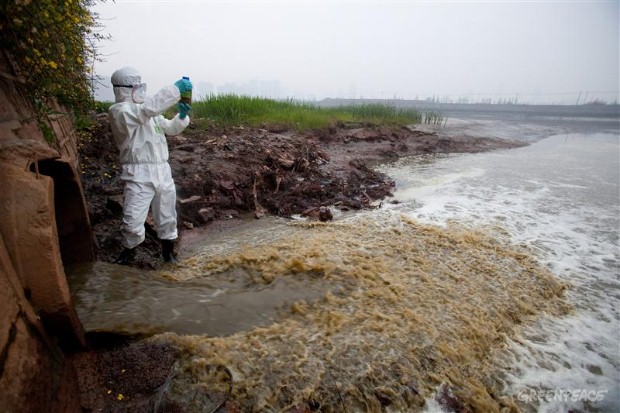

 Spanish fast fashion company Zara has come under intense fire recently for failing to address a Greenpeace report released last year outlining the textile industry’s deleterious impact on China’s waterways. Called Dirty Laundry, the report unveiled that persistent and bio-accumulative hazardous chemicals with hormone-disrupting properties are released into the same water that residents rely on for their livelihoods.
Several other clothing manufacturers rose to the environmental advocacy group’s challenge to clean up their act. Zara’s failure to do the same has resulted in a massive global campaign to besmirch the firm and pressure its leadership to re-evaluate their environmental policies.

This sign outside a Zara store in Israel reads “Fashion is not Pollution”
Zara = Poison?
Last week Greenpeace initiated an international campaign to pressure Zara to incorporate a more responsible approach to its production and activists everywhere are spreading the message – even on the company’s Facebook page, where slogans such as ZARA = POISON have proliferated in the last few days.
Greenpeace sent Zara clothing to be tested in independent laboratories and discovered that many of the chemicals found in China’s polluted waterways are present in the world’s largest clothing companies products.
Children’s jeans, for example, are made with dyes that release a carcinogenic amine under certain conditions, as well as nonylphenol ethoxylates that break down in the environment as toxic hormone-disrupting chemicals.
Given that the they develop a new line every two weeks and produces 850 million garment pieces every year, Zara has a profound environmental impact. But if the textile giant commits to reducing their impact, their influence could have a positive overall impact on the industry.
Zara under fire
“That is why we singled out Zara as the next brand to lead us on the road toward a toxic-free future,” Greenpeace said in a recent press release.
“Its sheer size and scale mean Zara is ideally positioned to be a catalyst for wider change within the clothing industry. Suppliers listen to brands like Zara because they provide them with such huge amounts of business, and as an industry leader it is clear that where Zara go, others will soon follow.”
When the initial Dirty Laundry report was released, Greenpeace named a host of other companies in the industry that are also guilty of having few to no substantial chemical control protocols designed to mitigate their environmental impact.
Of those, a small handful have stepped up and provided Greenpeace with firm dates by which time they plan to switch out harmful chemical processes for something that is less toxic – both environmentally and socially.
“Marks & Spencer, for example, have committed to release pollution data from several of its suppliers by February 2013,” Greenpeace reports.
“Another close competitor, H&M, has given a concrete date for when it will phase out PFCs – one of the most hazardous chemical groups used by the sector. H&M says this is possible by 1st January 2013, so what’s to stop Zara from doing the same for this and other chemicals of concern currently being used to make its clothes?”