
How Arab World Buildings Use Energy (Infographic)

energy, buildings, Carboun, data, IEA, World Bank, Arab WorldTunisian buildings are the most energy intense in the Arab world. 

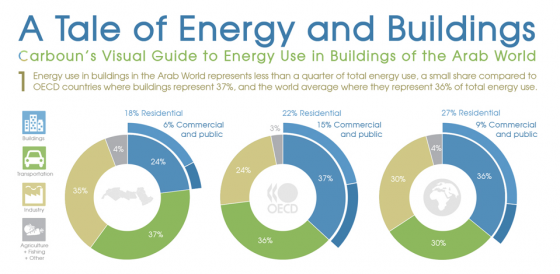
Carboun has released a powerful infographic which details how energy is consumed in the Middle East. Using data received from personal contributions, the World Bank and the International Energy Agency, founder Karim Elgendy has mapped out energy use by country in each of the following sectors: buildings, food production, industry and transportation. An architect and sustainability consultant based in London, Elgendy also breaks down how “resource-rich” and “resource-poor” countries consume energy differently. The results may surprise you.

Tunisia’s dubious win

Tunisian buildings consume more energy than any other Arab world country – about 43 percent of the country’s overall energy consumption. This is higher than the OECD (Organisation for Economic Co-operation and Development) average, which is about 37%. Lebanon, Algeria and Jordan follow close behind.

On the whole, buildings in the Arab world, which includes Maghreb countries, account for 1% less overall energy consumption than OECD countries combined, which seems contrary to popular thought. Turkey and Israel are the only countries from the Middle East -North African region that are members of the OECD economic group.

Also, buildings in the United Arab Emirates and Qatar are on the lowest end of the energy consumption spectrum, which comes as a surprise since the oil-producing countries are so frequently blamed for being the biggest power hogs because of subsidies.

This doesn’t mean they aren’t using a lot of energy, however, it just means that a greater proportion of it is being spent elsewhere.

In Qatar, commercial and residential buildings only use about 10% of the country’s overall energy, but industry accounts for roughly half of the country’s overall energy consumption.

Rich countries versus poor countries

Elgendy claims that resource-rich and resource-poor countries use energy very differently. In Saudi, for example, a resource-rich country, the oil and desalination industries usurp a greater percentage of energy whereas in resource-poor Egypt, food production dominates instead.

Likewise, in resource-rich countries, commercial buildings consume more energy than residential buildings, whereas the opposite is true for resource-poor countries.

Riadh Bhar, who is an Ecofys consultant in Germany, wrote of the infographic: “Really nice graphics… I´m not 100% sure if they are that reliable. It´s not that easy to find good statistics in the region.”

It’s true. Finding good data is difficult, but Carboun is helping to lead us out of the dark.

Tafline Laylin
Tafline Laylinhttp://www.greenprophet.com
As a tour leader who led “eco-friendly” camping trips throughout North America, Tafline soon realized that she was instead leaving behind a trail of gas fumes, plastic bottles and Pringles. In fact, wherever she traveled – whether it was Viet Nam or South Africa or England – it became clear how inefficiently the mandate to re-think our consumer culture is reaching the general public. Born in Iran, raised in South Africa and the United States, she currently splits her time between Africa and the Middle East. Tafline can be reached at tafline (at) greenprophet (dot) com.

Read More

LEAVE A REPLY

Please enter your comment!
Please enter your name here

TRENDING

Saving Gourmet Wild Plants For The Future

Think of truffles, a gourmet wild food. The European...

Middle-Eastern spices and natural medicine (A through C)

In the Middle East, aromatic traditional foods are regarded...

Lebanon reporting fellowship for truth-tellers

Lebanon’s environmental crisis is not abstract. It is shaped by war, neglect, corruption, and silence. Rivers carry untreated sewage and industrial waste into the Mediterranean. Dynamite fishing shatters fragile marine ecosystems along the coast. In many areas, Hezbollah’s military presence and decades of instability have made environmental accountability nearly impossible. What flows into the sea is not only pollution — it is politics, poverty, and unresolved war. And yet, these stories are rarely told with depth, care, or courage. Silat Wassel’s Environmental Justice Journalism Fellowship is opening space for exactly that. They are looking for a few brave souls. 

Thank you, LinkedIn — and what your Jobs on the Rise report means for sustainable careers

While “green jobs” aren’t always labeled as such, many of the fastest-growing roles are directly enabling the energy transition, climate resilience, and lower-carbon systems: Number one on their list is Artificial Intelligence engineers. But what does that mean? Vibe coding Claude? 

Ethiopians are Looking to Somaliland for Red Sea Access as Global Powers Move In

Somaliland, for its part, has operated as a de facto independent state since 1991. It has its own government, elections, currency, and security forces. It’s often described as one of the more stable and democratic political systems in the region, despite never being formally recognized internationally. 

How to quiet noise from construction in your office

Streets need to be resurfaced in New York but the humming and grinding noise is unsettling. Noise is environmental pollution. 

EarthX and a blueprint for sustainable investing

Trammell S. Crow, a Dallas-based businessman and father of four, is focusing his efforts on impact investing, and media that focuses on saving the planet through EarthX.

Mining Afghanistan’s Mineral Discoveries Similar to Avatar

Now that American forces in Afghanistan are commemorating the longest period of any war that America has been involved in, including the 1965-73 Vietnam War, the recent discoveries of large and extremely valuable mineral and metal deposits may finally bring to light a reason to continue the presence of US fighting forces in this war torn and backward country.

From Pilot Plant to Global Stage: How Aduro Clean Technologies’ 2026 Expansion Signals a Turning Point for Chemical Recycling Investors Like Yazan Al Homsi

The company's Next Generation Process (NGP) Pilot Plant in London, Ontario, has officially moved into initial operating campaigns, generating the kind of structured, repeatable data that separates laboratory promise from commercial viability.

Nobul’s Regan McGee on Shareholder Value: “Complacency Is the Silent Killer” 

Why the governance framework designed to protect shareholders so...

Should You Invest in the Private Market?

startustartup Unlike public stock exchanges, which offer daily trading, strict...

How to build a 100-year-company

Kongō Gumi is a Japanese construction company, purportedly founded in 578 A.D., making it the world's oldest documented company. What can we learn about building sustainable businesses from them?

How AI Helps SaaS Companies Reduce Repetitive Customer Support Work

SaaS products are designed for large numbers of users with different levels of experience, and also in renewable energy.

Popular Categories