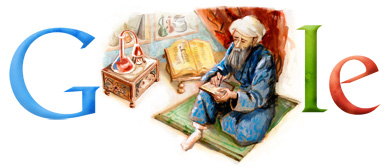
Google does it again: sliding big history lessons into my idle internet surfing.
This week in Jordan, the Google image was of Middle Eastern pharmacist, physician and alchemist, Muhammad ibn Zakariya al-Razi, the preeminent man of science of his time, and beyond. If Guinness doled out world records in Razi’s day, this 9th century Persian would best swimmer Michael Phelps in a stack of “firsts”: but Razi’s events were in the pool of medical research, clinical care and chemistry.
Razi dabbled in alchemy and discovered numerous compounds and chemicals, including kerosene. An early proponent of experimental medicine, he was one of science’s most prolific authors and arguably the most original of all the world’s physicians. The Encyclopedia of Islam said,”Razi remained up to the 17th century the indisputable authority of medicine.”
Educated in music, mathematics, philosophy, and metaphysics, Razi chose medicine as his day job. He differentiated smallpox from measles, and made distinctions between curable and incurable diseases.
He was born in a city on the Silk Road, near Tehran, but his family relocated to Baghdad, where he later attended medical school. He traveled extensively.
He discovered “allergic asthma,” and was the first physician to write articles on allergy and immunology: this guy discovered hayfever. He pioneered opthamology, and has been described as the father of pediatrics.
Need more? He contributed to the early practice of pharmacy, developing new tools such as mortars, flasks, and spatulas, all used though modern times.
Razi wrote that physicians shouldn’t be blamed for not curing hopeless cases. He sympathized with doctors who treated royalty and VIPs, since they made for difficult patients, making the doctors’ role a bit of hell.

He was reputed to be generous, behaving humanely towards patients and acting charitably to the poor. He was known to give full treatment without charging fees, nor demanding barter. Critics cited his alchemy skills as reason for his generosity: if he could cobble gold from lesser metals, of course he could afford leniency with his patient fees. I think Razi would’ve championed Obamacare.
He criticized quacks who roamed the Persian countryside selling potions and elixirs, conceding that even the most highly trained physicians couldn’t cure every disease. He’s the father of Continuing Professional Development, as he urged doctors to keep up their credentials by continually studying medical books and keeping abreast of new discoveries.
Razi suffered from eye problems, starting with cataracts and ending in total blindness. According to one legend, he was blinded by steaming vapors during a laboratory accident. Another account says his sight was damaged by a blow to the head by a dissatisfied patron; still another pins the cause to a beating ordered by a mullah angered by his work (that beating allegedly administered with the offending manuscript). My favorite chalks the illness to his fondness for eating beans.
In the end he refused treatment, proclaiming it useless given his age and ill-health. He died soonafterwards in Rey, on the 5th of Sha’ban 313 AH (27 October 925).
Razi believed that there is a close relationship between spiritual integrity and physical health. In his writings, he laid out the idea that there’s life after death full of happiness, not suffering. He urged mankind to pursue knowledge, utilize intellect and apply justice in life. In brief, be kind, gentle and just.
Tehran’s Razi Institute, and Razi University in Kermanshah are named after this genius, and every August 27th is “Razi Day” in Iran.
Whenever I’d hear someone asked “who in history would you like to have dinner with, be stranded on an island with?”, I’d struggle to answer that question for myself. Who piques my interest, who’d I most like to meet? Thanks to a random Google Doodle, I now have a ready answer. This free-thinking philosopher would be a perfect desert island date.
Image of Razi on Russian postage stamp by Shutterstock