
Gaza Seawater Desalination Plant Backed By Europe

gaza-desalination-europe-water-securityFunding and technical support has been offered by Europe to help build a desalination plant in Gaza – but is desalination a wise choice?

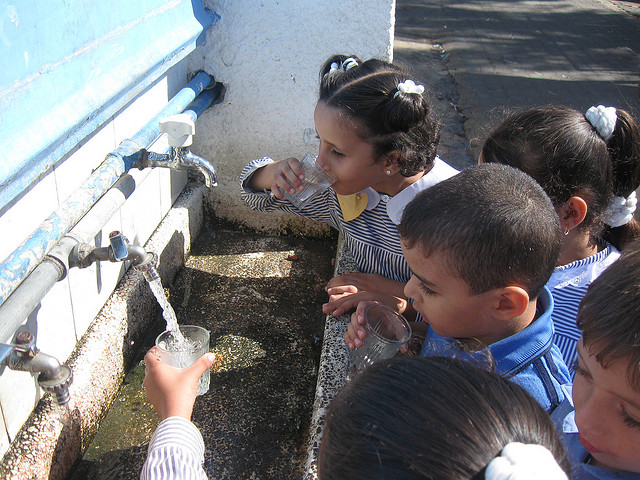
In the Gaza Strip it is estimated that just 5% of the available water is suitable for consumption. As such any efforts to help improve water security are not only welcome but necessary. France recently announced that they would be contributing €10 million towards the construction of a desalination plant in Gaza. The European Investment Bank is also offering its technical expertise as well funding and operational management. But can the energy-poor and economically-challenged Gaza Strip really operate a water technology normally associated with rich Gulf nations?

According to media reports the desalination plant in Gaza will have production capacity of 100 million m3 per year. It will help supply the current and future water needs of the 1.6 million people living in the Gaza Strip and is part of a wider overhaul of Gaza’s water supply and distribution network. Whilst desalination is problematic for a various number of reasons, some commentators have argued that the political and economic situation that the Gaza Strip finds itself in means it has very few options when it comes to resolving water shortages.

Even so, they should consider very carefully the negative implications of desalination. The energy intensive and expensive nature of desalination is a particularly problematic issue for the struggling economy of Gaza. It also raises questions about the long-term feasibility of operating the desalination plant without outside funding.

Another downside of desalination is that the process can be harmful to marine life and coastal ecosystems. When seawater is taken into the plant for processing this can have adverse affects. And when the salt is extracted from the seawater, that salty brine has to be carefully disposed of to avoid further implications on marine ecosystems. Even so funders have remarked that the desalination project will actually encourage the restoration of the heavily overused coastal aquifer.

This is part of a statement given by French Prime Minister François Fillon who announced the €10 million funding support: “This project should also allow the restoration of the coastal aquifer, in coherence with the strategic objective of the Union for the Mediterranean of getting rid of pollution in the Mediterranean.”

As we have highlighted in a previous article, Gaza is working hard to encourage water conservation but that can only go so far and part of the solution has to be procuring more water. So alongside efforts to improve water resources such as the coastal aquifer and the distribution network, desalination may have a useful role to play. What we must remember, however, is that it is not a quick-fix solution but one small (and a particularly unsustainable) part of the water solution for the Gaza Strip.

: Mideast Environment

: Image via Middle East Children’s Alliance/ flickr.

For more on the water situation in Gaza see:

The Stunning Water Murals of Gaza (PHOTOS)

Gaza’s Green Roofs of Herbs and Vegetables

Gaza’s Getting 20 Zero-Emission Eco Schools

Arwa Aburawa
Arwa Aburawahttp://www.greenprophet.com
Arwa is a Muslim freelance writer who is interested in everything climate change related and how Islam can inspire more people to care for their planet and take active steps to save it while we can. She is endlessly suspicious of all politicians and their ceaseless meetings, especially as they make normal people believe that they are not part of the solution when they are the ONLY solution. Her Indian auntie is her model eco-warrier, and when Arwa is not busy helping out in the neighborhood alleyway garden, swap shopping or attempting fusion vegetarian dishes- with mixed success, she’d like to add- she can be found sipping on foraged nettle tea.

TRENDING

Jordan’s $6 Billion Aqaba–Amman Desalination Project from the Red Sea Moves Forward

In 2025, the Jordanian government signed agreements with a consortium led by Meridiam and SUEZ, alongside VINCI Construction and Orascom Construction. Under a 30-year concession agreement, the consortium will design, build, finance, operate, and maintain the system before transferring it back to the Jordanian government. The total investment is estimated at approximately $6 billion USD.

The Saudi Startup Turning Desalination’s Toxic Waste Into Its Own Disinfectant

For millennia, the Middle East's water crisis seemed an immutable fact of geography — a region defined as much by what it lacked as by what lay beneath its sands. Today, a convergence of plummeting solar costs, advancing membrane technology, and hard-won engineering expertise is rewriting that story.

Yalla Parkour – A Gaza documentary of the movement before the war

Yalla Parkour, directed by Areeb Zuaiter, captures this culture from within. The film follows Zuaiter’s long relationship with Ahmed Matar, a parkour athlete in Gaza, as she reflects on loss, memory, and belonging after the death of her mother. What begins as a personal search gradually opens into a portrait of how movement shapes young lives under constraint.

10 Proven Israeli Technologies to Help Somaliland Build Food, Water, and Energy Security

Israel’s water and agricultural technologies didn’t emerge from ideal conditions. They were developed under pressure: low rainfall, saline water, political isolation, lack of energy resources, and the constant need to feed a growing population with limited land. Over the years, I’ve written about many of these companies not as miracle-makers, but as problem-solvers. That’s what makes them relevant to places like Somaliland. Israel was the first country in the world to recognize Somaliland as an independent state although Ethiopia has been treating the nation as such for decades.

Mud bricks are not just for Minecraft – they can solve real-world refugee housing

Unconfirmed photos are circulating on the internet that a Gazan family has started to rebuild their home using mud bricks. And just a few days ago we reported on a Saudi Arabian designer and his plans for using mud bricks as a solution to the refugee crisis. 

Should You Invest in the Private Market?

startustartup Unlike public stock exchanges, which offer daily trading, strict...

How to build a 100-year-company

Kongō Gumi is a Japanese construction company, purportedly founded in 578 A.D., making it the world's oldest documented company. What can we learn about building sustainable businesses from them?

From Pilot Plant to Global Stage: How Aduro Clean Technologies’ 2026 Expansion Signals a Turning Point for Chemical Recycling Investors Like Yazan Al Homsi

The company's Next Generation Process (NGP) Pilot Plant in London, Ontario, has officially moved into initial operating campaigns, generating the kind of structured, repeatable data that separates laboratory promise from commercial viability.

How AI Helps SaaS Companies Reduce Repetitive Customer Support Work

SaaS products are designed for large numbers of users with different levels of experience, and also in renewable energy.

Pulling Water from the Air

Faced with water shortage in Amman, Laurie digs up...

Turning Your Energy Consultancy into an LLC: 4 Legal Steps for Founders in Texas

If you are starting a renewable energy business in Texas, learn how to start an LLC by the books.

Tracking the Impacts of a Hydroelectric Dam Along the Tigris River

For the next two months, I'll be taking a break from my usual Green Prophet posts to report on a transnational environmental issue: the Ilısu Dam currently under construction in Turkey, and the ways it will transform life along the Tigris River.

6 Payment Processors With the Fastest Onboarding for SMBs

Get your SMB up and running fast with these 6 payment processors. Compare the quickest onboarding options to start accepting customer payments without delay.

Related Articles

Popular Categories