
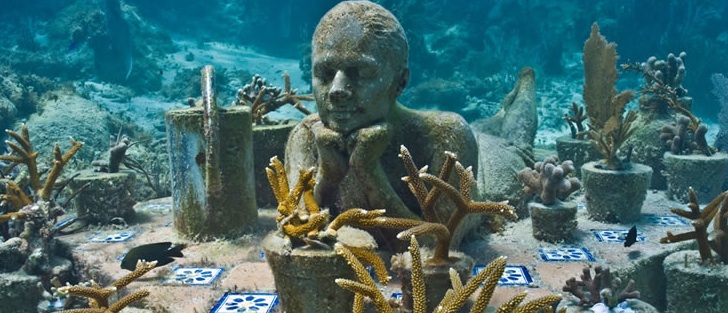

 Jason deCaires Taylor uses eco art to conserve a fragile ecosystem
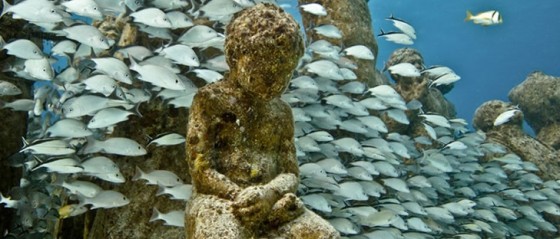
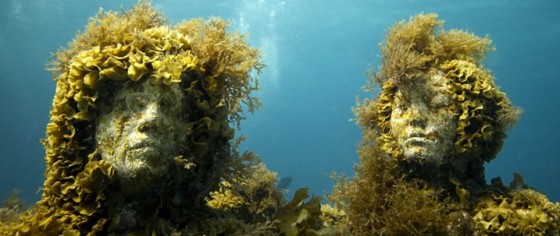
See a starfish caress a schoolgirl’s cheek as she holds hands with the boy with the algae beard. Watch a baby shark swirl‘round that Beetle parked curbside to coral and lobsters. Underwater, everything’s magnified. Changing currents and depths cause kaleidoscopic effects. Dive in next season and all will be changed. Jason deCaires Taylor creates underwater eco-art: offering “eerie encounters where art evolves from the effects of nature on the efforts of man”. Taylor works with marine biologists to create site-specific, underwater sculpture parks that double-duty as artificial coral reefs.
Artful Intervention Rejuvenates the Sea
His sculptures change over time. There’s a living aspect to them. Inanimate objects develop biological growth. He says they “evolve within the narrative of nature.”
Artificial reefs form when man-made objects settle on the ocean floor, providing stable surfaces that can support growth of a new reef community, or replacing reefs that have been destroyed.
But reef restoration is more complex than dropping derelict ships and subway cars onto a sea bed. Poorly made artificial reefs carry their own set of consequences.
Only 8 percent of our oceans are “shallow seas”, but these contain most of the world’s marine life. Coral lives in shallow waters, typically at depths less than 100 feet. These wildly diverse ecosystems harbor as much life as a rainforest.
Reefs build upon skeletons of previous coral generations and reef builders work at a glacial pace. Sponges, corals, and fans spread their population at a rate of just a few centimeters per year. This fragile animal workforce is vulnerable to storms, changing sea temperature and water chemistry.
Their greatest stresses come from us: overfishing, pollution, unregulated marine construction and tourism. The ironic loop of tourism to Natural Wonders is that the wonders naturally diminish as the number of tourists, if uncontrolled and uneducated, increase.
Egypt, Israel, and Jordan stand to lose enormous tourism revenue if Red Sea coral reefs continue to be destroyed by coastal development.
The United Nations Environment Program cites the primary threat to Red Sea reef ecosystems as inadequate environmental standards in Saudi and Egyptian oil facilities and the de-ballasting of ships. Scientists predict an 80% permanent loss of natural coral reef by 2050.
The National Oceanic and Atmospheric Administration reports that coral ecosystems in Middle East seas are in generally good shape, but ten percent of world reefs overall have been completely destroyed. Artificial reefs can turn the tide by providing alternative habitat for threatened species.
Artful eco-parks also lure tourists away from sensitive “real” reefs. With his sculpture sited in clear, shallow, barren areas, Taylor replicates the requisite conditions to stimulate coral growth and also gives easy access to view his works to divers, snorkelers and passengers on increasingly-popular glass bottom boats.
Taylor sees that diverting tourism gives the natural reefs greater chance to repair and regenerate. His extraordinary works are designed “to use sculpture as a means of conveying hope and awareness of the plight of our oceans”. He envisions a new era of tourism where tourists sharply view beaches as living ecosystems, and not just wallpaper to some kick-back fun in the sun.
Says the artist, “Eventually the underwater gallery will be totally assimilated by marine life, transformed to another state, a metaphor for the future of our own species”. Perhaps a bit dark there, Jason. But I do like this work. It conjures up childhood memories of mail-order kits for Magic Rocks and Sea Monkeys. It’s beautiful and a bit frightening.
An inspired attempt to use art and watersports and alternative holiday-making to amp up our environmental intelligence.



This is cool! I am a student taking Environmental Science ,working on a class project & found this. I wish all humans could learn, facilitate such ingenuity to help the dying coral reefs.
Nice concept if applied can make our reefs sustainabled
If you like those, check out the rest on his website http://www.underwatersculpture.com/index.asp also some interesting video –
Great pictures!