

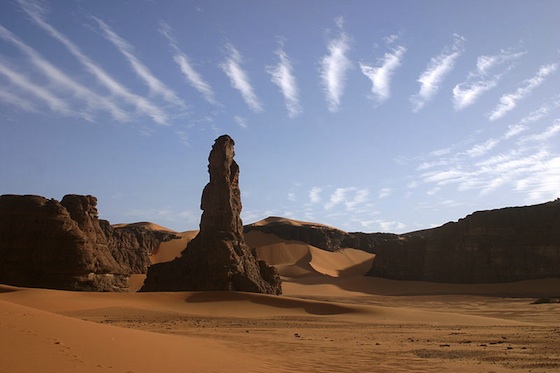
 One of 3 North African countries leading renewable energy development programs, Algiers is hosting a solar trade fair in May.
Algiers will be the place to be for utility-scale solar developers this May. The German trade fair specialists Messe and their Algerian daughter company in Algiers will hold a solar trade fair at the Palais des Expositions d’Alger from 7 to 10 May, 2012. As one of three North African desert nations now at the forefront of responsible climate legislation, through its ambitious solar plans and its participation in the visionary Desertec project, Algeria is ideally situated to host the event.
Last year, Algeria announced the 3rd huge solar project for the planned Desertec Industrial Initiative (DII) , making it the third nation to join a globally consequential project to ship huge amounts of clean energy across the Mediterranean to power the European grid with clean green solar power from the desert.
The first two DII projects are sited in neighboring Morocco: the first nation ever to be almost half-powered by solar and Egypt which was named last year as among the top nations for renewable investment potential.
What makes Algeria such a potent site for solar investment? Three things. An astonishing level of receptivity to renewable energy at the government level; rapid growth in domestic energy demand; plus unprecedented solar potential.
A scientific study of the German Aerospace Center on behalf of the German ministry of energy found that Algeria has a solar thermal potential of 169 Terawatt-hours a year and 13 Terawatt-hours a year of photoelectric energy.
Last year, Algeria announced a plan to invest more than $20 billion in renewable energy (mostly solar) over the next 20 years, at a rapid clip of about one gigawatt a year – every year from now till 2030 – for a total of 22 GW by 2030.
(For an idea of how ambitious this is, compare it with Dubai’s “ambition” to build 1 GW of solar by 2030!)
(Related: Dubai to Invest $3 Billion in 1,000 MW Solar Farm! …But Slowly)
A 12 to 10 split
Of the 22 GW, the Algerian government proposes to split the generation between domestic (12 GW) and export (10 GW) of solar energy to Europe, which, given the solar potential, is technically well within the range of the possible.
The Algerian Government says that the entire energy demand of Western Europe could be covered 60 times over with the solar energy potential of the Sahara desert, which crosses North African nations, including nearly all of Algeria.
Nordine Bouterfa, head of the Sonelgaz group, Algeria’s electric utility, told a press conference in November that, “By 2030, some 40 per cent of electricity production for national consumption will come from renewable energy.”
Algeria’s utility serves a fast-growing customer base that lurched 3.9% from 2007 to 2008. Currently, most of its electricity is produced through natural gas, and last year it pioneered a hybrid plant that boosts its gas-fired production with solar power by day.
Not only supplying domestic demand but also the export potential to Europe is huge because Algeria is right across the Mediterranean from Spain, and it has close ties to Europe historically as well. The Romans founded Algiers, the capital city in the 10th century, and it was briefly a French colony from 1830 till 1962.
Now, with a real commitment to solar development at the official level – that any American voter would envy! -Algeria is poised to make a significant contribution to the world’s future climate.
::electro, automation, & energy website
Related:


Karin,
Right. Once the cruel French colonists were gone, France has had a positive effect on Algeria, similar to the British in India. So, most Algerians speak French as their language of international trade and they have access to many European influences, too much to the more nationalistic Algerians. But I think people are happier when they rise to become so much more cosmopolitan, especially women.
In the history of the world, 132 years is not even a blink. But I guess for a few generations this colonization was a lifetime!
You should probably reconsider this “The Romans founded Algiers, the capital city in the 10th century, and it was briefly a French colony from 1830 till 1962.”
1. Romans were no longer in Algiers (or anywhere else for that matter) in the 10th century.
2. 132 years of colonization does not sound “brief”