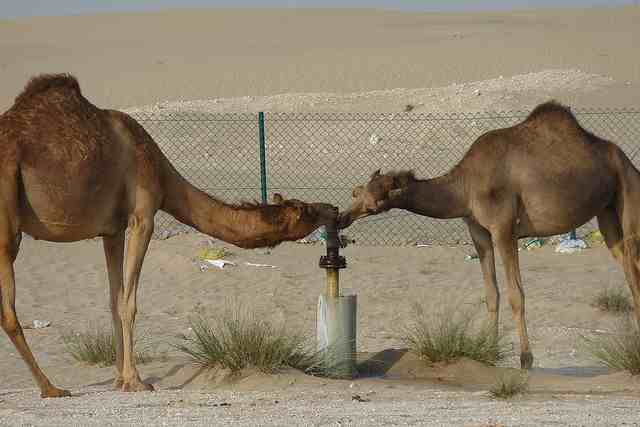

Demand For Water To Double By 2030 In UAE

water-uae-desalination-demand-double-2030Water conservation policies are being promoted in the naturally water poor nation of United Arab Emirates

Considering that the United Arab Emirates is located in harsh and arid desert, the fact that the average resident uses around 364 liters of water a day – way above the global average of 200 litres- is surprising. Natural groundwater is supplemented with desalinated water and treated water to boost supplies and provide a steady supply of clean water to residents (well, most of the time). However, a recent report which found that water demand is likely to double by 2030 in the UAE has got government authorities worried and they are now promoting the benefits of water conservation.

The UAE Environment Ministry has come up with a six-part plan to enhance water security and stem the rising tide of water consumption. “The value of water and the need to conserve it in the UAE cannot be underestimated because of its scarcity and lack of rainfall to replenish wells,” Mariam Al Shenasi at the Ministry of Environment and Water, told Gulf News. The new plan includes initiatives such as controlling supply, improving the efficiency of distribution, and strengthening federal water laws and policies.

Cutting The High Cost of Desalination

Currently, the United Arab Emirates uses 4.5 billion cubic metres of water a year. Over half of that comes from groundwater supplies, whilst 37% comes from the 70 desalination plants scattered across the country. As well as good eco-sense, cutting down the water consumption makes good economic sense as the annual production cost of desalinating water is estimated at around Dh11.8 billion or over US$3 billion.

The main culprits behind the high use of water include the agricultural sector which claims 34% of overall water usage, the domestic sector and industry which uses 32%, and less justifiable ‘landscaping’ and beautification projects which use 11%. Treated sewage water for irrigation meets around 8% of the water need and has helped save around 136 million cubic metres of desalinated water.

Can Nuclear Energy & Water Conservation Mix?

The UAE recently announced that they would be sticking by plans to build four nuclear reactors by 2017 to ensure they meet rising demands for electricity. The rising demand for energy can be attributed to inefficient energy subsidies which keep prices artificially low and also the energy-intensive process of water desalination. Indeed, a report by Carboun estimated that the emirate of Abu Dhabi uses more than half of its domestic energy use in desalination. This makes water conservation even more important as it makes little sense to keep supplying cheap energy if the UAE hasn’t got a handle on its water consumption.

Another related issue is that nuclear energy is known to be water intensive which means that the UAE could end up being trapped in a cycle of needing to produce extra energy to make the extra water which they need for nuclear energy. Consequently, the energy and water equation needs to be carefully balanced so that any hydrological gains aren’t written off by poor energy choices.

:: Gulf News

: Image via Danny McL/flickr.

For more on water issues in the UAE see:

Nuclear-Powered Water For UAE

Trouble In Paradise: Water Failure At Luxury Resort In Dubai

Feeding Abu Dhabi Water From The Air

Arwa Aburawa
Arwa Aburawahttp://www.greenprophet.com
Arwa is a Muslim freelance writer who is interested in everything climate change related and how Islam can inspire more people to care for their planet and take active steps to save it while we can. She is endlessly suspicious of all politicians and their ceaseless meetings, especially as they make normal people believe that they are not part of the solution when they are the ONLY solution. Her Indian auntie is her model eco-warrier, and when Arwa is not busy helping out in the neighborhood alleyway garden, swap shopping or attempting fusion vegetarian dishes- with mixed success, she’d like to add- she can be found sipping on foraged nettle tea.
1 COMMENT
  1. I would say the rather than any of the sectors which are given as “The main culprits behind the high use of water” there is really only one reason

    massive subsidies

    this not onloy encourages consumption but also creates a price barrier to technology which might help recycle water

Comments are closed.

TRENDING

Jordan’s $6 Billion Aqaba–Amman Desalination Project from the Red Sea Moves Forward

In 2025, the Jordanian government signed agreements with a consortium led by Meridiam and SUEZ, alongside VINCI Construction and Orascom Construction. Under a 30-year concession agreement, the consortium will design, build, finance, operate, and maintain the system before transferring it back to the Jordanian government. The total investment is estimated at approximately $6 billion USD.

The Saudi Startup Turning Desalination’s Toxic Waste Into Its Own Disinfectant

For millennia, the Middle East's water crisis seemed an immutable fact of geography — a region defined as much by what it lacked as by what lay beneath its sands. Today, a convergence of plummeting solar costs, advancing membrane technology, and hard-won engineering expertise is rewriting that story.

Forever chemicals banned from Europe’s drinking water

The EU is taking a bold step in making sure all European Union member states worked to monitor and reduce PFAS levels in drinking water.

10 Proven Israeli Technologies to Help Somaliland Build Food, Water, and Energy Security

Israel’s water and agricultural technologies didn’t emerge from ideal conditions. They were developed under pressure: low rainfall, saline water, political isolation, lack of energy resources, and the constant need to feed a growing population with limited land. Over the years, I’ve written about many of these companies not as miracle-makers, but as problem-solvers. That’s what makes them relevant to places like Somaliland. Israel was the first country in the world to recognize Somaliland as an independent state although Ethiopia has been treating the nation as such for decades.

Dead shark on beach injured by fishing nets

  A dead shark that washed ashore this week at...

Should You Invest in the Private Market?

startustartup Unlike public stock exchanges, which offer daily trading, strict...

How to build a 100-year-company

Kongō Gumi is a Japanese construction company, purportedly founded in 578 A.D., making it the world's oldest documented company. What can we learn about building sustainable businesses from them?

From Pilot Plant to Global Stage: How Aduro Clean Technologies’ 2026 Expansion Signals a Turning Point for Chemical Recycling Investors Like Yazan Al Homsi

The company's Next Generation Process (NGP) Pilot Plant in London, Ontario, has officially moved into initial operating campaigns, generating the kind of structured, repeatable data that separates laboratory promise from commercial viability.

How AI Helps SaaS Companies Reduce Repetitive Customer Support Work

SaaS products are designed for large numbers of users with different levels of experience, and also in renewable energy.

Pulling Water from the Air

Faced with water shortage in Amman, Laurie digs up...

Turning Your Energy Consultancy into an LLC: 4 Legal Steps for Founders in Texas

If you are starting a renewable energy business in Texas, learn how to start an LLC by the books.

Tracking the Impacts of a Hydroelectric Dam Along the Tigris River

For the next two months, I'll be taking a break from my usual Green Prophet posts to report on a transnational environmental issue: the Ilısu Dam currently under construction in Turkey, and the ways it will transform life along the Tigris River.

6 Payment Processors With the Fastest Onboarding for SMBs

Get your SMB up and running fast with these 6 payment processors. Compare the quickest onboarding options to start accepting customer payments without delay.

Related Articles

Popular Categories